Micah Mattix

Micah Mattix is a senior editor of The Spectator’s World edition and the author of the Prufrock newsletter. He has written for the Wall Street Journal, the New Criterion, the Atlantic and many other publications.

Misremembering E. O. Wilson

In Scientific American, Monica R. McLemore, an associate professor of nursing, tells us that the work of E. O. Wilson, who died on December 26th, is “problematic” because it was “built on racist ideas.” What evidence does she provide? Not much other than a reference to Wilson’s seminal Sociobiology in which he argued that biology played a role in behavior: His influential text Sociobiology: The New Synthesis contributed to the false dichotomy of nature versus nurture and spawned an entire field of behavioral psychology grounded in the notion that differences among humans could be explained by genetics, inheritance and other biological mechanisms.

In praise of habit

We have the kids home for Christmas — a son back from college in South Carolina, a daughter from Germany, a daughter and son-in-law from British Columbia for a three-week visit, and our youngest, who has been with us all year but who is as happy as a peach in summer to have her siblings home. We’re happy, too. Yesterday morning we were reading around the fire and started chatting about pastors and the emphasis in the Protestant church on feelings and niche theology. It is sometimes held that if one feels a certain way or espouses certain esoteric ideas, then one is a “mature” Christian.

The not-so-great Great Books debate

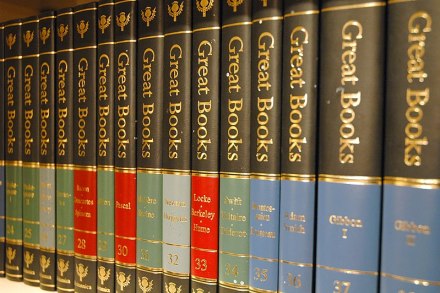
In this week’s New Yorker, Louis Menand reviews two books that defend a Great Books curriculum — Roosevelt Montás’s Rescuing Socrates: How the Great Books Changed My Life and Why They Matter for a New Generation and Arnold Weinstein’s The Lives of Literature: Reading, Teaching, Knowing. He doesn’t like either. Both authors claim that great works of literature shape our lives for the good and that this sort of moral or personal approach to texts is undervalued at modern universities, which, in turn, are more concerned about vocational training and marketable skills. English and comparative literature departments — are there any of those left? — emphasize specialization and ignore wisdom.

Tom Stoppard, libertarian

Tom Stoppard, libertarian Hannah Gold reviews Hermione Lee’s biography of Tom Stoppard in The Nation. I haven’t read the book, but I want to. Gold does a fair job in the first part of the review of providing us with a basic outline of Stoppard’s life and discussing Lee’s approach. In the second half, she turns to Stoppard’s politics and what she sees as a weakness of his work: In a speech delivered by Jake Milne, one of the journalist characters in Night and Day, which Lee posits "sums up the author’s views," Stoppard argues that "Junk journalism is the evidence of a society that has got at least one thing right, that there should be nobody with the power to dictate where responsible journalism begins.

Notre-Dame de Paris and that French esprit

I won’t say “Au revoir, Notre-Dame.” That’s a tad overdramatic. But something will be lost if the diocese in charge of the cathedral’s interior goes through with its recently approved plans to “modernize” it. For those of you who haven’t been following the story: French authorities have approved a proposal to revamp the interior of Notre-Dame Cathedral despite opposition from 100 cultural figures and criticisms saying the changes would “Disneyify” the historic landmark. The French National Heritage and Architecture Commission offered a favorable opinion to the proposal following a meeting on Thursday, December 9, giving the plan a green light to proceed.

Saving Henry James’s Christmas ghost story from the critics

If you have a graduate degree in English, I’ll bet you my neglected copy of Jacques Derrida’s Dissemination, you’ve read Henry James’s The Turn of the Screw. It’s long been a favorite of critics because we don’t really know what happens in the end — everyone loves a puzzle — but the postmodern critics love it big time. You can superimpose any half-baked theory with impunity because no one will call you on it. In 1995, Wayne Booth wrote that he found more than 500 books or articles on the novella before he got tired of adding them up. It’s easily double that now. That’s not to say it’s a bad story. Quite the opposite. I think it’s one of James’s best. It is also a good example of how James has been misunderstood.

ghost

Racist little free libraries

Racist little free libraries This piece in the New York Times is really something, and I mean that in the worst possible sense. Erin Aubry Kaplan lives in Inglewood, “a mostly Black and Latino city in southwestern Los Angeles County,” and she decides to build a Little Free Library, as they are called, in her front yard so neighbors walking by can borrow a book. She builds one because she loves books, but because in our puritanical times nothing can be as simple as that, she writes that she also put one up “to signal to my longtime neighbors that we had our own ideas about improvement, and could carry them out in our own way. There are organizations that help people build these little libraries, but I did mine independently.

An unconvincing case for cancel culture

An unconvincing case for cancel culture In this weekend’s Wall Street Journal, Barton Swaim reviews Erich Hatala Matthes’s Drawing the Line: What to Do With the Work of Immoral Artists From Museums to the Movies. While not a defense of cancel culture per se, Matthes attempts to provide a framework to help answer the question of which artists should be “canceled” and why. All cultures censor things. They have always prohibited certain works from being published or viewed, but this has almost always been because the works were inherently damaging, or so it was claimed, and usually to the young.

How a small publisher survived the digital age

Godine at Fifty: A Retrospective of Five Decades in the Life of an Independent Publisher, by David R. Godine, David R. Godine, 2021 In The Truth about Publishing, Sir Stanley Unwin writes: “It is easy to become a publisher, but difficult to remain one.” David R. Godine has accomplished the difficult task of remaining one for fifty years, and in the beautifully designed and set Godine at Fifty — would we expect any less from a Godine book? — he tells the story of the company’s beginning and survival and of each book he has published over the years, chock-full of reproductions of the company’s covers, woodcuts, and illustrations. This is a book about books for book lovers. Raised in Boston, David R.

The forgotten poetry of John Martin Finlay

Dense Poems and Socratic Light: The Poetry of John Martin Finlay, edited by David Middleton, Wiseblood Books, 2020 To say that the poet John Martin Finlay has been forgotten is not quite right. He was never “remembered” — read by a significant number of people — in the first place. But his best work is as good as the best work of many of the poets of his time, and Wiseblood Books is hoping to set things right with a two-volume collection of his poetry and prose. Born in southern Alabama on a peanut and dairy farm in 1941, Finlay went to university in Alabama and Louisiana, where he graduated with a Ph.D. from Louisiana State University in 1980 and converted to Catholicism that same year.

Those long, meaningless end-of-year book lists

It happens every year now: long, heavily-linked end-of-year book lists with the “best” 100 books of the year, or the 500 books from 2021 that everyone should read, or the year’s 50 most transgressive books. The New York Times, for example, just published it’s “100 Notable Books of 2021.” Publishers Weekly has a list of the top 150 books of 2021, though it also provides a “best of the best” list of 10 books. NPR takes the prize for size so far. It has a list of the 369 “Books We Love” from 2021. Talk about indiscriminate passion. There are some good books on these lists — Francis Spufford’s Light Perpetual, John McWhorter’s Woke Racism. How can there not be when they are so long, which is, of course, one problem with them.

Celebrating holidays in a strange land

On national holidays In the podcast this week, I talked to Thomas Kidd about the first Thanksgiving. One thing I asked him was whether Thanksgiving was a national holiday or a religious one. His answer was both. I thought about this question again after my wife told me that my daughter, who lives in Canada, was thinking about celebrating Thanksgiving with her husband and some friends this week. If you have ever lived overseas for a significant period, perhaps you’ve done something similar: gotten together with a few expats or some long-suffering locals to eat some turkey or touch off a few fireworks on the Fourth. It sounds like a good idea, and it can be fun, but most people give up on it after a few years. We did.

Why I didn’t start a Substack

When I first began thinking about restarting my email newsletter, Prufrock, after a nine-month break (during which I cycled the Blue Ridge Parkway twice, slept until six every morning, and read novels), one option I considered was Substack. I started Prufrock in 2013 when there were very few newsletters, especially on the right. It was basically Ben Domenech’s The Transom, Michael Brendan Dougherty’s The Slurve, and Prufrock. Sometime around 2016, everyone had a newsletter. Then came Substack in 2017, which grabbed people’s attention in 2019 when Jonah Goldberg and Stephen Hayes agreed to run their new publication, the Dispatch, exclusively on the platform.

substack

Will Self on our modern anxiety

Modern trauma In the latest issue of Harper’s, Will Self argues that trauma is a distinctly modern phenomenon: I shall be advancing the heretical notion that trauma as we now understand it is not a timeless phenomenon that has affected people in different cultures and at different times in much the same way, but is to a hitherto unacknowledged extent a function of modernity in all its shocking suddenness. By “modernity” — that wench of a word — he means mostly modern technology; that is, technology after the Industrial Revolution. Self quickly makes the distinction between trauma and suffering. Suffering, of course, has always been with us. Western literature is a literature of suffering. Sometimes the suffering is a consequence of ignorant or evil decisions.

The pleasures of detective fiction

The pleasures of detective fiction In the latest issue of The Lamp, B.D. McClay writes: “Detective stories have long been thought of as ‘smart’ genre entertainment, something people openly profess their enjoyment of no matter how status-anxious they are.” It’s true that most people are happy to admit to enjoying detective fiction. The same goes for science fiction, which is surely more “respectable” than romance. Yet, however quick people may be to admit to these pleasures, for some, they remain guilty ones — or at least mere pleasures.

The miracle drug called poetry

Back at the desk As you can see, if you are reading this, I have decided to bring Prufrock back thanks to the persuasive powers of Dominic Green and Matt Purple at The Spectator’s new World edition of the magazine. I’ll be sending the email three times a week (tell your friends to sign up here), writing a weekly column (read the first one), and hosting a weekly podcast. Send tips or suggestions to micah@thespectator.com. Hate mail should be sent straight to Dominic at editor@thespectator.com. The miracle drug called poetry If you read stuff online, you’ll learn, among other things, that poetry is a miracle drug — balm for all sorts of problems and conditions, irritants and itches.

Lionel Trilling against cancel culture

You’re sick of cancel culture, and you’re not alone. Just last week, the fashion designer Tom Ford complained that cancel culture “‘inhibits design’ because ‘everything is now considered appropriation’ and designers can no longer ‘celebrate other cultures’.” The actress Dakota Johnson, famous until recently for being the daughter of Don Johnson and Melanie Griffith, told The Hollywood Reporter she finds the whole thing — and I do mean the whole thing — sad. “I feel sad for the loss of great artists. I feel sad for people needing help and perhaps not getting it in time. I feel sad for anyone who was harmed or hurt. It’s just really sad.

Jung love

This article is in The Spectator’s January 2020 US edition. Subscribe here. If Jim Proser’s goal in writing Savage Messiah was to convince people to take Jordan Peterson seriously, I am afraid he has failed miserably. Peterson, for those without an internet connection, is a Canadian psychologist who rose suddenly to fame after he posted a video on YouTube criticizing a bill that proposed criminalizing speech against transgenderism. In 2018 he published 12 Rules for Life: An Antidote to Chaos, which has sold several million copies. He has confounded undemanding television hosts like Cathy Newman, but he has also debated Sam Harris and Slavoj Žižek, all while keeping up his popular podcasts and lectures.

peterson