Melanie McDonagh

Melanie McDonagh

Melanie McDonagh is an Irish journalist working in London.

The desecration of Canterbury cathedral

From our UK edition

According to canon 1220 of the Catholic church's code of canon law, 'all those responsible are to take care that in churches such cleanliness and beauty are preserved as befit a house of God and that whatever is inappropriate to the holiness of the place is excluded'. So, if Canterbury cathedral were still Catholic, as it was for 900 years before the discordant event of the Reformation, it is fair to say that the ghost of Thomas Becket would not have been disturbed by the rave in the nave which took place last night and is repeated tonight.

A tribute to Ismail Kadare, a writer who really deserved a Nobel Prize

From our UK edition

Apart from Bob Dylan and Kazuo Ishiguro, it’s a fair bet that most people’s reaction to the Nobel prizewinners for literature this century is, who? Arguably the most recent, Jon Fosse, is an exception but the majority of winners don’t really stand up to the weight of the award. Annie Emaux? Abdulrazak Gurnah? Louise Gluck? It’s hard to avoid the impression that the judges were swayed by ethno-gender considerations rather than outright lifetime literary merit. I asked him about Albania obtaining European Union membership and he got tetchy This week there died, and today was buried, one man who really did merit the award for which he was nominated 15 times, and really did want it and who never got it: Ismail Kadare.

What’s wrong with calling a female walker ‘sweetheart’?

From our UK edition

So, another place where men have to mind their language: on mountains. In an article in Scottish Mountaineer magazine by one Dr Richard Tiplady, he advises male walkers never to call women ‘sweetheart’ or ‘darling’. They should not assume that women can’t read a map. ‘If they ask for advice about kit or their route, be polite without being condescending – but don’t offer advice if you’re not asked for it’.  If we carry on at this rate, the human race is going to die out A brief chat about hills, the weather and the man’s intended route is fine, but ‘don’t ask what route they are taking’. If a male walker catches up with a lone woman walker, the rule is a brief ‘hello’, and then onwards.

Why Lakeland beats John Lewis

From our UK edition

In these febrile times, there is one place to take refuge and that is in the Lakeland catalogue. Change and decay in all around I see, as John Henry Newman observed, but at Lakeland there is still a universe where you can conquer the perennial problem of taking the tops off strawberries, so tricky if they are a little underripe, with a Chef’n’Stem Strawberry Huller (£8.99), combine a blender with a separate coffee grinder with the Lakeland Blender (£69.99), keep insects off cake outdoors with a food umbrella (£4.49) and deal with wet laundry when you don’t have a washing line with the Dry Soon heated airer (from £99). There is no problem in domestic economy that is not covered somewhere, somehow, by this house and kitchenware retail company.

Max Jeffery, Melanie McDonagh, Matthew Parris, Iain MacGregor and Petronella Wyatt

From our UK edition

28 min listen

On this week’s Spectator Out Loud: Max Jeffery reports on the rise of luxury watch thefts in London (1:18); Melanie McDonagh discusses the collapse of religion in Scotland (5:51); reflecting on the longevity of Diane Abbott and what her selection row means for Labour, Matthew Parris argues that shrewd plans need faultless execution (10:44); Iain MacGregor reviews Giles Milton’s book ‘The Stalin Affair’ (17:30); and, Petronella Wyatt ponders her lack of luck with love (21:49). Presented and produced by Patrick Gibbons.

Scotland’s religious collapse

From our UK edition

Last week, I had a drink with a Catholic priest friend who works with young people in custody. Inevitably, our talk turned to how radically unchurched they are – not badly disposed to Christianity, just unfamiliar with much of the doctrine and almost all the forms of worship, even though many had a Catholic granny or a non-practising parent. He mused over the startling speed of the secularisation of society. ‘Protestantism has collapsed,’ he said, and not in any triumphalist spirit. ‘Most people believe in or at least want to believe in some form of afterlife’ And so it has turned out in Scotland. The latest census, published last month, shows that for the first time a majority of Scots identify as ‘no religion’ whatsoever.

Woman’s Hour has a diversity problem

From our UK edition

On the bright side, Nuala McGovern isn’t Emma Barnett, she of the combative approach to broadcasting. The new presenter of Woman’s Hour is a bright, cheerful experienced broadcaster. She’s Irish, spent time in Italy and America, and has lived and worked in the UK for many years. She covered for Emma B when she was on maternity leave and did well. Mind you, I’ve been going out of my way to avoid Woman’s Hour for years now, with some success. The whole notion of a daily broadcast specially for the ladies seems downright odd, but since it’s now firmly embedded in the schedule, it’s not much use complaining.

‘No mow May’ isn’t long enough

From our UK edition

There’s one way of getting the look of the Chelsea Flower show winner, Ula Maria’s forest bathing garden, and that’s not to mow your lawn but let the flowers and long grass spring up. 'This is not,' I would say austerely to the neighbours if they hang over the wall to suggest a man who could cut the grass, 'an unkempt and neglected space; it is immersive, relaxing and calming'. Actually, that would be pushing it given that most people’s grassy area lacks flint, a blue shed and trees, but you get the gist. And one of the important aspects of this garden, according to Liz Nicholson, the chair of the judges, is that it created 'possibly the biggest insect habitat I’ve ever seen' – in Chelsea, presumably.

Why Gillian Keegan is right to scrap the free school cap

From our UK edition

The other day a nice Albanian builder came round. He was in an upbeat mood because his son had been admitted to Cardinal Vaughan, a London school for which the optimum Ofsted rating of 'outstanding' probably doesn't suffice. The school has got one of the best heads in England in Paul Stubbings, a choir, the Schola, which is- as excellent as any in the country and a reputation for tough discipline and good pastoral care which draws parents like bees to a jam pot. The upshot is, as the nice builder observed, there were 1,000 applicants for that year's places. Now, he wasn't religious himself, from a Muslim family in Kosovo, but his wife was Polish and Catholic.

The young are missing out on a proper breakfast

From our UK edition

More proof, if it were needed, of the gastronomic generation gap. It seems one in ten young persons has never had a full English/Irish/whatever cooked breakfast and one in five only has it once a year. They are, of course, missing out on one of the pleasures of life. The cooked breakfast and afternoon tea are, with pudding, the great contribution of these islands to food. As to what constitutes a good breakfast, I refer you to what I consider the perfect cookery book: The Cookery Year, published by the Reader’s Digest in the 1970s. There, Theodora Fitzgibbon, a wonderful Irish food writer, briskly summarises it thus: Porridge or cornflakes may be followed by fried bacon and eggs, with sausage, tomatoes and mushrooms.

Why the public doesn’t support decriminalising abortion

From our UK edition

Curious, isn’t it, how sentiment changes on a critical issue all of a sudden? Not so long ago, the prospect of turning a blind eye to someone who carried out an abortion in the last trimester of pregnancy – that is, on a foetus of six to nine months’ gestation – would have seemed unthinkable. Is this trend towards liberalising abortion really a sign of progress?  At present, the only circumstances in which you can abort a foetus after 24 weeks is if the mother's life is at risk or the child would be born with a ‘severe’ disability (which has included cleft palate and hare lips, remediable conditions) – which is itself pretty hard to square with the spirit of equalities legislation, as Liam Fox points out.

How the shamrock became the symbol of St Patrick’s Day

From our UK edition

St Patrick’s Day is coming up and you know what that means… a Shamrock Shake at Starbucks, featuring those well-known Irish ingredients vanilla, mint and green tea. And then there’s the Paddy’s Day merch: shamrocks again. If the Princess of Wales as Colonel of the Irish guards turns up to celebrate the day, she’ll be sporting a sprig of it the size of a small broccoli. What could be better as a symbol of all things Irish than this botanical metaphor for the Trinity? Because, as we all know, it was St Patrick who, to describe the triune God to the native Irish, picked a shamrock to demonstrate the Three Persons in one God.

Irish voters have refused to erase the family

From our UK edition

It’s not been a particularly good weekend for the political establishment in Ireland. Two constitutional changes have been rejected by the electorate, despite being backed by all the mainstream parties – Fianna Fail, Fine Gael, Labour, Greens, Sinn Fein – plus the usual pundits and something called the National Women’s Council (a quango which is meant to represent women but somehow doesn’t). The state broadcaster, RTE, which finds itself in a similar position to the BBC after the Brexit vote, is curiously subdued about the outcome.

Menopausal women shouldn’t be treated differently

From our UK edition

Granted, I could be a beneficiary of the latest guidance from the Equality and Human Rights Commission (EHRC) about women going through the menopause. It advises employers to make 'reasonable adjustments' for women who experience symptoms such as broken sleep, brain fog and hot flushes (viz, most of us). This includes possibly relaxing uniform requirements, lowering the temperature in the office, providing quiet areas and protecting the menopausal from humorous observations about any of the above from their colleagues. It's preposterous guidance from a body which has little notion of the realities of a workplace that isn't publicly funded. These suggestions will end up pathologising the human condition – at least, as it affects half the population.

How to help the 400,000 workers who want to return to their jobs but can’t

From our UK edition

Question: what’s a way of getting up to 400,000 willing workers into the workforce without importing them from abroad? The clue is that these are carers of elderly or disabled dependents who left paid employment because they couldn’t combine work with their responsibilities. If they were women with very young children, there would be practically nothing the government wouldn’t throw at them to enable them to stay in work – and I’m not even sure that’s wise, certainly with pre-school age toddlers. But these are people who could work, who want to work, but can’t work because it’s too difficult financially and practically.  And the answer?

Why is John Lewis selling sex toys?

From our UK edition

Well, for the Waitrose classes, it seems you can get all the accessories for middle class eroticism at John Lewis. The store has started selling sex merchandise and the good news is that there’s been a restock this week for Valentine’s Day, which used to be sacred to roses, Charbonnel et Walker chocolates and scent – though excitingly, I was sent an offer of 30 per cent off a subscription to the Economist, billed as the perfect Valentine’s gift (funny people at that magazine). Ann Summers is entering a partnership with Deliveroo: can you think of anything more grim?

Sadiq Khan’s dreadful new Overground line names

From our UK edition

By and large the London transport system is pretty unremarkable in terms of names. Unlike the Paris metro on which stops are sometimes named after battles (like Sébastopol) or individuals (Franklin D Roosevelt) a line or a stop in the London network is normally noncommittal. The Northern line, self-explanatory; the Metropolitan for the oldest line. The nearest anyone got to politicising the network was Waterloo station and the naming of the Jubilee line after the late Queen's Silver Jubilee, and the Elizabeth line also after her.  That was, until now. TfL has named six of its hitherto anonymous overground lines - the twin objectives being to help passengers get round the system and ‘showcasing London's rich diversity.’  So, what do we get?

How to get through Lent

From our UK edition

Well, it’s a pig of a coincidence to have Ash Wednesday coinciding with Valentine’s Day. So, at the start of Lent, on the very day that traditionalists are allowed one light meal and two collations – basically less of everything and no meat – you’re meant to be celebrating the love stuff, always supposing you’re of an age. There are ways round this. First, remember that fish is fine. Oysters, that well known aphrodisiac, are absolutely legitimate; ditto lobster. You can’t really feel that hard done by if you’re putting away Coquilles St Jacques for two.  Or else you could always go vegan. It’s not often you want to embrace the no meat, no dairy, no joy, regime, but Lent is absolutely a time for it.

Canterbury Cathedral’s ‘rave in the nave’ is indefensible

From our UK edition

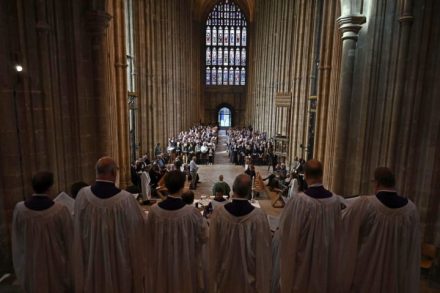
It's too late to get tickets for Canterbury Cathedral's silent disco tonight – as with last night's event, they sold out long ago – but you can still join the orderly prayer vigil against this caricature of the contemporary Church of England. Some 750 clubbers are expected to attend each of the four events over two days, to dance in the nave to hits from Britney Spears, the Spice Girls and Eminem. They'll party the night away not far away from where Thomas a Becket was murdered in 1170 as he clung to a pillar; his brains and blood mixed on the floor. His shrine is somewhere nearby. Oh, and alcohol will be available for revellers. This martyrdom site was once the second most popular pilgrimage destination in the Middle Ages.

Is Caroline Nokes really a Conservative?

From our UK edition

Quite a number of people have been asking what Caroline Nokes MP is doing in the Conservative party after her very odd appearance on Newsnight on Thursday. She was meant to be discussing the asylum status of Abdul Ezedi, the sole suspect in the horrific Clapham alkali attack which left a mother with life-altering injuries and her two daughters in hospital. His asylum status – he was granted asylum the third time he asked after claiming to have converted to Christianity and therefore to be at risk of persecution in Afghanistan – was quite an issue, given that, in 2018, he was found guilty of a sex offence. Something there for the chair of the women and equalities committee to get her teeth into, no? Nope.