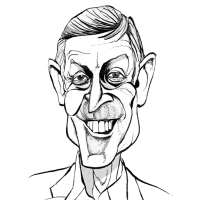
Matthew Parris

Matthew Parris

Matthew Parris is a columnist for The Spectator and The Times.

Why this should be David Dimbleby’s finest hour

The obvious can be so obvious that we discount it, supposing that other people must have thought of it already. There is an obvious candidate for chairman of the BBC governors. I have no idea whether he is going for it, but if not then he should be and people should be telling him so. David Dimbleby would be at the same time a solid and an inspired choice for the helm of an anxious public body going though tempestuous times and in need of the confidence of public, politicians and its own employees. And, no, I have not just had lunch with Mr Dimbleby. I do know his programme’s editor (who is not the originator of this idea) but have never spoken with or met Dimbleby other than as one of the panellists on his BBC2 Question Time programmes.

The question that just won’t go away: is Sunday this week or next week?

Very occasionally in the life of a nation comes the need for a short period of dictatorship. Not for major reform: democracy can easily manage historic change. No, it’s the little things which dictators do so well. General Franco, for example, rationalised Spanish spelling. In the sorting out of obstinate silliness, democrats lose heart and autocrats alone can stay the course. Any populist can sweep away major injustice, but only a dictator can standardise plugs or bring back the proper use of the letter ‘z’. To remove the minor anomalies of life, decree absolute can be the only way.

Three cheers for the renaissance of the provincial towns and cities of England

Bradford is to demolish huge swaths of its own centre. Acres of hateful Sixties concrete are to be pulverised in the year ahead, according to a tiny article in the Guardian this week. Much of Broadway, Cheapside and Petergate are to be bulldozed as part of the city’s programme of ‘reinventing’ its core. An architect, Will Alsop, has made plans for surrounding the Victorian city hall with a lake; a buried stream is to be uncovered; and great blocks of brutalist mid-20th-century building will be coming down, storey by storey. Three cheers for this news, almost unnoticed in London. A cheer for a dawning 21st century which has the guts and self-confidence to own up to the mistakes we made in the last and start again.

Détente is back in fashion, thank heaven, and the horrors of Bam could change history

Should liberal internationalists feel irritated when neoconservative hawks piggyback on to the successes of our own approach, and take the credit for themselves? No, we should feel satisfied that they want to, for it is a kind of repentance. Their tantrums past and the damage obvious, we can be pretty confident that they will not repeat such mistakes. We can feel quiet pleasure in their implicit acceptance that liberal internationalism works, after all. There will be no more Iraqs — you may count on that. Towards Tripoli, towards Tehran, and hopefully towards Damascus too, détente is back in fashion, thank heaven. The important thing is that the firebrands in Washington are being marginalised and the traditionalists are winning.

Sanctions may make us feel good, but they will not topple Mugabe

Margaret Thatcher was right and Thabo Mbeki is right. British-led sanctions against a renegade regime in Central Africa — be it Ian Smith’s when the country was called Rhodesia, or Robert Mugabe’s when it had been renamed Zimbabwe — are a counterproductive response to an unacceptable government. My family and I lived in Rhodesia from 1958, when I was eight, to 1968, when I was 18. Ian Smith’s unilateral declaration of independence (UDI) was made in November 1965 and we experienced three years in which the economic screw was progressively tightened.

Sorry, Stephen, but I certainly would work for Richard Desmond

How incredible it is,’ wrote Stephen Glover in last week’s Spectator’s Media studies, ‘and how depressing,’ that Richard Desmond might buy the Telegraph. He went on to paint a most unflattering picture of the minor media magnate, his main complaint being that Mr Desmond is a pornographer because he owns publications that print pornography. I am rather relaxed about pornography. Some of it isn’t very nice, but then much that we entertain in our heads isn’t very nice and it is at least an open question how far expressing our imaginings, or enjoying their expression by others, makes us worse (or better) people, or alters us in any important way. The current fuss about Internet porn strikes me as hysterical.

Blair is not guilty of mendacity but of weakness and poor judgment

Swimmers, scanning the sea for signs of danger, look beyond what breaks the surface. It is by the slight but unexpected troubling of the waters that hidden peril is often best located. Where something jagged lurks beneath or where two currents collide, a sudden agitated choppiness in a small patch of sea may tell us more than the great, regular rollers which we know how to breast. Most people seem to think that as regards the David Kelly affair, the Prime Minister himself is out of the roughest water; that Lord Hutton’s evidence-taking has somehow ‘cleared’ Downing Street — or at least that lesser figures are conveniently placed to take the rap. I too expect Mr Blair to escape.

Thank God for the rain — and for the gentle Afrikaners

Limpopo Province, South Africa Ottoshoek means ‘Otto’s corner’ or perhaps more colloquially ‘Otto’s place’ in Afrikaans. But this cabin in the Soutpansberg mountains is not so much a den as a lookout. Perched on the very edge of a green, rocky ridge, it overlooks the bushveld plain at the range’s feet, stretching grey-brown to the flat southern horizon perhaps 80 miles away. At Ottoshoek, on top of a lonely mountain range in the extreme north of South Africa — the Limpopo region — you are 2,000 feet higher, a great deal windier and cloudier, and about ten degrees cooler than the sweltering world beneath. It is a sort of God’s-eye view: all-seeing but unobserved.

The barnacle goose is very clever, and was once, technically, a fish

The view, I thought, appeared much as it would to a young barnacle goose. I was diving out of a blustery, dove-grey sky, my wing tips tipping cloud. Far below I could see the browns and greens, the heather and grass, of a big, low-lying Hebridean island. To the east lay the Scottish mainland. From the west the ocean, whipped by a stiff breeze, drove tiny white horses on to long sandy shores. The Atlantic rollers were just visible beneath my wings. But my wings were manufactured by Saab. Nose pressed to the window, I was aboard a 30-seater twin-prop passenger plane heading from Glasgow airport to the landing strip on the island of Islay. I would land there at ten in the morning on Monday, 13 October. About 30,000 barnacle geese had landed just ahead of me this month.

A trip to the Moon accompanied by Debussy, Liszt and Wallace and Gromit

It was was pure coincidence that The Spectator should have landed itself with our own space correspondent — me — as chance witness to the launch of Europe’s first trip to the Moon last Sunday morning. I was visiting an old friend who now works in IT support at the European Space Agency’s headquarters in Darmstadt, near Frankfurt. That same weekend, take-off of Arianespace’s flight 162 from Kourou, French Guiana, to Nowhere had been rescheduled to 00.03 GMT on 28 September. Arianespace is a sort of Tomorrow’s World parcels service. Flight 162 would be carrying three packages: an Indian satellite and a European broadband satellite, both for orbit around the Earth, and the European Space Agency’s Smart-1 satellite for orbit around the Moon.

The Iraq blunder will make Americans say, ‘Never again!’ And that’s a pity

A charge should be laid at the door of those who urged America onward into Iraq this year, and it should come not from pacifists, United Nations groupies or Uncle Sam-baiters, but from those on the Right who think that a great power does have special responsibilities, including – sometimes – a responsibility to intervene. We should charge the neoconservatives with fouling it up. We should charge them with spoiling the case. We should charge hotheads in the media with egging an administration into making a fool of itself when wiser friends urged restraint. The yee-hah tendency in the Pentagon and in the press has besmirched, by misapplication, a decent philosophy of muscular great-power diplomacy of which the civilised world may have future need.

How a balloon flight over the Pyrenees cured my mother’s fear of flying

What, for her 77th birthday, do you give a woman who has everything? I do not mean that my mother is rich or lives in luxury, but that though we, her six children, have all our lives been the recipients of birthday gifts lovingly chosen by her – she never fails to think of something useful or touching – it has never been easy to think, when her own birthday comes around, of what you can give someone who has all the possessions she wants. She and my father live in a house they love in the Catalan Pyrenees. They are comfortably off. My mother is only fitfully interested in clothes, does not wear hats and has never carried a handbag.

Those who opposed the war must not allow themselves to hope that things go wrong

In human governance, men matter as much as measures. If this is true for us in Europe, why should it be any less true for the occupying powers in Iraq? The governors whom America and Britain install there are not just ciphers or functionaries; their character, demeanour and local reputation will matter very much, and matter more as the smoke of war clears. We British, whose experience of wielding imperial power is very recent, should know this perhaps better than our American counterparts in Iraq. Colonial history proves time and again that the difference between a good governor and a bad one may amount to the difference between peaceful administration and a riot.

Is that blood running through Geoff Hoon’s veins, or is it refrigerant gas?

Various explanations have been offered for the decision by the Defence Secretary, Geoff Hoon, to leave for his summer holiday before the funeral this week of Dr David Kelly. Mr Hoon himself has let it be known via 'friends' that he would be in trouble with his wife Elaine if he delayed a holiday that was already planned. Others have speculated that he would not have been welcome at Dr Kelly's funeral. It is possible that the speculation is accurate, but I wonder.

Being on the radio was a welcome relief from duck husbandry

Let me tell you the story of the Docklands Eight, otherwise known as the Docklands ducklings. They came into my life briefly and by chance, ushered in by Kim. Kim helps me keep my London flat, by the Thames in Limehouse, clean and tidy. A great animal-lover, she comes in on Monday mornings bringing new stories of the family of ducks which has been hatching on the stones in a shallow section of canal near where we live. Last year there was a disaster when a water-disinfecting operative eliminated a whole generation of ducklings in a single morning, so this year Kim has been watching over the brood and feeding them with bread. A couple of weeks ago, most of the family were grown up enough to fly, waddle or sail away. A couple, however, stayed behind in the canal.

Without belief, can we go on cursing our enemies – or blessing our friends?

Has the power to curse lost its meaning for modern man? Might we, in losing it, lose something precious: the power to bless? I was made to think about this last week, in Bristol, recording for later broadcast a couple of programmes in a series I present for BBC Radio Four. Off the Page is a modest little affair in which three writers discuss with each other and with me the short columns I have commissioned from them on a single, simple subject. Each week we take a different topic and I invite different writers (some famous, some new or unknown) to join me in talking and writing about it. The result is discursive, very informal, sometimes rambling, often sharp, never thoughtless or dim. At its best it is like half an hour with The Spectator.

The fact is that I don’t give a damn about gay bishops

Why is it that not only I but millions (I suspect) of my fellow-countrymen too are left cold by the dispute raging within the Church of England about gay bishops? One has only to see the newspaper headline for the eye to slide away. It was not always thus. Such controversies used to fire many of us on both sides of the argument with passionate conviction. There was a time when I would have leapt to my laptop, determined to join the debate. Chosen as a panellist on BBC 1's Question Time in a week when such a question was likely to come up, I would have counted myself lucky.

Why the world would be better off if Saddam were still in power

What would you have done? Would you have left Saddam Hussein in power? The inquiry, familiar to all of us who opposed the war, is put in a finger-stabbing sort of way – as though that clinched it; as though the answer is so obvious that the peaceniks can only stammer. Just ask them what they would have done and watch them squirm! Elsewhere, the tactic is more typical of left-wing polemicists than of the Right. 'How could you stand by and see...?' is a favourite way of arguing for state intervention (and taxpayers' money) for any amount of expensive interference with nature. Any Tory with guts learns to summon them when reminded of dying patients, hungry jobseekers, sinking industries, failing railways or freezing pensioners, and asked, 'What would you do?

My part in Iain Duncan Smith’s sullen, sarcastic and ill-tempered outburst

Iain Duncan Smith and his party have thrown two big wobblies about BBC coverage in recent weeks. One episode occurred in the small hours of Friday 2 May when David Dimbleby compered BBC Television's local- election-night programme. The other unfolded last Sunday lunchtime on Radio Four's The World This Weekend as the presenter, James Cox, took a look at the Tories' post-local-election prospects. Iain Duncan Smith is furious about both broadcasts. As it happens, they have something in common: me. But in each case I was little more than a chance witness. Hardly seen by the Tory leader as an exceptionally fearsome creature, I will feature in these complaints as no more than symptomatic of what the Tories think is wrong with the BBC.

If I had £100,000, I would buy this picture of Margaret Thatcher

Socrates was never wider of the mark than when he said that the unexamined life is not worth living. He brushes aside some of the best lives ever led – if, that is, by 'best' we mean productive and by 'unexamined' we mean unexamined by the individual himself. This reflection occurred to me as I explored an exhibition (closing this Saturday, 17 May) at the Blue Gallery in London. Thatcher: An Exhibition of New Contemporary Art is a small collection of specially commissioned works of art and design inspired by Margaret Thatcher. 'Good Heavens,' she would say. 'What nonsense is this?' She wouldn't see the point. She hardly ever writes or talks of her feelings, her doubts, her joys or sadnesses. She does not find herself half as interesting as we do.