Matthew Leeming

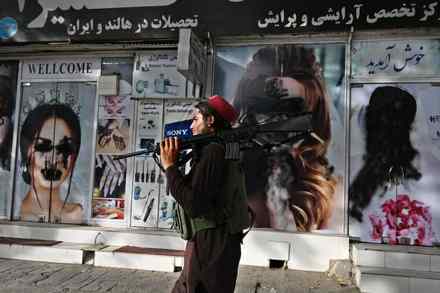
Kabul is now a city of the dead

I lived in Kabul for nearly ten years. I had a house there for many years and I loved being there. I loved the sense of life on the edge — even at the risk of sudden death — and the extraordinary array of interesting people who visited. I later became a partner in a fuel distribution business in Kabul, with a contract to supply the jet fuel used by Nato. We supplied $2 billion worth of jet fuel, amounting to around 100,000 tons a month, giving Nato the ability to bomb the Taliban. Several Afghans worked for me, friends as well as colleagues, and over the past few weeks I’ve been trying desperately to get them out of the country, but have come up against the brick wall of government bureaucracy.
Ahmad Shah Massoud was Afghanistan’s best hope

Ahmed Shah Massoud was described as ‘the Afghan who won the Cold War’. While famous in France (he was educated at the Kabul lycée, and the French saw him as the ultimate maquisard who drove a super-power out of his country), he is not a familiar figure in Britain. This book, a rich and detailed account of the travails and tragedy of Afghanistan between 1976 and Massoud’s murder in 2001, will correct that. Sandy Gall’s knowledge of the jihad is encyclopaedic. He was the first well-known journalist to make the dangerous journey into occupied Afghanistan and bring the human cost of this terrible war to our TV screens. To produce such a book at the age of 93 deserves admiration. Many warlords are also writers: Babur, T.E.

In the lap of the Gods

The Oxus, that vast central Asian river that rises somewhere in the Afghan Pamirs, has fascinated explorers for centuries. Its name gives us the land of Oxiana. Yet few Europeans had set eyes on it before the second world war. Robert Byron’s 1937 book, The Road to Oxiana, is an account, among other things, of a failed attempt to find it. What most gripped the handful of 19th-century explorers, diplomats, spies and sportsmen who did make the perilous journey, however, was identifying its source. While the sources of other great rivers were being more or less accurately traced, that of the Oxus was fiercely contested, owing to the unusually difficult terrain.

The Quaker Prince of Ghor

The saga of the First Afghan War, one of the greatest disasters ever met by the British army, has been told many times before, and I had vowed to throw any book that told it again away in the bin. But Ben Macintyre has found a wholly original angle on it by turning the spotlight on a mysterious American, Josiah Harlan, whose story briefly crosses other accounts of this period. In doing so, he has produced a riveting book and a valuable contribution to Great Game literature. It is the story of the American adventurer who has passed into the folklore of the North-West Frontier and was almost certainly Kipling’s inspiration for ‘The Man Who Would Be King’. Some of the story has been told before in the comparatively obscure journal Afghanistan (July-September 1947).

Culture of shame

I really thought I had made it when I went to give a talk at my old Oxford college. But when I got there I discovered that there had been an attempt to have me banned. I was accosted by a dusky beauty in the quad who, practically incoherent with indignation, told me that this was because I produced ‘the worst kind of neo-colonial travel writing’. In other words, I had once described an arranged Afghan marriage between a 14-year-old girl and a 38-year-old man as ‘legitimised rape’. I thought I had rather understated the horror of it. My thought-crime was ‘Orientalism’, the depiction of eastern cultures as strange and inferior to the West, rather than portraying them as both equally bad. In future I will give any cultural relativist this book.

The horror! The horror!

I have to declare an interest. In the late 1980s, I travelled with the author of this book. After university we went to run the bulls in Pamplona together, while our neighing contemporaries were being strapped into their first pinstriped suits. Then we went to Africa, where his family had lived since the 1930s. That Grand Tour was the beginning of the rape of ideology by reality for both of us, a lurch to the right, an end to half-baked student leftyism. Then our paths diverged and I have not seen him for many years. But Aidan Hartley’s subsequent odyssey is much more frightening. He has continued to use his experiences to question theory but has seen, in Somalia, humanity in Hobbes’s state of nature and, in Rwanda, the utter evil of our species.

TRAVEL AND INTERNATIONAL PROPERTY: Where no birds sing

Very few white people have seen the source of the Oxus in the Great Pamir. This vast Central Asian river that never meets an ocean was a source of fascination to 19th-century geographers, and the question of its origin, for which there are six candidates, was only finally settled in 1892 by Lord Curzon himself. He chose the highest glacier as the true source. I prefer the source of the biggest volume of water, christened Lake Victoria in 1835 by a British army officer. Both are found at the end of the Wakhan Corridor, that thin finger of Afghanistan that pokes out towards China.

The making of the Taleban

I saw the first tourists arriving in Afghanistan this summer. I saw their incredulity at the graveyard of crumpled aeroplanes at Kabul airport and at the Hazara suburb of the city that looks like Berlin in 1945. The question everyone asked was: how did this happen? How did a country famous for its hospitality and poetry sleepwalk back into the Middle Ages? In future the tourists will be carrying this book. As an account of how the country got into its present state, and of the making of the grotesque regime of the Taleban, it could not possibly be bettered.

Diary – 12 October 2002

Kabul On the trail of genetic traces of Alexander's soldiers in Afghanistan, I arrived in Badakhshan, the country's most remote and beautiful province that abuts China. I went to see my old friends at the government guest house, which is set on an island in the middle of the Kokcha river. We sat on a terrace with the river roaring 20 feet below us. Night fell quickly, and I looked up at more stars than I have ever seen before in my life; it was as if my sight had been miraculously restored. Occasionally, an orange tracer shell arced silently upwards as government soldiers tested their guns. The only thing to do for fun here is to take naswar. I asked Shafid, a turbaned old man who seems to have some sort of decorative function, what it was, and he said, 'It is part of narcotic.