Martin Bright

Why Not Vote Lib Dem?

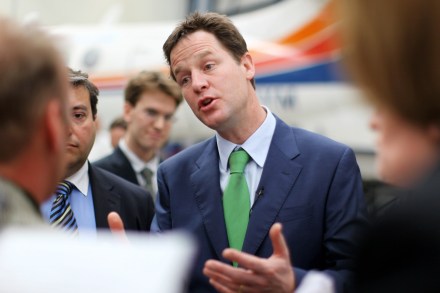
There is a terrible desperation about the Tory approach to the Lib Dem surge. There is a clear desire to find some sort of killer story about Nick Clegg or a killer strategy to reassert David Cameron's claim to be the candidate of change. What is odd is that Cameron seems to have forgotten what made him so attractive in 2005, which was that he was the candidate of the moderate, progressive centre ground.  The recession pushed the Conservative Party into the language of austerity - a message the British public is not yet ready to hear - and they have not recovered.  I have never understood why David Cameron and his allies stopped short of marching further onto the centre ground of British politics.
A New Tory Policy: Back to the Eighties

I cornered Ken Clarke after the press conference on employment and welfare today and asked him a direct question about my pet subject - Margaret Thatcher's Enterprise Allowance Scheme. I couldn't get in a question during the press conference itself, which was dominated by journalists from Channel 4 (three questions, come on chaps, fair's fair!) and some bloke called Forsyth from the Spectator. I asked Clarke about his post on the Linked In social networking site asking for people's experiences of the 1980s scheme for people wanting to come off the dole and set up their own small businesses. I have been lobbying for this for some time, as has the Federation of Small Businesses.

Labour Cheery About Lib Dem Surge

Labour's press conference this morning was a surprisingly cheery affair. Peter Mandelson was very much in control of proceedings and the media mob was clearly feeling benevolent on a lovely spring morning. I'm not sure it was entirely wise to run a spoof post-election news broadcast on the double-dip recession caused by Tory economic policy. It felt too much like the Labour high command has already accepted the inevitable. However, the focus wasn't really on the Tories but the Lib Dem surge. The Labour Party has the right strategy on this: hug them close and emphasise how much common ground there is. They know the Tories stand to lose most from a Lib Dem poll boost.

Time for a National Government?

Gordon Brown should have done it at the beginning of the recession. He and David Cameron should be thinking very seriously about it now. Perhaps national government is an idea whose time has come. Again. With the prospect of a very close election, in which people are clearly sick of the conventional two-party system, there is every reason to imagine a genuine government of all the talents after the election, with ministerial posts given to senior figures from all three parties. Is there any reason that Nick Clegg shouldn't be prime minister in a national government? It would seem he is the people's choice.  The obvious objection is that a national government would be anti-democratic.

Where Did Labour’s Funniest Line Originate?

I must say I had a chuckle at Alastair Campbell's tweet during the leaders' debate: "Clegg done well on style, Cameron clear winner on shallowness, GB winner on substance".  I had another chuckle when Alan Johnson used the line in the post-debate analysis and now I see David Miliband congratulating Alan Johnson for using it and  Miliband's comments being recirculated by eager Labourites. So who stole it from whom? For we socialists all property is theft and everything should be owned in common so I guess it doesn't really matter. But it is amusing to see how pleased everyone is with this one-liner.

The Leaders’ Debate: Well Done Chaps

Shall we stop being cynical for a moment and congratulate Brown, Cameron and Clegg for being the first political leaders in Britain to take part in a televised election debate? Indeed, we should particularly congratulate Gordon Brown for agreeing to this. He had by far the most to lose. There is absolutely no doubt that Nick Clegg won this. He faltered from time to time, but was the only one confident enough to take thoughtful (if sometimes stagey) pauses.  I thought Gordon Brown also did surprisingly well. He kept his cool and showed that he is an accomplished debater. His jokes were over-prepared and characteristically dreadful, but he warmed up through the 90 minutes and challenged Cameron very effectively on several occasions, especially over police spending.

What Do We Really Want from a Labour Government?

After reading Seumas Milne and Timothy Garton Ash in the Guardian and then looking at the advert for the New Left Review on the back of the London Review of Books ("Good Riddance to New Labour"), I do wonder what these people want from a centre-left government. God knows I have been critical of New Labour -- I've had a pop at its record on civil liberties, education, radical Islam, prisons. I could go on. This government has lacked imagination and it has failed to be bold enough. But between 1997 and 2008 Britain became more tolerant and more confident. Hell, it has almost became a modern European nation. It is a better place to be than it was in the 1980s. David Cameron knows that and so do his closest allies in the Conservative Party.

The Lib Dems Lose a Voter

I had my first experience of frontline canvassing in a marginal at the weekend, when I visited my mum in the west country for a few days. She lives in a village in Nick Harvey's North Devon constituency, a key target seat for the Tories. As a lifelong Labour and former activist she is torn between wasting her vote on the Labour candidate or voting tactically to keep out  the Tory, Philip Milton. On Monday we found some Lib Dem canvassers on the doorstep and very cheery in that way Lib Dems have to be. They explained why it made no sense to vote Labour in North Devon and the clincher was when one local Lib Dem said, "You really should vote to keep Milton out, I should know, I'm his cousin." Well, it was almost the clincher.

Still Looking for the Clear Blue Water?

With the publication of the Labour and Conservative manifestos we should now have some idea of the real differences between the two largest parties. But I am more struck by the similarities. I know we are supposed to believe that Labour is the party of the enabling state, but it chose to emphasise how it would enable the individual during its manifesto launch, just as the Tories did. For the Tories' Big Society read Labour's "mutualisation". There is not as much difference as the politicians would have you believe. Both policies are born out of a simple, pragmatic realisation that the state will not have the cash to intervene even if it wanted to.

The Gita Saghal Saga Continued

I have no doubt that history will vindicate Gita Sahgal in her decision to challenge Amnesty International over its relationship with former Guantanamo detainee Moazzam Begg and his organisation Cage Prisoners.  She has now left her job, as The Times reports today. This will be a great loss to Amnesty, which has lost a deeply respected figure in international human rights, especially in the field of women's rights and the threat of authoritarian Islam.  I can't really better Oliver Kamm's analysis of how damaging this is for Amnesty: "Its critics charge that it has diluted its defence of universal human rights by allying with a group that rejects that principle.

What Makes a Labour Candidate Unsuitable?

Stuart McLennan, Labour's candidate for Moray, has resigned over his Twitter stupidity and quite right too. What a repellent individual. And how obvious he made the fact by tweeting his every last small-minded thought. So what of Battersea MP's Martin Linton's outburst warning about the "tentacles" of Israel that were buying the election? As I report in today's Jewish Chronicle, the Board of Deputies of British Jews has asked the Labour Party to consider Linton's suitability as a candidate. Linton has since apologised for the tentacles comments, but not for the suggestion that the Israel lobby has  undue influence on British politics.

Turns Out David Lammy Has Every Right To Be Seething

Although it does not really make any difference to my original argument (which was about political quick thinking rather than the origins of the thought), it does seem that David Lammy has every right to be irritated that the idea of civic national service ended up as Tory rather than Labour policy. He first wrote on the subject for Prospect in April 2006 in a web article called Close Encounters. He returned to the subject just over two years later in the New Statesman after a conversation with me about a horrific sexual attack carried out his constituency. He raised it again at last year's Labour Party conference. He then then took a certain amount of stick for his support for a Demos pamphlet on the subject at Christmas.

Why Labour Needs To Be Much Fleeter of Foot

It is difficult to fault Cameron's idea of a national volunteer force. While the Labour Party was forced to spend today defending the National Insurance hike, the Tories were able to seize the intiative with a genuinely far-sighted proposal. All the more galling for the government that this idea has been rattling around in Labour circles for at least a year. Cameron has stolen Labour's clothes on this just as he did on co-operatives. David Lammy will be seething. His ideas for compulsory civic service were promoted in the pages of Prospect a year ago. He has been lobbying within the Labour Party for the policy for considerably longer.

What the Party Leaders Are Saying

I really enjoyed Anne McElvoy's Standard column today. She is absolutely right to identify the false notes of day one of the election campaign. Gordon Brown really was talking nonsense about his ordinary middle-class background and David Cameron should certainly drop the glottal stop. She is right to say that neither has any clarity of vision yet. For what it's worth I agree with Kevin Maguire agreeing me that Labour looked more confident on day one and that the Tories seemed nervous. On day two, Cameron was beginning to get into his stride and Brown's interview with NIck Robinson was awful. The wall-to-wall media coverage is almost all completely absorbing, generally well-executed and sometimes even informative. But i've already had several sneaking "so what" moments.

The Inter-Generational Election

Geoffrey Wheatcroft has kicked off the election campaign with possibly the most depressing article I have ever read about British politics. Jetting off to the States for an academic engagement, the old curmudgeon says he feels no regret at missing an election in which he has lost interest.  This say more about the author of the piece than the election, which promises to be the most fascinating in my adult life. But then I am nearly twenty years younger than Mr Wheatcroft. His central argument is that the Labour and Conservative messages are uninspiring. The Labour government will admit that the situation is dire, but claim it would be worse under the Tories; the Tories will call for change, without having much to offer.

Creative Survival in Hard Times

Those of you who have been following the fortunes of my New Deal of the Mind project with a mixture of interest and scepticism will perhaps wish to read the report we have published today with the Arts Council. Creative Survival in Hard Times is an attempt to grapple with the issue of employment in what has, for better or worse, become known as the "creative industries".  We make a number of recommendations, but central to the report is the conviction that a new spirit of entrepreneurship should be nurtured from the bottom up. For this reason we believe the next government should revisit the Enterprise Allowance Scheme, which ran from 1983-91. The EAS gave people slightly more than the dole for a year if they agreed to come off benefit and set up their own businesses.

A New Dawn for the “Decent” Left?

Readers of The Bright Stuff may be interested in the launch of Arguing the World, a new blog from Dissent, the American journal of the American democratic Left.  The idea is to collect the thoughts of journalists and academics in Britain and America in a format beyond the usual long-form essays and reviews printed in Dissent itself.  For those unfamilar with Dissent, the editors describe the publication thus: "Dissent is a quarterly magazine of politics and culture edited by Michael Kazin and Michael Walzer. A magazine of the left, Dissent is also one of independent minds and strong opinions. "A pillar of leftist intellectual provocation," writes the New York Times, Dissent is "devoted to slaying orthodoxies on the right and on the left.

Truesay! A Motto for Our Times

My friend and colleague Jo Phillips has been roaming the country promoting the must-read book of the forthcoming election. Why Vote? -- which she has co-authored with David Seymour, the former political editor of the Mirror Group, who won't mind me calling him a veteran political commentator. The book is a jaunty affair, designed to appeal to people who have been put off the political process (so just about everybody).  I know she has been struck by the general "what have politicians ever done for anyone?" response as she tours the nation. But when she pointed out to one group of young people the benefits that politicians had brought us (universal health provision and education, for example, and the right to vote itself) they were stopped in their tracks.

Where Are the Jobs in the Election Budget?

I agree with Fraser that there is a welcome modesty about Alistair Darling's budget. It was also good to see Maggie Darling outside Number 11, a wife of whom the Chancellor is justly proud.  But I did wonder where the measures are for tackling the joblessness, which will be the likely consequence of the public sector cuts any new government will have to impose. Last year we had a "budget for jobs" with the announcement of the Future Jobs Fund, but this year the only announcement was the extension of the young person's job guarantee until 2012.  Unemployment has not hit the levels first feared at the beginning of the recession, but the situation is still grave.

Does America Point to a Future for the British Left?

I have had the pleasure of meeting two major figures of the American intellectual left over the past two weeks: Washington Post columnist EJ Dionne and Michael Kazin, co-editor of Dissent magazine. I'm sure there are as many differences as similarities in the politics of these two men, but what struck me about meeting them was how complacent and flabby we have become in Britain with our progressive politics. The relative strength of the Labour Party and the trade unions make us believe our radical traditions are safe here. But last night's Dispatches made me realise just how fragile a principled left-wing politics has become.  It is as well not to get over-romantic about other intellectual cultures.