Mark Leonard

Would Brexit voters really accept the return of freedom of movement?

19 min listen

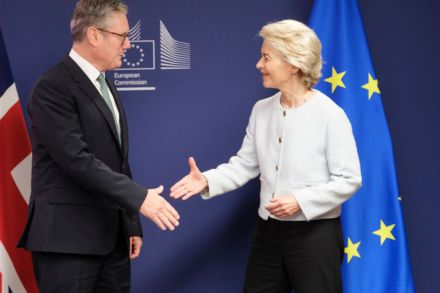
New research this week suggested that a majority of Brexit voters would accept the return of freedom of movement in exchange for access to the EU single market. The poll, conducted by the European Council on Foreign Relations (ECFR), found that 54% of Brexit voters – and 68% of all respondents – would accept this. Facing their own changing domestic concerns, how close can the UK and EU governments really get? Could Defence hold the key for collaboration? And how much is this driven by a more volatile geopolitical landscape ahead of Trump’s return as US president? James Heale speaks to Anand Menon, director of the think-tank UK in a Changing Europe, and Mark Leonard, director at the ECFR. Produced by Patrick Gibbons.
Big Brother versus YouTube: let the Beijing Games commence

Mark Leonard, Britain’s pre-eminent analyst of modern China, says the Olympic genie is out of the bottle. The prospect of global scrutiny has actually increased repression as the authorities try to stamp out dissent. But digital technology is impossible to police ‘For years we couldn’t wait for the Olympics to start. Now we can’t wait for them to be over.’ That is how a Chinese friend described the horrible limbo in Beijing as a control-freak state tries to anticipate and eliminate any possible challenges to its glorious coming-out party on the 8th of the 8th, 2008.

Yuschenko: historical times

I had almost given up. The time of our appointment had changed six times in 24 hours. The presidential palace was — as it still is — in full crisis, and my interview seemed to be receding out of reach. When he finally showed up, the man at the centre of the political storm seemed perfectly calm. Victor Yuschenko was wearing a well-cut suit and a bright red tie, but it was his face that captivated my attention. This was the famous face that had shocked the world and launched a revolution. Disfigured by pocks and carbuncles, it tells the story of Yuschenko’s near-death and of his country’s bitter struggle for democracy.

How Gordon sees the world

Mark Leonard, an authority on Labour foreign policy with strong connections to the government, has spoken to those close to the Chancellor in search of Brown’s notoriously opaque views on international affairs. This is what he discovered Imagine the scene. It is 2007. The pale November sun is slowly melting the frosted roofs of Camp David. A throng of journalists — bristling with cameras, arc lamps and microphones — jostle for position around two podiums. Suddenly the doors of a log cabin swing open, and President Bush and Prime Minister Brown walk out for their first joint press conference. They ignore the battery of predictable questions — ‘Does Prime Minister Brown — like Blair and Bush — use Colgate toothpaste?