Luke McShane

Luke McShane is chess columnist for The Spectator.

No. 614

From our UK edition

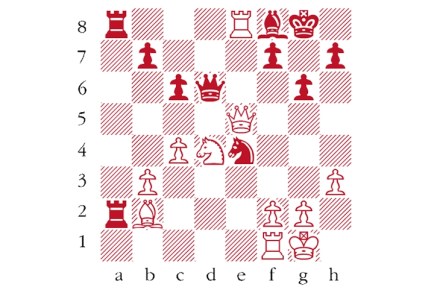
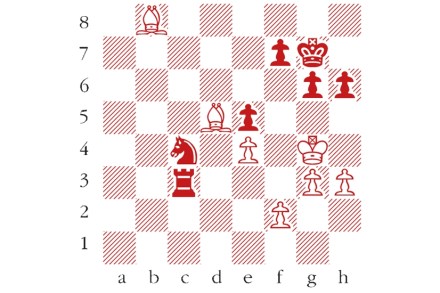
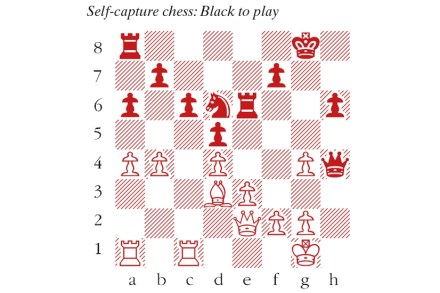
White to play. Stefano Tatai–Spyridon Skembris, Budva Zonal 1981. Morricone’s teacher found a delightful conclusion to this attack. What was his next move? Answers should be emailed to chess@spectator.co.uk by Monday 27 July. There is a prize of £20 for the first correct answer out of a hat. Please include a postal address and allow six weeks for prize delivery. Last week’s solution 1 Rb8+! Rxb8 (or 1...Bxb8 2 Rxa8 and 3 Rxb8 mate) 2 Rh1! and 3 Rh8 mate. Not 1 Rh1 0-0-0!, or 1 Rxa7 Rd8!

An ugly duckling problem

From our UK edition

The position shown in this week’s main diagram is the starter problem for the Winton British Chess Solving Championship, an annual competition. White must force mate in two moves, against any defence. (White moves, then Black moves, then White delivers checkmate.) For entry details, see the final paragraph. Many composed positions have an ugly duckling problem. Practical players are accustomed to discernible pawn structures and an approximate balance of material. An irrational starting position, like this one, is apt to draw a little wince. But look deeper, as there is grace and harmony to be found. Composed problems teem with ingenious and beautiful ideas expressed in ways that you might never encounter in practical play.

No. 613

From our UK edition

White to play and mate in three moves. A problem composed by grandmaster Jonathan Levitt (British Chess Magazine, 1995). One tip: note that there is an ‘obvious’ mate in two which actually falls short. Answers (first move only) should be emailed to chess@spectator.co.uk by Monday 20 July. There is a prize of £20 for the first correct answer out of a hat. Please include a postal address and allow six weeks for prize delivery. Last week’s solution 1 Re6! wins, as taking the rook costs Black his queen. The game ended 1...Qd8 2 Qf4+ Kg8 3 Rxe7 Rxe7 4 d6+ Re6 5 d7 g6 6 Rd6 and Black resigned.

The Streisand effect

From our UK edition

There is no sight so compelling as one that would be hidden. I am fascinated by the Streisand effect, named after Barbra Streisand, whose Malibu house appears in a large online collection of aerial photographs documenting the California coastline. In 2003, she filed a lawsuit to have it removed, which as well as being unsuccessful drew much more publicity to the photo. You can count on that appetite for mischief: Goya’s ‘Portrait of the Duke of Wellington’ was more in the public eye after it was stolen from the National Gallery in 1961 than before. (Wittily, the painting ‘appeared’ the following year in the hideout of Bond villain Dr No; the real thing was returned in 1965).

No. 612

From our UK edition

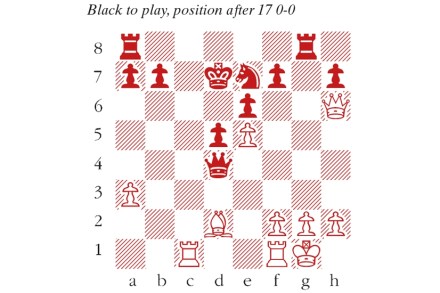
White to play. Giri–Nepomniachtchi, Chessable Masters 2020. Giri has sacrificed a knight to lure the black king forward. Which move forced a decisive breakthrough? Answers should be emailed to chess@spectator.co.uk by Monday 13 July. There is a prize of £20 for the first correct answer out of a hat. Please include a postal address and allow six weeks for prize delivery.

Twitch pageant

From our UK edition

Chess has much in common with video games — not least, the eager disdain of uninformed critics. An 1859 article in Scientific American noted the achievements of Paul Morphy ‘vanquishing the most distinguished chess players of Europe’ but concluded sniffily that ‘skill in this game is neither a useful nor graceful accomplishment’. You can’t please everyone. Gamers are used to suffering the same old brickbats — their pursuits are addictive, isolating, sedentary, a channel for violent impulses, or just a waste of time. This is mostly silly: games can offer a rich and fulfilling competitive environment.

No. 611

From our UK edition

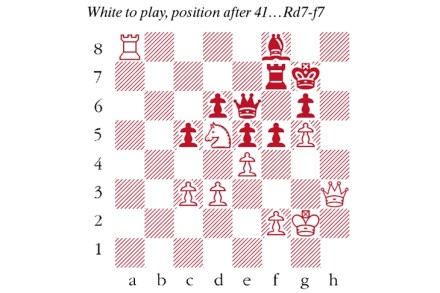
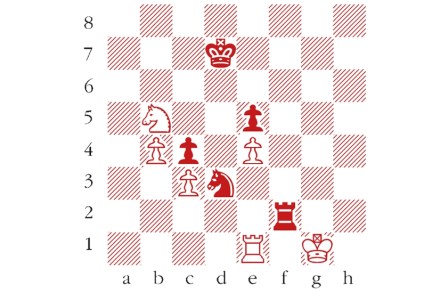
White to play. From the ridiculous to the sublime. According to the ‘Chess Notes’ website, a game won by Edward Gestesi in Paris, 1911. Which move forces a quick checkmate? Answers should be emailed to chess@spectator.co.uk by Monday 6 July. There is a prize of £20 for the first correct answer out of a hat. Please include a postal address and allow six weeks for prize delivery. Last week’s solution 1 Ra1! draws. The key line is 1…Ke3 2 Ke5 Kd3 3 Kf4 Kc3 4 Ke3 Kb2 5 Kd2 Kxa1 6 Kxc2 stalemate.

Clutch fun

From our UK edition

‘May the best scoring system win!’ is hardly a sentiment to stoke the passions. In the 2011 referendum, the alternative vote (AV) system was mooted to replace first-past-the-post. The electorate didn’t care for AV, which lost by two votes to one. Indeed, people didn’t much care for the issue at all: the 42 per cent turnout was far feebler than 72 per cent for the Brexit referendum in 2016. The fact remains — how you keep score does matter. In elections, the ‘popular vote’ does get counted, but it isn’t usually what counts, much to the chagrin of, say, Hillary Clinton’s supporters in 2016. In sport, as in politics, much depends upon the scoring system, even as we know that the exact details are arbitrary.

No. 610

From our UK edition

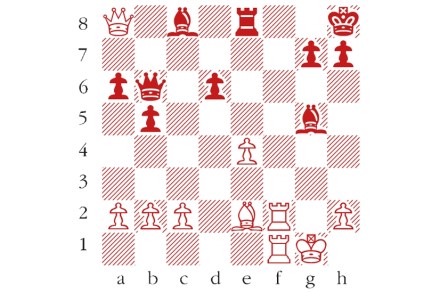
White to play. Grischuk–Aronian, Clutch Chess 2020. Only one rook move draws here. Which one? Answers should be emailed to chess@spectator-.co.uk by Monday 29 June. There is a prize of £20 for the first correct answer out of a hat. Please include a postal address and allow six weeks for prize delivery. Last week’s solution 1 Na4! is a nasty surprise, trapping the queen.

Chequered histories

From our UK edition

As statues are scrutinised, the tensions that existed within historical figures are thrown into relief. You can admire Churchill’s leadership and criticise his imperialism. Beyond politics, whether one can or should separate the art from the artist is a well-trodden critical minefield. How to appraise the work of sculptor Eric Gill, whose corporeal forms can hardly be detached from the unspeakable sexual behaviour which came to light decades after his death? Bobby Fischer must be the most prominent chess player to inspire deeply conflicted feelings. His views were repugnant, and his games were sublime. But even if they are related, in that a passionate hatred fuelled his maniacal drive, it would be absurd to describe the moves as anti-Semitic or hateful.

No. 609

From our UK edition

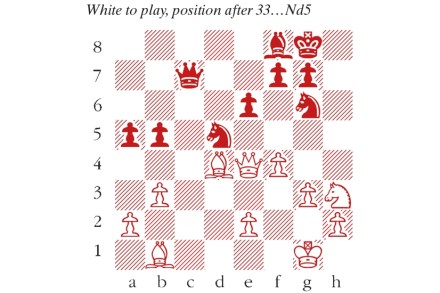
White to play. Tolush–Aronson, Moscow 1957. Strangely, this quick win was once wrongly attributed to Alekhine. How did White exploit the exposed position of the Black queen? Answers should be emailed to chess@spectator.co.uk by Monday 22 June. There is a prize of £20 for the first correct answer out of a hat. Please include a postal address and allow six weeks for prize delivery. Last week’s solution 1…Bg2! 2 Bxh8 Qh3 and mate follows on h1. No better is 2 g4 Bxf3, or 2 cxb7 Rh1+!

No. 608

From our UK edition

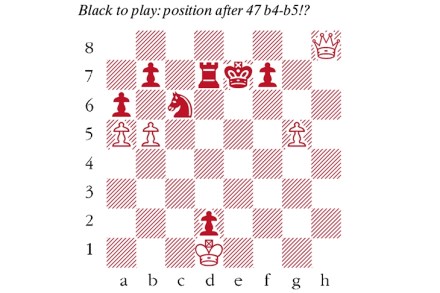
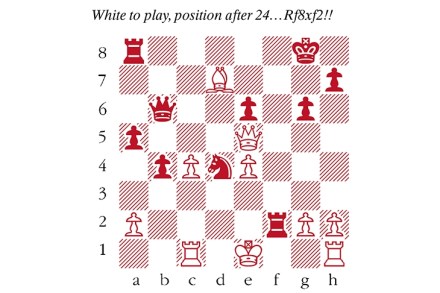
Black to play, Ding Liren–Daniil Dubov, Lindores Abbey Rapid Challenge, May 2020. Dubov’s rook is under attack, but his next move turned the tables, prompting immediate resignation. What did he play? Answers should be emailed to chess@spectator.co.uk by Monday 15 June. There is a prize of £20 for the first correct answer out of a hat. Please allow six weeks for prize delivery. Last week’s solution 1 Rh6!! gxh6 2 Qf5+!!

Lindores Abbey online

From our UK edition

The Lindores Abbey Distillery in Fife, Scotland was an idyllic setting for an exciting rapid event last year, won by Magnus Carlsen. This year, the ‘views’ were of a different sort, as the Lindores Abbey Rapid Challenge was held online. The Tironensian Abbey is now a ruin, but a quaint entry in the inventory records from the 1480s makes note of ‘twa pairs of thabills wt thair men’, (probably: two chessboards with pieces), which suggests that the monks enjoyed a game too. The online reboot marked the second leg of the Magnus Carlsen Chess Tour, following on from the Magnus Carlsen Invitational held in April and May. Three more events are planned in the coming months, culminating in a Grand Final in August, with a $1 million total prize fund across the series.

Robot Wars

From our UK edition

Twenty years ago, I was an avid fan of the cult TV programme Robot Wars. Teams of contestants would design and nurture their metal offspring, and then set them to fight. The goal of these remote-controlled battles was to cripple the enemy robot, or eject it from the arena. They sliced, bashed, torched, shoved and flipped each other, and much of the fun lay in trying to guess which technique would triumph. A clash of contrasting styles clearly holds some visceral appeal. Mongoose or cobra? The shackled bear, or the snapping bulldogs? Bearbaiting is consigned to history, but there is an ongoing online dogfight between two of the top chess engines, Stockfish and Leela Chess Zero. Stockfish, an open-source chess engine, is freely available and very powerful.

No. 607

From our UK edition

White to play, Stockfish–AllieStein, TCEC Season 16. Stockfish found a beautiful knockout blow in this game against a different neural net engine. What did it play? Answers should be emailed to chess@spectator.co.uk by Monday 8 June. There is a prize of £20 for the first correct answer out of a hat. Please include a postal address and allow six weeks for prize delivery. Last week’s solution 1 Qe5?? g5+! and White resigned, since 2 Kh5 Qxh3 is mate.

Swindlers’ art

From our UK edition

A lost cause at the chessboard is hard to define, but, like obscenity, I know it when I see it. There comes a point where prolonging the matter is downright indecent, so thank goodness that custom permits us to save our blushes with a timely resignation. Then again, there are a great many chess positions that lurk in the shadows — distasteful, but not beyond redemption. The degenerate defender must thirst after a swindle to salvage a draw (or more!). I confess that so long as some hope remains of a juicy swindle, I can stomach almost any position, no matter how unseemly. The Complete Chess Swindler (New in Chess), a new book by Australian grandmaster and economist David Smerdon, is a thrilling guide to this netherworld of not-quite-resignable positions.

No. 606

From our UK edition

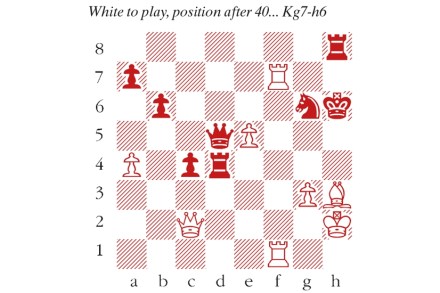
Tamas Fodor — Michael Adams, Hull 2018. White to play. One from the puzzles section of Smerdon’s book, which I witnessed myself. Adams’s last move, 60...Kf6-f7 set a trap. White’s next was a queen move that walked right into it. What was the losing move? Email answers to chess@spectator.co.uk by Monday 1 June. There is a prize of £20 for the first correct answer out of a hat. Please include a postal address and allow six weeks for prize delivery. Last week’s solution 1.Qf6! Mate follows with Qf2/Qf3/Qxe5/Qxd4/Nxf5/Rb3, depending on Black’s reply.Last week’s winner A.

Steinitz Memorial

From our UK edition

I like a memorial tournament. It’s true that the champions they celebrate may be less skilled than their modern counterparts. That’s to be expected, as players of today stand upon the shoulders of their predecessors. So I tend to picture the world champions as squabbling gods of myth, made vital by their flaws, and memorial tournaments as temples in their honour. Some characters, like the urbane Capablanca or the charismatic Tal, capture the imagination more readily, but they all have a place, as do the demigods such as Chigorin, Keres or Korchnoi, who never reached the summit but are revered in turn. Usually a memorial event bears a national significance too, such as the Capablanca Memorial in Cuba, or the Chigorin Memorial in Russia.

No. 605

From our UK edition

White mates in two moves against any defence (composed by Walter Pulitzer). Steinitz admitted he could not crack this within 15 minutes. What is White’s key first move? Answers should be emailed to chess@spectator.co.uk by Monday 25 May. There is a prize of £20 for the first correct answer out of a hat. Please include a postal address and allow six weeks for prize delivery. Last week’s solution 1 Bb2! entombs the Bc2. The a-pawn decides the game. After 1... h5 2 g5 h4 3 a4 Black was completely lost.

Online Nations Cup

From our UK edition

Fifty years ago, the USSR faced a ‘Rest of the World’ team in a match in Belgrade, with the likes of Spassky, Petrosian, Larsen and Fischer doing battle on the top boards. The Soviet team, which included five world champions, managed a narrow 20.5-19.5 victory. In 2020, there are three chess superpowers: the USA, Russia and China. Russia has the deepest pool of talent, and between all three, they boast around half of the world’s top 100 players. Each country occupied a podium spot at the most recent Olympiad in 2018. The Olympiad is normally biannual, but the 2020 edition, due to be held in Russia this summer, has been postponed for a year. An online version of the event has been mooted by Fide, but there has been no official announcement.