Luke McShane

Luke McShane is chess columnist for The Spectator.

Four puzzles in one

From our UK edition

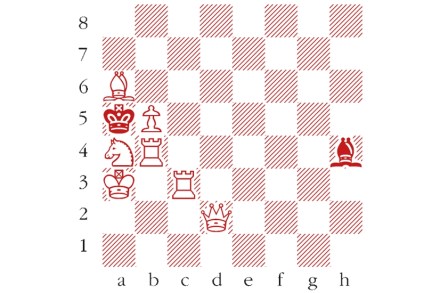
Four puzzles in one, composed by Werner Speckmann, 1963. In each case, White to play and mate in two. (a) As in diagram; (b) In (a), move Qh7 to a7; (c) In (b), move Ke6 to c6; (d) In (c), move Ke4 to c4. We regret that there is no prize for this puzzle, owing to the Christmas printing schedule. Last week’s solution 1 g4!! blocks the c8-h3 diagonal, so a back rank mate with 2 Rc8+ is threatened. In defending the threat, Black loses the queen.

Chess improvement

From our UK edition

The juicy prospect of improvement constantly dangles above a chess player. Those morsels of knowledge one has acquired whet the appetite for others which lie just out of reach. Even players at peace with their ambient proficiency can’t help but acknowledge that their better games coexist with lousy ones. Once you admit that, it’s a hop, skip and a jump to the idea that replicating the good games might confer improvement. Unless you have the equanimity of a monk, wanting to play well becomes an unshakeable existential burden. Many chess books will promise to boost your results at the board. Usually, it is taken for granted that absorbing the book’s insights will generate the desired improvement.

No. 633

From our UK edition

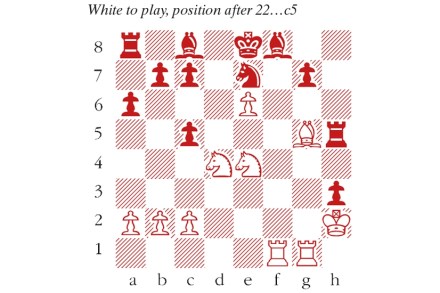
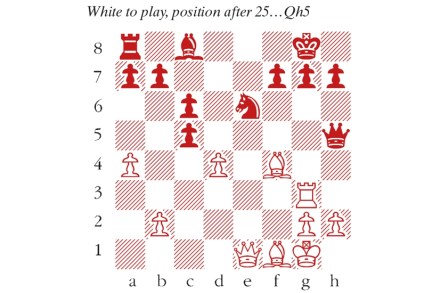
White to play. A position taken from Chess Improvement (perhaps from Luchowski–Gridnew, Moscow 1992.) Black’s menacing pieces make the situation look desperate. How can White turn the tables? Answers should be emailed to chess@spectator.co.uk by Monday 7 December. There is a prize of £20 for the first correct answer out of a hat. Please include a postal address and allow six weeks for prize delivery. Last week’s solution 1 Qc8+! Kxc8 (or 1...Kd6 2 Qe6#) 2 a8=Q+ Kd7 3 Qe8+ Kd6 4 Qe6 mate.

Forbidden pairings

From our UK edition

Put yourself in the shoes of Aryan Gholami, the teenage master from Iran who was paired with an Israeli opponent in Sweden in January 2019. It’s a blitz tournament, so you’re due to begin in minutes. For political reasons, your country expects that you will refuse to play the game, and there may be repercussions if you do play it. Gholami duly forfeited the game. His ‘virtue’ of omission was celebrated back in Iran, where he was photographed with Supreme Leader Ali Khamenei and General Qasem Soleimani (the latter was killed in a drone strike earlier this year). Recent years have seen a spate of incidents in which Iranian players boycotted their games with Israelis. It is a paradox that this regrettable practice attests to a flourishing chess scene in Iran.

No. 632

From our UK edition

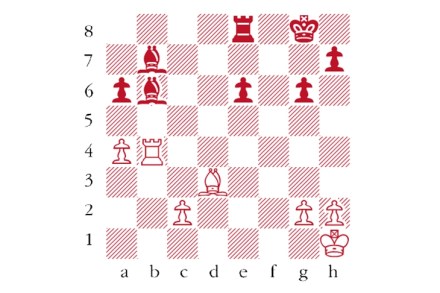
White to play and win. E. Pogosjants, Shakhmaty v SSSR 1976. Promoting the a-pawn allows Black a perpetual check. Which move wins the game? Answers should be emailed to chess@spectator.co.uk by Monday 30 December. There is a prize of £20 for the first correct answer out of a hat. Please include a postal address and allow six weeks for prize delivery. Last week’s solution 1 Qa8! If 1…Ra1 2 Qxa1#, while any knight moves are met with Ne2# or Nd3#.

Speed freaks

From our UK edition

Writing in January, I described internet bullet chess, where the players have one minute for all their moves, as ‘popular, addictive and pointless’. Bullet games are shallow and unwholesome because if you stop to think, you lose the game on time. Never mind a junk food tax: taxing bullet chess is the real social imperative — or indeed banning it. Blitz chess, where the players have three or five minutes per move, is a much healthier proposition. The pleasure of a well-played blitz game goes beyond a mere adrenalin rush and the experience might well be beneficial — as part of a balanced diet, of course. Were he alive, I presume that Mikhail Botvinnik, the Soviet world champion, would take exception even with that.

No. 631

From our UK edition

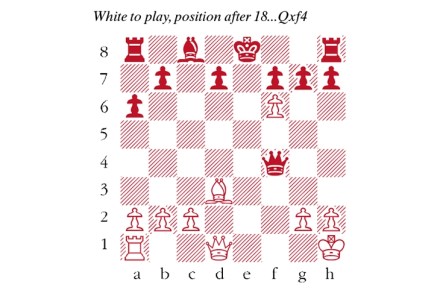
White to play and mate in two moves. Composed by Sam Loyd, 1857. Answers should be emailed to chess@spectator.co.uk by Monday 23 November. There is a prize of £20 for the first correct answer out of a hat. Please include a postal address and allow six weeks for prize delivery. Last week’s solution 1 Qg7+!! Kxg7 2 Nf5+ Kg8 3 Nh6 mate.

The Brick

From our UK edition

I own a few chess books that could serve as a murder weapon, but none so hefty as Chess: 5334 Problems, Combinations and Games. Nicknamed ‘The Brick’ by its fans, its thousand-odd pages forgo instructional text in favour of an escalating procession of puzzles, mostly mates in 1, 2 or 3 moves. These illustrate the most important patterns in chess, which form the vocabulary of any skilled player. This is a primer with a pedigree: the book was written by Laszlo Polgar, the father of the famous Polgar sisters, who believed that geniuses are made, not born. The manifest effort of compilation demands commensurate exertion from the reader.

No. 630

From our UK edition

White to play. Mista–Kloza, Poland 1955 (supposedly). Which move does White play to force a quick checkmate? Answers should be emailed to chess@spectator.co.uk by Tuesday 17 November. There is a prize of £20 for the first correct answer out of a hat. Please include a postal address and allow six weeks for prize delivery. Last week’s solution 1 Kd7! If 1…Bg7 2 Nd6 and 3 Ne8 mate. Or if 1…Kg7, 2 Nd6 and Nd6-e8, Nd6xf5 or Ng5-e6 mate.

The Queen’s Gambit – Accepted

From our UK edition

‘It’s chess. We’re all prima donnas.’ You can hear it spoken with a wink in the Netflix miniseries The Queen’s Gambit, released two weeks ago in seven episodes of about an hour. My heart swelled to hear the game’s essence so appreciated: of course nothing else matters when you’re playing chess. So yes, we are prima donnas, thank you, and roundly indulged by this fine TV series, which is based upon the novel of the same name by Walter Tevis, published in 1983. (My edition includes an endorsement from Lionel Shriver on the cover.) Anya Taylor-Joy is mesmeric in the role of Beth Harmon, the novel’s troubled hero.

No. 629

From our UK edition

White to play and mate in 3. A puzzle featured in The Queen’s Gambit, apparently composed by W. Atkinson in 1890. What is White’s first move? Email answers to chess@spectator.co.uk by Tuesday 10 November. There is a prize of £20 for the first correct answer out of a hat. Please include a postal address and allow six weeks for prize delivery. Last week’s solution 1 b5! is ‘Zugzwang’. After 1...Kh5 (or 1...Kf6 2 Kg4 g5 3 Kh5) 2 a5! Black resigned in view of 2...bxa5 3 b6!

Collapsing barricades

From our UK edition

Geometry shmometry. The pirouette of a knight may be pleasing to the eye, but sometimes what I really crave is a demolition. I don’t mean a smash-and-grab king hunt. I want to see a crumbling edifice, a colossal concrete barrier wilting beneath a torrent of water, as in The Dam Busters. On the chessboard, diagonal chains of pawns are our barriers: daunting, manmade and ostensibly impermeable. Aron Nimzowitsch theorised in My System that pawn chains should be attacked at their base. Sound strategy, but when the base lies beyond reach, a more drastic bombardment can be called for, such as that which occurred in a recent game between two computers. Leela Chess Zero has been hunkering down since the opening, and Stockfish has lain siege. We join the game at move 150(!

No. 628

From our UK edition

White to play. Wade–Korchnoi, Buenos Aires, 1960. Bob Wade’s next move prepared a surprising and decisive breakthrough. What did he play? Answers should be emailed to chess@spectator.co.uk by Monday 2 November. There is a prize of £20 for the first correct answer out of a hat. Please include a postal address. Last week’s solution 1…f5! wins, because 2 exf6 Rxf6+ 3 Ke2 Bg4+ is crushing. (1…f6 2 Nd2!, or 1…Qxb2+ 2 Nd2!) After 1…f5 White tried 2 cxd5 f4! 3 Bxh7+ Kxh7 4 Qxd4 Nxd4 and resigned before further losses.

Sweet surrender

From our UK edition

It’s over. Magnus Carlsen’s undefeated streak in classical chess has finally come to an end, after 125 games. It is hard to exaggerate what an unlikely accomplishment this is: Carlsen faced top-flight opposition in almost every game, winning 42 and drawing 83. He was beaten by the Polish grandmaster Jan-Krzysztof Duda at the Altibox Norway Chess tournament (played over the board!) earlier this month. Carlsen’s preceding loss came against Shakhriyar Mamedyarov during a difficult period in late 2018. Back then, the talk of the town was Ding Liren’s progress toward what became a 100-game unbeaten streak, while Carlsen’s confidence looked at a low ebb. With gritted teeth, he defended his world championship title against Caruana.

No. 627

From our UK edition

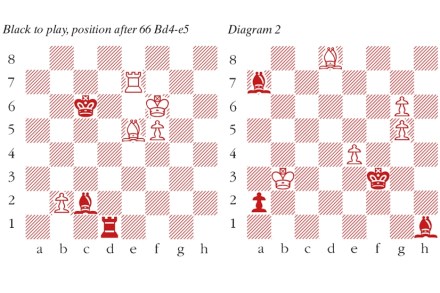
Black to play. Sjugirov–Paravyan, Russian Higher League, October 2020. A piece for a pawn down, Black’s follow up was subtle but devastating. What did he play? Answers should be emailed to chess@spectator.co.uk by Monday 26 October. There is a prize of £20 for the first correct answer out of a hat. Please include a postal address. Last week’s solution 1 Bxc4? h5+! (not 1…Rxc4 as played) 2 Kh4 Kh6 3 f4 f6!

Chess players on ice

From our UK edition

We are what we do. Alas, in its zeal to suppress the virus, this government would have many people doing not very much. Since March, many musicians, actors, sportspeople and more have had precious few opportunities to perform. In his 2008 book Outliers, Malcolm Gladwell claimed that the hundreds of live performances played by the Beatles in Hamburg 1960-1962 were a key ingredient in their later success. If he is right, 2020 marks a daunting setback for countless aspiring artists. Government handouts can mitigate the long-term damage to their careers, but they cannot possibly make them whole. Chess is in the same boat: it’s a communal activity where performance and practice are central.

No. 626

From our UK edition

Rapport–Sprenger, Bundesliga, September 2020. The game continued 1 Bxc4 Rxc4 2 Bxe5+ f6 3 Bf4 Rxe4+ 4 Kf3 and was eventually drawn. How could Black improve on this sequence? Answers should be emailed to chess@spectator.co.uk by Monday 19 October. There is a prize of £20 for the first correct answer out of a hat. Please include a postal address. Last week’s solution 1…g5! threatens Rc1-e1 mate. After 2 Bd4+ Kg8 3 Ra8+ Kf7 4 Ra7+ Ke8 White soon runs out of checks.

A trout in the milk?

From our UK edition

I can’t tell you why the Armenian grandmaster Tigran Petrosian was found guilty of cheating last month, because I don’t know. The event was the 2020 PRO Chess League, an online team event organised by Chess.com. Petrosian (not to be confused with his namesake, who was World Champion in the 1960s) was playing for the Armenia Eagles, who appeared to overcome the St Louis Archbishops by 9.5-6.5 in a David and Goliath final. Petrosian’s 3.5/4 score against the mighty Archbishops’ squad (including wins against Fabiano Caruana, Wesley So and Leinier Dominguez) was exceptional. After his games were investigated and the results overturned, the title (and $20,000 first prize) was re-awarded to the team from St Louis.

No. 625

From our UK edition

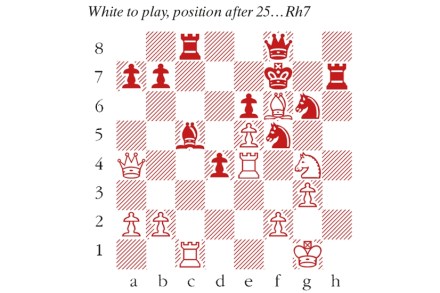
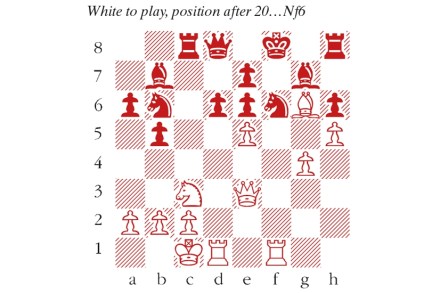
Black to play. Khodashneli — Willow, European Online Youth Championship U18, September 2020. White has just advanced 40 g3-g4, and England’s Jonah Willow spotted his opportunity. What did he play?Answers to chess@spectator.co.uk by Monday 12 October. There is a prize of £20 for the first correct answer out of a hat. Please include a postal address and allow six weeks for prize delivery. Last week’s solution 1 h8=Q+! Rxh8 2 Nh7+! Kxh7 3 Rd3 Bd8 4 Rh3+ and mate follows. Or 1…Kxh8 2 Nxf7+ Kh7 3 Rd6 and Rh6 mate. Not 1 Ne4/e6+ Kh8!

Real live chess

From our UK edition

It is nigh on seven months since I sat opposite a flesh and blood opponent, so I expected to feel unusual playing my first games in the Schachbundesliga, Germany’s team competition. I had no special concern on grounds of health. German case numbers look (relatively) low, the playing hall was cavernous, to facilitate social distancing, and the organisation was slick. Rather, I feared that the trappings of Covid might tarnish the atmosphere. There was talk of mass testing before the event began. Plexiglass screens divided the board, and players wore masks as they paced around. Handshakes were out, hand sanitiser was in — tiny bottles wherever you looked. There was no coffee. No coffee! What gritty reportage might one dispatch from this brave new world? Nothing of the sort.