Luke McShane

Luke McShane is chess columnist for The Spectator.

No. 601

From our UK edition

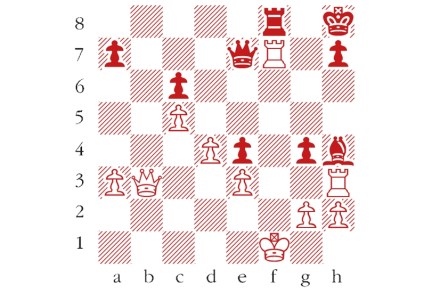
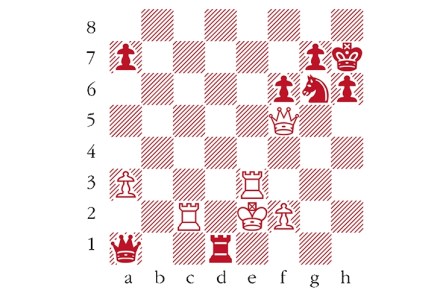
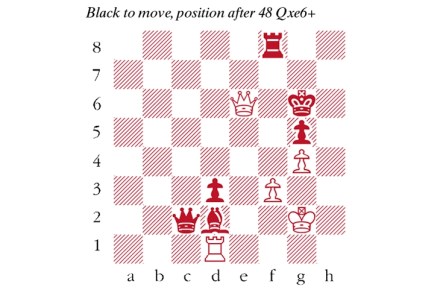
Black to play. Sjugirov–Carlsen, Chess24 Banter Blitz Semi Final. In this wild position, Carlsen’s next move put the result beyond doubt. What did he play? Answers to chess@spectator.co.uk by Monday 27 April. There is a prize of £20 for the first correct answer out of a hat. Please include a postal address and allow six
Old wine, new bottles

From our UK edition

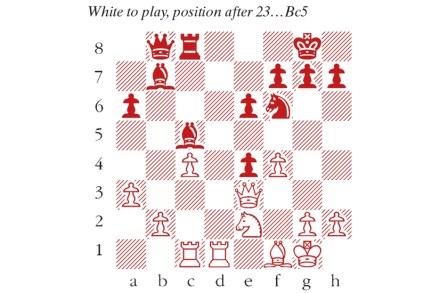
‘Old wine in new bottles’ must be the most protean idiom in the English language. I encountered it a few years ago, as a title to an article by the Romanian grandmaster Mihail Marin, who likes to lean upon his deep knowledge of the chess classics to elucidate games played in the modern era. (Recently

No. 600

From our UK edition

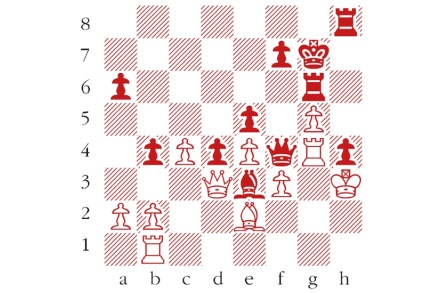
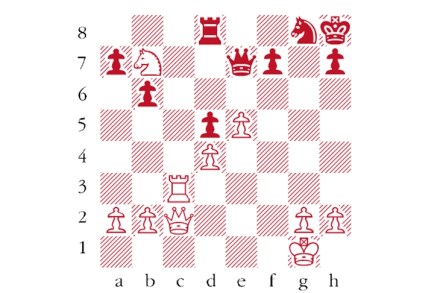
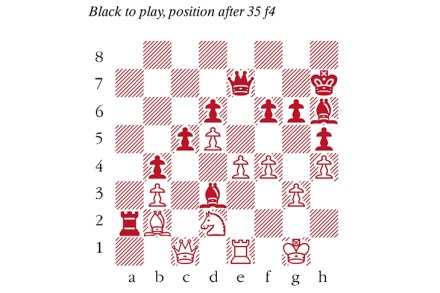
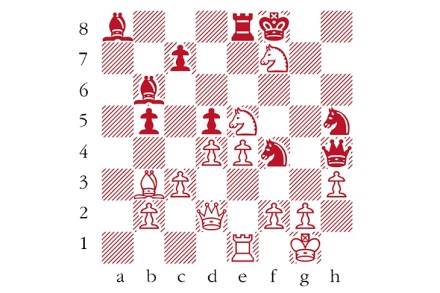
Black to play. Andrew Stone–Martin Jogstad, 4NCL Online, April 2020. The queen is trapped on f4, so 1…Rxg5 looks worth a try, as after 2 Rxf4 Bxf4 threatens Rg5-g3+. But in the diagram, Black found a far stronger move. Which one? Answers should be emailed to chess@spectator.co.uk by Monday 20 April. There is a prize

At your own risk

From our UK edition

If there were regulatory oversight of chess openings, some would come with a litany of disclaimers. ‘You may lose more than your initial gambit.’ ‘Possible side effects may include dizziness and nausea.’ ‘Use at your own risk.’ Nonetheless, such openings as the King’s Gambit, the Dragon Sicilian, or the Botvinnik Semi-Slav often enjoy a cult

No. 599

From our UK edition

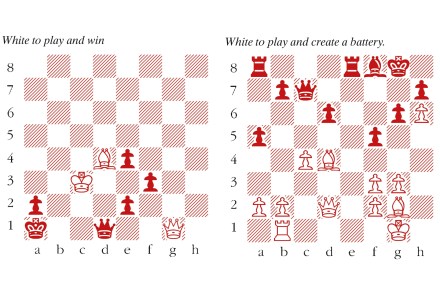
A position adapted from Vojtech Plat–Ravi Haria, Hull GM tournament, 2019. The d6-pawn is crucial here, but White needs a clever move to sweep aside the blockade. What is it? Email answers to chess@spectator.co.uk by Monday 13 April. There is a prize of £20 for the first correct answer out of a hat. Please allow

No. 598

From our UK edition

A variation from the game above. Although White is a pawn down, he can rustle up decisive counterplay with one accurate move. Which one? Answers should be emailed to chess@spectator.co.uk by Monday 6 April. There is a prize of £20 for the first correct answer out of a hat. Please include a postal address and

Half measures

From our UK edition

Would you slice a book in two? I learned of this peculiar practice in January, and I can’t fault its brutal pragmatism. Undeniably, half of War and Peace is more portable than the whole thing, and perhaps even less intimidating. When you finish the first chunk, you just swap it for the second. Books want

The slow puzzle movement

From our UK edition

I could list all manner of things I don’t try, because I know I won’t like them, like skydiving and revolting cocktails. But there’s another list of things I don’t try, knowing I might like them just a bit too much. ‘Puzzle Rush’ was, for some time, in the second category. Chess.com is one of

No. 597

From our UK edition

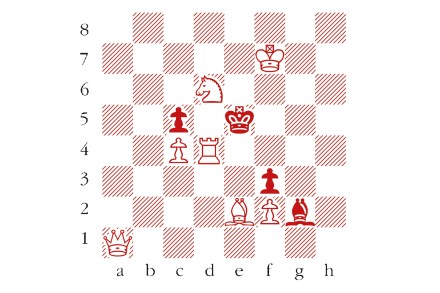
A puzzle used in the solving championship, composed by Vittorio de Barbieri in 1918. White must give mate in two moves, against any defence. It is tempting to use the long diagonal directly, but the solution is more subtle: look for a move without a direct threat. Answers (first move only) to chess@spectator.co.uk by Monday

Candidates goes ahead

From our UK edition

Coronavirus is causing chess events to fall like dominoes, with cancellations all over the world. But the Candidates tournament in Yekaterinburg, which selects a challenger for the World Championship, is still standing. The first round took place on Tuesday 17 March. It goes ahead without Teimour Radjabov, from Azerbaijan, whose request to postpone the event

No. 596

From our UK edition

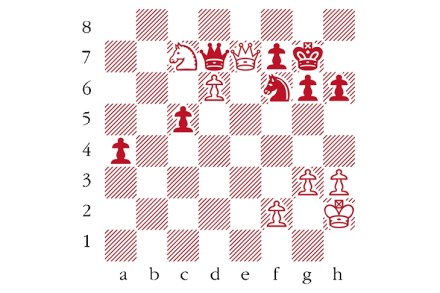
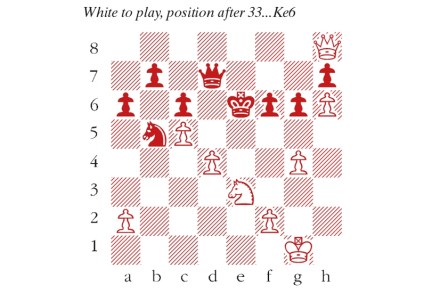
White to play. Shirov–Yuffa, Nutcracker Battle of the Generations, Moscow 2020. The rook on f7 is pinned, and 1 Rxf8+ Qxf8+ costs White the rook on h3. How did Shirov turn the tables? Answers should be emailed to chess@spectator.co.uk by Tuesday 24 March. There is a prize of £20 for the first correct answer out

Chess borders

From our UK edition

In the 1800s, several chess matches were conducted by telegraph. Modern technology ought to make long-distance matches easier than ever, but in fact competitive international chess is almost always played in person these days. That is partly because it is impossible to police computer-assisted cheating if the players play at home. But equally, the practical

No. 595

From our UK edition

Black to play. Tomashevsky–Lomasov, Nutcracker Battle of the Generations, Moscow 2020. A position with a surprising twist. Tomashevsky has just captured a bishop on b7. What is Black’s best response? Answers to ‘Chess’ at The Spectator by Tuesday 17 March or via email to victoria@-spectator.co.uk. There is a prize of £20 for the first correct

Peasants’ revolt

From our UK edition

The German word for pawn, ‘bauer’, can also be translated as peasant, or farmer. There are many spectacular games in which the pawns pick up their pitchforks and overrun the landed gentry. A historic example, played in 1834, is the game McDonnell–de La Bourdonnais, in which the Frenchman playing Black advanced his pawns to d2,

No. 594

From our UK edition

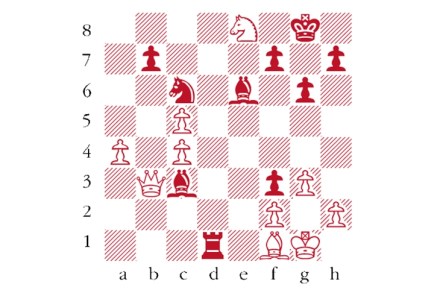
Black to play. Puranik–Sjugirov, another spectacular game played at the Aeroflot Open. Puranik was perhaps counting on 1…Rc1 2 Qa3 Bd2 3 Qb2! threatening mate on g7. Sjugirov found a much more powerful move. What was it? Answers to ‘Chess’ at The Spectator by Tuesday 10 March or via email to victoria@-spectator.co.uk. There is a

Increment and excrement

From our UK edition

The science-fiction writer Douglas Adams ridiculed our primitive species for considering digital watches to be ‘a pretty neat idea’. Digital chess clocks really are pretty neat, because they enable modern competitive games to be played with an ‘increment’. For each move played, you earn extra seconds to make the next one, a simple innovation which

No. 593

From our UK edition

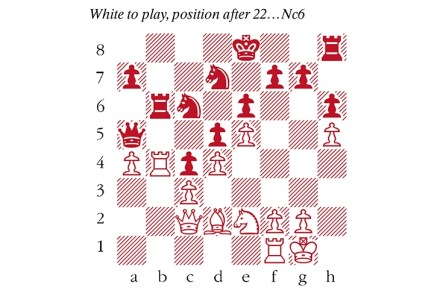
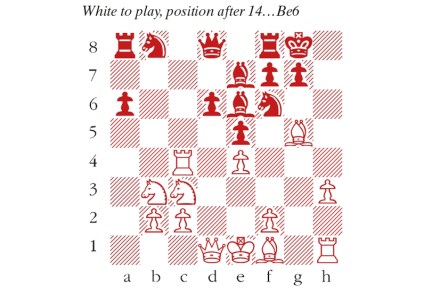
White to play, a variation from McShane–-Kamsky. In the game above, I was hoping to see 31…Qa5, as I had spotted an opportunity to turn the tables completely. What is White’s next move? Answers should be sent to ‘Chess’ at The Spectator by Tuesday 3 March or via email to victoria@spectator.-co.uk. There is a prize

Confidence tricks

From our UK edition

Three consecutive losses in a tournament is dryly termed ‘castling queenside’, in reference to the chess notation for that move (0-0-0). Carissa Yip went one worse, starting with four demoralising zeros at the Cairns Cup in St Louis this month. The 16-year-old American was the lowest ranked player in the elite women’s all-play-all tournament, so

No. 592

From our UK edition

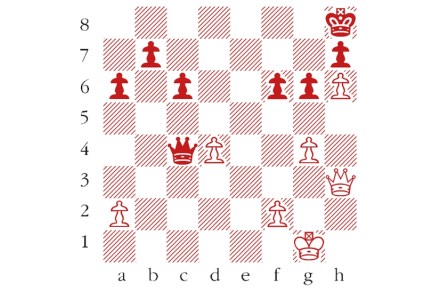
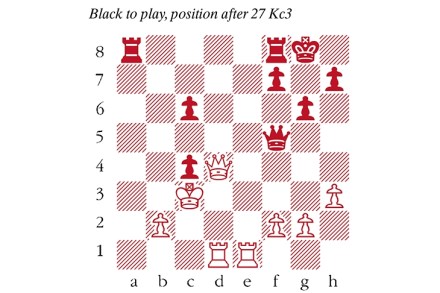
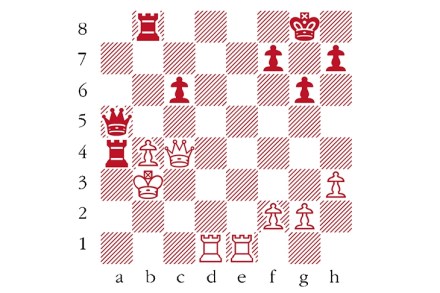
Black to play, Kateryna Lagno–Ju Wenjun, February 2020. Material is approximately balanced, but White’s king is in serious danger. What was Ju’s next move, which prompted immediate resignation? Answers should be sent to ‘Chess’ at The Spectator by Tuesday 25 February 2020 or via email to victoria@spectator.co.uk. There is a prize of £20 for the

Beasts of the board

From our UK edition

The Dutch artist Theo Jansen has a unique speciality. His ‘Strandbeest’ (beach animals) are kinetic sculptures, which he likes to set free upon a windswept beach. Fashioned from plastic tubes, bottles and the like, these imposing skeletons appear to ‘walk’ along the seafront with a gait at once laboured and graceful: a compelling synthesis of