Lucy Vickery

Spectator competition winners: pretentious wine writing

In Competition No. 3231, you were invited to supply an example of pretentious wine writing. Space is tight and the standard stellar, so to make way for the maximum number of winners I’ll pause only to commiserate with unlucky losers Brian Murdoch and Basil Ransome-Davies before handing over to those printed below, who earn £25 each. Keen to self-identify, this Australian merlot arrives sans label in a bottle refreshingly untainted by phallic thrust or feminine curve: a box, in fact. A wine with important things to say about the way we live now, it’s a living refutation of the prejudice which asserts that vinicultural outcomes stem from biochemical composition or geographical provenance.

Spectator competition winners: double acrostics

In Competition No. 3230, you were invited to supply a double acrostic poem, the first and last letters of each line, read vertically, spelling out The Spectator and New Statesman in either order. This fiendish technical challenge, designed to sweep away the cobwebs, drew an entry that was on the smallish side but varied and engaging for all that. Some took the topical route. Here’s Tracy Davidson, who turned her sights on the shenanigans at No. 10: Taste turkey crown, then trousers down! Have cheese and wine. It’s work, it’s fine… Other submissions worthy of honourable mentions came from Basil Ransome-Davies, Hugh King, Bob Trewin, Steven Smith and Josephine Boyle. But the winners, in a keenly fought contest, earn their authors £20 each.

Spectator competition winners: Harold Pinter’s Nativity

In Competition No. 3229, you were invited to provide the story of the Nativity retold in the style of a well-known author. Star performers, in a most excellent entry, included Janine Beacham’s W.S. Gilbert: Young Mary was the model of a good and humble Nazarene, So Gabriel requested of her, ‘be our human go-between, you will conceive a holy child, in keeping with theocracy, you and your husband Joseph will be sainthood’s aristocracy… Brian Murdoch and Nicholas Lee were also snapping at the winners’ heels, but after lengthy deliberation I have pleasure in awarding £25 each to the authors of the submissions printed below. A happy Christmas to you all. Do you remember an inn, Miranda? Do you remember an inn?

Spectator competition winners: Goldfinger for tots

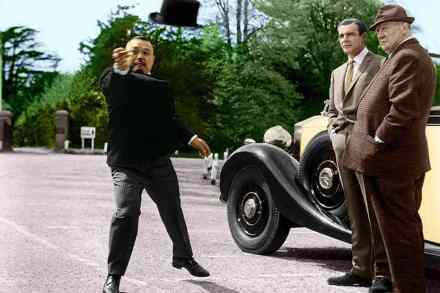
In Competition No. 3228, you were invited to provide a well-known extract from adult literature rewritten for inclusion in an anthology of children’s literature. It was Julie Burchill’s verdict, in this magazine, on Sally Rooney’s latest novel that prompted me to set this task: ‘Her writing is so blank,’ she wrote, ‘that in parts it reads like a children’s starter book — Janet and John Get Naked and Say Stuff About the Pointlessness of Existence.’ One of the many high points in a terrific entry was John MacRitchie’s recasting of Wolf Hall as Francesca Simon might have written it: ‘Horrid Henry wakes up one morning feeling really cross. Weepy Wolsey says he has to be nice to Catty Catherine.

Spectator competition winners: presidential mnemonics

In Competition No. 3227, you were invited to provide verses to help children remember the sequence of the last eight US presidents. The same challenge was set in these pages more than 30 years ago, and on that occasion the late Martin Fagg, a titan in the world of literary competitions, emerged victorious. Here’s a snippet from his winning entry, which takes us more or less to the point where yours start from: Gerald Ford — so superdumb He couldn’t walk straight chewing gum. Georgia’s Carter — folksy guy, First ‘Jimmy Who?’, then ‘Jimmy Why?’ Last, Reagan — filmic do-or-die man, And one-time husband of Jane Wyman.

Spectator competition winners: ‘O scintillate, bright orb celestial! Gleam’ (‘Twinkle, twinkle, Little Star’)

In Competition No. 3226, you were invited to rewrite, in pompous and prolix style, any well-known simple poem. The seed for this pleasingly popular challenge was a recasting of ‘Twinkle, Twinkle, Little Star’, attributed to John Raymond Carson, which begins: ‘Scintillate, scintillate, globule vivific…’ Star performers, in a most excellent and enjoyable entry, include AdrianFry’s Larkin: Jointly and severally, your begetters rudely discombobulate your psycho-social equilibrium.

Dominic Raab’s ‘Nightmare Song’

In Competition No. 3225, you were invited to provide a version of the Lord Chancellor’s ‘Nightmare Song’ from Iolanthe for any member of the British cabinet. Long Gilbertian lines mean there’s space only for me to applaud stellar contributions all round, but especially from D.A. Prince, Katie Mallett, Rachael Churchill, Janine Beacham, George Simmers and Bill Greenwell, who imagines what might rob the levelling--up secretary of his rest. Here’s a snippet: When you’re lying awake and it feels like a snake Is adjusting your weak moral compass Then you groove to ‘Le Freak’ as an elderly geek Throwing shapes in an Aberdeen rumpus… The winners below net £35 each.

Spectator competition winners: tourist misinformation

In Competition No. 3224, you were invited to submit snippets of misleading advice either for tourists visiting Britain or for British tourists travelling abroad. You normally embrace this challenge with mischievous relish but this time around the mood felt somewhat muted, perhaps not surprising under the circumstances. There were plenty of zingers all the same, and as usual those with a ring of plausibility worked best. Several of you submitted permutations on this one, from Janine Beacham: ‘It’s traditional to picnic on the lawns at Oxford University, so pack a basket.

Spectator competition winners: Beano acrostics

In Competition No. 3223, you were invited to supply an acrostic poem in which the first letter of each line, read vertically, spells DENNIS AND GNASHER. A varied and excellent entry, which celebrated with gusto the Beano’s spirit of naughtiness and irreverence, also reflected how it has evolved to accommodate modern sensibilities. As Stuart Jeffries observed recently in this magazine, Dennis’s ‘bottom these days is rarely sore since corporal punishment is frowned upon and so he cannot be given his weekly slippering…’ William McGonagall, a regular fixture in the postbag at the moment, popped up again, this time courtesy of Frank Upton: But he was nudged out by the winners, below, who snaffle £25 each.

Spectator competition winners: dystopian animal stories

In Competition No. 3222, you were invited to supply a dystopian short story that incorporates as many collective nouns for animals or birds as possible. Your appetite for dystopian imaginings may be somewhat limited at the moment — ‘How about setting something sweet and optimistic?’ write Frank Upton — and there was a dismal sameness about the entry this week. Notable exceptions included David Silverman’s Huxley-Orwell-Collins-Atwood mash-up, Nick Syrett’s Conan Doyle-inspired vignette, and the winners, below, who each pocket £25. After the human colonies had been obliterated, meetings of the Great Unkindness took place, of course, at Ravenna.

Spectator competition winners: odes on the Marble Arch Mound

In Competition No. 3221, you were invited to submit an ode on the Marble Arch Mound. The 25 metre-high artificial hillock, dubbed ‘Teletubby Hill’, has drawn near universal mockery and derision, leaving Westminster City Council red-faced and poorer to the tune of £6 million. But it inspired a funny, imaginative entry, with a strong whiff of Keats and Wordsworth. The Bard of Dundee, channelled by Brian Murdoch, speaks for many: When the Mound next to Marble Arch was first erected You had to pay to walk up it, which made many good folk dejected… Commendations go to Bob Trewin and George Simmers; the winners earn £25. I hail thee, Mound!

Spectator competition winners: Newly discovered short stories by poets

In Competition No. 3220, you were invited to supply a newly discovered short story by a well-known 19th- or 20th-century poet. In a distinguished entry, Nick MacKinnon’s tale — unearthed in Wendy Cope’s archive and featuring the poet herself and her alter ego Jake/Jason Strugnell — stood out; as did Brian Murdoch’s T.S. Eliot, showing his hard-boiled side. It was especially painful to separate winners from losers this week, but after much humming and hawing I have awarded £25 each to the six printed below. Honourable mentions go to runners-up Moray McGowan, R.M. Goddard, Joe Houlihan, Frank Upton and David Shields.

Clerihews on scientists

In Competition No. 3219, you were invited to supply clerihews on well-known scientists, past and present. The subject of the first ever clerihew — a pseudo-biographical quatrain, AABB, playful in tone, metrically clunky — which was written, for fun, in about 1890 by schoolboy E.C. Bentley (and illustrated by his chum G.K. Chesterton) was a scientist: Sir Humphry Davy Abominated gravy. He lived in the odium Of having discovered sodium. But it was all downhill from there, it seems. In his introduction to The Complete Clerihews of E.Clerihew Bentley, the poet Gavin Ewart contends that ‘nobody much except Bentley has ever written really good clerihews’. Even literary giant W.H. Auden, he says, doesn’t quite cut the mustard.

Spectator competitions winners: W.S. Gilbert makes a ham sandwich

In Competition No. 3218, you were invited to supply a recipe as it might have been written by the author of your choice. I tip my hat to Mark Crick’s Kafka’s Soup, which gave me the idea for this excellent challenge. In it you’ll find such delights as John Steinbeck’s mushroom risotto, Virginia Woolf’s clafoutis grand mère and cheese on toast à la Harold Pinter. Nick MacKinnon, Moray McGowan and G.M. Southgate were worthy runners-up in an exceptional field. The six who made the final cut earn £25 each. Take plump apples of beech-leaf green, ripened in a cuckoo-calling summer. Score a line around their bounteous girths.

Spectator competition winners: ‘Why must it always be tomato soup?’

In Competition No. 3217, you were invited to supply a poem that begins or ends with the line ‘Why must it always be tomato soup?’. In Katherine Mansfield’s short story ‘Bliss’, Eddie Warren, a poet, quotes this ‘incredibly beautiful line’ of poetry, which, it turns out, inspired an incredibly witty and well-made entry. Well done, all, and £20 to the winners. ‘Why must it always be tomato soup?’ said Andy. ‘It’s high time I made a change, I’ll start to paint a comprehensive group of every flavour in the Campbell’s range.

Spectator competition winners: Bridget Jones’s Bible

In Competition No. 3216, you were invited to retell a well-known biblical story in a secular style that would enhance its appeal to a contemporary audience. You might have drawn inspiration from ‘A Brief Statement of our Case’, a rendering of the Sermon of the Mount by the writer and critic Dwight Macdonald in the style of the New English Bible using only phrases that appear in that translation. (You can find it in the excellent Oxford Book of Parodies edited by John Gross.) Macdonald took a dim view of attempts to bring the Good Book as close as possible to ‘the life and language of the common man in our day’.

Spectator competition winners: In memoriam Geronimo the alpaca

In Competition No. 3215, you were -invited to supply a poem about Geronimo the alpaca. The camelid’s fate was finally settled just the day before the closing date for this challenge, and your entries have an added poignancy now that we know which way the dice rolled for poor old Geronimo. I admired Gareth Fitzpatrick’s touching clerihew and Chris O’Carroll’s Ogden Nash-inflected submission. Elsewhere, amid echoes of Manley Hopkins and Milton, was a nice spin on Gray’s ‘Elegy’ courtesy of Max Ross along with impressive contributions from J.C.H. Mounsey, Mike Morrison and Duncan Forbes. The winning entries, printed below, earn their authors £25.

Spectator competition winners: the Mona Lisa has her say

In Competition No. 3214, you were invited to choose a well-known painted portrait and let the subject speak for itself, in poetry or prose. Among those who seized the opportunity to have their say were pre-Raphaelite poster girl Lizzie Siddal, who fell dangerously ill while spending several months floating in a tin bath for Millais’s 1852 ‘Ophelia’; David Hockney’s Mr and Mrs Clark (and their cat Percy); Franz Hals’s ‘Laughing Cavalier’; and ‘Weeping Woman’ Dora Maar (‘All his portraits of me are lies. They’re Picassos. Not one is Dora Maar,’ she once told the American writer James Lord.

Spectator competition winners: Villanelles after Elizabeth Bishop

In Competition No. 3213 you were invited to submit a villanelle whose first line is: ‘The art of [insert gerund of choice here] isn’t hard to master…’ Floating in the slipstream of Elizabeth Bishop were some fine entries, including those by Bob Trewin and Philip Roe, who earn honourable mentions. The winners take £30. The art of winning isn’t hard to master; Your errors can escort you to success. There is no better teacher than disaster.  Triumphs will come your way a little faster When Nike offers you that first caress. The art of winning isn’t hard to master.  The skills you gain from failed attempts will last a Lifetime. You’ll be a loser less and less. There is no better teacher than disaster.

Spectator competition winners: Mrs Malaprop turns tour guide

In Competition No. 3212 you were invited to provide a spiel that a well-known character from the field of fact or fiction might give in their capacity as a tourist guide to a capital city or notable monument. In a hotly contested week, I was sorry not to have space for P.C. Peirse-Duncombe’s Tristram Shandy (‘To begin at the beginning of our tour — for to begin elsewhere might be a beginning though not the beginning and thence to a conclusion which we could not call The End, let us commence with this view of a tower, a mere 324 metres of lattice ironwork created by Gustave Eiffel…’) or David Silverman’s Buck Mulligan (‘Now behold Dublin Bay and its snotgreen, scrotumtightening sea. Thàlatta Thàlata!