Lloyd Evans

Lloyd Evans

Lloyd Evans is The Spectator's sketch-writer and theatre critic

Why Osborne saved Wallace and Gromit

From our UK edition

‘It is the determined policy of this government to keep Wallace and Gromit exactly where they are.’ So proclaimed George Osborne in his Budget speech yesterday, as he announced new tax credits for the video games, animation and televesion industries. But what prompted this? Had he been reading The Spectator? In an interview for the magazine a couple of months ago, Miles Bullough — head of broadcast at Aardman Animations, the studio that produces Wallace and Gromit — told Lloyd Evans of the competition that the British animation industry faces from other countries where the governments do offer subsidies, and the need for something similar here. Here's the full interview: Shaun the Sheep is at the meeting too.

A quiet PMQs, ahead of today’s main event

From our UK edition

It started like a bit of good old political knockabout. PMQs opened with a planted question from Mark Menzies (Con, Fylde) asking the PM about Britain’s sick-note culture. Cameron, looking suitably grave, declared that the fake-sniffle problem afflicts even senior management. Ed Miliband, he told us, had recently claimed he was too ill to attend a rally called by health workers. Three hours later he was seen heartily cheering at a football match having been driven to the ground in a Rolls Royce. ‘What was it,’ asked Cameron, ‘that first attracted the Labour leader to the multimillionaire owner of Hull football club?’ This prompted howls and jeers from every part of the house. Ed Miliband ignored them.

Knock-off Chekhov

From our UK edition

Calling all thespians. Roll up, you theatre folk. The Hampstead’s new show is a dramatic love-in you can’t afford to miss. Farewell to the Theatre introduces us to Harley Granville-Barker, one of the greatest playwrights of the early 20th century, as he enjoys a sabbatical in Massachusetts in 1916. Everything is languid, atmospheric and high-minded. Granville-Barker is busy giving lectures and watching American productions of Shakespeare while one of his chums, a literature professor, has had a bust-up with another academic. It’s a pity this off-stage conflict doesn’t test or expose Granville-Barker at all. He just lolls around the garden of a country house making cold, lofty speeches about the theatre and generally being a didactic pest.

Nick rises to Harriet’s limp challenge

From our UK edition

Basketball in America. Netball at PMQs. Harriet Harman, Labour’s venerable form-prefect, took her leader’s place today and lobbed a few rubbery missiles at the PM’s under-study, Nick Clegg.  It came down to arithmetic. Even if Hattie had stormed it at PMQs she had no hope of reviving her extinct career. But Clegg has it all to play for. He was ready for it too. Assured, combative and well-briefed, he filled his replies with fresh, punchy rhetoric. (Mind you, his match-fit performance should be credited to his party activists. Clegg must have spent the last 22 months fielding nasty questions from chippy wonks at Lib Dem constituency meetings.)  Hattie tried to upset him by accusing the coalition of ‘throwing women out of work.

Only the best

From our UK edition

Jackie Mason, the New York stand-up, looks very strange. It’s as if somebody shrank Tony Bennett and microwaved him for two hours. Mason is short, dark, troll-like, densely built, with shining bulbous lips and a twinkly expression of diabolical mischief. His hair gathers over his head in a wave of red-brown crinkliness. For his solo show he wears a sharp, grey business suit. He could be Rumpelstiltskin selling real estate. All his jokes are Jewish. And none of them are. He uses ‘the Jew’ as a catch-all tag for a fretful, brow-beaten loser. ‘The Gentile’ is his relaxed, prosperous and self-confident counterpart. The Jew wants to impress people by sporting designer outfits but everyone who talks to him spends all their time reading labels.

Labour’s PMQs strategy: the Super-Vulnerable Voter ploy

From our UK edition

A sombre and muted PMQs this week. Dame Joan Ruddock raised the issue of benefits and asked David Cameron if he was proud of his new reforms. Tory backbenchers cheered on the PM’s behalf. ‘Then would he look me in the eye,’ Dame Joan went on, ‘and tell me he’s proud to have removed all disability payments from a 10-year-old with cerebral palsy.’ This tactic — the Super-Vulnerable Voter ploy — is highly manipulative and highly reliable. But Dame Joan had forgotten something which Mr Cameron is unlikely to forget. Explaining his reform of the Disability Living Allowance he glared angrily at her. ‘As someone who has had a child with cerebral palsy I know how long it takes to fill in that form.

Bohemian bliss

From our UK edition

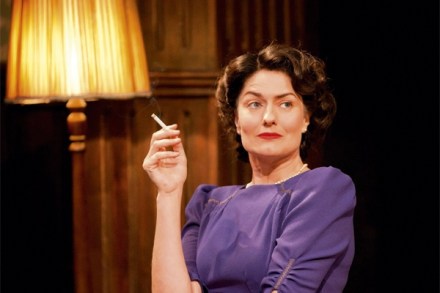
Strange sort of classic, Hay Fever. Written when Noël Coward was an unknown actor, it won him no converts among producers. He couldn’t get anyone to stage it. The title is weak and vague. The script lacks incident and action. And the humour is more subtle than audiences were used to. Only after Coward had broken through with his auntie-blasting Oedipal shocker, The Vortex, could he find managers ready to take a second look at his back catalogue. Hay Fever introduces us to a family of maddeningly self-indulgent Bohemians, the Blisses, whose home is swamped by a quartet of weekend guests. A gruesome house party follows. All the wrong people flirt with each other. A few hasty kisses and some overfrantic proposals ensue. Then everyone leaves and the Blisses carry on as before.

These NHS bouts are becoming more insipid by the week

From our UK edition

Health reforms again dominated PMQs today. That’s four weeks in a row. And the great debate, like a great sauce, has now been reduced to infinitesimal differences of flavouring. David Cameron repeated his claim that 8200 GP practices are implementing his policies. But, corrected Ed Miliband, that’s not because they love the reforms. It’s because they love their patients. He quoted a Tower Hamlets health commissioner who berated the PM for confusing reluctant acquiescence with whole-hearted endorsement. Fair enough. But this nicety won’t resonate beyond the tips of either men’s brogues. The rest of the bout was a repeat of last week’s effortful stalemate.

Retro rubbish

From our UK edition

Joy of joys. Huge, fat, inebriating doses of adulation have been squirted all over Josie Rourke’s first show as the châtelaine of the Donmar Warehouse. It’s a breakthrough production in many ways. You have to break through the treacly tides of critical approval. Then you have to break through the Donmar’s overenthusiastic heating system, which sends unwary play-goers to sleep long before their bedtimes. Finally you have to break through the script — The Recruiting Officer by George Farquhar, one of those neglected classics that everyone agrees is marvellous and no one bothers to read. Hardly surprising. We’re in Herefordshire in 1706.

Miliband snipes, Cameron deflects, Bercow bobs

From our UK edition

Let’s be honest. I shouldn’t say this but I can’t help it. I’m fed up. The NHS reform process has been dragging on for months, and still there’s no end in sight. Ed Miliband brought it up at PMQs for the third week running. The position remains the same. Miliband loves it. Cameron lives with it. The PM claimed that 8,200 GP practices are now practising his reforms and the Labour leader replied with a list of professional bodies — nurses, doctors, midwives, radiologists — who oppose them. And that’s exactly the trouble, for me, at least. If the issue were a race-horse some crazy campaigner would plunge beneath its thundering hooves. But it’s not. It’s a set of abbreviations.

Callas versus Callas

From our UK edition

As a human, Maria Callas was a diva. As a musician, she was a divinity. In the early Seventies she came down from Olympus to share her wisdom with us mortals and gave a series of open classes at the Julliard in New York. These seminars inspired Terrence McNally to create a full-scale portrait of opera’s greatest star. The play opens as a biting slice of character comedy as Callas inflicts her brand of ‘coaching’ (i.e., character assassination) on three wannabe soloists. It’s amazing. She’s back. The legend walks the earth again in all her gorgeous and contradictory coloration. She’s exacting, brilliant, charming, shy, arrogant, needy, fragile, evasive, fiery, frigid, miserable, exuberant. She’s magnificently paranoid and heroically lonely.

Marshmallow drama

From our UK edition

An outbreak of heritage theatre at the National. She Stoops to Conquer, written by Oliver Goldsmith in 1773, is the ultimate mistaken-identity caper. A rich suitor woos his bride-to-be while under the impression that the home of his future in-laws is an upmarket inn. Boobs and blunders multiply until love triumphs and harmony is restored. This is marshmallow drama. Nothing is required of the audience but immobility and the occasional polite chortle. Jamie Lloyd’s handsome production gets virtually everything right. The sets by Mark Thompson are five-star stunnahs. The 18th-century drawing room, with a baronial mantelpiece and a fireplace big enough to roast an ox, will please the most avid property-porn addict. The exterior forest scene is extraordinarily lovely.

In PMQs, Cameron plays for a draw on the NHS

From our UK edition

How much does it cost to change a light bulb? Three hundred quid, said David Cameron at PMQs today. Ed Miliband came to the House eager to pile more pressure on the PM and his unloved NHS restructuring plan. Cameron fought back by citing the health bungles Labour presided over while in office. Billions wasted on kaput computers. Hundreds of millions blown on phantom operations. And dead light bulbs that cost more to replace than a week’s holiday in Spain. Cameron’s tactics were better than in previous weeks. Rather than citing some lone wolf medic who supports his reforms he gave us a surprise announcement, albeit unsourced.

From Dewsbury to the stars

From our UK edition

What does superstardom look like? Well, nothing at all. Like anonymity personified. The seriously big celebs, the ones for whom walking down the street is either irksome or potentially hazardous, develop a knack for blending into the background. When Patrick Stewart arrives to meet me at the Young Vic, I scarcely notice him. The jacket and scarf are regulation winter­wear. His blue jeans are unexceptional, and his natty trilby is hoiked downwards to conceal his face. Only when he lifts the brim and reaches out to shake my hand does the sonorous magnitude of Sir Patrick coalesce, like magic, before me. He apologises for arriving 45 seconds late and sits down to sip coffee and eat a chocolate croissant. ‘Bingo,’ he begins. ‘Bingo is a lifelong obsession.

Royal regret

From our UK edition

Here he comes. Royalty’s favourite crackpot is back. Alan Bennett’s trusty drama, The Madness of George III, doesn’t really have a plot, just a pathology. The king is fine, he then goes barmy, he stays barmy for a bit, he gets bashed about by sadistic healers, then he recovers. It’s less a play and more a monologue amplified by a cast of glove puppets. Each supporting character is given, at most, two attributes. William Pitt drinks and keeps his counsel. The queen snorts and whinnies like a German weightlifter. Pious equerries proclaim their loyalty. Various doctors wheedle and pontificate. The Prince of Wales, an overdressed slob, waddles in and out sounding greedy. The aristocratic Lady Pembroke trundles around like a wax cleavage in a noose of pearls.

Miliband finds his niche, and leaves Cameron looking boorish

From our UK edition

Miliband is getting the measure of PMQs. Not with respect to Cameron. With respect to himself. He’s learned that his strongest register — sanctimony — will always ring hollow unless it’s attached to a powerful cause. And his gags don’t work. So he’s ditched his team of funny men and wise-crackers and turned to his political instincts instead. Miliband’s gut worked today. He began with a question which he knew Cameron couldn’t answer. Why hasn’t the government activated the laws requiring banks to name all employees earning over a million year? The PM answered by not answering. He performed a transparent switcheroo from the particular question to the general topic.

Model employer

From our UK edition

Miles Bullough of Wallace and Gromit creators Aardman Animations on the pressure to move jobs abroad Shaun the Sheep is at the meeting too. I walk into the office of Miles Bullough, head of broadcast at Aardman Animations, and find him sitting opposite a four-foot model of the ovine superstar. I’m offered a seat, and an assistant comes in with refreshments. Tea for me, coffee for Bullough. Nothing for Shaun, whose sombre and kindly face is poised inquisitively over my tape-recorder. ‘Shaun was the star of A Close Shave,’ Bullough tells me, ‘which was Nick Park’s third film. [It was also the third film to feature perhaps Aardman’s most famous characters, Wallace and Gromit.] That was a breakthrough moment for Aardman as a studio.

Borat with a beard

From our UK edition

Last November I suggested that Nicholas Hytner had gone mad. Now he confirms the diagnosis with a new satire by Nicholas Wright, Travelling Light, which is the most embarrassing and mindless blunder I’ve ever seen on a subsidised stage. Hytner’s November crime was to mount a retro sitcom about Stalin’s terror. Now he baits the Russians again with a sketch-show set among the Tsarist peasantry. Wright’s play, which Hytner directs, asks what might have happened if a crew of Jewish bumpkins had made a movie in 1900 using an early hand-cranked camera. We meet Motl Mendl, a jabbering numbskull armed with some film gear. He shoots five minutes of dreary footage in his shtetl and exhibits the results to his neighbours.

Miliband delivers for once, but Cameron’s left unharmed

From our UK edition

Incredible events in the chamber today. An absolute sensation at PMQS. For the first time since last summer, Ed Miliband got through the session without triggering talk of a leadership crisis. There was gloomy news aplenty to dwell on. Debts soaring; growth flat-lining; dole queues snaking back through blighted high streets and bankrupt business parks. The Labour leader chose to wallop Cameron with a well-prepared attack on the NHS. Quoting the prime minister’s vow, ‘to take our nurses and doctors with us’, he asked why the government had stopped listening. The prime minister’s reply was frivolous and desperate. He giggled and smirked like a teenager at the despatch box and tried to make light of his loathed policy.

Secret History

From our UK edition

A year late but worth the wait. Last year’s centenary of Terence Rattigan’s birth brought two excellent revivals of lesser-known works, Flare Path and Cause Célèbre, to London. But the playwright’s personal story remains a subject of uncertainty and guesswork. Giles Cole’s little gem of a play, The Art of Concealment, brings the dramatist’s secret history to life. Rattigan complained that to outsiders his success seemed quite effortless. In fact, his whole career was a fluke. After dropping out of Oxford without a degree, the young wannabe was given an ultimatum by his boorish, womanising father: succeed as a playwright or take a job in the Foreign Office. Rattigan failed. Every play he sent out came boomeranging back by return of post.