Lloyd Evans

Lloyd Evans

Lloyd Evans is The Spectator's sketch-writer and theatre critic

The lesson from today’s PMQs? Unemployment makes Cameron uncomfortable

From our UK edition

What’s the point of Ed Miliband? Does the Opposition leader have any purpose in life other than to provide ritual entertainment for the Tory wrecking crew at PMQs? Having spent the New Year listening to lethal attacks from his dearest supporters, Mr Miliband has now seen his leadership shrivel to a pair of policy statements which rival each other in desperation and barminess. The first, outlined by Liam Byrne this morning, is a fantasy tax on banking, ‘to create 100,000 jobs’. The second is Labour’s new position on the government’s austerity programme. This would baffle the dippiest and trippiest resident of Alice in Wonderland. We hate the cuts. We back the cuts. We oppose the cuts. We endorse the cuts. We accept the cuts.

Pessimism fiesta

From our UK edition

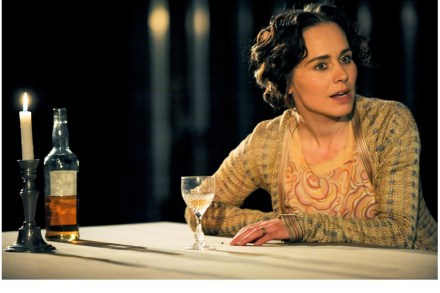
In early new year, we play-goers hunker down at home. We shiver and fast, we murmur and groan. We sweat off the excesses of the Christmas wassail. No impresario will launch a West End opening with the audience in recess. And into this brief void surges the Finborough Theatre in Earls Court. Fog is a brand-new play with an eccentric parenthood. Actor Toby Wharton and his mother’s lesbian lover, Tash Fairbanks, co-wrote an audition piece for young Toby’s Rada interview. When the distinguished panel of thesps heard the candidate perform his self-penned piece, they were so impressed that they commanded a full-length version. Here it is. The setting is a London housing estate where various no-hopers are scrabbling around trying to escape the scrapheap.

Ed Miliband lives to flop another day

From our UK edition

Miliband survives! That news should steady Labour nerves. For today at least. Their leader has the knack of turning near-certain defeat into absolutely-certain catastrophe, but he bumbled through PMQs this afternoon without suffering a serious setback. He has so little ground from which to attack the government that he had to lead on a niche issue. Rail fares. He asked the prime minister why the operating companies have managed to hike prices by 11 per cent on the busiest routes. Cameron: ‘Because of a power given to them by the last Labour government.’   With that lethally terse response the PM sat down. To his credit, Miliband wasn’t rattled.

The anti-academies club

From our UK edition

‘Anyone here from the Spectator?’ Last night a packed meeting at Downhills Primary in Haringey began with this ominous query from the chairman, Clive Boutle, who leads a local campaign against academies. Seated at the side of the hall I kept quiet. ‘No one?’ said Boutle, ‘Great, we’re safe.’ The meeting had attracted about 800 protesters and activists who oppose Michael Gove’s decision to force Downhills – a failing multi-ethnic school – to become an academy. ‘Michael Gove really hates us,’ continued Boutle, his manner urbane rather than menacing. ‘The government doesn’t like Haringey. There hasn’t been a Tory here since Noah was in short trousers. So we’re no risk.

Behind the scenes | 7 January 2012

From our UK edition

Frank Rich loved it. ‘Noises Off,’ said the great N’Yawk critic, ‘is, was and always will be the funniest play written in my lifetime.’ Michael Frayn conceived the idea of writing a farce about farce while watching one of his early plays from the wings. The frantic hustle-bustle of the actors behind the scenes was far funnier than anything on stage. So Frayn, the West End’s brainbox-in-residence, wrote an intricate play-within-a-play where he showcased every theatrical blunder imaginable. Just describing his amazing creation requires quite an investment of mental energy. So here goes. The inner play, Nothing On, is a traditional farce featuring three couples, each oblivious of the other two, arriving at an unoccupied mansion for a dirty weekend.

Meryl, Maggie and me

From our UK edition

Director Phyllida Lloyd on Meryl Streep’s eerily accurate portrayal of the Iron Lady Maybe she’s lost interest. Perhaps she’s just knackered. Almost certainly she’s had a bellyful of listening to herself talking about her film, The Iron Lady. When I meet Phyllida Lloyd, who also directed the 2008 smash hit, Mamma Mia, I’m expecting to find the sparkling quintessence of Hellenic romance and frivolity. But she’s all in black, and all on her own, in the sort of under-lit room where freed hostages are debriefed. On the table sits a bit of half-finished lunch in a cardboard box. Next to it there’s a litre bottle of diet lemonade. As soon as I arrive she scoots out to grab a loo-break.

Glorious farewell

From our UK edition

Michael Grandage says farewell to the Donmar with a farewell play. Richard II tells of a glorious but profligate king compelled to hand over his realm to a workmanlike, Steady Eddie successor. Entirely devoid of romantic interest, and with only teeny-weeny roles for women, this is not a show-stopping Shakespeare favourite. It appeals to specialists who note that it marks the Bard’s transition from medieval thriller-writer to dramatic philosopher. Grandage rises to this level and puts on a production that will satisfy the most ardent purist. Richard Kent’s ecclesiastical set is ravishing. The clever split-level arrangement of arches and tracery creates a versatile warren of spaces that are entirely practical but also fully evocative of religious awe.

Dollop of woe

From our UK edition

Juno and the Paycock is a slice of documentary realism from the earliest years of the Irish Free State. The skint Boyle family are living like a gang of hobbits in the leprotic ruins of a grand Dublin townhouse. The paint blisters and peels. Diseased mortar crumbles into scabby flakes. The plaster-work centrepiece on the ceiling is like a charred meringue the size of a cartwheel. It’s grim. Money’s tight, food is scarce. Everyone’s depressed. There’s no work. The pride of the family, young John Boyle, would probably give his right arm to get a job if it hadn’t been blown off during the civil war. Then a glimmer of hope. Cap’n Jack Boyle inherits a small fortune from a forgotten cousin. Hooray! The happy times are here. The Boyles go bananas.

Miliband crumples to a new low in PMQs

From our UK edition

Inept, useless, incompetent, maladroit, hopeless, clumsy, crap. With thesaurus-rifling regularity Ed Miliband comes to PMQs and delivers a performance which is inept, useless, incompetent, maladroit, hopeless, clumsy and crap. The only virtue the Labour leader has is consistency. He’s consistently worse than last week. In theory he should have scored some damage today. Unemployment is soaring. Growth seems grounded. Cabinet ‘partners’ scuffle in public whenever they get the chance, and Nick Clegg changes his mind as often as he changes his socks. And Miliband’s tactics had some merit too. By disinterring the PM’s New Year Statement from January 2011 he was able to open up the Coalition’s wounds and have some seasonal fun at their expense.

Geometry lesson

From our UK edition

It’s the usual old muddle. You take a Shakespeare classic and you time-travel it to an alien century, usually the present one, which has no connection with its historic setting. The plan, we’re always told, is to generate that supremely irrelevant attribute, ‘relevance’. Director Dominic Cooke has fast-forwarded The Comedy of Errors to modern London and I have to confess it works extremely well. For once, it’s OK to have wrong-era costumes and juggled chronologies and a visual setting that’s out of whack with the literary context because Cooke is simply mimicking Shakespeare. The Bard nicked a Roman favourite, The Menaechmi of Plautus, and dolled it up in the culture and lingo of London’s red-light district, Southwark.

Ed the arch-bungler lets Cameron off the ropes

From our UK edition

Ed Miliband had an open goal today. And he whacked it straight over the bar. Cameron was in trouble from the start. Having placated the rebel wing of his party with vague talk about ‘repatriating powers’ he is now expected to deliver. But he can’t make specific demands without weakening his hand at the negotiations so he has to talk in generalities. The Labour leader spotted this weakness and tried to exploit it with one of his lethally brief questions. ‘What powers would the Prime Minister repatriate?’ Cameron gave several answers without addressing the issue. His aim in the negotiations, he said, was to resolve the eurozone crisis, ‘and that means countries coming together and doing more things together.

Anatomy of an uprising

From our UK edition

They can’t even be bothered to think of a decent title. Good thing too. The Riots, at the Trike, is a rush job, a gripping and pacey attempt to analyse the disturbances that engulfed Britain last August. Cops, criminals and community leaders have been interviewed by Gillian Slovo, who fashioned their statements into a dramatic investigation. The riots might never have happened if more prudent tactics had been used at the start. The family of Mark Duggan, shot dead by police on 4 August, staged a demonstration outside Tottenham police station two days later. Police refused to speak to them, claiming that the independent investigation into Duggan’s death obliged them to remain tight-lipped. The family didn’t believe this.

Rowdy and raucous — but that’s how we like it

From our UK edition

It was vicious. It was frenetic. It was full of rage and class-hatred. It was great political sport. If you like a serious punch-up, the Commons at mid-day was the place to be. The viewing figures at home were boosted by the many millions of strikers who couldn’t quite make their local anti-cuts demo and were sitting out the revolution with a nice cup of tea and PMQs on the Parliament channel.  Ed Miliband started by claiming that the PM had been seen in private rubbing his hands, like Moriarty, and boasting that ‘the unions have walked into my trap’. Cameron, although not denying this, slammed the Labour leader for supporting a strike which had been called in the middle of the negotiations.

Historical knockabout

From our UK edition

It’s a palace drama with all the trimmings. Trevor Nunn’s new production, The Lion in Winter, plunges us into the court of Henry II and his spurned wife, Eleanor of Aquitaine, as they struggle to decide which of their three sons should inherit the throne. Eleanor, held prisoner in a deluxe royal fortress, has been granted leave to join the family at Christmas. ‘Thanks for letting me out,’ she says, on their first meeting. ‘It’s only for the holidays,’ jokes Henry. Clearly a king who locks his wife in the broom cupboard won’t pay much heed to her views on the succession. So there’s an emotional and dramatic illogicality here right from the start. And, right from the start, the playwright couldn’t give a stuff. Which helps.

Ed looks more dead than deadly

From our UK edition

If Roman Abramovich owned the Labour party, Ed Miliband would be toast by now. The floundering opposition leader gave the sort of inept, predictable and ill-organised performance at PMQs that would get a manager sacked in the Premiership. It scarcely helps that Mr Miliband seems to prepare for these sessions like a deluded psychic. He and his team of prophets at Labour HQ clearly believe they can foretell what the prime minster will say and how best to smash his answers to pieces. Referring to the rise in unemployment, Mr Miliband began by attacking the PM for scrapping the Future Jobs Fund in March. He boasted, rather weirdly, that ‘under Labour, youth unemployment never reached 1 million.

Sheer madness

From our UK edition

‘I’m off to see a play about a man who kills his dad,’ I told my five-year-old as I left the house. ‘Because he didn’t give him any ice-cream?’ he said. Mmm, I wondered, it’s possible that Hamlet harboured some childhood grudge against Claudius over a Mr Whippy refusal episode. But such meta-textual speculation is extremely perilous. And when I reached the Young Vic I realised just how grave the danger can be. Ian Rickson’s bumptious show sets the play in a loony bin. Banana yellow walls. Tannoy announcements. Leering staff wearing canvas security uniforms. Claudius, in a three-piece suit, setting chairs in a semi-circle for Hamlet, Gertrude and the court. Visually this is clear enough but narratively it creates disorder.

Blood-stained humour

From our UK edition

I take no pleasure in saying this but the director of the National Theatre, Nicholas Hytner, appears to have lost his sense of propriety. Or possibly the balance of his mind. He’s asked John Hodge (author of the Trainspotting screenplay) to write a sitcom about the Great Terror. And, rather than bunging it in the nearest skip, Mr Hytner has decided to direct it at the Cottesloe. The blood-stained gag-fest begins in 1938 when a secret policeman orders Russia’s leading satirist, Mikhail Bulgakov, to write a play about Stalin’s early life. Bulgakov meets the Great Leader and Teacher and finds him keen to assume personal control of the scriptwriting. So Bulgakov takes over Stalin’s day job, running Russia. This inspires many hilarities in the horror-slapstick genre.

The return of Ed Nauseam

From our UK edition

Hot summer, drippy autumn. Ed Miliband’s performances have declined steeply after the heady highs of July. He came to PMQs today badly needing to fight like a champion. Things looked rosy for him at the weekend. And they got better overnight. We learned that a pilot scheme to fast-track incoming tourists last summer had allowed Britain’s border controls to slip so far that visiting bombers and convicted sex-criminals were being greeted at Heathrow with high-fives, goody-bags and a slice of Theresa May’s blueberry tart. Or so it seemed. Worse still, a suspended UKBA official, Brodie Clark, had contradicted the Home Secretary’s statement and was threatening her with unfair dismissal proceedings. Useful stuff for Labour.

Splendid dereliction

From our UK edition

Long may it lie in ruins. Wilton’s Music Hall, in the East End of London, is a wondrous slice of Victoriana which exploits its failing grandeur to the max. All visitors are implored to find a couple of quid for the restoration effort. But decay and dilapidation are the best things about it. Every wrinkled façade, every petal of tarnished gilding, is like a tear shed for an age that will never return. It’s wonderful. The administrators have realised this, too. Ruination is their main selling point. The cover of the brochure shows a heart-rending image of the terracotta entrance flaking and declining beautifully. If the renovation campaign were to find enough loot for a proper facelift, the place would go bust overnight. No one wants a squeaky-clean music hall.

Debate report: Britain must cut its overseas aid budget now

From our UK edition

Last night, as we mentioned yesterday and the day before, was The Spectator's debate on whether Britain should cut its overseas aid budget. Here, for CoffeeHousers who couldn't attend the event, is Lloyd Evans' review of it:   Chair: Rod Liddle Proposing: Ian Birrell, Richard Dowden, Stephen Glover Opposing: Prof Paul Collier, Alan Duncan MP, Richard Miller   Ian Birrell, former speechwriter for David Cameron, proposed the motion by likening aid programmes to helping child beggars in the third world. The gift, though well-intentioned, keeps children out of school, encourages more kids to start begging and condemns entire families to penury. If aid worked, Birrell would happily treble it. But it distorts economies and humiliates the recipients.