Lionel Shriver

Lionel Shriver

Lionel Shriver is a columnist at The Spectator and author of We Need to Talk About Kevin, among other books.

Heritable guilt is in vogue

I made a poor excuse for a Presbyterian even as a kid. I resented religious indoctrination every precious school-free Sunday. Yet despite my apostatic nature, any number of biblical tenets with broad secular application have become touchstones. Of particular value during our post-Floydian festival of flagellation is Ezekiel 18: ‘The son shall not bear the iniquity of the father, neither shall the father bear the iniquity of the son: the righteousness of the righteous shall be upon him, and the wickedness of the wicked shall be upon him.’ Ergo, while we can’t take credit for our forebears’ virtues and achievements, at least whatever horrors our ancestors got up to is not our fault.
The truth about ‘affirmative action’

I’ve never cared for the expression ‘affirmative action’, which puts a positive spin on a negative practice: naked, institutionalised racial discrimination – that is, real ‘systemic racism’, which was initiated in the United States long before the expression came into fashion. After all, following the Civil War, the 13th, 14th and 15th amendments to the constitution were expressly added to establish equality under to law for Americans of all races, and a raft of Congressional civil rights legislation has since reinforced this colour-blind principle. Perhaps I risk sounding ungrateful.

The unspeakable truth about housing

Earlier this year I was a panellist for Any Questions, and a young man in the audience asked what could possibly be done to make it easier for Britons his age to buy currently unaffordable property. I said what none of my fellow panellists was foolish enough to venture on the radio: scarcity always raises prices, and the UK’s housing shortage is overwhelmingly caused by high rates of immigration. Reduce newcomers, ease the problem. I’ve appeared in enough public forums to read the room. A sudden pin-drop silence followed by murmurous resettling in chairs conveyed shock, then palpable unease. Clearly I had just broken a fierce social taboo. Once upon a time, taboo-breaking entailed saying something incorrect, tasteless or immoral.

The weather isn’t ‘climate change’

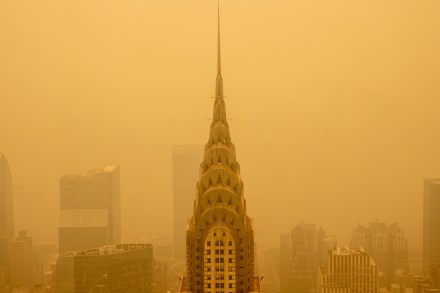
I was in New York while the smoke from Canadian wildfires filtered over the city for three days last week, and I took a guilty pleasure in the aesthetic thrill. Midday, the light assumed the roseate hue of sunset. A cloudless sky appeared overcast, and the ghostly sun was so occluded one could look straight at it. Honestly, the atmosphere of anomaly was electrifying. New Yorkers advertised their sense of snow-day exceptionalism by driving even more atrociously than usual. Despite hysterical health warnings to batten ourselves in our homes with closed windows, I played three daily hours of tennis throughout the respiratory emergency – though it was nice to have a ready excuse when I botched another cross-court forehand.

The case against Ulez – by a cyclist

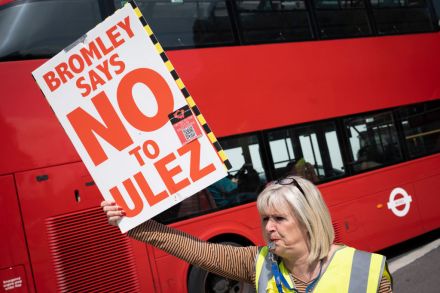
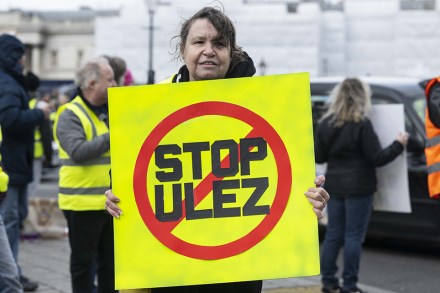
Whether you’re more afraid of the forces of order or the forces of chaos is generally a matter of disposition. A natural anti-authoritarian who despises being told what to do – especially when told to do something stupid – I’m more horrified by excesses of order. Granted, my greater fear of the state may simply betray that I’ve largely lived in an orderly western world, and after a few dog-eat-dog nights of mayhem and carnage I might change my tune. Nevertheless, during the Covid lockdowns, for example, I was less distressed by the odd neighbour who dared to invite a friend to tea than by most Britons’ blind, bovine compliance with an economically self-destructive, socially disastrous, politically despotic and medically idiotic regime.

The myths around immigration

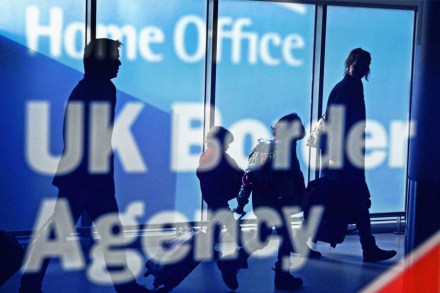
After the media bigged up the expiration of America’s Covid-era Title 42, which enabled the US to block entries into the country, the anticipated stampede across the southern border doesn’t seem to have occurred. No worries, then? Behold the miracle of social adaptation. Before the handy illegal immigrant ejection seat was retired last week, illegal entries from Mexico had risen to 11,000 per day – if sustained, more than four million per year, and that’s after 2.3 million southern border apprehensions last year. The record-breaking influx had already become a stampede, and apparently people can get used to anything.

I’m a sucker for Tucker Carlson

I was asked on Tucker Carlson Tonight only once, while in New York about two years ago, and I turned the invitation from America’s most popular cable news commentator down. Did I worry that while discussing my previous Spectator column, I might put my foot in it? The subject of immigration is always a minefield. No, I believed computer modelling of the astonishingly high number of illegal immigrants really living in the US had attracted far too little press, and a sympathetic host would have given these staggering figures a wider airing.

Sam Leith, Lionel Shriver and Angus Colwell

23 min listen

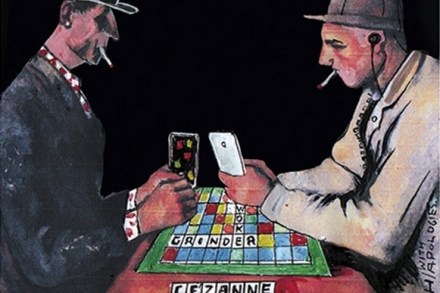
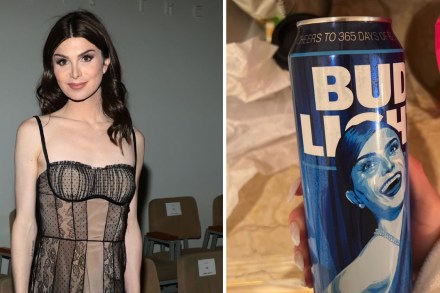
This week: Sam Leith explains how he’s been keeping up friendships by playing online scrabble (00:55), Lionel Shriver questions Nike and Bud Light's recent marketing strategy (06:52) and Angus Colwell reads his review of the V&A Dundee’s tartan exhibition (15:24).

How to lose sales and alienate people

In some quarters, American enterprise is alive and well. Established in 1929 to promote consumer protection, the conservative non-profit Consumers’ Research is launching the free service ‘Woke Alerts’, which texts subscribers news of companies ‘putting progressive activists and their dangerous agendas ahead of customers’. Using iconography reminiscent of adverts for those high-frequency plug-ins that ward off mice, the parent website urges shoppers tired of corporations latching onto fashionable left-wing causes to dramatise their displeasure through product boycotts. The idea is a bit goofy. Yet the app could appeal to a far more than niche market. Only 8 per cent of the US public self-identifies as far left.

Why Democrats want Trump

Manhattan district attorney Alvin Bragg’s indictment of an even more prominent fat man seems a big win for Donald Trump, regardless of how the case is decided. If convicted, Trump is a martyr, managing to portray himself once more as a persecuted Washington outsider, a status that’s quite a feat for a politician to retain after setting up shop in the White House for four years. If found not guilty, Trump is exonerated, a contrived case likely to rely on tentative legal reasoning exposed as an overtly partisan manhunt. After all, in a Quinnipiac poll last week, a plurality of Americans (42 per cent) considered the charges in New York either ‘not too serious’ (16 per cent) or ‘not serious at all’ (26 per cent).

The high price of low interest rates

You’ll recall that I’ve railed for years against zero interest rates, which transplanted a cancerous marrow into the very bones of the financial system. Originally a novel emergency expedience to shore up a fiscal skeleton riddled with osteoporosis in 2008, effectively free money was allowed to persist for an improbable 14 years. Not to forget, bank rates also plummeted in 2002, barely recuperating to a modest 5 per cent at last when the spectre of the end of the world shoved rates smack down to nothing. Brief expedience slid to long-term crutch. So we’ve really had two decades of central banks setting up lemonade stands on the corner: cups brimming with millions for five cents. Europe got downright dystopian with negative interest rates.

Despotic social controls cost lives

Look, I realise you don’t want to read this column. I’m unenthusiastic about writing it. For most of us, any mention of Covid triggers a deep aversion and desperation to flee. Even recalling the uncanny tranquillity of the first you-know-what – the blue skies, the blazing sunshine, the serene silence in once-bustling London – makes me wince. Between the slow drip-feed of the Telegraph’s Lockdown Files and Rishi Sunak’s dubious Protocol breakthrough, most UK news consumers would have greeted last week’s headlines with a double-whammy of ‘Oh, no, not that again!’ – since the only subject that rivals Covid’s revulsion quotient for Brits is Northern Ireland. Waves of variants came and went, oblivious of state diktats.

My list of banned words

North America’s Ecology and Evolutionary Biology Language Project has released yet another list of Bad Say. Scientists are to swap ‘male’ and ‘female’ for ‘sperm-producing’ and ‘egg-producing’ – as presumably most biologists are stuck in remedial learning and haven’t yet got to the chapter explaining that humans come in only two sexes. But rather than opt for another chortle at these petty rhetorical tyrants’ expense, I’m regarding turnabout as fair play. Behold, a by no means complete list of the expressions I’m banning right back. ‘Black and brown bodies’ – a bizarrely dehumanising reduction of people to biomass, often disconcertingly employed by the very folks in possession of said black and brown bodies.

Why publishers are such cowards

After publishing 17 books, I’m no stranger to the publicity campaign. In my no-name days, my publicist would purr that my novel’s release would be ‘review-driven’ – which decodes: ‘We don’t plan to spend a sou on your doomed, inconsequential book.’ By contrast, as we’ve seen writ large with Prince Harry’s Spare, your volume can be cast upon the public waters as not a mere object but an event. The intention is to convince book-buyers that unless they snap up a copy sharpish they’ll be caught up short at cocktail parties.

Matthew Parris, Lionel Shriver and Gus Carter

24 min listen

On this week’s episode, Matthew Parris wonders what ‘winning’ in Ukraine really means (00:52), Lionel Shriver says she’s fighting her own war against words (08:43), and Gus Carter wonders whether it’s a good idea to reintroduce Bison into Britain (18:28).

The war against words

The University of Washington technology department has banned the word ‘housekeeping’. Not because the ‘problematic’ noun is overtly ist (ableist, sexist, racist, ageist…; by now, you must know the ist list). No, because it ‘feels gendered’. Would that they’d simply banned housekeeping. I hate scrubbing the shower. This month, the University of Southern California’s School of Social Work proscribed the word ‘field’. ‘Field work’ might have unpleasant connotations for the descendants of slaves. (Sorry! Descendants of ‘enslaved people’. Nouns that reference persons – like, you know, ‘doctor’ – are reductive and dehumanising.) A ‘field of study’ is henceforth a ‘practicum’.

Lionel Shriver, Theo Hobson and John Maier

25 min listen

This week: Lionel Shriver asks whether we are kidding ourselves over Ukraine (00:56), Theo Hobson discusses Martin Luther King and the demise of liberal Protestantism (09:28), and John Maier reads his review of Quentin Tarantino's new book Cinema Speculation (18:11). Produced and presented by Oscar Edmondson.

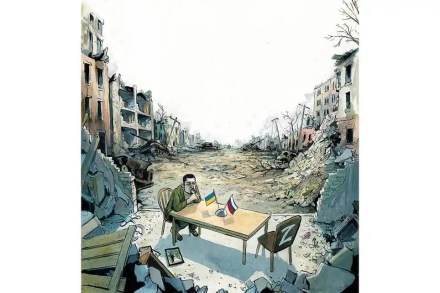
Are we kidding ourselves over Ukraine?

Optimism can be surprisingly hilarious. In my last novel, two spouses agree to quit the planet once they’ve both turned 80, and the book explores a dozen possible outcomes of their pact. No chapter made me chuckle at the keyboard more than ‘Once Upon a Time in Lambeth’ – in which the couple don’t kill themselves but live to 110 in perfect health because they eat their vegetables. Young people flock to their table for advice, as my protagonists grow only wiser and more physically riveting in old age. Meanwhile, modern monetary theory makes everything free. Limitless energy is derived from carbon dioxide. A new portmanteau religion, ‘Jeslam’, eliminates Islamist terrorism. The reader gradually twigs that this happy-clappy scenario is a piss-take.

Most-read 2022: Why are so few Americans willing to defend their country?

We’re finishing the year by republishing our ten most popular articles from 2022. Here’s number seven: Lionel Shriver’s piece from March on fighting for your country. For many of us war voyeurs watching the news with a glass of sherry, admiration of the little-engine-that-could Ukrainian fighters is underwritten by unease. As families escape to safety, plenty of feisty Ukrainians are remaining behind to battle a far more powerful aggressor, and they’re not all men, either. The question nags, then: in the same circumstances, would we stick around to defend our homelands, or would we cut our losses and get out? Earlier this month, that’s precisely what a Quinnipiac poll asked Americans. Some 7 per cent answered ‘Don’t know’.