Kate Chisholm

Democracy on trial

At the debate on parliamentary democracy recorded last week in Portcullis House for The Forum (broadcast on Sunday on the World Service) as part of Parliament Week, we in the audience were asked whether we thought democratic values were universal or whether they applied differently in different places. Most people voted for them being universal but I found myself in a dilemma. What does the question mean? Human rights must surely be everywhere the same. But does this mean that democracy should be the same wherever you are around the world? Do villagers living deep within the Swat Valley have the same democratic needs as shoppers on the Ku’Damm in Berlin?

After the tyrants

What’s the best way for a dictator to fall, wondered Owen Bennett-Jones on Saturday night’s Archive on 4 (Radio 4, produced by Simon Watts). Is sending the deposed dictator into exile better for the recovery of the abused nation than execution? Would a domestic trial lead more quickly to justice than an international tribunal? These are tricky questions. Yet the recent fall of dictatorships in Tunisia, Egypt and Libya requires us to find some way of understanding how these countries might find a way of living peaceably with the reality of their violent pasts. Gaddafi’s rule of terror in Libya ended with his brutal death, but very few dictatorships are brought to an end in this bloody way, as Bennett-Jones reminded us.

Great expectations | 29 October 2011

‘We chose to believe things that could not be true,’ says Velma Hart, the American finance officer who famously confronted President Obama at a town hall meeting in Washington DC and told him straight that she was tired of constantly having to defend him against his former supporters among the middle classes. She voted for Obama, believing that with him as President real change was possible in America, but since then she has become less sure of his ability to make any difference. Having just lost her job, her fears for the future have been realised. Would she vote for Obama again? Hart was talking to Gary Younge, who reported on the Obama election campaign for the Guardian.

Care in the community

‘We all need to rendezvous every week. It keeps us all as a community,’ said Jane Copsey on the In Touch anniversary programme (produced by Cheryl Gabriel). The Radio 4 magazine for the blind and partially sighted has been around for 50 years dispensing advice and encouragement, hope and cheer. Nowadays it’s been cut to just 20 minutes, but at least it’s still in its Tuesday-evening slot, where it’s been scheduled for decades. Copsey was arguing for the survival of the programme, even though there’s now an online equivalent, called Ouch!

Smart operator

Back in the Fifties, it was possible for a single TV sitcom to capture 92 per cent of the small-screen audience; 92 per cent? It sounds astonishing to us now. The idea of so many people watching the very same comic gags at the very same time. Those fabled water-cooler, coffee-machine chats about what was ‘on’ last night no longer happen. Offices have lost their communal buzz, and are often as dead quiet now as a funeral parlour. No more telephone calls, as everyone is texting. No need to talk to anyone, you just email. Nothing to talk about, because we’re all listening, watching, playing something different. No wonder we have a coalition government. There’s just no chance for any single party to be heard, or seen, by sufficient numbers to have any impact.

Eastern promise | 1 October 2011

Sad to say that none of the ex-pats who were interviewed in India for Home from Home (Radio 4, Friday) talked about missing the BBC. Their removal to the subcontinent from the UK might have left them with a longing for a pint of Guinness, but not a word about Jazzer and the Grundys, Nicky Campbell or even John Humphrys. It was as if British radio had never touched their lives, in spite of growing up here. Hardeep Singh Kohli, the turban-wearing broadcaster with a broad Glasgow accent whose taste for highly spiced food derives from his family ancestry in the Punjab, went in search of British Indians who have gone back to live in India — PIOs as they are known there (People of Indian Origin).

Musical chairs

It’s such a relief to come back from a trip to America, to switch on the first available radio and fall into Francine Stock talking about Nicholas Ray on The Film Programme. Americans have lost the radio habit. You won’t find sets in any, let alone every, room in the house. No one I know there listens to radio except in the car, where all you can find are music stations devoted to just one type of music, country, Cajun or classical, or the terrifying fire-and-brimstone lectures of the evangelist broadcasters. In the run-up to the presidential election, they’ll be joined by a flurry of far-right ear-bashers, dedicated to rustling up support for the Tea Party among the freeway cruisers. No nightly sequence of live concerts. No programmes like Analysis or In Touch.

Novel experiment

Having argued last week that it takes time (maybe a couple of generations) before fiction can be appropriately applied to traumatic historical events along comes a Radio 4 season celebrating the work of the Russian writer and ‘heroic war journalist’ Vasily Grossman, who wasted no time in translating his bitter experiences into a series of novels. Grossman witnessed the struggle for Stalingrad in the winter of 1942–3 as the war correspondent of the Red Star newspaper. He followed the Nazis’ retreat from Russian soil, and was one of the first reporters to enter and then write about the extermination camps at Treblinka and Auschwitz.

Conversation piece | 17 September 2011

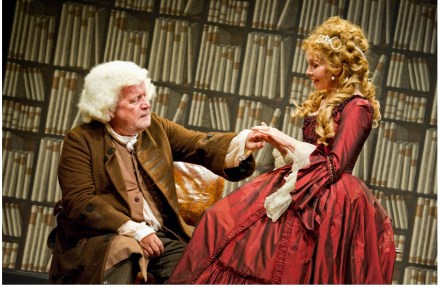
Dr Johnson would be thrilled. His name up there in lights in the West End. He craved theatrical fame, and was cruelly disappointed that his only play, an exotic tragedy set in Constantinople, had just nine performances in 1749. But here at the Arts Theatre on Great Newport Street (London WC2, until 24 September) he is brought to vivid dramatic life by Ian Redford. In A Dish of Tea with Dr Johnson, the rough-mannered and ill-figured dictionary-maker also finds himself on stage with a glamorous woman, Trudie Styler, who as Hester Thrale even pecks his cheek. Did they ever kiss? Who knows? Their friendship has puzzled scholars for 200 years. Adapted from James Boswell’s biography, a book that is unusual in the richness of its verbatim conversations, the play is rich in apt quotation.

One day

‘History is not a dull subject,’ warned Caryl Phillips, the novelist, at the end of his 9/11 Letter. ‘It’s a vital, contested narrative, peopled with witnesses to events which touch both head and heart. It’s the most important school subject because not remembering is the beginning of madness.’ Perhaps he should have said ‘not remembering correctly’ in this week of commemoration of the events of ten years ago. Phillips’s letter was the most powerful of the five that were specially written for Radio 4’s Book of the Week (and produced by Julian May and Beaty Rubens).

The bees’ knees

‘It makes you happy that something like that exists,’ says Devente, a young beekeeper from Hackney as he emerges from his protective suit in a halo of smoke, having just checked that all is well in the colony. ‘It makes you happy that something like that exists,’ says Devente, a young beekeeper from Hackney as he emerges from his protective suit in a halo of smoke, having just checked that all is well in the colony. You could almost hear the puffs of smoke. ‘Once you understand the bee,’ he says, ‘then your perspective changes from swatting to staying still.’ Devente has been keeping bees for a while now, with the help of a social enterprise foundation called the Golden Company.

Personal best

Two programmes, two very different worlds, and all in the space of a Sunday afternoon. Imogen Stubbs gave us a Radio 4 moment when she used the network to campaign against those personal statement forms which young students have to write as part of their applications to colleges and universities. The instruction booklet (or guidance for parents) obtainable from Ucas (the centralised organisation otherwise known as Universities and Colleges Admissions Service) suggests that this is an opportunity for the prospective candidate ‘to demonstrate their enthusiasm and commitment and, above all, ensure that they stand out from the crowd’. Orwell would have been horrified by the use of that meaningless cliché. How can they all ‘stand out’?

Bearing witness

Even the great Alan Bennett sounded out of synch with the times as he read from his new short story ‘The Shielding of Mrs Forbes’ for this week’s Book at Bedtime (Radio 4). Even the great Alan Bennett sounded out of synch with the times as he read from his new short story ‘The Shielding of Mrs Forbes’ for this week’s Book at Bedtime (Radio 4). His peculiarly English brand of wit, mordant, slightly sinister, a touch supercilious, grated on the nerves. No one else on radio can put together a character with such economy and yet such excruciating vividness. But in the light of the events of last week his characters sounded a bit jaded, a little worn out, too caricatured to gather us in as listeners.

Kate Chisholm on The Reunion

There was a scary moment on last Sunday’s The Reunion when we heard that the derivatives market has ‘exploded’ since the collapse of Barings in 1995. Banking has become more, not less, dependent on the kinds of gambling on future (i.e., virtual) values that brought down Britain’s oldest merchant bank. When Barings fell, just over $1 billion went down the drain. Now, the derivatives market is worth $1.4 quadrillion — a figure that becomes more and more meaningless the bigger it gets, wafting through the ether like a cloud of poisonous gas.

Sporting Witness

It took just ten minutes for the secret of Nadia Comaneci’s extraordinary success at the 1976 Olympic Games in Montreal to be revealed. Comaneci achieved the first-ever perfect score when she was given a clean sweep of 10s from all the judges for her performance on the uneven bars. ‘What I remember is the dead silence in the stadium,’ recalls Vera Atkinson, a champion gymnast herself who was reporting on the Games for Bulgarian national television. ‘She flew between the bars, performing so many different things with the human body, before landing perfectly still...Yet the routine took barely 30 seconds.

Spreading the word | 30 July 2011

Sometimes the simplest ideas are the best. Take Dolly Parton’s Imagination Library. She wanted ‘to do something nice for the folks in my home county [Tennessee]. I wasn’t thinking on a larger scale,’ she says. But her idea to send a free book every month to every child enrolled in her scheme from the moment of birth right up until the age of five has now taken off and is reaching children across Australia, America and Canada. Four years ago she arrived in the UK to launch it in Rotherham, south Yorkshire, at the invitation of the local council. From sending out just 2,300 books each month when the scheme began 12 years ago, 700,000 children are now part of Dolly’s library.

The divine spark

‘You have to live. ‘You have to live. You have to find a way to live,’ a Japanese woman told the 15 elderly people who were trapped on the third floor of a concrete building in one of the small towns worst affected by the natural disaster in March. She had gathered them together after the earthquake, and in fear of a tsunami she kept urging them to struggle up the stairs to the third floor: ‘Move up. Move up.’ Then suddenly she saw that the telegraph poles were ‘popping’ out of the ground and a sea of black water was surging towards them. ‘Am I going to die now?’ she thought.

Pursuit of excellence | 16 July 2011

Amid all the chattering about hacking it’s a relief to discover that some things don’t change and yet still, surprisingly in these tainted times, proffer sterling quality. Amid all the chattering about hacking it’s a relief to discover that some things don’t change and yet still, surprisingly in these tainted times, proffer sterling quality. Saturday mornings on Radio 3, for instance, which this week gave us a deconstructed version of Bizet’s L’Arlésienne (or The Girl from Arles) on CD Review. I’ve been listening to this staple of the Third’s diet since long before CDs were even invented. Yet on Saturday somehow I heard it afresh and realised just how much my musical education has depended on this single 45-minute programme.

Where have all the flowers gone?

My favourite fact of the week is to have discovered that in the UK there are 2,500 species of eyebright, 2,500 different varieties of that dainty, slender-stemmed flower, with its bright white trumpet. It’s so small and yet always stands out, demanding to be noticed. You can tell it’s a plant that’s determined to survive no matter how much we might try to stamp it out. At this time of year you can see them, tiny but dazzling dots of white, on grassy roundabouts and roadside verges and in your own lawn, if you’re lucky.

The inspirational Suu Kyi

‘To be speaking to you through the BBC has a very special meaning for me. ‘To be speaking to you through the BBC has a very special meaning for me. It means that once again I am officially a free person,’ says Aung San Suu Kyi at the beginning of the first of her Reith Lectures on Radio 4 (Tuesday mornings). That connection between the BBC and the powerful, emotive word ‘freedom’, made by one of the most influential figures of the 21st century, has finally broken through to the politicians who are deciding on the fate of the World Service.