Kate Andrews

Kate Andrews

Kate Andrews is deputy editor of The Spectator’s World edition.

Is a boost to defence spending feasible?

From our UK edition

15 min listen

As Rishi Sunak finalises his Spring Statement, how can he resolve the trilemma of an ageing society, no peace dividend and low growth? Meanwhile, there is a broad Tory desire for increased defence spending amid the Russia Ukraine invasion. But from where will this money be taken? 'This isn't an easy time for Rishi. If you look at what it is costing us just to service the debt, it's going up by billions and billions of pounds' - Kate Andrews. All to be discussed as Katy Balls speaks to Kate Andrews and James Forsyth.

Why has P&O ferries laid off its staff?

From our UK edition

13 min listen

Today P&O ferries announced to 800 staff that they were being made redundant with immediate effect as security mounted to ferries to escort the staff off the premises. The company said the staff will be served with "enhanced" severance packages, calling it a "necessary decision" to protect its remaining 2,200 staff. Was this fair when they received furlough pay from the taxpayer all through lockdown?Also on the podcast, the Bank of England has announced a rise in interest rates in a bid to curb inflationary pressures. Can this help ease the looming cost of living crisis?All to be discussed as Katy Balls speaks to Kate Andrews and James Forsyth.

The Bank of England is playing catch up with inflation

From our UK edition

The Bank of England has voted to hike interest rates to 0.75 per cent, the third successive rise, which puts rates back to their pre-pandemic levels. Historically, we’re still at ultra low levels, but the rise is anything but insignificant. After the Federal Reserve made its first move to lift interest rates by 0.25 per cent (its first rise since 2018), it was all but guaranteed that the Bank would vote to lift interest rates again. The Fed had been holding out longer than most, with CPI in the United States hitting nearly 8 per cent, a 40-year high, before it took action. But the narrative that price hikes are ‘transitory’ finally broke down and no one – on either side of the pond – is credibly pretending this is a temporary phenomenon any longer.

Why Boris can’t blame rising energy prices on Ukraine

From our UK edition

Are you ready to take cold showers to do your bit for the war effort? Protestors in Berlin have been holding up placards suggesting they’d sooner do so than use Russia’s gas. Boris Johnson has called on the British public to make similar sacrifices, solemnly telling us that we need to drop cheap Russian energy and ‘accept that such a move will be painful’. The government will spend billions to help ease that pain, he says, but ‘none of us can afford to carry on like this for long’. On the surface, it sounds like the start of an honest conversation: telling voters that the cost of living squeeze we’re experiencing now has only just begun.

Why isn’t the UK doing more to help Ukrainian refugees?

From our UK edition

18 min listen

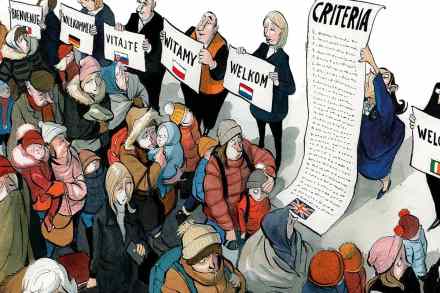
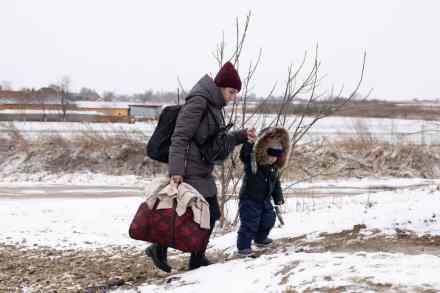
‘Watch this space,’ the armed force minister James Heappey said when asked whether Britain would make it easier for Ukrainian refugees to come to the country. Still, though, refugees – even those with family connections to the UK – are stuck in Calais and Paris trying to make to our shores. What more should we be doing? Would a Polish model, where refugees are welcomed first and registered later, work? The Spectator’s editor Fraser Nelson speaks to our economics editor Kate Andrews.

Rishi Sunak’s energy bill dilemma

From our UK edition

This morning’s revelation that the UK economy grew 0.8 per cent in January, the fastest growth since April last year, is welcome news after a Christmas plagued by Omicron – but it’s news that’s out of date, too. As Capital Economics warns: ‘This is as good as it gets for the year'. Russia’s invasion of Ukraine, the commodity price jump and the cost-of-living crisis will soon show in the figures. Today’s ONS release warns that even in January, businesses were already reporting significant rises in the cost of energy and staff wages. The week after next, Rishi Sunak will present a mini-Budget. The Chancellor faces a conundrum: how to explain the inflation and energy bill hikes that are still to come?

Border farce

From our UK edition

42 min listen

In this week’s episode: is the UK dragging its feet when it comes to Ukrainian refugees?For this week’s cover piece, Kate Andrews and Max Jeffery report from Calais, where they have been talking with Ukrainian refugees hoping to make it to Britain. Kate joins the podcast along with former MEP Patrick O’Flynn to discuss the UK’s handling of the refugee crisis. (00:48)Also this week: are commodity traders finding a moral compass?In the wake of colossal sanctions on Russia are commodity traders feeling pressured to look more critically at the people they buy from? In this week’s issue, Javier Blas, Bloomberg’s commodities columnist and the co-author of The World for Sale, reveals what’s going on in the world of commodity trading.

What is the significance of the sanctioning of Roman Abramovich?

From our UK edition

13 min listen

After seemingly dragging its heels for weeks, the government is ramping up its individual sanction measures against those close to the Kremlin. When Roman Abramovich bought Chelsea football club it was seen as a symbol of closer Russian and British ties, we will now see what signal him losing it creates. Kate Andrews hosts Fraser Nelson and James Forsyth to talk through sanctions, peace talks and Eurovision.

Lessons from history: improving UK railways for passengers

From our UK edition

30 min listen

The UK has recently lifted almost every Covid restriction and with that, thousands of commuters will return to their offices. Will those memories of delays, cancellations, costly tickets and overcrowding come back to haunt the commuter? Most of the problems are linked to the patchwork of Victorian infrastructure that has struggled to meet the demands of the modern-day passenger. With grandstanding projects like Hs2 dominating the headlines, is this the kind of investment that's best spent for the consumer? And with other issues on the rise, such as extreme weather conditions, inflation and flexible working patterns, how will the industry prepare itself?

What’s behind the Tory revolt on refugee relief?

From our UK edition

14 min listen

While Europe opens its arms up to the Ukrainians fleeing war, the UK is taking a much slower approach. While people are allowed to come in relatively quickly if they have family here, that definition of family is extremely limited. Our response is causing confusion with the public but seemingly also within the Conservative party.Katy Balls and James Forsyth are joined by Kate Andrews from Calais who has been spending the last two days talking to refugees on the ground looking to seek refuge in Britain.

Will Europe remain united against Putin?

From our UK edition

18 min listen

Kate Andrews talks to James Forsyth and the historian Orlando Figes about whether Europe's united response to the Russian invasion of Ukraine will hold, and the effect of sanctions on Russia's economy and its oligarchs.

Russia’s invasion: one week on

From our UK edition

12 min listen

It's been just over a week since Vladimir Putin began his invasion of Ukraine and in that time we have seen some truly unprecedented events: A former comedian leading an extremely effective homeland resistance against one of the world's largest armies, an estimated million people fleeing over the borders and a more unified Western response than we have seen in decades. Kate Andrews talks with The Spectator's Editor Fraser Nelson and its Deputy Editor Freddy Gray to assess the shocking events we have seen this week.

Bear market: Russia’s economy is in free fall

From our UK edition

How quickly can a G20 economy collapse? That question has come to the fore this week, as the world has united in targeting Russia’s economy while Vladimir Putin continues his illegal invasion into Ukraine. So far, the rouble is down more than 30 per cent on where it was pre-crisis, at an all-time low against the dollar. Russia’s central bank has upped interest rates to 20 per cent to stop a currency collapse. Its stock market is still closed, and is expected to remain so until mid-next week at the earliest – a record shutdown in the country’s history. BP has walked away from its 20 per cent stake in Russia’s state-owned Rosneft, while Shell is forgoing its stake in Gazprom, thought to be worth roughly $3 billion.

Paralysing Russia’s central bank could cripple Putin’s plans

From our UK edition

Pushing Russia out of Swift, the international bank transfer system, has long been spoken of as one of the most forceful economic moves the West can make. Only last week Joe Biden suggested the idea was off the table as the Europeans did not want to do it, with so many countries dependent on Russia’s natural gas. But after frantic negotiations, we have movement. The USA, UK, European Union and Canada have agreed plans to cut at least some of Russia’s banks out of the Swift as well as to work to stop the Russian central bank from accessing its vast reserves, estimated to total roughly $630 billion. But will this round of response get Vladimir Putin’s attention?

What is Sunak’s vision for the economy?

From our UK edition

11 min listen

Katy Balls speaks to Kate Andrews and Tony Danker, the director general of the Confederation of British Industry (CBI), about the Chancellor's Mais lecture on Thursday, where he reaffirmed his belief in 'sustainably' cutting taxes.

Is Britain prepared for the cost of sanctions?

From our UK edition

Sanctions hit both sides: this is a point that Joe Biden has made to Americans and Olaf Scholz is making to Germans. But Boris Johnson is not (so far) talking about the economic implications of this war. They will be — and in fact, already are — profound.  When Russian tanks moved into Ukraine, the price of gas for next-day delivery in the UK shot up 40 per cent. A study by Investec yesterday suggested this means typical household energy bills — already expected to approach £2,000 in April — could end up closer to £3,000. Quite a hit for a country already facing a cost-of-living crisis. And this is just one way in which the conflict could impact household budgets.

Germany’s canning of Nord Stream 2 will hit Putin hard

From our UK edition

Vladimir Putin’s threats towards Ukraine have, in part, been an operation in stoking divisions throughout the West. As James Forsyth explains in the magazine’s latest cover piece, it was just weeks ago that Germany was not on the same page as the US and the UK about what actions from Putin might classify as an invasion – and how such actions might trigger western countries to respond. The obvious sticking point for Berlin has been Nord Stream 2: the now-completed gas pipeline running under the Baltics, built to transfer 110 billion cubic metres of gas supplies from Russia to Germany each year and bypass the current pipeline which runs through Ukraine.

Who’s in charge of the NHS?

From our UK edition

Who runs the NHS? With a £136 billion budget for NHS England and NHS Improvement eating up 17.5 per cent of tax revenue, there should be a clear answer to this. But ministers were left wondering when the time came to announce what the health service would achieve with its extra £12 billion from the tax rise. I write in this week's magazine about the row over waiting lists and how ministers thought the extra cash would cut it to 5.5 million — only to be told it could possibly hit close to 11 million. But there was a row over another point too: the timeline for cancer care. It’s no secret that cancer care was badly hit during lockdown, with a huge drop in diagnosis.

Britain’s remarkable economic recovery in 2021

From our UK edition

With prices soaring, interest rates rising and the cost of living crisis growing more acute by the day, we could do with some more positive news: and this morning’s GDP update has played a small part in providing it. Despite suffering the largest economic contraction in 300 years in 2020 – and taking the biggest economic hit in the G7 – Britain had the fastest growing economy in the G7 last year, boosting its GDP by 7.5 per cent. It's still a mixed story: looking at where the UK economy is now compared with pre-pandemic levels, it ranks average within the G7. But with one of the steepest hills to climb back to recovery, the UK’s relatively fast growth enabled the economy to get there several months before it was forecast to do so.

Kate Andrews, Kevin Hurley, Lawrence Bernstein

From our UK edition

21 min listen

On this week's episode, we’ll hear from Kate Andrews on the NHS’s waiting list crisis. (00:52)Next, Kevin Hurley on the impact of demonising the police force. (07:04)And finally, Lawrence Bernstein on the secretive world of speech writing. (12:41)Produced and presented by Sam HolmesSubscribe to The Spectator today and get a £20 Amazon gift voucher:spectator.