Jonathan Jones

A plan that could change the face of future Budgets

‘I’ve never seen a government document with a Laffer curve in it before’, declared Ed Balls last week. Well it looks like he might be seeing a lot more of them, if George Osborne gets his way. Yesterday, as James noted, the Chancellor told the Treasury select committee that: ‘I think the Treasury can now, and I've asked this to happen, start undertaking some real research into dynamic scoring, and what the broader economy effects are of changes to taxation’. Now, it’s hard to get all that excited about something with a name like ‘dynamic scoring’. It was never going to make the front pages, especially when there’s a ‘pasty tax’ to get worked up about.
The government’s keen to avoid the petrol chaos of 2000

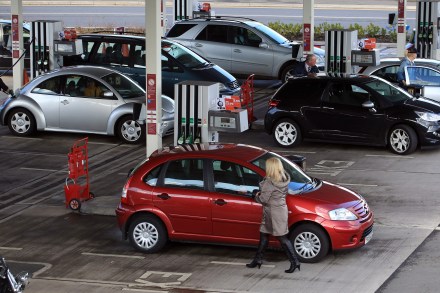
So, once again, we face the prospect of disruption at the pumps, as tanker drivers have voted for strike action over their terms of employment. According to the union Unite, their demands are 'industry minimum standards and industry wide bargaining on pensions, terms and conditions, training and health and safety'. In all, around 2,000 drivers at seven fuel distribution companies voted, with 61 per cent of them in favour. A majority approved strike action at five of the seven firms, while at DHL and Suckling drivers rejected it. The government is, naturally, keen to avoid such a disruptive strike and has been quick to condemn it. Energy Secretary Ed Davey told the Today programme this morning that 'This strike is completely unnecessary. It should not go ahead.

Obama reiterates his commitment to a nuke-free future

https://www.youtube.com/watch?v=Ajuq5u3IoSQ As leaders from 53 nations gather in Seoul for the second Nuclear Security Summit, President Obama spoke of his ‘vision of a world without nuclear weapons’. It’s a vision he described during his 2008 campaign, and which was later the focus of his 2009 speech in Prague. Today, as then, he talked about the ‘obligation’ he feels to act on this in strikingly personal terms: ‘I say it as a father, who wants my two young daughters to grow up in a world where everything they know and love can’t be instantly wiped out.

Romney can’t shake off his ‘Etch A Sketch’ label

https://www.youtube.com/watch?v=cKtNYmsarUE Presidential candidates are used to having all sorts of derogatory monikers hurled in their direction. But they don’t expect them to come from one of their own senior advisers. And yet that’s exactly what’s happened to Mitt Romney this week. On Wednesday, just after Romney had won the Illinois primary and secured the endorsement of former Florida Governor Jeb Bush, Eric Fehrnstrom told CNN: ‘Well, I think you hit a reset button for the fall campaign. Everything changes.

What did the public make of the Budget?

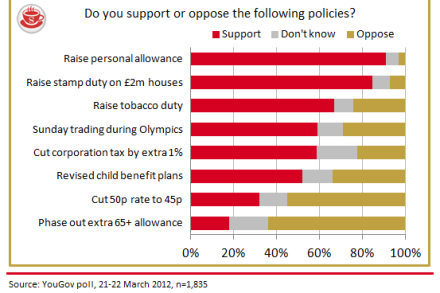
After weeks of hearing what people think about the policies that Osborne might’ve adopted, we now have the first evidence of what they make of the Budget itself. Today’s YouGov poll lists eight of its main policies, and it seems they fit into three broad groups. First, the very popular ones: raising the personal allowance and increasing stamp duty for £2 million houses. Second, those backed by the majority but not so overwhelmingly: the corporation tax cut, the child benefit changes, Sunday trading during the Olympics and the tobacco duty rise. And finally, the unpopular measures: cutting the 50p tax rate and phasing out the extra personal allowance for over-65s.

The IFS gives its Budget verdict

The Institute for Fiscal Studies’ briefing is always a good place to pick up a few interesting nuggets of detail about the Budget — and this year’s is no exception. Here are five of the most striking points from their presentation this morning: 1. Beyond the next election. In November, Osborne caused a stir by announcing that — in order to meet his fiscal target — further spending cuts would be needed after 2015. Annex A of the Budget gives some more detail on this, and the IFS has crunched the numbers even further. They calculate that the fiscal consolidation from 2009-10 to 2016-17 will total £123 billion and that the overall ratio of spending cuts to tax rises will be 83:17. But where will those extra spending cuts come from?

The Budget: What you need to know

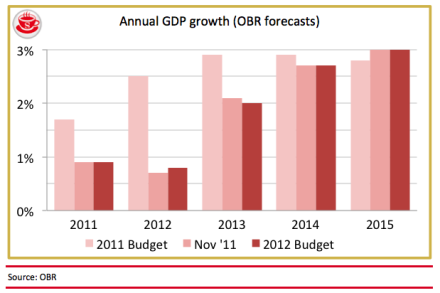
1. Growth. The OBR's forecasts are essentially unchanged from the Autumn Statement, but nevertheless represent a much bleaker outlook than we were given a year ago:  2. Debt. Despite Osborne's talk of 'paying down the debt', he's actually adding to it — by 59 per cent over this parliament. He is, though, on course to meet his second fiscal rule to see the debt to GDP ratio falling by 2015-16: 3. Deficit. Ignoring the effects of transfering the Royal Mail pension deficit, there's hardly any change to the borrowing forecasts since November. Progress on deficit reduction will be much slower than announced in Osborne's first two Budgets: 4. Unemployment. The OBR expects unemployment to peak at 2.

Support for scrapping the 50p rate grows, but why?

Will Wednesday’s Budget herald the end of the 50p tax rate? It’s looking increasingly likely, with today’s Telegraph claiming that Osborne will replace it with a top rate of 45 per cent. Leaving the economic arguments aside, the consensus is that this will prove an unpopular move that could damage the Tories. Tim Montogmerie tweets that ‘if the post-Budget headlines are about 50p then Tories have a political problem’. The New Statesman's George Eaton writes that it ‘would do more to retoxify the Tory brand than any other measure’. But how dangerous a move is it? Certainly, scrapping the 50p rate doesn’t poll well. Yesterday’s YouGov poll found 60 per cent opposed and just 27 per cent in favour.

Cameron dines with Obama… and Clooney

https://www.youtube.com/watch?v=mX6mT0kpoyQ The Camerons weren’t the Obamas' only big-name guests at the State Dinner last night. They were joined by a host of stars including Warren Buffett, Richard Branson and George Clooney, who’s just returned from war-torn Sudan. In their speeches (above), the two leaders had very warm words for each other. Of Cameron, Obama said: ‘In good times and in bad, he’s just the kind of partner that you want at your side. I trust him. He says what he does and he does what he says.’ And the PM returned the compliments: ‘There are three things about Barack that really stand out for me: strength, moral authority and wisdom.

Unemployment’s high, but at least it’s stopped rising

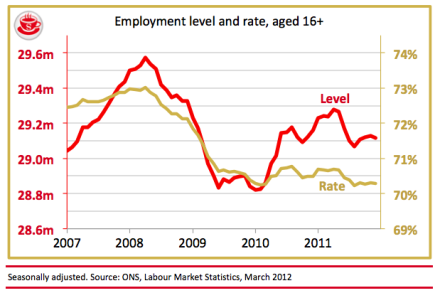
So, new jobs figures out today. Which do you want first: the bad news, or the kind-of-alright news? The bad news is that employment’s showing no signs of growth: the total number in work has been stuck at 29.1 million since it fell there in the summer. It’s a touch better than the trough of 28.8 million we hit at the end of 2009, but still half a million below where we were when the recession hit. And we’re showing no signs of getting there any time soon: And the not-so-bad news? Unemployment’s slightly down on last month, which was slightly down on the month before. It’s not a big drop — well within the margin of error — and the number of unemployed still stands at 2.7 million, so this doesn’t exactly count as good news.

A Lib Dem alternative to Beecroft

When the Beecroft report’s recommendation of ‘Compensated No Fault Dismissal’ was first leaked back in October, Norman Lamb was one of the strongest Lib Dem voices to speak out against it, describing it as ‘madness’. Back then, he was Nick Clegg’s chief of staff. Now, thanks to Chris Huhne’s resignation and Ed Davey’s promotion, he’s in an even better position to prevent this ‘madness’: Employment Minister in the Department for Business. As James has said, the Lib Dem MPs are unanimous in their opposition to Beecroft’s proposals, and until recently it didn’t look like they would be translated into policy at all.

Rising gas prices hurt Obama

Barack Obama’s re-election has been looking more and more likely in recent weeks. His approval rating has risen fairly steadily, economic forecasts have improved and he’s opened a nice lead in head-to-head polling against Mitt Romney, as the Republican primaries have taken their toll on his most likely opponent. But the latest polls show things moving dramatically in the other direction, for the first time since early October. A Washington Post-ABC poll conducted last week shows Obama’s approval rating dropping from a healthy 50 per cent last month to 46 per cent now. It also shows Romney leading Obama 49 to 47, compared to 51-45 to Obama last month.

Obama wins Super Tuesday

It wasn’t a great night for Mitt Romney — but it wasn’t a particularly bad one either. He won by big margins in the four states he was supposed to: Massachussetts, Vermont, Virginia and Idaho. He also won Alaska by a four-point margin and managed to beat Rick Santorum by just one point in Ohio. The fact that he finished way behind Newt Gingrich in Georgia was no surprise, nor was his losing to Santorum in Oklahoma. He could have done with better results in North Dakota (third, 16 points behind Santorum and 4 behind Ron Paul) and Tennessee (second, 9 points behind Santorum), but six wins from ten states is probably about what he was expecting.

Graduates struggling to get graduate jobs

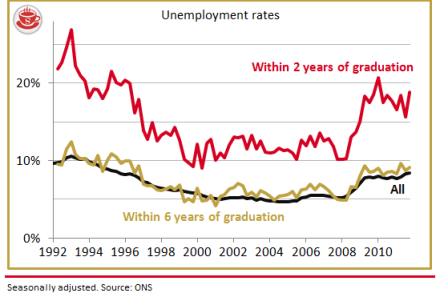
Today’s ONS release will make pretty grim reading for students and recent graduates. It shows that the unemployment rate among recent graduates — those who graduated in the last six years — stands at 9.1 per cent, higher than the overall unemployment rate of 8.4 per cent. It’s even worse for those who graduated in the last two years — the unemployment rate among them is 18.9 per cent, up from 10 per cent before the recession. But there’s an even more worrying trend among those recent graduates who do find employment. In 2001, three-quarters of them were in ‘higher skill’ jobs — those requiring more than GCSEs. Now, less than two-thirds of them are: So what does this mean?

A super Tuesday in store for Romney

After regaining the momentum with victories in Michigan and Arizona last week — and another in Washington State at the weekend — Mitt Romney looks set to enjoy a pretty good Super Tuesday. He’s very unlikely to win all ten states voting today, but will probably substantially strengthen his position in the all-important delegate race nonetheless. Much of the focus has been on the two biggest states: Georgia and Ohio. Georgia should provide Newt Gingrich with a much-needed and fairly comfortable victory — it is the state he represented in Congress, after all, and he’s focused a lot of his efforts there. The polls suggest a 20-point or so win for Gingrich in Georgia, but Romney looks likely to beat Rick Santorum for second place.

Cutting legal aid might actually <em>cost</em> money

This afternoon’s Lords debate on the government’s Legal Aid Bill promises to be a heated affair. The Independent’s interview with Baroness Scotland – Labour peer and former Attorney General — gives a taste, beneath the headline ‘Women and children could die because of legal aid cuts’. But even before we get into an emotional debate about domestic violence and hitting ‘the poorest and weakest’ — important though it is — there’s one potential flaw that could undermine the whole point of the proposal: it might not actually save us any money. Take benefit claimants, for example, who will now longer be entitled to legal aid when challenging decisions about their benefits.

Which tax cuts do the public want?

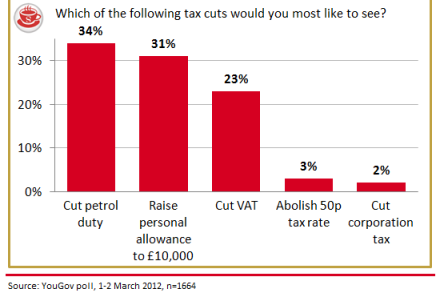
YouGov’s new poll for the Sunday Times includes one set of numbers that will be of particular interest to George Osborne at the moment. It asks the public: ‘If the government has money available to cut taxes in the budget later this month which of the following tax cuts would you most like to see?’ Here are the results: With the news this week that fuel prices are at an all-time high and expected to rise further, it’s hardly surprising that the public support a cut in the taxes on it. The AA, among others, has already called on the Chancellor to abandon the 3p rise in line with inflation currently planned for August. Last week, Osborne didn’t sound terribly likely to bow to their demands, but as Pete said on Tuesday, he might surprise us still.

Private policing is nothing new

‘Revealed: hidden government plans to privatise the police’, proclaims the Guardian headline this morning. The story is that, in an attempt to protect frontline services in the face of a 20 per cent cut in government funding: ‘West Midlands and Surrey have invited bids from G4S and other major security companies on behalf of all forces across England and Wales to take over the delivery of a wide range of services previously carried out by the police. The contract is the largest on police privatisation so far, with a potential value of £1.5bn over seven years, rising to a possible £3.5bn depending on how many other forces get involved.

Romney: ‘we didn’t win by a lot, but we won by enough’

https://www.youtube.com/watch?v=hzY8ppsAIdQ It'll be a relieved Mitt Romney and a deflated Rick Santorum who head to Ohio ahead of next week's Super Tuesday primaries. Romney scored an impressive 21-point victory in Arizona — exceeding the already high expectations for him there. This win provides him with a significant boost in the delegate count — a factor that becomes more important the longer the race drags on — as Arizona assigns all of its 29 delegates to the winner. But more important for Romney was the three-point margin he secured over Santorum in Michigan.