John Sturgis

John Sturgis is a freelance journalist who has worked across Fleet Street for almost 30 years as both reporter and news editor

The lost art of browsing

From our UK edition

The paperback’s cover showed a woman and man walking down Ludgate Hill towards Fleet Street with St Paul’s behind them and a red double decker passing to their right, dressed in the office fashions of the post war years. It looked like a still from an Ealing Comedy. A friend posted the image on his social media because he liked the look of the Fontana edition which he had found on his father’s shelves. It was a copy of London Belongs to Me by Norman Collins. Most people seeing this would immediately start thinking of the fifties but for me it had rather different associations, triggering intense memories of the 1990s. This was because I had spent many hours over several years of that decade trying to find a copy of this very book.

Why Wordle won’t last

From our UK edition

My name is John Sturgis and I am a Wordle addict. It’s not quite heroin or crack cocaine but it did have me hooked within minutes of trying it. And I have been chasing the high that those first hits gave me ever since. Or at least, I was a Wordle addict. Just two weeks ago I was confidently predicting that this was a hobby that I would keep up on a daily basis until I went to the grave. I was completely sold. Today that seems a much less likely scenario. I hear of people who find it so easy they are now attempting it in French or Spanish Wordle was invented by a British geek, Josh Wardle, working in the US tech sector, the game’s name a wordplay, natch, on his surname. He launched it for family and friends last summer and went public in the autumn.

The Netflix sommelier: what to drink while you watch

From our UK edition

Are we there yet? No, not a child on a long drive (remember those?) but me every day of last week as I struggled to stay strong towards the closing stages of Dry January. Yes - finally we are there: the sunlit uplands of 1 February. Having spent the best part of a month dry, it’s fair to say I have done a good amount of reflection on the subject of alcohol and abstention thereof. No, not about how awful I’ve realised drinking is and how I now plan to stop drinking forever - none of that nonsense. I was thinking more about how it’s made me realise once again quite how much I love wine.

The real difference between rugby and football fans

From our UK edition

England's rugby match against Australia at Twickenham last Saturday was my first visit to the home of English rugby in 42 years. During my school days, football was not only third best after rugby and cricket but frowned upon. I quickly rebelled, rejecting what I saw as the establishment sport and falling for the illicit populism of the round ball. Since that day I estimate I have been to something like 700 football matches, principally at West Ham where I’ve had season tickets for most of the last 30 seasons. So what is it like to be a football fan at the rugby? First off, Twickenham’s transport links make Wembley look like Piccadilly Circus.

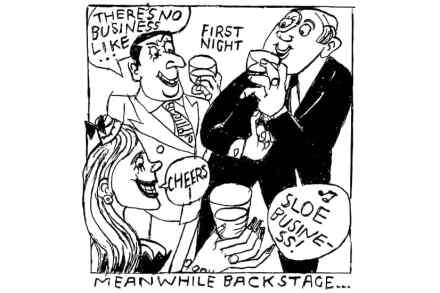
The simple pleasures of sloe gin

From our UK edition

The gin craze of recent years has reached a scale that would have horrified Hogarth. You can now buy strawberry, raspberry, rhubarb, blueberry and lime gins in supermarkets. For me, though, there is only one flavoured variety worth bothering with: sloe gin. Where the rest are novelties, this is a staple dating back to the early 19th century. Sloe gin is everywhere — Buckingham Palace even launched a line this year. But it is the easiest thing to make at home and there’s something very pleasurable about the ritual of doing so. Folk wisdom suggests you should go foraging for sloes in the days after the first frosts — by which point they won’t ripen further but haven’t yet dried up — which means from mid-late October through November.

The secret to restoring old records

From our UK edition

It’s a kind of alchemy, transforming worthless clutter into pleasing and valuable collectors’ items, a slow but gratifying process all but forgotten in the modern age. I first learned it from the woman who ran a second-hand record store in my hometown, Tunbridge Wells, from the late seventies to the early nineties, where I misspent much of my youth and most of my pocket money. Fiona, a hangover from the hippie era, with her whispered husky voice and the endless extraordinarily-thin hand-rolled cigarettes that perhaps explained it, first imparted this lesson in around 1982. I speak of the lost art of fixing warped records.

An ode to London’s closed restaurants

From our UK edition

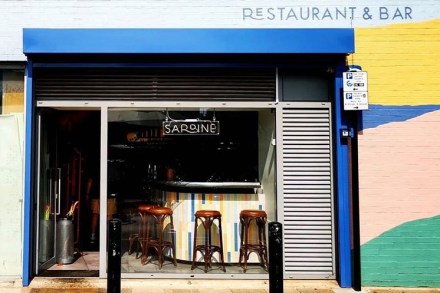
Leg of lamb à la ficelle: 'First, inherit an ancient stone farmhouse lost somewhere in the hills of the Luberon, then string up a leg of young lamb over a smoky wood fire...' As I chuckled over this sardonic intro to a recipe in one of my favourite cookery books of recent years, Sardine by Alex Jackson, my laughter quickly died as I realised that not only will I never inherit such a farmhouse — but I’ll also never again go to the restaurant that launched the book. Sardine was one of my best-loved London restaurants of the last decade, tucked away in an unlikely and not especially salubrious corner behind a drive-thru McDonald’s in the unfashionable hinterland between Old Street and Angel.

Latitude 2021: the long-awaited taste of freedom

From our UK edition

There was a palpable feeling of freedom in Henham Park, Suffolk over the weekend - as masks disappeared and social distancing was replaced by dancing. For a blissful 72 hours, Covid was all but forgotten as Latitude became the first major festival to return in nearly two years. And even if the cost of that freedom was £6.00 for a pint of not-quite-cold Carlsberg in a plastic cup, it still felt worth paying for this three day party in a field. As Katherine Ryan put it: 'I feel so free! The only way I could feel freer was if I was Britney Spears and I just heard my Dad had died.

Are we on the verge of forgetting Amy Winehouse?

From our UK edition

Before she became associated more with tragedy than comedy, there was a joke which went: ‘What’s Amy Winehouse’s favourite tube station?..High Barnet’. Not the best joke admittedly and one that required a degree of knowledge of rhyming slang - but it did anchor the beehived chanteuse and the borough she came from together in the popular imagination. I should be clear from the outset that I’m a fan. For me she was the last great pop star. Back to Black is one of the best albums of all time and she isn’t remotely out of her depth in that dead-at-27 club alongside Kurt Cobain, Jimi Hendrix, Janis Joplin et al. Even if she was out of her depth in life.

We still believe: Could England win Qatar 2022?

From our UK edition

Here’s a two-pointer pub quiz question: who was Bunny Austin and when, where and why did you hear his name mentioned annually until 2012? The brilliantly-named Bunny was, for an agonising 74 years of hurt, the last Briton to reach the final of the men's singles at Wimbledon. He didn’t actually win it in 1938, like the better known Fred Perry had three times earlier in that decade. But his name came up in commentary and sports reports without fail every year for decades, in late June or early July, whenever the last Brit was knocked out or, on heady occasions, when one reached the quarters or even semis. Tim Henman must curse his name to this day.

Jess Phillips is wrong about football’s double-barrelled surnames

From our UK edition

As the nation went football mad last week, nowhere was there a more stark expression of the ‘I’m-new-to-this performative fandom’ phenomenon than in Westminster. We were treated to the Prime Minister wearing an England top over a shirt and tie, Jacob Rees-Mogg bizarrely recreating the John Barnes ‘World in Motion’ rap and so on and so on. But amid this stiff competition the MP who most – unwittingly – revealed their apparent real lack of interest in or knowledge of the beautiful game was Labour’s Jess Phillips. ‘My youngests question for tonight “why do footballers never have double barrelled names?”’, she asked.

The joy of blue plaques

From our UK edition

This week saw the unveiling of the latest English Heritage blue plaque. It marks one Caroline Norton, a 19th century writer celebrated for her pioneering legal battles against her drunk and violent wastrel of a husband which resulted in some of the first legislation to enshrine women’s rights. The plaque is at Chesterfield Street, Mayfair, where, in 1877, the always-unlucky-in-love Norton died just three months after marrying again. It’s a riveting story that deserves to be told yet, relatively, Mayfair doesn’t really need any more plaques - like Chelsea, Bloomsbury, Hampstead and the like, it’s already dotted with them. You can go on blue plaque walks there.  But Southgate, where I live, has none.

The tabloid art of the ‘knobbly monster’

From our UK edition

Here be monsters, knobbly monsters. A ‘knobbly monster’ is tabloid newsroom slang for that tricky second reference in copy to your subject when you’ve already used the obvious or only word for it. The term originated, so the story goes, in the late nineties or early 2000s when a quite possibly well-refreshed Sun hack was working on a sensational account of a fatal crocodile attack. By his fourth or fifth paragraph he was groping for an alternative way of describing his deadly protagonist. He settled on describing it as ‘a knobbly monster’. And a legend was born.

The problem with Desert Island Discs

From our UK edition

It should be the basis for new playlists, exciting discoveries, the leftfield, the overlooked, the forgotten gem. But too often these days listening to Desert Island Discs is akin to being stuck in a minicab with the radio locked to Golden Greats FM, where the hits just keep on coming. It’s not so much that many guests have bad taste but that they have no discernible taste at all, their choices plucked almost exclusively from the canon of the bleeding obvious. It’s Exile on Mainstream Street.

The viral appeal of the aubergine

From our UK edition

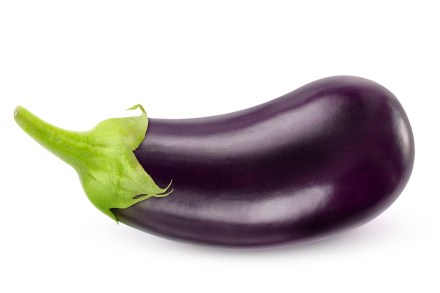
It seems at first an unlikely ingredient for global domination - particularly if, like me, you first encountered it as an unappetising squidge at the centre of a badly-made seventies moussaka. While the actual aubergine - the palpable purple signature ingredient from said retro Greek bake - remains a relatively minor player in the western larder at least, its visual representation, the aubergine in emoji form, has broken out of the virtual veg box.

Parents should stop complaining about World Book Day

From our UK edition

Every year, at the same time, they come – great flocks of them. Squawking, squabbling, screeching. Never mind the first cuckoo call or the sighting of the earliest swallow, there is no more reliable metric in modern Britain for the arrival of spring than parents moaning about their children having to dress up for World Book Day. What started in the mid-nineties as a fairly innocuous celebration of all things children’s lit, has somehow in the quarter century since evolved into an annual festival of epic parental whining: ‘it’s too commercial’; ‘too demanding’; ‘too expensive’; ‘too tacky’; ‘too much’. These are all, I concede, to a degree, reasonable criticisms.

We have Charlie Chaplin to thank for the blockbuster

From our UK edition

The pandemic has hit the film industry for six - but there’s a precedent to suggest that it can come back stronger. Because that’s what Hollywood did after the devastation of the Spanish Flu a century ago. As that killer virus was still ravaging post-WWI America, a great auteur was at work on a project that would change everything.  This week sees the centenary of the result - the first ever movie blockbuster. 21 January 1921, was the US release date of Charlie Chaplin's first feature film, The Kid. Never mind the endless present-day stress about if and when anyone will ever get to see the 25th Bond film; it’s small beer compared to the significance of The Kid to the 1920s and their subsequent roaring.

Confessions of a failed royal reporter

From our UK edition

Half a lifetime ago, I was, briefly, an occasional royal reporter – and watching The Crown, season four has revived memories of that inglorious chapter.  It began with my one and only encounter with my favourite Crown character, Princess Margaret, on a sweltering July evening in 1997. I had arranged a trial night shift on the Evening Standard, starting at 5pm, which only allowed me ten minutes to get from my day job at the Old Bailey across London to their offices in Kensington, by bicycle, in 90-degree heat. I arrived breathless, only for the news editor to spin me straight back out, saying I had just five minutes before I needed to be in Regents Park, prompting another frantic ride across the scorching city.

The weird world of Masterchef

From our UK edition

‘What’s that earthy flavour in the sauce?’ ‘It’s a black Himalayan moss which monkeys find an aphrodisiac.’ If 2020 has been the weirdest year the modern world has known, that was well and truly reflected in Masterchef, The Professionals. Because this year's series, the 13th annual, dispensed with its own unwritten rules. For years the received wisdom had been just to cook some meat or fish in a modern European style with traditional pairings. If you wanted to be dangerous you might put a square of dark chocolate in the sauce for your venison but even this was usually considered de trop; if you wanted to be playful use popcorn.

Roald Dahl was vile, but it would be a pity to cancel him

From our UK edition

Where the Chilterns rise over Roald Dahl's family home, which is now a museum, diggers are at work, tearing up the beech woods that inspired one of his greatest books, Danny the Champion of the World, to clear a path for HS2. In the wider world, however, it is Dahl’s reputation that is being dug into.  Dahl’s family recently issued a quiet apology for infamous anti-Semitic comments he made in interviews in the final years of his life. ‘I’m certainly anti-Israel,’ he said in 1990, eight months before his death, ‘and I've become anti-Semitic in as much as that you get a Jewish person in another country like England strongly supporting Zionism’.