John O'Neill

Streeting’s wealth tax could be very costly

Claim: Streeting’s wealth tax would raise £12 billion a year. Reality Check verdict: False Wes Streeting has proposed a ‘wealth tax that works’, raising around £12 billion a year by aligning capital gains tax rates with income tax rates. That would mean an increase in the top rate from 24 per cent to 45 per cent. He says ‘a pound made from simply owning assets should not be taxed less than a pound made from a hard day’s work.’ There are a few problems with his proposal. It would mean huge tax rates on assets that hadn’t actually made money, after inflation. It reduces the incentive to take investment risks that make us all richer – though Streeting has proposed allowances for ‘genuine entrepreneurialism’.

Why can’t we agree on data?

12 min listen

John O’Neill and Sam McPhail, the Spectator’s research and data team, join economics editor Michael Simmons to re-introduce listeners to the Spectator’s data hub. They take us through the process between the data hub and how their work feeds into the weekly magazine. From crime to migration, which statistics are the most controversial? Why can’t we agree on data? Plus – whose data is presented better, the Americans or the French? For more from the Spectator’s data hub – which may, or may not look like the thumbnail photo – go to: data.spectator.co.uk Produced by Patrick Gibbons and Megan McElroy.

The graphs that expose Keir Starmer’s failure to ‘stop the boats’

After ten months in office, Keir Starmer has promised to ‘finally take back control’ of migration – but what's his record so far? We don’t yet have the key figure for net migration (that’s due in ten days’ time), but other more timely data shows that the Prime Minister is failing to live up to promises he made before the election. This failure is most obvious on small boats. Starmer said he would ‘smash the gangs’ to stop small boat crossings. It hasn’t worked: record numbers are crossing the Channel. Some 11,574 people have made the journey so far this year, 25 per cent more than in the same period last year. Since the general election, just under 35,000 small boat migrants have arrived.

Revealed: ONS blames Ring doorbells for dodgy jobs data

What caused the Office for National Statistics (ONS) to lose faith in its own jobs figures? After the pandemic, the ONS asked for the ‘national statistic’ quality mark to be taken off its estimates of whether Brits are working when response rates to its labour force survey collapsed. Fewer and fewer people were willing to invite an interviewer into their home to give them the 45-minute questionnaire. Bank of England governor Andrew Bailey said ‘it is a problem’ to not have accurate unemployment numbers when setting interest rates, while Lord Bridges, chair of the House of Lords eco­nomic affairs com­mit­tee, asked: ‘How are the Treasury and the bank to make critical decisions based on dodgy statistics?’ So why did the response rate fall?

Businesses give Reeves’s Budget a ‘thumbs down’

What did businesses really think of Rachel Reeves’s Budget? Today we have one of the first economic indicators reflecting their responses to Labour’s tax and spend changes – as well as global events like the US presidential election. The Purchasing Managers’ Index (PMI) fell below 50 in November, which suggests the private sector economy is now contracting after a year of expansion.  Firms said that employment has been shrinking for two months and they are not replacing staff who leave voluntarily in order to offset the coming rises in the cost of workers. They also reported subdued customer demand – something shown in the retail sales figures Ross Clark examined this morning.

Can anything stop benefits spending hitting £120bn?

The Office for Budget Responsibility’s (OBR) forecasts on Budget day included the startling figure that spending on health and disability benefits is set to pass £100 billion in five years’ time. Figures from the Department for Work and Pensions (DWP) today, which are based on a broader range of benefits and recipients, put the amount even higher: £120 billion.  The DWP’s figures include housing benefit for health and disability benefit recipients. In real terms, spending on this definition is forecast to rise by 20 per cent (or £18 billion) over the next five years. The share of government spending that goes on these benefits will be at a record level this year, at just under 7.1 per cent (defence is a little under 5 per cent of government spending).

Fact check: How much will Trump’s tariffs hurt the UK? 

Last week the National Institute of Economic and Social Research said Britain ‘would be one of the countries most affected’ by Donald Trump’s proposed tariffs, with growth cut by 0.7 percentage points in year one, 0.5 percentage points in year two, and inflation 3-4 points higher. But research from Oxford Economics today suggests the impact would be ‘limited’, even in the worst-case scenario.  During the election campaign, Trump suggested putting tariffs of 10 or 20 per cent on all imported goods – except those from China and Mexico, which would be stung with 60 or even 100 per cent rates. At the moment, average UK tariffs on goods from the US are 2.2 per cent and US tariffs on goods from the UK are 3.3 per cent.

Boris vs David Davis – the most likely battle for the Tory leadership

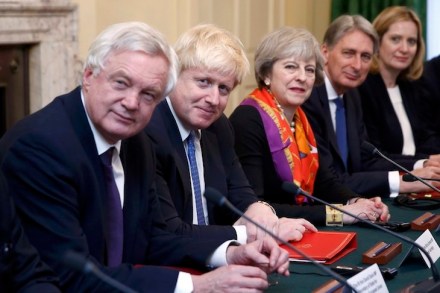
Having squandered the Conservative majority, Theresa May is coming under pressure to resign. It's not just from Jeremy Corbyn and opposition parties: Tory MPs are calling for her to go too, with Anna Soubry first out of the blocks this morning. So if she does resign (perhaps after the ‘period of stability’ she's called for) who might take over? Douglas Carswell says it's a straight fight between David Davis and Boris Johnson: https://twitter.com/DouglasCarswell/status/873054521068408832 But who do the bookies fancy? Although she won in Hastings and Rye, with a small majority of just 346, Amber Rudd has been written off by PaddyPower. They agree with Carswell: Boris is the 3/1 favourite, with Davis behind him on 10/3. Other prospective candidates trail behind.

Theresa May is heading for a general election landslide

Recent opinion polls have given the Conservatives bigger leads than they've had in years. So what if today's polls were June's General Election results? According to Electoral Calculus, Labour would lose 47 seats and the Conservatives would gain 51. The SNP may have a clean sweep in Scotland – and it still looks too early for a Lib Dem recovery. The net result? The Conservative majority would rise from 13 to 112 – plunging Labour into another leadership crisis.

EU toasts defeat of ‘backward-looking populism’ as Hofer concedes Austrian election

Norbert Hofer has just conceded defeat in Austria’s presidential election after exit polls and interim results showed him losing by 47 per cent to 53 per cent. Victory goes to Alexander Van der Bellen, the 72-year-old former Green party leader. He has said the election result sends a message ‘to the capitals of the EU that one can win elections with high European positions.’ The last time Hofer lost to Van der Bellen, in May, his margin of defeat was just 0.4 per cent, or 31,000 votes. His right-wing populist Freedom Party brought an appeal and Austria's Constitutional Court ordered the election to be run again. But this time, Hofer seems to have lost by at least 300,000 votes.

Nicola Sturgeon says Scotland could stay in the EU and the UK

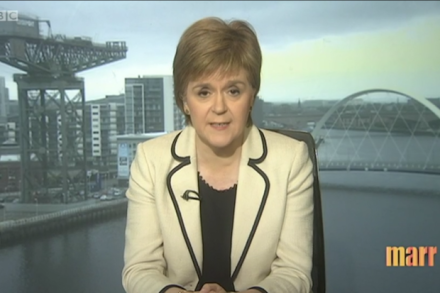
We are ‘in uncharted territory with, effectively, a blank sheet of paper’ in front of us – and that means ‘there might be’ a way that Scotland could stay in both the UK and the EU after Brexit, Nicola Sturgeon said on the Andrew Marr Show this morning. So England and Wales would get what they want and Scots what they want – except for the two-in-five Scots who voted to Leave. But Ms Sturgeon had no suggestion as to how such a plan might work in practice, because it wouldn't work in practice. Scotland voted in 2014 to stay in the UK, and the UK voted in June to leave the EU. And EU countries including Spain and France don't want to give Scotland the choice to stay in.

Bank of England holds the base rate at 0.5 per cent

So, the Bank of England didn’t do it: against market expectations that there would be a cut, the base rate has been kept at 0.5 per cent, where it’s been since March 2009. The pound shot up by 1.5¢ against the dollar on the news. https://twitter.com/bankofengland/status/753544578947481600 The Bank is keeping its powder dry and today's hold doesn't mean there isn't a cut coming: The Monetary Policy Committee is meeting again in three weeks’ time when it will have new forecasts for the economy and more official data on the impact of the referendum. ‘Most members of the Committee expect monetary policy to be loosened in August,’ the minutes of this month's meeting note.

Labour’s disintegration begins

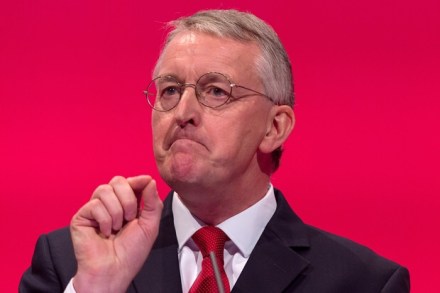
Will Jeremy Corbyn have a shadow cabinet by the end of the day? By 9am there have already been two departures. As Isabel said on the our Coffee House shots podcast last night, a lot of Labour MPs think the mood of the membership has shifted after the EU referendum and they think this vote of no confidence could be coming at the ideal time. In the early hours of this morning Jeremy Corbyn sacked shadow foreign secretary Hilary Benn. Benn had been calling fellow members of the shadow cabinet to ask whether they thought he should call on Corbyn to stand down as leader; and whether they would join him in resigning were he to refuse.

Bookies anoint Boris as next Tory leader

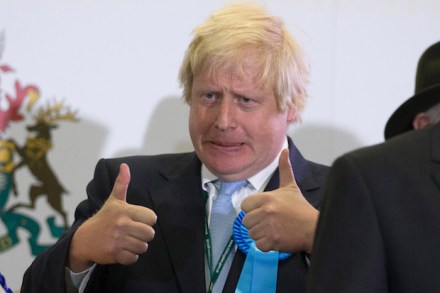
The betting markets are all-but-ready to crown Boris Johnson as the next Conservative leader. After it became clear that Leave had won, the implied chance of Johnson succeeding David Cameron spiked to over 50 per cent – while the chance of George Osborne taking over plummeted. But these are the same betting markets that predicted a 14 per cent chance of Leave yesterday – so while this market is fun to watch, you might prefer to leave your money in your pocket.

Jo Cox murder suspect had links to neo-Nazi group: report

New allegations are emerging about the man suspected of murdering Jo Cox yesterday. He was named locally as Thomas Mair, and his brother said he had a history of mental illness – and no known interest in politics. But overnight, the Southern Poverty Law Center – a US civil rights campaign group that tracks extremist organisations – reported the following: The Daily Telegraph disclosed that Mair was identified as a subscriber to S. A. Patriot, a South African magazine that was published by the pro-apartheid group White Rhino. It has yet to be established if he did shout ‘Britain first’ as some reports suggested, or whether he has any link to the organisation of that name.

Brexit chances surge: live chart of bookmakers’ odds

Two polls putting Leave well clear of Remain – five points according to yesterday's Guardian/ICM poll, seven points  according to a Times/YouGov poll  – have seen bookies slash their odds on Brexit, implying that it's more likely than ever before – as shown by the chart above. A few weeks ago, the betting markets thought there was an 18 per cent chance of Leave: now it's 41 per cent. This does mean the markets think Remain is the more likely outcome, due to the status quo effect: Whatever people tell pollsters, they tend to stick to the devil they know in referenda. The above chart is calculated by taking an average of all bookies’ odds, which (at time of writing) imply a 41 per cent chance of a vote to Leave.

Nadine Dorries leads calls for Cameron’s resignation

The knives have been out for David Cameron today. The Sunday Telegraph splashed on Priti Patel saying that he is too rich to care about immigration; the Sunday Times on a letter to the PM, signed by Boris Johnson and Michael Gove, calling his failure on the migration target ‘corrosive of public trust in politics’. And the Sunday Times quoted a Tory MP saying ‘I don’t want to stab the prime minister in the back — I want to stab him in the front so I can see the expression on his face... You’d have to twist the knife, though, because we want it back for [George] Osborne’. Yikes! The morning's papers were just the start.

Business investment falling could be good news for Remain

Today’s migration figures (net migration was 333,000 in 2015, up by 20,000 on the previous year) are bad news for the Remain campaign – but there’s a crumb of comfort for them in today’s GDP and business investment figures. This second estimate of GDP growth is unchanged from last month’s, still saying that the economy grew by 0.4 per cent in the first quarter of 2016. But business investment unexpectedly fell by 0.5 per cent. Whatever the reasons for it, Remain can say it’s due to uncertainty over the outcome of the referendum – and dish up more Brexit fearmongering: if businesses are putting off investment because we might leave, what terrible things might happen if we do go?

Inflation rises to 0.5 per cent in March

Annual CPI inflation rose by more than forecasters expected to reach 0.5 per cent in March, up from 0.3 per cent in February, figures released today show. The rise was due to a jump in the cost of air fares, which were affected by the timing of Easter. Growth in fuel prices slowed and consumers benefitted supermarket price wars that saw the cost of food fall by 0.6 per cent between February and March. Core inflation, which strips out energy, alcohol, tobacco and food, rose to 1.5 per cent from 1.3 per cent – further evidence the UK's period of low inflation may, slowly, be coming to an end.

UK economy grew by 0.5 per cent in Q4

GDP growth accelerated to 0.5 per cent the final three months of last year, compared with 0.4 per cent in the previous quarter. Based on this preliminary estimate, the economy grew by 2.2 per cent last year, a little shy of the OBR's November forecast of 2.4 per cent, and down on 2014's expansion of 2.9 per cent. [datawrapper chart="http://static.spectator.co.uk/Yp3bt/index.html"] The construction and production sectors shrank, and manufacturing output was flat with the UK's dominant services sector driving growth. But it's worth remembering that this is a flash estimate, based on around two-fifths of the data that the ONS collects about the economy. Initial figures tend to be revised – and they tend to be revised up.