James Forsyth

James Forsyth

James Forsyth is former political editor of The Spectator.

Bad news travels

Context is all in politics and, with the government widely considered to be in big trouble, every piece of bad news is making waves. So, the Labour peer Lord Desai’s observation that "Gordon Brown was put on earth to remind people how good Tony Blair was" is going to be headline news for the rest of the day, ensuring that Brown has yet another bad news cycle. Brown also can’t be too pleased with the Reuters preview of his day in Washington which, after noting his scheduled meeting with the three presidential contenders, says this about his meeting with the President: “He then goes to the White House to meet Bush, who shares the British prime minister's plight -- low popularity and economic problems at home.
Ken’s supporters come under question again

Today’s Evening Standard leads with the headline, “Suicide bomb backer runs Ken campaign.”  The Standard alleges that Azzam Tamimi, who is a leading figure in the Muslims for Ken campaign, is on record as both praising suicide bombing and suggesting that he himself would be prepared to be one. “If I can go to Palestine and sacrifice myself I would do it. Why not?” If this quote is accurate, then Ken must disassociate himself from Tamimi and accept no help from his organisation.

Shared values

Gordon Brown’s visit to the USA shows that his team really has developed the reverse Midas touch. The Embassy has secured meetings with all three presidential candidates and on home turf to boot, an impressive demonstration of diplomatic clout that few countries—if any—could match. But by arriving at the same time as the Pope, the Prime Minister has guaranteed that he’ll be over-shadowed. (Tomorrow’s US front pages are going to be dominated by pictures of the Pope blowing out the candles on his birthday cake at the White House). As Pete notes, Brown’s Wall Street Journal op-ed is hardly likely to make any American mist up—as Tony Blair’s speeches so often did.

An ally let down

The total lack of interest surrounding Gordon Brown’s visit to the United States is a testament to how shamefully detached from the Iraq project Britain now is. Back in the hey-day of the Bush and Blair relationship, the arrival of the British Prime Minister the week after Congress had held hearings on Iraq and the President had outlined his strategy for the next few months would have been a major event. But now it is little more than a footnote—Brown makes page A12 of The Washington Post while The New York Times does not deem his landing worthy of even one column inch. In the highest reaches of the Brown government, there exists a simplistic mindset that thinks of Afghanistan as the good war and Iraq the bad one.

Is Basra back under Iraqi government–not militia–control?

Today’s AFP dispatch from Basra makes for fascinating reading. It suggests that the Iraqi government efforts to rein in the militias that had come to dominate the town, thanks in part to British policy, has been much more successful than initially thought:  “Residents say the streets have been cleared of gunmen, markets have reopened, basic services have been resumed and a measure of normality has returned to the oil-rich city. The port of Umm Qasr is in the hands of the Iraqi forces who wrested control of the facility from Shiite militiamen, and according to the British military it is operational once again.

One of Gordon’s goats is abandoning him

Tomorrow’s Times splashes on the news that Digby Jones will resign before the next election as he is not prepared to say that he supports Gordon Brown during an election campaign. The Times reports that the former CBI head made the remark at a private event at the end of January. Brown must wish that the news had leaked out earlier as coming now it fits all too well into the current narrative that this is a government in disarray and on the way out. Expect plenty of Labour backbenchers to say I told you he was a rat, many had always questioned the wisdom of making someone a minister who wouldn’t even say if they voted Labour or not.

Another day, same bad story for Brown

Every day now brings another set of bad headlines for Gordon Brown. Today, there’s that dire poll in the FT--which Pete mentioned, the news that a cabinet minster told Nick Robinson that "the danger we face is that we are just too damaged to recover”, and a whole slew of columns laying into the Prime Minister. There is, as Jackie Ashley argues, an element of piling on in this coverage. But there’s definitely a feeling in Westminster that there’s blood in the water. Brown desperately needs to change the story but he’s lost control of the news agenda. At the risk of sounding like a broken record, May 1st is his best—and perhaps only chance—to once more become master of his fate.

Labour would be doing better with Blair in charge

If Tony Blair were still Prime Minister Labour would be five—not sixteen—points behind the Conservatives, according to the latest YouGov poll. With Blair back at the helm, the Conservative vote falls to below 40 percent, while the Labour vote rises by six points. More voters think that it is unlikely than likely that Brown will be Labour leader after the next election. There is, though, no clear successor; that modern-day Vicar of Bray, Jack Straw is the only Labour politician to break into double-figures when voters are asked who they would like it to be. The finding that should really worry Brown, though, is that 61 percent  of voters blame his management of the economy for its current problems.

Not worth the candle

The full absurdity of the health and safety culture is brought home by this story in The Sunday Times.  A chap was taking his date to the champagne bar at St Pancras for her birthday and so asked if he could bring a candle for them to put on a cake for her. This is the email he received in response: “I have asked the station operations if we would be allowed to have a lit candle at the champagne bar for a birthday cake and they have said that we will have to submit a risk assessment form stating what the risk will be to the bar and the station, and what we will put in place to combat any possible risks. “The risk assessment form will then be put to Mike Page (head of station operations).” So, the date went ahead but without the candle.

No day of rest for Brown in trouble stories

The Sunday papers pick up where the Saturday ones left off. The Independent on Sunday reports that Charles Clarke is preparing a stalking horse challenger  if Labour does badly on May 1st. The Mail on Sunday revives the story that Brown has promised to only fight one general election. A poll for The Sunday Times finds that “Brown’s personal rating has plunged further and faster than any other British leader since political polling began in the 1930s”. While the paper says that he is facing a cabinet revolt over 42 days. The Observer notes speculation that Brown will opt for a snap cabinet reshuffle after May 1st. Only a stronger than expected performance on May 1st will end this feeding frenzy.

May Day for the Prime Minister

May 1st is becoming ever more important for Gordon Brown. Holding London and exceeding expectations in the rest of the country is the only thing that can put a stop to the increasingly frequent stories about how his government is doomed and he is the problem, see the Martin Kettle and Matthew Parris articles that Pete flagged up earlier today.  If Labour were to lose London and suffer heavy loses elsewhere, then the steady flow of stories about how the Brown government is in terminal decline will become a torrent. It is increasingly hard to see how Brown could turn things around in these circumstances. The other problem for Brown if Labour does badly on May 1st is that he would be under fire from both the left and the right.

Curbing Iranian influence in Iraq

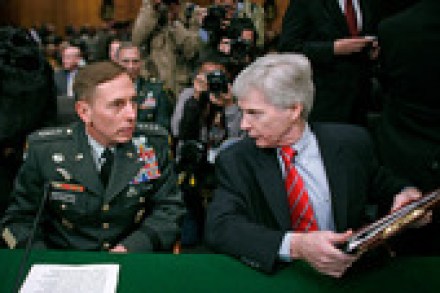
One of the most important things to have emerged from recent events in Basra and the testimony of General Petraeus and Ambassador Crocker is that Iran has stepped up its efforts to destabilise Iraq. The crucial question is whether the Maliki government is now more prepared to confront this Iranian influence.  The signs are promising. First, Mailiki was prepared to order his forces into Basra in an effort to curb the power of the militias and the Iranian trained special groups. Second, it seems that Iran’s role in the fighting in Basra has been, as Defense Secretary Gates put it, "a real eye-opener" for  Malik.

What if…

Another week, another PR Week story about what Stephen Carter’s new Downing Street team has planned. The frequency with which these stories are appearing is becoming really quite comic—it must be doing wonders for PR Week’s circulation in Westminster but it also seems to prove that the outsiders the Prime Minister has recruited are more interested in getting a good write up in the trade press than working away for Gordon’s greater glory. But isn’t it all a little too unsubtle? Surely if you’re a new hire from the world of PR, you’d realise that you would instantly cop the blame for any leaks to PR Week?

Essential viewing on Iraq

This episode of Charlie Rose with John Burns and Dexter Filkins of The New York Times (full video below) is by far the most informative thing I’ve seen on the Petraeus and Crocker testimony and the whole state of the war in Iraq. Both Burns and Filkins stress that things are precarious but equally they are both sure that things are improving in Iraq and there is a real possibility of a positive outcome although there is a long way to go—as Filkins puts it, it is ‘the bottom of the third innings’ in a nine innings game.

Yet another Balls up

Ed Balls has had a rather bad week and it now appears that Jim Knight, the schools minister, has been sent to mend fences with the Board of Deputies over Balls’s attack on the admission procedures of Jewish faith schools. This whole row over admissions was concocted by Balls himself but has ended up back-firing dreadfully on him. Maybe the Prime Minister should take his protege in hand and tell him that a period of silence on his part would be most welcome.

That didn’t take long, did it?

Gordon Brown has only been Prime Minister for 289 days but already The Sun  is devoting its main commentary slot to handicapping the race to succeed him. George Pascoe-Watson lists nine contenders—Ed Balls, David Miliband, James Purnell, Andy Burnham, Alan Johnson, Harriet Harman, Jacqui Smith, Jon Cruddas and Charles Clarke—giving Balls and Purnell particularly favourable write-ups. Now, you might say this is just one newspaper story on a quiet Thursday but it does show that the current chatter has broken out of the Westminster Village. If Labour takes a pasting on May 1st, then this chatter will only get louder and Brown’s authority will be diminished even further.

Was this the Straw that broke Jack’s back?

The knives are out for Ed Balls at the moment. Partly this is because, as Michael White points out in The Guardian, he is a proxy for Gordon Brown. But it is also because he’s been empire building with little thought to the feelings of his fellow ministers. One friend of Coffee House points to evidence that Balls gave to the inaugural meeting of the Children, Schools and Families Committee as a reason why Jack Straw might have felt like punching Balls: I am jointly accountable to Parliament and this Committee, with Jack Straw, for every aspect of youth justice and youth justice policy, even though most of the budget for youth justice is in either the Ministry of Justice or the Home Office, rather than my own Department.

Brown’s Olympian confusion

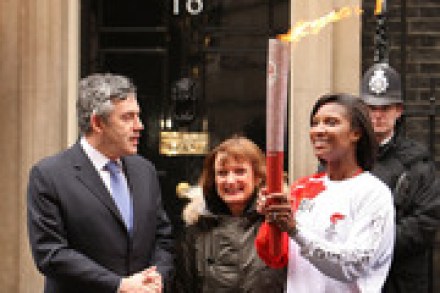
Gordon Brown’s position on the Beijing Olympics is becoming more absurd by the day. He’s happy to have the Olympic flame surrounded by guards from a particularly unsavoury branch of the Chinese security services in Downing Street but not to touch it himself. Now, he’s planning to skip the opening ceremony but doesn’t want anyone thinking that he is snubbing or boycotting the event. Brown’s confused position has seen him drawn into the US presidential campaign with Hillary Clinton—who supports a boycott of the opening ceremony—praising Brown for his stance: “I wanted to commend Prime Minister Gordon Brown for agreeing not to go to the opening ceremonies of the Olympics in Beijing.