James Forsyth

James Forsyth

James Forsyth is former political editor of The Spectator.

Will the recess save Brown?

From our UK edition

The one consolation for Gordon Brown about tonight's result is that the MPs are all leaving Westminster for the Whitsun recess and so the opportunities to plot will be limited. Alternatively, MPs could get it in the neck from their constituents and local parties about how bad things are and return to London steeled to the task ahead.

Labour’s expectations management strategy fails again

From our UK edition

If there is one aspect where the Tories still feel that they lag behind Labour it is expectations management. Tory staffers feel frustrated that Labour succeeds so easily in getting its worst case scenarios into the journalistic blood stream. But once again things are going to be a lot worse for Labour than even they though. Earlier in the week, Labour were spinning that a defeat by 3,000 or less would be a decent result for them. Whether the Tory majority is going to be big enough to ‘force the bastard out’ remains to be seen.

More hopeful signs in Iraq

From our UK edition

There was an important story in yesterday’s New York Times about the apparent success of the Iraqi army’s operation in Sadr City. Here’s how it opens: “Iraqi forces rolled unopposed through the huge Shiite enclave of Sadr City on Tuesday, a dramatic turnaround from the bitter fighting that has plagued the Baghdad neighborhood for two months, and a qualified success for Prime Minister Nuri Kamal al-Maliki. As it did in the southern city of Basra last month, the Iraqi government advanced its goal of establishing sovereignty and curtailing the powers of the militias.” It is hard to overstate the importance of these developments.

Labour is out of ideas

From our UK edition

Westminster might be waiting for the voters of Crewe and Nantwich to cast their ballots, but we have already learned one thing from the campaign: Labour’s policy cupboard is bare. That Labour’s hopes of hanging onto this normally safe seat rest solely on hoping for a sympathy vote for the daughter of the popular, recently deceased MP and on caricaturing the Tory candidate as a toff shows that no one in the Labour campaign team can think of a compelling, positive reason to vote for the party. Martin Bright nails this point in his New Statesman column when he asks what would someone on the left see if they looked beyond Brown’s current political difficulties:   "The truth is that they would see a landscape largely barren of ideas.

Great Expectations

From our UK edition

Politics Home’s Insider panel’s benchmarks for the Crewe and Nantwich by-election give us a pretty good idea of how the pundit class would treat various results tonight. If the Tory majority is over 4,000, the panel thinks, that Labour would go into a tailspin and it would be confirmed that the Tories were on their way back to Downing Street. So, if the Tories do win tonight—watch the majority. Brown can probably weather a fairly narrow loss, but a thumping defeat would take us into a whole new political stage.

Labour Conference abolishes Britishness

From our UK edition

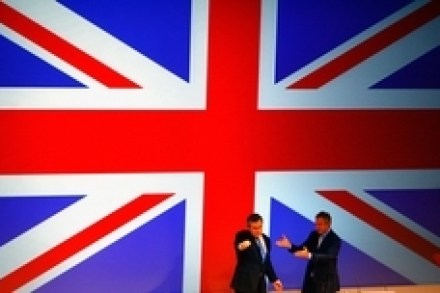
I’ve just been filing in an application for credentials to the Labour party conference and was gobsmacked to find that you could not declare your nationality to be British. Instead, you had to pick English, Northern Irish, Scottish, Welsh or a foreign nationality. I’m sure that this is just an oversight. But given how much Gordon Brown talks about Britishness and the giant Union flag backdrop at the special Labour conference that elected him leader, it is rather amusing. I’m now considering starting a campaign: British passes for British hacks.

Why the abortion time limit will soon come down

From our UK edition

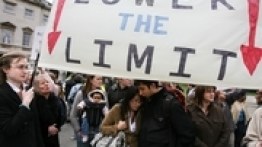
Sadly, the abortion vote last night pretty much split down party lines with 83 percent of Tories in favour of a lower limit and 80 percent of Labour MPs supported the 24 week status quo. It would be a disaster for British politics if abortion was to become a partisan issue—imagine the Commons continually changing the time limit after an election in much the way that US administrations suspend or enact the Mexico City policy. Indeed, my one criticism of the campaign against the 24 week timeframe for so-called ‘social abortions’ is that some of its advocates veered too quickly into partisan language. But I am hopeful the time limit for ‘social abortions’ will soon come down regardless of which party has a majority in Parliament.

Police problems for Labour as the Home Secretary gets banged to rights

From our UK edition

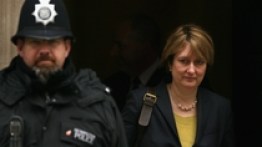
Labour must be hoping that not many people in Crewe and Nantwich decide to watch the evening news tonight. For if they do, what they’ll see is hardly like to encourage them to vote Labour. The first item, if the BBC website is any guide, is going to be Jacqui Smith being berated by Jan Berry, chair of the Police Federation. With the Home Secretary sitting on the stage, Berry joked about Smith’s past drug use and then absolutely went for her over the government’s failure to backdate the pay rise set by the Police Arbitration Tribunal. She asked who in the Cabinet stood up for police and then denounced the refusal to backdate the deal in headline-grabbing terms: "It was a breach of faith, a monumental mistake, and you betrayed the police service," she added.

Attempts to reform abortion laws fail

From our UK edition

Tonight the attempts to reduce the time limit for so-called ‘social abortions’ were defeated. The 22 week amendment lost by 304 to 233, the 20 week one 332 to 190, 16 weeks by 387 to 84 and 12 weeks by 393 to 71. It is tragic that the attempt to reduce the limit from 24 weeks failed. One does not have to believe that life begins at conception to think that aborting a foetus after six months when the mother’s health is not in danger and there is no risk of a serious handicap is wrong. Even if only a small number of foetuses are viable at 24 weeks, then we should not accept them being aborted except in the most limited circumstances.

Obama nears the finish line

From our UK edition

Over on Americano, some thoughts on today's primaries in Kentucky and Oregon and what it means that by the end of night Obama will, almost certainly, have an absolute majority of pledged delegates.

Teddy Kennedy, liberal lion

From our UK edition

Today, Teddy Kennedy’s doctors announced that he has a malignant brain tumour. This is sad news. Whatever one thinks of Kennedy’s politics, there’s little doubt that he’s been the most effective legislator in recent US history. The finest speech Teddy Kennedy has ever given was at the 1980 Democratic convention. Kennedy had unsuccessfully challenged President Carter for the Democratic nomination and lost fairly comfortably but carried his fight all the way to the convention. His address was both beautifully crafted and delivered. Indeed, it was so good that it overshadowed Carter receiving the actual nomination. The peroration, which you can listen to below, was particularly fine.

The spread in Crewe

From our UK edition

Today’s ComRes poll, the weekend one by ICM and reports from the ground have persuaded most of us that the Tories are going to win Crewe and Nantwich. That alone is a sign of how fast events have moved in recent weeks. Just before the local and London elections, the consensus on Coffee House was that there “a very small chance of a Tory victory”. If Labour do lose, the margin of defeat will be key to Brown’s prospects. A Labour loss by up to four points has already been factored into the Brown share price. So, it would probably not change that much though it would lead to a few more people putting their heads above the parapet. Anything above that and things get interesting.

One to watch

From our UK edition

John Denham is now only 7 to 1 to be the next leader of the Labour party and Mike Smithson is tipping him as the potential Gordon replacement best placed to keep the government alive in the south. So, I was interested to see how he’d do on Straight Talk which is one of the tougher, most intellectually rigorous interviews out there. (You can watch the interview here) Denham stands up pretty well; he does a particularly nice job of arguing that there’s no contradiction between courting the Labour base and the aspirational classes. However, his understated style makes it hard to see him as a leader.

Labour support is now the lowest it has ever been in The Guardian / ICM poll

From our UK edition

A new ICM poll for The Guardian has the Tories up two on 41, Labour down seven to 27 and the Lib Dems on 22, a three point rise on last month. This is the lowest level of support for Labour ever recorded in The Guardian / ICM poll which started in1984.   There is no silver lining to the poll for Brown. He trails Cameron on every attribute of leadership that ICM asked about and three quarters of people who voted Labour in 2005 think Blair was a better Prime Minister than Brown. Update: The Independent also has a new poll out which has the Tories 13 ahead in Crewe and Nantwich.

Labour’s campaign in Crewe is now beyond parody

From our UK edition

Here’s the latest quote from Tamsin Dunwoody: “I am just a single, unemployed mother of five fighting hard for a job” Now, come on Tamsin—you’re also the daughter of two MPs, the grandaughter of a peer, a former member of the Welsh Assembly and a university graduate. PS: The quote is from Sky's online debate between the main candidates which is well worth reading in full.

Labour spikes its own guns

From our UK edition

Stephan Shakespeare had a smart post up on Centre Right over the weekend, arguing that Labour were weapons-testing the class issue in Crewe. But it seems that Labour’s clumsy-premature use of the issue has actually forced them to remove it from their general election arsenal.Today’s Standard reports that  This is good news for the Conservatives. David Cameron and George Osborne’s respective decisions to join the Bullingdon are a—potential—election weakness. But Labour by having played the class card so early and so crudely has made it far less effective should they choose to use it in future.

West Midlands Police owe the public an explanation of why they got it so wrong over Undercover Mosque

From our UK edition

Alasdair Palmer’s column in The Sunday Telegraph on the whole Undercover Mosque business is essential reading. Undercover Mosque was the Channel 4 programme which revealed the extremism that was being preached inside a Mosque in Birmingham. Rather than examine that, the West Midlands Police decided to investigate the programme makers. It ended up referring the programme to Ofcom; claiming that it had “misrepresented” the preachers featured in the programme and had “undermined community cohesion”.  This, worryingly, suggested that West Midlands Police wanted to set itself up as some sort of censor, controlling what could and could not be said in public. The programme makers had, though, behaved entirely properly.