James Forsyth

James Forsyth

James Forsyth is former political editor of The Spectator.

The wisdom (?) of pundits

From our UK edition

Over at Centre Right, Peter Cuthbertson has launched a new blog dedicated to tracking the accuracy of pundit predictions. This is a fun idea—albeit one that rather fills those of us who make predictions with dread—so if you see any good examples do email Peter.

Osborne to step back from fundraising 

From our UK edition

Today’s papers report that following the Deripaska affair, George Osborne will no longer take a direct fundraising role. A source close to Osborne tells The Times, “Lessons have been learnt. From now on, George has decided that he will not be involved in discussions about individual donations from individual donors”. This is a sensible move. As shadow Chancellor, Osborne is too vulnerable to the appearance of conflicts of interest to play an active fundraising role. If he had carried on doing so, Labour would have made hay out of the issue. The Tories need to leave the business of fundraising to those like Michael Spencer and Andrew Feldman whose principal party job it is. Involving members of the shadow cabinet just creates an unnecessary reputational risk.

The BBC’s odd sense of priorities

From our UK edition

This downturn is going to feel awfully long if everyone is to be banned from having a laugh during it. The Sunday Times reports today that Robert Peston was pulled from Have I Got News For you because, according to a source close to the programme, “The producers were told it wouldn’t be right for somebody in a position of trust to be seen laughing in the current economic circumstances”. Now, I know the current situation is serious and some families might lose their home. But it is not equivalent to some natural disaster that has claimed thousands of lives and should not be treated as such.

The petro-states could be left scraping the barrel by this crisis

From our UK edition

A few weeks ago, folks were busy claiming that this financial crisis and the ensuing recession would mark the end of American hegemony. But, as the Washington Post points out in its editorial today, it is America’s enemies who look like they are going to be hardest hit by it. Those petro-states that have been buoyed up by the high-oil price, are in a far weaker position now oil is $65 a barrel. As the Post puts it: “Unless oil prices quickly recover, Venezuela's Hugo Chávez and Iran's Mahmoud Ahmadinejad are likely to face even tougher domestic economic challenges in 2009 than the next U.S. president.

Avoiding the next scandal

From our UK edition

If the Deripaksa affair persuades the Tories that they need to vet everyone from whom a shadow cabinet member accepts hospitality and that the shadow cabinet should be kept as far away as possible from the soliciting of donations then some good will have come of it. The Observer reports today that the vetting process designed to stop David Cameron meeting people who could embarrass the party will now be extended to ‘other senior figures’ and that senior Tories are pressing for all donations to be left to Feldman. But there are still other potential pitfalls the Tories need to deal with. First, and most pressingly, there is the issue of Lord Aschroft’s tax status.

Pinning the blame on Brown

From our UK edition

Gordon Brown’s political strategy for the recession involves claiming that it came from America, that Britain is uniquely well placed to deal with it thanks to his policy decisions and that only he has the experience to see the country through this crisis. But as the Observer points out in its editorial today—entitled “It’s your recession, Mr Brown. Deal with it”—these claims are simply not accurate:  “The implication is that recession is a foreign ailment that the UK only contracted through its exposure to global financial markets. But for a decade, the government promoted the City of London as the international centre of financial services.

The main reason why McCain is losing

From our UK edition

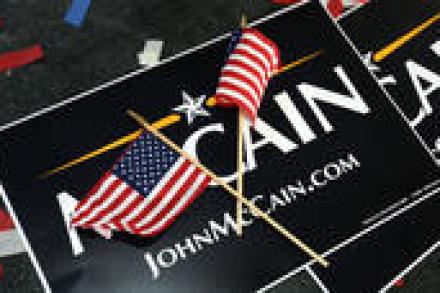
The post-mortems are already beginning on John McCain’s campaign. There is plenty for folk to get stuck into—the lack of a domestic policy message, the Palin pick, the failure to distance from Bush until so late in the campaign—but McCain is trailing principally because he is a national security candidate in what has turned into an almost exclusively economic election. As Steve Hayes notes, back in 2007 the most important issue in picking a president for both Republicans and Democrats were national security related—terrorism for Republicans, Iraq for Democrats. Now only nine percent cite terrorism and seven percent Iraq as their top issue while 57 percent name the economy.

London is going to be hit particularly hard by the recession

From our UK edition

When you look at these figures from Time magazine you realise how hard hit this country, and London especially, is going to be by this recession: “In 2007 financial services accounted for 10.1% of the U.K.'s gross domestic product, up from 5.5% in 2001. Add in professional services linked to finance, such as accounting, law and management consulting, and the total rises to 14%. And that's for Britain as a whole. For London, finance has been even more important: it accounts for almost one-fifth of the city's total output, perhaps as much as one-third if professional services are included. That's far more than for even New York City, where financial services account for about 15% of its economy.

On the trail in Glenrothes

From our UK edition

Ian Jack has a dispatch from Glenrothes in today’s Guardian. Here is his main point: “The conventional wisdom about Glenrothes goes like this. After its victory in Glasgow East, the Scottish National party thought it could wipe out Labour's 10,000-majority. Then the global crisis erupted. Small-country nationalism no longer looked so clever - Salmond will never praise Iceland again. The UK Treasury bailed out Scotland's two greatest banks and Brown emerged as the saviour of the world economy. An SNP victory is no longer secure. There's a new spring in Labour's step. All may be broadly true; people will mention it when asked, though usually only as a kind of hearsay opinion.

Who will be the change?

From our UK edition

There is an argument that British politics since 1994 is a historical freak, a product of a period of ever-increasing prosperity which allowed politicians to avoid the hard choices that typically define politics. As Charles Moore puts it in today’s Telegraph, “our two main parties have both been caught facing the wrong way. Their policy preoccupations, their political positioning, their promises have depended on perpetual prosperity. Now these look as relevant as estate agents' freesheets offering timeshares in Spain. When a really big crisis hits, it takes people a surprisingly long time to understand the basic point, which is that Everything is Different Now. Fear makes people reluctant to admit this, and plays into the hands of those in charge.

Oh Darling

From our UK edition

On October 7th, Alistair Darling called the Icelandic Finance Minister in an attempt to find out what iceland was doing to protect British savers who had money deposited in Icelandic banks. Here’s how the conversation starts: Mathiesen: Hello. Darling: Hello. Mathiesen:  This is Árni Mathiesen, Minister of Finance. Darling: Hello, we met a few months ago, weeks ago. Mathiesen:  No, we have never met. You met the Minister of Trade. Darling: Alright, sorry. Mathiesen:  No problem Perhaps, not the best way to kick things off.

Mandelson sketches out his policy vision for Labour

From our UK edition

Peter Mandelson’s interview in Progress is well worth reading. In it, he sets out the three areas where he thinks Labour needs to up its policy game: “First, social mobility where Labour needs to provide ‘new ladders for working-class youngsters to climb, taking advantage of the growing aspiration of ... parents for their children to go to university.' Second, the party also needs to outline a vision for ‘the jobs of the future ... regearing our economy and our sources of employment to match the opportunities the changing global economy is going to offer'. Finally, Mandelson advocates ‘further individualisation of our public services'.

Recession and oligarchs

From our UK edition

The Deripaksa story rumbles on in the papers today but Osborne will be relieved to see that he appears to be out of the woods now. The Guardian reveals that Mandelson and Deripaksa met in October 2004, a meeting which his Brussels staff appear to have been unaware of. Meanwhile, The Independent reports that David Cameron took free flights to go and see Rupert Murdoch aboard his yacht.  In other news, official figures out later this morning are expected to show the first quarter of negative growth since 1992.  One imagines that the public are not overly impressed by tales of politicians spending their times on super yachts with Russian oligarchs when the economy is actually shrinking. This has not been a good week for the reputation of politics.

What should McCain’s final roll of the dice be?

From our UK edition

The state polling numbers are grim for McCain right now. One poll today even had Obama up by 10 in Indiana, a state Bush won by 20 points. McCain clearly needs to do something to shake things up. Mike Murphy, who worked on McCain’s 2000 campaign but in recent months has been a critic of the style of McCain’s campaign, has an intriguing idea: “There is no state by state way to break out of the campaign's current spiral. Trips to Iowa will not do it. McCain has to go global with a big closing message. So, why not... Strip down the state by state media budget and use the money to follow Obama's lead with a prime-time 30 minute TV address? McCain direct to camera. And for God's sake don't make it another raging attack on Obama.

A mad world

From our UK edition

Keith Dovkants has a great feature in the Standard on  the relationship between Rothschild and Deripaska. But this anecdote stood out to me: “Witness his excursion into Kalmykia, a remote Russian republic run by Kirsan Ilyumzhinov, a charismatic leader who fought an election campaign on promises of providing a free mobile phone for every shepherd and a guarantee that Diego Maradonna would be signed up by the local football team. Ilyumzhinov confides in friends that he had been captured by aliens and has glimpsed a view of the universe not allowed most mortals. His political ruthlessness is combined with a sense of divine right and what rare visitors to his country call a shocking charm.

The heart of the matter

From our UK edition

One of the oddest aspects of this whole Deripaska affair is why Nate Rothschild went nuclear on George Osborne. It was understandable that Rothschild was irritated about Osborne breaching the privacy of his fellow guests but writing a letter that could have destroyed Osborne’s career seems like a disproportionate response. Especially when you consider that Osborne and Rothschild are old friends. Charles Moore puts it typically well: “But why did Nathaniel Rothschild write to the Times? Yes, he was genuinely annoyed that George Osborne had relayed Peter Mandelson’s disobliging remarks about Gordon Brown to the Sunday Times. The then Mr Mandelson was Mr Rothschild’s guest, as was Mr Osborne. Mr Osborne betrayed hospitality and strained an old friendship.

The worst seems to have passed for Osborne

From our UK edition

There will be relief in Tory circles this morning that today’s papers contain no further damaging revelations about George Osborne and Andrew Feldman’s holiday activities. The Tories can begin to hope that this story is on the wane or that the focus of attention will soon shift back to Mandelson; do see Melissa Kite’s revelations about Mandelson and Deripaska. The greatest danger to Osborne now is an accidental recommencement of hostilities. For instance, if a Sunday tabloid designed to try and dig dirt on the Rothschilds, Nate might go nuclear even if the Tories had not played any role in encouraging the paper. He is clearly a man with a trip-wire temperament. Lessons must be learned from this episode.

Leaderless

From our UK edition

The Times has gone understandably big on its scoop about George Osborne’s activities in Corfu. Many have been taken aback by quite how hostile the tone of its coverage has been—Osborne and The Times editor James Harding were thought to be friends—and if what Guido and several others are hearing is true, it seems that tomorrow’s coverage will be the harshest yet towards Osborne personally. But in all this there is one notable absence: The Times has not yet run a leader on the matter. On Tuesday, one of its editorials did refer to Deripaska but the reference was to his financial difficulties not to the hospitality that he had extended on his yacht. It does seem odd for a newspaper to lead on a story for two days in a row but not think it worthy of an editorial.

PMQs: the aftermath

From our UK edition

Gordon Brown’s call for an inquiry into the allegations surrounding George Osborne was pure political mischief. But it has worked. Both the BBC and Sky reported the call prominently on their one o'clock news broadcasts. As Nick Robinson noted on the Daily Politics, it was a clever way of giving the press a second day angle to the story. The Speaker’s decision to call Dennis Skinner right towards the end is not going to do anything to silence the whispers that he is too partisan. There was only one topic that Skinner - who has previously been chucked out of the Commons for making allegations about Osborne and cocaine - was ever going to ask about. P.S. Andy Porter has the details on what rules Labour think Osborne might have broken. Count me unconvinced.

PMQs live-blog

From our UK edition

Even before the revelations about George Osborne, today’s PMQs was of particular importance for the Conservatives. The encounter was perceived to be the Tory’s best chance to burst Brown’s bubble. But now it has taken on even more importance. If Cameron gets clunked, Tory backbench morale—which is surprisingly low given that the Tories still have a sizable poll lead—could plummet. We’ll have live coverage from noon. 12:03 Osborne is sitting on Cameron’s left. 12:05 Brown looks confident. But Cameron gets in a good jibe calling Brown ‘a master of dodgy accounting.’ The Labour backbenches are raucous today, the Osborne scandal has put a spring in their step.