James Forsyth

James Forsyth

James Forsyth is former political editor of The Spectator.

Three hours to drive 30 miles, 100,000 people

From our UK edition

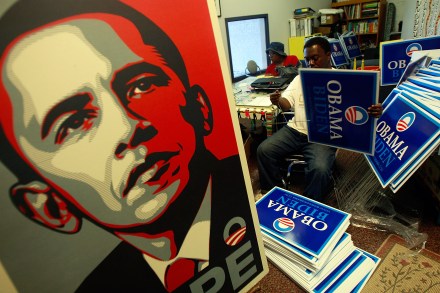
Barack Obama’s last rally of election eve filled the Prince William county fairground and some. Obama claimed there were 100,000 people there and considering the traffic on the road in that number seems plausible. The key question is how many of those 100,000 were Virginians rather than political tourists from DC and Maryland, Democratic strongholds. Obama wasn’t on fine form, his delivery was surprisingly lacklustre. But to the crowd it didn’t matter. They were there so they could tell their children they were there. The frantic ‘yes we can’ chants that greeted the beginning of Obama’s speech were gradually replaced with increasingly confident chants. This was a crowd that believes their candidate will win tomorrow.
Washington readies itself for an Obama presidency

From our UK edition

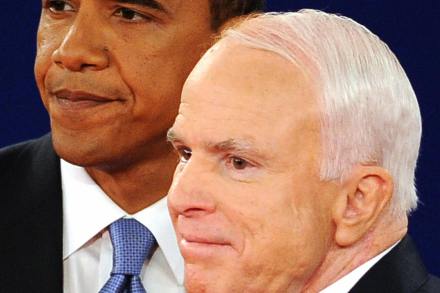
The atmosphere in Washington today is very different from it was four years ago. Then, everyone was on tenterhooks. Today, I haven’t spoken to a single person who thinks the result is in doubt (and that includes several McCain supporters). The conversation has moved on to Obama’s appointments, the future of the GOP and whether Obama is winning what amounts to a two-term mandate. One thing worth thinking about is how Obama will handle a Democratic Congress with comfortable Democratic majorities in both chambers. For instance, the rationale for Obama’s health care plan—which is not universal in the way that the one Hillary presented was—was that it stood a better chance of being passed.

On the verge

From our UK edition

The state polls today show what an advantage Obama has with a day to go. He leads in Ohio and Pennsylvania, two states that McCain has to win, by seven and ten points respectively. If it wasn’t for the memory of how wrong the polls were before New Hampshire, everyone would be calling this. (These polls, though, are almost certainly more reliable. In New Hampshire they were surveying a far more volatile and fast moving electorate). It is hard to believe that this amazing election is almost over. There is almost a sense that we have thought about it so much that we can at times forget just how historic it is going to be: America is in all likelihood going to elect its first black president. In a way that no other president has, Obama will change the country just by being elected.

Your election night viewing guide

From our UK edition

Here’s Americano’s guide what to watch for hour by hour on Tuesday night  / Wednesday morning: 7 pm (Midnight UK Time) Polls close in six states. The battleground states of Virginia and Indiana won’t be called instantly but watch to see if Georgia and South Carolina are. If they’re not, that suggests that black turnout has soared. If Virginia is called within the hour for Obama, that means that he is almost certainly on course for victory and quite comfortably.  7.30 pm Ohio’s polls close. This state is an absolute must win for McCain but they don’t count their votes quickly here. 8 pm 15 states and the District of Colombia cease voting.

What 9/11 effect?

From our UK edition

Four years ago, Bush v. Kerry was essentially a foreign policy choice. If you knew someone’s view on the war, you probably knew which way they were going to vote. The final days of the campaign were dominated by arguments about who could best keep America safe. But now foreign policy has largely been bumped from the closing conversation. Both McCain and Obama talk about it far less than they did during the primaries. One of the many ironies in all this is that if the primary electorates had know how little role foreign policy would play in the general election, they probably wouldn’t have nominated McCain or Obama.

The final Sunday

From our UK edition

The Sunday before a presidential election is always odd. The candidates are madly criss-crossing the country in one final effort, the press are trying to predict the result while covering themselves for all eventualities and the country is wondering who is still really undecided at this point. This morning’s papers and the Sunday shows are dominated by process talk—which states are in play, whose ground game is better and reflections on the campaign as a whole. Structurally, these conservations favour the frontrunner. They tend to emphasise the momentum that he has. Indeed, it is noticeable how Obama is spending most of his final few days on the trail in states that Republicans won last time out.

What’s wrong with McCain’s message

From our UK edition

I must admit that I left McCain’s rally in northern Virginia today more convinced that ever that this American hero will, sadly, lose on Tuesday. The bulk of McCain’s stump speech is dominated by an argument against redistribution. It is a classic right-left fight—and that’s what’s wrong with it. McCain is preaching to the choir but the choir is smaller than it has been in a generation. If in 2005, when talk began about a second McCain run for the White House, one had been told that McCain would have to win Pennsylvania to win the White House one could have sketched out a plan for how he would do it. It would have involved him running as part of the radical centre, a bold reformer.

McCain tries to use taxes to turn the tide in Virginia

From our UK edition

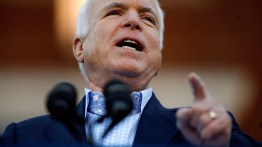
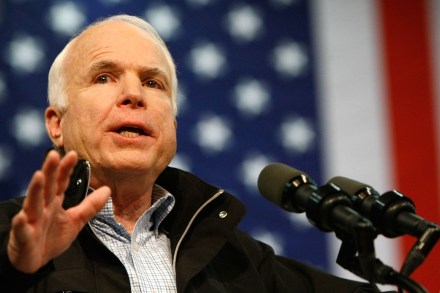
If this election was a speech-making contest it would have been over before it started. McCain is still a halting speaker with a tendency to step on his words. But he has a biography that resonates with his supporters. Warm-up speaker after speaker stressed how McCain had risked his life for his country, so the people here could give up a couple of hours to turn voters out for him. In 2004, John Kerry won this county by 25 points and the McCain campaign knows that they need to stop Obama from racking up a margin here that is so big that they can’t overcome it in the rest of the state. The theme of service continued when Cindy McCain introduced her husband by pointing out that the McCains and the Palins currently have three children on active service.

McCain’s final push in Virginia

From our UK edition

Springfield, Virginia I’m at the final McCain rally in Virginia before polling day. The polls here have Obama ahead by a quite significant margin but the McCain campaign is hoping that its get out the vote operation and Democratic talk of cutting the defence budget by 25 percent can turn things around in this military-heavy state. Interestingly McCain has chosen Northern Virginia, an area regarded as an Obama stronghold, for his final event in the state. It is a beautiful day and the mood among the crowd is upbeat and defiant; a national tracking poll which put McCain up by one has lifted spirits. There is a lot of abortion literature being handed out with folk being urged to pass it on at church tomorrow.

They think it’s all over

From our UK edition

Washington, DC It says something about the mood in Washington that the chatter today have revolved around who might get what job in an Obama administration rather than which states the McCain campaign is closing in. With polling day only four days away, McCain doesn’t appear to be gaining in the swing states at the speed he needs to. The Obama campaign is sufficiently confident not to have scheduled a stop in Pennsylvania, a state McCain needs to flip, before polling day and is instead sending Obama into traditionally Republican states. Given the state of the polls, the Obama campaign will be quite happy to run down the clock on the last weekend of the campaign. A weekend with no major news will be good news for Obama.

Do the math

From our UK edition

The crucial number on Tuesday night is 270, that’s the number of electoral college votes needed to win the presidency. The Obama campaign has multiple options for getting to 270. Karl Rove’s map, which is based on public state by state polling, has Obama with 311 supposedly solid electoral college votes with another 70 too close to call. Realistically, it is hard to see McCain winning every toss up state and peeling off Ohio, Pennsylvania and New Hampshire from Obama’s column which is his quickest route to 270. McCain needs the race to change nationally, to be reframed around who would be an effective Commander in Chief—a question on which he still leads.

Could McCain’s Pennsylvania gamble be paying off?

From our UK edition

Last night’s Barack Obama infomercial was a typically high-quality, well produced Obama product. There wasn’t much in it that was audacious but it sold the Obama message effectively and made him appear a safe choice. But this morning, spirits will have been raised in the McCain camp by a new poll which shows him within four points in Pennsylvania, a blue state that McCain now probably has to win to get to 270. This is the first bit of good polling news the McCain campaign has had in a while. However, the other polling numbers out today are really grim for McCain—he is even trailing in North Carolina and another poll has him down by double-digits in the Keystone state.

Ross and Brand shouldn’t distract us from the other news of the day

From our UK edition

The whole row over Russell Brand and Jonathan Ross’s disgusting prank calls continues to dominate the headlines this morning. That prime political opportunist Jack Straw has now waded into the matter, dropping heavy hints that Jonathan Ross should be fired. Brand and Ross have created a good moment to bury bad news--normally the news that house prices have fallen 15 percent in the last years would be a huge story. But it is still worth coming back to the deeply unsatisfying Mais lecture delivered by the Chancellor last night. As Fraser noted, Darling declared the old fiscal rules inappropriate for the present last night without putting anything else in their place. Indeed throughout the speech, Darling ducked the big questions.

Japan shows the limits of pump-priming

From our UK edition

Hamish McRae is one of the few economic commentators to have come out of this crisis in credit. His column today on how to avoid the stagnation that has gripped the Japanese economy for the past twenty years is well worth reading. Here’s the key section but do read the whole piece: “During the early 1990s the country escaped recession, unlike for example the UK, but the economy was flat and when the recession did come, in 1997, it was a biggie. Then until a couple of years ago it was back to stagnation. So while cheap money will help, and some increase in government borrowing is inevitable, they will not on their own fix things. Wasting money on ill-conceived public spending (which Japan did) is damaging in the medium-term.

The McCain campaign’s final week gets off to a bad start

From our UK edition

Mike Allen reports that in conversation with him “a top McCain adviser one-ups the priceless “diva” description [of Palin], calling her “a whack job.” Now, this is—to put it mildly—unhelpful. The idea of Palin ‘going rogue’ is catnip to the press and this quote will dominate at least the first news cycle of the day. The McCain campaign is down in every key battleground state with a week to go. They are going to have to turn in one of the great final week performances in campaign history to turn this round. They cannot afford to lose news cycles to distractions like this.

What public service does Russell Brand’s show perform? 

From our UK edition

Russell Brand and Jonathan Ross deserve all the opprobrium being poured on them over their phone calls to Andrew Sachs boasting about Brand’s relationship with Sachs’ granddaughter. Their behaviour was as pathetic as it was boorish. But there is a broader point here, what on earth is the public service justification for Brand’s show? Brand and Ross were providing precisely the kind of lowest common-denominator humour that advocates of the licence fee tell us would dominate the airwaves without public subsidy. Leaving aside the offensiveness of their calls to Sachs, there really does seem to be no justification for having the licence fee support the base comedy that Brand and Ross peddle.

The unanswered Ashcroft questions return

From our UK edition

As soon as Nat Rothschild's letter to The Times about George Osborne and Deripaska was published, it was obvious that it was only a matter of time before the Ashcroft issue got dragged into the spotlight again. Sure enough, today Rachel Sylvester devotes her column to Ashcroft’s tax and residency status. There is no getting away from the fact that the questions about Ashcroft are legitimate. As Rachel points out, “The Conservative Party has, however, already taken millions of pounds from a man who refuses to say whether he is resident and pays tax in this country.... The problem is that Lord Ashcroft, who grew up in Belize, refuses to declare publicly his tax and residency status.

No hedge

From our UK edition

James Surowiecki has a good primer on why nothing worked to counter the flurry of selling in the markets. Here’s the key part of his argument, but do read the whole thing: “Rating agencies and Wall Street analysts are always with us. But the most destructive procyclical force in today’s market is relatively new—hedge funds. There’s an irony here: hedge funds have been touted as a great countercyclical force. Because hedge-fund investors, unlike mutual-fund investors, usually can’t pull their money out on a daily basis, the funds were supposed to be able to take a longer-term view and pursue contrarian strategies (like the hedge-fund manager John Paulson’s huge bets against the subprime bubble).

A way out of the Tory class pickle

From our UK edition

Tim Montgomerie is running an excellent series on what the Tories should do next. One of his ideas is to move Eric Pickles to party chairman in an attempt to make the Tory top team more socially balanced. Certainly since David Davis’ resignation the Tory top team has appeared too posh. The problem has only been exacerbated by all the photos of George Osborne in his Bullindon Club outfit and the descriptions of Osborne’s holiday habits. Pickles would help offset this impression. The class card didn’t work for Labour in Crewe and Nantwich because they played it too crudely. It could be deployed far more effectively against the Tories by tying it to their actions.