James Forsyth

James Forsyth

James Forsyth is former political editor of The Spectator.

On a spin and a prayer

Today’s papers contain two stories that will make you laugh. First, there’s the news that Damain McBride is on a shortlist of three for the job of "Business and Community Manager" at his old school, Finchley Catholic High School. The Sunday Telegraph reports that the salary for the post is £22,000 a year. The fact that this news is coming out now suggests that McBride and Downing Street are rattled by all the Westminster chatter that McBride is still offering advice to Brown and his allies. As soon as McBride has a new job, it will be much easier to deny that charge. Then, there is the Sunday Telegraph’s story that the Prime Minister is going to appear on Songs of Praise to talk about, yes you guessed it, courage.
The Brown will go stories won’t go away until he does

Simon Walters’ Mail on Sunday story about the possibility of Brown stepping down in January so as to avoid being voted out later in the year is going to set tongues wagging. Although there are no named sources in the piece, Walters knows the lay of the Westminster land so well that he wouldn’t be writing it up like this without cause. What the story is really a reminder of, though, is that once Labour MPs believe that they can replace the leader without having to hold a snap election, then Brown’s position will be far more precarious. At that point, many Labour MPs will think why not roll the dice and see if a new leader can save some of their skins. (Oddly, Walters list of potential new leaders is Johnson, Balls and Purnell.

How Brown views himself

The Gordon Brown interview in The Guardian is revealing about the man. As Fraser noted earlier, Brown takes the opportunity of the interview to lie again about his spending plans. He also does the classic Brown trick of saying he won’t use his children for political gain even as he has them come in and play as he is interviewed. He seems oblivious to this clear double-talk. Brown’s response to the question of whether he knew about Damian McBride’s habit of sending journalists abusive texts is comic: "I didn't know that. I didn't know that. It's not what I do. Anyway, I don't text. But when that behaviour was discovered: out! Gone! Away! No longer working for me. And I think if you look at the people who work in our office ...

Scotland Yard will investigate abuses of expenses

The BBC is reporting that Scotland Yard will investigate some MPs and Peers over their abuses of the expenses system. The Met is refusing to say who is under investigation but the BBC says that it “understands Labour MPs David Chaytor and Elliot Morley are among those under scrutiny” and “that Parliamentary standards inquiries into Mr Chaytor and Mr Morley are on hold while the police continue to consider their cases.” The BBC also thinks that Baroness Uddin may face questions. It appears that the investigation will be narrowly focused, concentrating on the most egregious cases: any MP who is seriously investigated will already have had their political career effectively ended by the revelations entering the public domain.

Iran, the next phase

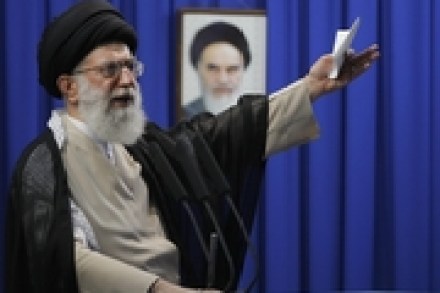
Reading about Khamenei’s speech at Friday prayers, it is clear that the situation in Iran has now reached a critical phase. The Supreme Leader has put his authority on the line with his demand that the protests now cease. As he put it, “street challenge is not acceptable”. If they continue tomorrow and the crowd is of the same size as Monday’s, then we are into a new phase where the protests are much more of an explicit challenge to the regime. The fact that Mousavi did not attend the speech, despite reported pressure to do so, suggests that he is not minded to back down. However, one senses that the phrase “street challenge is not acceptable” implies that a far-harder line will be taken with the protesters.

The argument that Mandelson lost, might be the argument that guarantees that Labour loses the next election

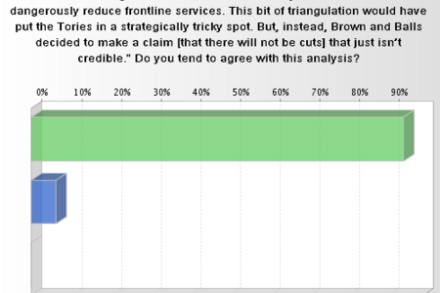
One of the few arguments Peter Mandelson is reported to have lost since returning to British politics, is how to present the argument about cuts. Mandelson was, apparently, in favour of making cuts and then claiming that any further cuts would endanger front-line services. This would have gone some way to acknowledging the fiscal reality but still enabled Labour to claim that public services are only safe in its hands.  According to Politics Home’s Insiders survey—a politically balanced panel split between MPs, journalists and wonks—nearly everyone in Westminster seems to agree with Mandelson’s analysis not Balls and Brown’s. Now of course, the Westminster Village can often get it very wrong.

The Iraq inquiry we need

John Rentoul is right that many of those who agitated for a sixth inquiry into the Iraq war will not be satisfied until an inquiry returns the verdict that they want, namely that the lying bastards lied to take us to war. Any inquiry that does not come to this conclusion is taken as proof that the lying bastards are still lying to us. But if not much is to be gained by going over the pre-war intelligence once more—and Gordon Brown only conceded this inquiry as part of his attempt to square a certain faction of the party to his continuing leadership, there is something to be gained by finding out who advised and who decided that British forces should essentially hand Basra over to Shi’ite militias. This decision was wrong militarily, as the Charge of the Knights showed.

The Brown-Mandelson relationship

Donald Macintyre has a fantastic essay on the Brown-Mandelson relationship in this week’s New Statesman. Two things in it stand out. First, Blair cautioned Alastair Campbell against going back into government but encouraged Mandelson to do so: “Blair’s advice, similarly solicited by Alastair Campbell, whom Brown also offered more or less any job he wanted, was more equivocal. Campbell refused the job offer; he had built another life, which he enjoyed.” Second, when Mandelson and Brown were at their most detached, Brown still called Mandelson on the death of his mother: “Even during the worst of the feud, the bond was never quite broken.

Campbell wonders at Balls’ motives<br />

This post from Alastair Campbell is fascinating and shows just how much Brown’s authority has slipped: “I had a brief chat with Ed Balls, unaware that he had said on TV yesterday morning that his 'personal' view was that the Iraq inquiry should have been more open than the one announced by Gordon Brown. As I said here the other day, the question of whether the inquiry is private or public is not as simple and straightforward as GB's critics are making out. But what is strange is that a member of the Cabinet, and one so close to the PM, should not be supporting him, totally, one hundred per cent, at this time, on a contentious issue. He must have heard GB's arguments in the Commons.

Beckett better than Bercow – but not by much

When Michael Martin announced that he was stepping down as Speaker, there was a general feeling that the House needed a substantial figure to step into the job, someone who could command the respect of the House and—just as importantly—the country. Well, it looks increasingly like we are going to get Margaret Beckett. Beckett is not the worst outcome of Monday’s Speakership election though. That would be John Bercow. Bercow has virtually no support on the Tory side and is being pushed forward by Labour MPs who rather like the idea of having a Tory Speaker who is disliked intensely by the Tories. But as Gary Gibbon reports, wiser heads are seeing the problem with this and an anti-Bercow bandwagon is beginning to roll of which Beckett is the most likely beneficiary.

What a Balls-up

A new poll out from Politics Home shows that the Balls and Brown attempt to claim that the next election will be a choice between Labour investment and Tory cuts isn’t doing Labour any favours. When asked which party is being most honest about tax and spend, Labour came third on 16 per cent behind the Tories on 37 and the Lib Dems on 28. Not even a majority of Labour supporters think their party is being straighter than other parties about its plans. Among non-aligned voters, only six percent say the Labour party is the most honest. The smartest strategy for Labour on cuts would have been to make a big show of making some and then claim that any further cuts would dangerously reduce frontline services.

Why the Tories might be backing Blair for the EU presidency

This morning’s story in The Times about how the Tories won’t oppose Tony Blair becoming President of Europe if the post is created can be read on two levels. The high-minded one is that Blair as a pro-American, economic liberal is as good as it is going to get from a British perspective so why try and block him. As one top Tory tells the paper, “Frankly we could do a lot worse”. The more scheming one is that the Tories are still worried about Blair’s domestic vote-winning potential. A few weeks back I was chatting with one of the most politically astute Tory strategists about how the coming general election campaign might play out. I was struck by how he was convinced that Blair’s return to the trail would give Labour a boost.

The race to stop Iran getting the bomb is what counts

The scenes from Tehran have been inspiring and show that democracy is changing the shape of the Middle East, says James Forsyth. But the immediate decision facing President Obama is what to do about Iran’s fast-moving nuclear programme It was what the West had long dreamed of seeing in Iran. The largest rally in Tehran since the Islamic Revolution of 1979 was not demanding death to America but respect for the democratic process. Those who have long claimed that the Iranian people are the greatest threat to the theocrats of Tehran appeared to have been proved right as hundreds of thousands marched against the status quo. The much-talked-about liberalism of Iran’s youthful urban population was making itself shown.

Reporting from Iran

The New York Times’ excellent Iran blog flags up the fact that the Iranian government are now clamping down on reporters: “Iranian authorities are restricting all journalists working for foreign media from firsthand reporting on the streets. The rules cover all journalists, including Iranians working for foreign media. It blocks images and eyewitness descriptions of the protests and violence that has followed last week’s disputed elections. The order issued Tuesday limits journalists for foreign media to work only from their offices, conducting telephone interviews and monitoring official sources such as state television.” This is, obviously, not a surprising move.

Re-vote rumblings from Iran<br />

The New York Times is running an excellent rolling news blog on the situation in Iran; I’d recommend it to everyone. Interestingly, Moussavi—the defeated candidate—is saying he would accept a re-vote: ‘In his first public appearance since the elections three days ago, Mir Hussein Moussavi, the defeated presidential candidate, told supporters at the rally in Tehran on Monday that he would take part if new elections were called. “The vote of the people is more important than Moussavi or any other person,” he said' The blog also reports that Press TV, the state-backed news channel, is saying that Moussavi’s rally against the announced results drew “hundreds of thousands of people”.

Is McBride back?

An email lands in my inbox, directing me to this story in yesterday’s Scotland on Sunday: “Just weeks after McBride was forced to resign after writing an e-mail suggesting that Conservative leaders be smeared, insiders say the former special adviser is actively working for ministers again. Downing Street last night insisted McBride had not returned. But one respected party figure said that while the former adviser was not working at Number 10, he was engaged in informal briefings once again.” Now, this story isn’t conclusive. But the next time Brown or Balls do a broadcast interview, it would be well worth asking them when the last time they spoke to McBride was.

The Mandelson solution, just keep taking the pills

Peter Mandelson dominates the Sunday newspaper; it seems that everyone has a long profile of him. But the best anecdote is in Jonathan Oliver’s Sunday Times piece:  One aide recalls the recent humiliation of a junior member of the cabinet: “We were called into Mandelson’s huge office. Peter said to my minister, ‘You look dreadful, poppet, take one of these’. Peter produced a bottle of painkillers and gave [the minister] two pills. He meekly swallowed them with a glass of water provided by Peter. It was all about asserting psychological control.

The next Speaker must command cross-party support

Frank Field is right that the new Speaker must be able to “command support amongst all the parties here at Westminster, including their own.” Field, who would make a fine Speaker, is right that it would be inappropriate for him to run unless he can gain considerable Labour support over the next couple of days. One hopes that John Bercow, whose Tory support is minimal, comes to the same, statesman-like conclusion.  If he gets the job thanks almost entirely to Labour voters he will be ineffective. As Field says: “It is important that our election of Speaker is seen to be one that is not driven by party advantage.

The Iranian election was fixed from the start

Elections in Iran are neither free nor fair. Even before anyone started campaigning, the Iranian theocracy had barred any candidate they perceived to be a threat to the Islamic revolution from standing. So, it is not surprising that there appears to have been considerable interference with the voting process to give Ahmadinejad victory in the first round of voting. (The Interior Ministry says that with ninety percent of the vote counted, Ahmadinejad has sixty three percent of the vote and Moussavi a little under 35 percent). The three opposition candidates are saying that they will not accept the result. But it is unclear whether they will be able to mobilise their supporters to seriously challenge it.