James Forsyth

James Forsyth

James Forsyth is former political editor of The Spectator.

Clegg collides with Cameron over extremism

From our UK edition

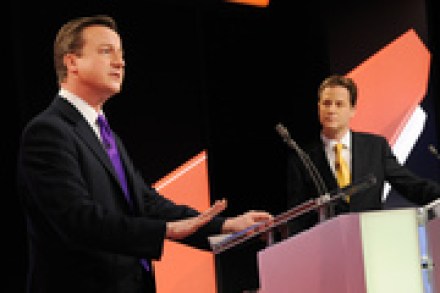
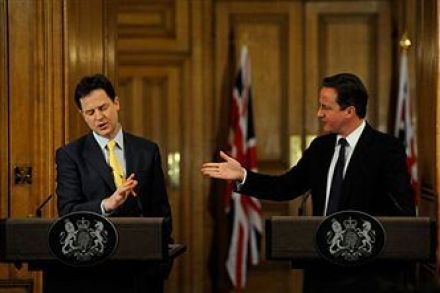
Nick Clegg’s speech in Luton today on extremism is a challenge to large parts of David Cameron’s remarks on the subject in Munich just last month. Indeed, even the venue of the speech can be seen as a rebuke to Cameron who was attacked for giving a speech on Islamic extremism on the same day that the English Defence League was marching in Luton. Cameron’s speech, which was one of the best of his premiership, argued that ‘the ideology of extremism is the problem’ and that terrorism’s ‘root lies in the existence of this extremist ideology’.
Hunt’s rising star

From our UK edition

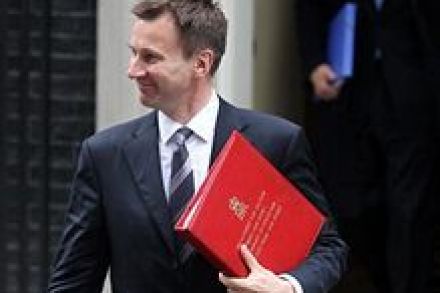
The decision on News Corp's take-over of BSkyB has thrust Jeremy Hunt into the spotlight. The culture secretary is many Tories' bet to be the next leader of the party. Hunt is ambitious even by political standards: during the Brown bounce he canvassed opinion as to whether he should stand in the Tory leadership contest that would follow an election defeat, and has a John Major like ability to make factions in the party feel like he is one of them. Add to this, a good television manner and one can see why people think he'll go far. One of the odd things about politics is that there is no heir apparent to Cameron in the Tory party. Hague used to be considered the obvious emergency replacement. But that is no longer true.

Promoting Cameron from a party leader to a national leader

From our UK edition

Danny Finkelstein’s paean of praise (£) to Andrew Cooper, the PM’s new director of political strategy, contains several interesting lines.  Finkelstein says that his former flat mate’s biggest challenge is, ‘Devising a strategy for changes in the NHS so that a critical political battle isn’t lost disastrously’. This is yet another indication of how nervous Osborne and co are about Lansley’s reforms and reopening the NHS as a political issue. The second is him reporting that Cooper will tell ‘Cameron to be a national leader, rather than a party politician. Especially in the Commons.

The domestic politics of oil

From our UK edition

Developments in Libya continue to dominate the news, and rightly so. The view from Whitehall is that this stands off will continue for some time. There is even talk that we might be heading to a situation where Gaddafi holds onto Tripoli for months while the rest of the country is liberated from his rule. The longer this instability continues in the Middle East, the higher the price of oil is going to go. This will have two immediate domestic political consequences. First, the price of petrol at the pump will increase—making fuel duty an even bigger political issue. Second, higher oil prices will depress economic growth. Word is that the Saudis are prepared to pump more to keep prices down if necessary.

Iranian regime moves against opposition leaders

From our UK edition

There are two significant developments in the Middle East to reflect on tonight. The New York Times is reporting that two Libyan air force jets conducted bombing raids on Monday. These raids appear to have been relatively ineffective. But they do suggest that there are still pilots prepared to carry out the regime’s orders, something that makes the issue of a no fly zone pertinent. But, perhaps, more important is that ground-level counter attacks by pro-Gaddafi forces have been repelled with relative ease by the rebels. Second, the Iranian government have, according to the BBC, removed Mir Hossein Mousavi, the ‘defeated’ 2009 presidential candidate, and Mehdi Karroub, the reformist politician, from their homes.

Cameron: military action not out of the question in Libya

From our UK edition

The government’s game of catch-up on Libya continues apace. David Cameron came to the Commons to update the House on the current situation. His main message was now that we have the vast majority of our citizens out, we can have a policy. Indeed, the government is today openly admitting that it was hamstrung last week by the continuing presence of a large number of British nationals in Tripoli. Cameron told the House that ‘we do not in any way rule out the use of military assets’; a dramatic shift from the tone of his entourage on last week’s trip. At the moment, the main military option on the table seems to be a no-fly zone and Cameron said he had asked the MoD and the chief of the defence staff to examine how this could be done.

The need to address National Pay Bargaining

From our UK edition

National Pay Bargaining is one of the major impediments to rebalancing the national economy and improving the quality of public services. But as Julian Astle, the head of the Liberal think tank Centre Forum, notes the coalition is doing little about it. It knows that the public sector unions will go to the wall for national pay bargaining and so are holding off. Gordon Brown flirted with doing something about national pay bargaining, announcing a review of it in the 2003 Budget. But he then backed away from the issue. One area where the coalition is chipping away at national pay bargaining is schools. Academies and free schools have the right to set their own pay and conditions. But, interestingly, academies tend not to use these freedoms.

The charge that the coalition should fear

From our UK edition

The greatest political, as opposed to strategic, threat to the coalition from the Libya evacuation crisis was that it would give the government a reputation for incompetence. As I say in the Mail on Sunday, Labour are looking to pin the incompetence charge to the coalition at every possible opportunity. The Miliband team knows that if the coalition comes to be seen as incompetent, then it is done for. Once a government comes to be seen as incompetent, then it is almost impossible for it to gain support for any of its proposals as even those who agree with the ideas don’t trust the government to implement them. Equally, any good news is seen to be fortuitous and not a consequence of the policies that the government has pursued.

Politics: Europe poisons the lot of the minister

From our UK edition

Have the Tories rediscovered the Right instincts? If power without responsibility has been the prerogative of the harlot throughout the ages, then the lot of a government minister can seem like responsibility without power. In private moments, ministers complain that they are overwhelmed by paperwork and have to drive change through a recalcitrant Civil Service. Members of the coalition Cabinet are rapidly finding out that the answer to the question ‘who governs Britain?’ is not as simple as they’d hoped. Nothing new there. Relative impotence is the perennial complaint of new ministers. They quickly come to appreciate that Yes, Minister was as much fact as fiction.

What the Libyan debacle reveals about the Civil Service

From our UK edition

The headlines about Nick Clegg forgetting that he was running the country and the botched evacuation of British nationals from Libya have combined to make the coalition look rather incompetent, the most dangerous thing for a government to appear as. Certainly, the effort to get British people out of Libya has been a national embarrassment. The whole evacuation debacle is, though, more a tale of bureaucratic incompetence than anything else; a painful reminder that the Civil Service machine, upon which the government relies, is in bad repair. I hear that William Hague has already carpeted senior officials in the department over the whole episode.

Making the case for high-speed rail

From our UK edition

Today’s letter in the FT from 69 business leaders in support of high-speed rail is a great example of how you advance an argument. We have so often heard politicians announcing that a particular scheme will create jobs and promote growth that we have become inured to it. But the public does listen when a huge number of businesspeople come out in favour of something. The opponents of high-speed rail are well-organised and have hired one of the best companies in the business to make their case. But this letter moves the debate onto the territory where the government needs it to be: high-speed’s importance in creating jobs in the Midlands and the North.

What to do about the Gaddafi family?

From our UK edition

The Al-Jazeera live blog has a fascinating report that the Gaddafi’s daughter Ayesha has unsuccessfully attempt to leave Libya for Malta, the Maltese refused her plane permission to land. There are also reports that a Libyan plane that wanted to land in Beirut contained one of Gaddafi’s daughters-in-law. The question raised by this is whether it is a sign that the family is splitting or just an attempt to get various members out before the violence becomes even worse. Unpalatable as it is, one option that should be explored is whether Gaddafi might step down in exchange for asylum for him and his family somewhere. Persuading him that there is a better option than the martyrdom he was talking about yesterday is one way of preventing mass blood-shed.

Act soon or face another Guernica

From our UK edition

We now know that Libya is heading into a full on civil-war and that Gaddafi is prepared to do pretty much anything to stay in power. The former interior minister Abdel Fattah Younes al-Abid, admittedly a partial source, says that he defected after arguing with the Libyan leader over his plan to bomb the rebel stronghold of Benghzai. In an ideal world, the United Nations would move to impose a no fly zone on Libya. But this is unlikely to happen. Russia and China, for obvious reasons, want to uphold the principle of non-interference in another state’s affairs even if that state is brutally repressing its own people.   This puts the ball in Nato’s court as the largest military alliance of liberal democracies there is.

Libya on the brink

From our UK edition

Tonight, Libya appears to be on the verge of a full on civil-war. The interior minister has defected to the opposition and urged the army to do likewise. The interior minister has also warned that there are half a million mercenaries in Libya under Gaddafi’s orders. This seems further grim confirmation of just how far Gaddafi is prepared to go to hang onto power. If Gaddafii does step up his campaign of violence against his own people it raises the question of what the international community can—and should—do. There’ll be some who say that this is no one but Libya’s business. But this argument is flawed strategically as well as morally as slaughter in Libya will have a spill-over effect.

Ashdown goes Fox-hunting

From our UK edition

There’s a quite remarkable op-ed by Paddy Ashdown in The Times (£) today which goes public with a lot of the griping about Liam Fox that one heard behind the scenes at the time of the Strategic Defence Review. Ashdown remarks that the ‘problem with the SDSR was not speed, but lack of political direction.’ He then details how ‘Sir David Richards, then head of the Army and now Chief of the Defence Staff, had to bypass the whole process (and his Secretary of State) to appeal to the Prime Minister to avert catastrophe in the Army.

Cameron’s fine, liberal speech

From our UK edition

David Cameron’s speech in Kuwait today did not take on his hosts in the way that Harold Macmillan’s ‘winds of change’ speech did. But it was a still fine, liberal speech. The key argument of the speech was that: ”As recent events have confirmed, denying people their basic rights does not preserve stability, rather the reverse. Our interests lie in upholding our values – in insisting on the right to peaceful protest, in freedom of speech and the internet, in freedom of assembly and the rule of law. But these are not just our values, but the entitlement of people everywhere; of people in Tahrir Square as much as Trafalgar Square.” This is the crucial point: crude realism is not realistic.

Three reasons why David Cameron should get involved in the No to AV campaign

From our UK edition

Over at Comment Central, Danny Finkelstein has written a post saying that it might not be in the best interests of the No campaign for Cameron to campaign heavily against AV. His argument is that the No campaign’s best hope is to run as a spiky, anti-establishment effort. I think this is true but that the No camp has rather forfeited this chance by appointing Margaret Beckett as its president and having a former Labour MP front its launch. If the No campaign is going to be use so many politicians as spokesmen for it, it might as well have one of the most able ones involved. Second, and most importantly, Cameron’s presence on the trail would highlight Nick Clegg’s absence.

Is David Cameron about to have one of his Garibaldi moments?

From our UK edition

To date, this government has not had much of a foreign policy. Where there should have been grand strategy there has been trade promotion. But this appears to be changing. It is certainly striking that Cameron is the first western leader to visit post-Mubarak Egypt. Cameron himself is, normally, at the realist end of the foreign policy spectrum. But, as one close friend observes, one of the most important things to grasp in understanding the Prime Minister is that Garibaldi is one of his great heroes. As Cameron told Charles Moore, he admires Garibaldi’s ‘romantic nationalism'.

Will Clegg’s caution turn Cameron’s big bang reforms for public services into a damp squib?

From our UK edition

David Cameron’s piece on opening up public services today is, as Ben Brogan notes, one of the most important moments of Cameron’s premiership so far. First, it is, as I discussed last week (subscribers here), part of a concerted attempt to get the Big Society back to its original meaning, that public services do not need to be provided by the state. As Cameron writes, “our plans to devolve power from Whitehall, and to modernise public services, are more significant aspects of our Big Society agenda than the work we're doing to boost social action.” Next, the ideas in this piece are the central thread that runs through the public service reforms the coalition is pushing through.

Is the Libyan military about to dump Gaddafi?

From our UK edition

There’s an intriguing Sky News report this evening which suggests that the Libyan Army might be about to turn away from Gaddafi. The channel is reporting that soldiers in the second city of Benghazi have turned from the regime and have told locals that they have ‘liberated’ the city. If the bulk of the military abandon him, then Gaddafi is done for. This combined with the news that the demonstrations have spread to Tripoli and that several of the tribes are joining the cause suggests that the revolution is Libya is gaining momentum. Certainly, the live resignation of the Libyan Ambassador to China live on air indicates that the governing class is split. Set against this though is that Gaddafi is nothing if not a survivor.