James Forsyth

James Forsyth

James Forsyth is former political editor of The Spectator.

Osborne’s white rabbit

From our UK edition

We can expect at least one rabbit out of the hat in George Osborne’s Budget speech. The Chancellor is a canny enough operator to have held at least one big announcement back. Already this morning, we have had news that all councils will freeze or reduce their council tax next year. But I expect there is one more on fuel to come in the speech itself, possibly the suspension of the fuel duty escalator for this parliament. This move would be expensive but it would also say I feel your pain and stop Osborne having to come back to the price of petrol every year. For Ed Miliband, today will be a test of his ability to think on his feet.
Budget eve

From our UK edition

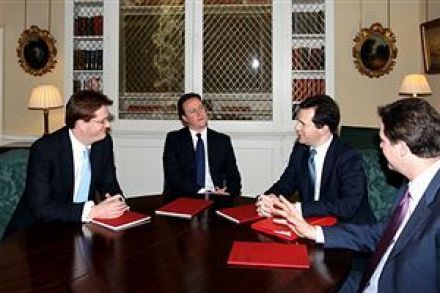
In stark contrast to 2003, when Gordon Brown delivered his Budget on the same day that Baghdad fell, the Treasury is phlegmatic about the Budget being overshadowed by Britain’s involvement in a conflict overseas. But the signs are that this will be, within the obvious fiscal constraints, an ambitious Budget. Tonight, we have had confirmation of a raise in the income tax allowance to £8,000, something that will please the Lib Dems . Tomorrow, we’ll almost certainly get at least one unexpected rabbit out of the hat. What we do know is that the Budget and the growth review will be built around four things: deregulation, planning reform, tax simplification and targeted investment.

Removing Gaddafi is key

From our UK edition

The question of whether Gaddafi should be targeted and what the exit strategy should be in Libya are intimately linked. In truth, there is no exit strategy that does not involve Gaddafi’s fall from power. As long as he is there, the threat to those that the international community is now pledged to protect will remain. Even a de facto partition of Libya with Gaddafi in charge of the west and the rebels the east would require — at least — an over the horizon presence to ensure that Gaddafi did not attempt to raid across the line or invade the east. At the moment, the British government appears to be relying on Gaddafi being toppled by his own military in an act of self-preservation.

The Commons votes to support the intervention in Libya

From our UK edition

The House of Commons has just voted by 557 to 13 to support Britain’s participation in the enforcement of UN Security Council Resolution 1973. This came at the end of six and a half hours of respectful debate rounded off by a speech from the Foreign Secretary that reminded us why he was for so long regarded as the best parliamentary performer on either side of the House. Hague offered an assurance that if the mission changes, the government will return to the House. This was widely understood to mean that no ground troops would be committed without the support of the House. He also confirmed that the costs of the operation would be met from the reserve. Having watched much of the debate, I would say that the mood of the House was not quite as the vote suggests.

Cameron promises that Libya is ‘not another Iraq’

From our UK edition

Discussion of military action brings a different atmosphere to the chamber of the House of Commons: quieter, less disputatious, more consensual. In opening the debate, the Prime Minister took a huge number of interventions including a large number from those MPs who are most sceptical of this intervention. All were heard respectfully and answered respectfully. Cameron’s desire to find consensus was part of his broader message that this is ‘not another Iraq.’ He stressed that the action in Libya was necessary, legal and right and that any kind of occupying force is ruled out. He argued that the intervention had been ‘in the nick of time’ to prevent a massacre in Benghazi.

Targeting Gaddafi

From our UK edition

The press is currently making great play of an apparent difference between General Richard and Liam Fox on whether or not Gaddafi can be targeted. The whole debate flags up one of the absurdities of international legal convention. If it is legitimate to hit a Libyan tank crew moving on Benghazi, why it is not legitimate to target the person who is ultimately giving these orders?     Given the whole nature of the Libyan state, the fastest — and, I would say, most humane — way to end this conflict would be to kill Gaddafi.

Allied strikes hit targets in Tripoli

From our UK edition

Tonight’s news of major explosions in Tripoli shows that the allies are putting little store in the Gaddafi regime’s unsubstantiated claims of a ceasefire. Some of the targets appear, from reports, to have been in the same area of the city as Gaddafi’s barracks and residence. The US military, though, says the allies are not targeting the dictator specifically. Judging from comments made by the US Defence Secretary Robert Gates, the Americans are looking to hand over control of the operation to the French and/or British in the next few days. Pentagon fears over US military overstretch, which are part of the reason that Obama has sounded such an uncertain trumpet on Libya, are still playing a large part in determining the American response.

Why Osborne is so interested in merging income tax and National Insurance

From our UK edition

When trying to understand George Osborne Budgets, you need to bear in mind the mantra that he and his team live by: in opposition you move to the centre, in government you move the centre. It is this desire to move the centre ground that lies behind Osborne’s keenness to merge income tax and national insurance. As I say in the Mail on Sunday, the thinking behind it is that if people were more aware of how much tax they really paid, they’d be more inclined to vote for low-tax parties. At the moment, National Insurance is one of the taxes people are least aware of as it is simply deducted from their pay cheque. It is no coincidence that the most unpopular taxes—council tax, inheritance tax—are the ones that voters are most aware of paying.

Allied military intervention in Libya has commenced

From our UK edition

Reports are coming in that French jets have fired the first shots in the UN-supported intervention in Libya. The coming conflict will determine, in the short term, whether the Gaddafi regime is toppled and, in the longer term, whether the international community rediscovers its appetite for intervention which had been so diminished by the controversies over Iraq and the difficulties of the Afghan mission. That there is intervention at all in Libya is down in no small part to David Cameron and William Hague. Hague played a key role in ensuring that Arab countries were prepared to commit to putting planes in the air in this operation, something that was crucial to moving the vacillating Obama off the fence.

One week to get a grip

From our UK edition

It was meant to be a routine budget. Now Osborne looks like the government’s last chance ‘The Cameron project is worth saving’, a government insider said to me recently. It was a striking declaration. After ten months in government, the people on the inside are not talking about a bumpy start or a rough patch. Rather, their language suggests an existential struggle: they worry that, unless something changes, they will fail. The sense of panic that was so acute among Conservatives four years ago, when Gordon Brown seemed ready to call and win an election, has returned. And with that, a feeling that something drastic needs to be done — and that George Osborne is the man to do it.

Allies’ statement on Libya demands more of Gaddafi than just a cease-fire

From our UK edition

A statement has just been issued by the sponsors of last night’s Security Council resolution, it reads: “Resolution 1973 lays out very clear conditions that must be met. The UK, US, France and Arab States agree that a cease fire must be implemented immediately. That means all attacks against civilians must stop. Gaddafi must stop his troops from advancing on Benghazi, pull back his troops from Ajdabiyah, Misratah, and Zawiyah, and re-establish water, electricity and gas supplies to all areas. Humanitarian assistance must be allowed to reach the people of Libya. These terms are not negotiable. If Gaddafi does not comply with the Resolution, the international community will impose consequences, and this Resolution will be enforced through military action.

Libya declares a ceasefire

From our UK edition

What to make of Libya’s declaration of a ceasefire and acceptance of the UN resolution Seen most cynically, it could just be seen as the Gaddafi regime playing for time, using the extra hours to make it more difficult in both military and political terms for action to be taken. Or, it could indicate a division within the regime, with more pragmatic elements trying to temper Gaddafi’s threats and avoid anything that brings the situation to a head.

Cameron’s sombre statement

From our UK edition

David Cameron was calm, measured and far from messianic as he delivered his statement to the House on the coming action against Libya. He was keen to stress that last night’s resolution ‘excludes an occupation force of any part of Libyan territory.’ However, he did, in answer to a question from James Arbuthnot, agree that regime change was likely to be necessary to achieve the aims of the resolution.   Cameron said there would be a statement later today from international leaders and it seems that this will be an ultimatum to Gaddafi. If military action does follow, Cameron said that he had ‘some guarantees’ from Arab leaders that they would play an active role in the operation.

Cameron’s persistent leadership on Libya was key to tonight’s resolution

From our UK edition

David Cameron deserves huge credit for tonight’s Security Council vote. He has kept plugging away for a no fly zone and has succeeded in moving the Obama administration’s position. Cameron’s decision to have Britain table with the French and the Lebanese a Security Council resolution without the support of the Americans or even having talked to the president was a bold move that has turned out to be a game changer. The Prime Minister has proved himself an effective and courageous actor on the world stage. The question now is how quickly and effectively military force can be deployed and how Gaddafi is to be ousted. It, obviously, would have been better if the no fly zone had been imposed when the rebels had the military momentum.

The government’s escalating fight with the civil service

From our UK edition

Talk to a Cabinet minister these days and you’ll nearly always get a string of complaints about the civil service. Cabinet ministers have come to see them as obstructionist, problem finders. David Cameron went public with these feelings in his spring forum speech when he announced that there were ‘enemies of enterprise’ within the government machine. This prompted a rebuke from Sir Gus O’Donnell, the Cabinet Secretary. Traditionally, criticising civil servants is regarded as out of order because they can’t answer back. But the truth is, as former Blair speechwriter Phil Collins points out in the Times today, that civil servants now have power without accountability.

Zelikow’s case for a no-drive zone

From our UK edition

Philip Zelikow, who served on the 9/11 Commission and in both Bush administrations, has a persuasive piece in today’s FT arguing that a no drive zone on the highway from Tripoli to eastern Libya could be as effective as a no fly zone and easier to implement. He says that it could be enforced from off-shore with the use of precision weapons. Legally, there would be issue with this scheme—as there would be with any intervention in Libya that is not based on a full Security Council resolution  under chapter 7. But there simply will not be enough time now to get full UN authorization before Gaddafi has reasserted full control. The Obama administration, though, seems content to let the clock run down.

Rattled Cameron battles through PMQs

From our UK edition

A testy PMQs today with Miliband trying to pin Cameron down on the specific question of whether the NHS is now subject to EU competition law, and Cameron responding by dubbing Miliband ‘son of roadblock'. The exchange revealed that although Cameron is not a details man, something that will cause him problems in time, he still has enough presence in the chamber to withstand tricky moments. But I suspect that Labour will be happy if Miliband’s parting shot of ‘you can’t trust the Tories on the NHS’ makes it into the news bulletins this evening.

UN Security Council Resolution proposing a no fly zone over Libya is tabled

From our UK edition

Britain, France and Lebanon’s decision to table a UN Security Council resolution proposing a no fly zone and a bar on flights in and out of Gaddafi’s Libya is an honourable effort to push the international community to move before the window for action closes entirely. Yet as the French Foreign Minister Alain Juppe acknowledged yesterday,  "If we had used military force last week to neutralize some airstrips and the several dozen planes that they have, perhaps the reversal taking place to the detriment of the opposition wouldn't have happened," Juppe told Europe-1 radio. "But that's the past." "What is happening today shows us that we may have let slip by a chance," he added.

Gaddafi’s coming victory is a huge strategic setback for the West

From our UK edition

It now seems almost certain that Colonel Gaddafi will now not only survive in Libya but reassert control over the whole country. With the fall of Ajdabiya, there is no break between Gaddafi’s forces and the rebel capital of Benghazi. The window for international action is shutting rapidly, even if it has not yet closed. But, as so often, there seems to be no multilateral desire for action. Gaddafi’s triumph is a disaster for the Libyan people but also one of the biggest strategic set-backs the West has suffered in the post 9/11 world. Every dictator will now know that they can suppress a revolt with violence without fear of retribution.

Cameron’s call to the White House

From our UK edition

David Cameron’s statement on Libya today reflected his growing frustration at the pace at which the wheels of diplomacy are moving on this issue. In his statement, Cameron warned that ‘time is of essence’ and that Gaddafi staying in power, something Cameron had previously called ‘unthinkable’, would send a ‘dreadful signal’. Time, really, is of the essence. If we don’t see movement in the next few days, it seems almost inevitable that Gaddafi will crush the revolt. One of the things that Cameron stressed is that Gaddafi continuing in power would be more than a moral and humanitarian disaster.