James Forsyth

James Forsyth

James Forsyth is former political editor of The Spectator.

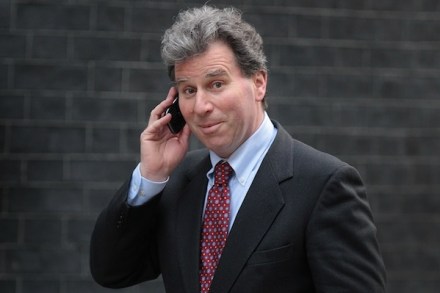
Letwin fails to consult about the consultation on consultations

Oliver Letwin’s decision to launch a consultation on reducing the amount of time that government has to spend on consultations has sparked controversy in Whitehall. Sticklers for procedure are complaining, in a way that only Sir Humphrey himself could do justice to, that other ministers hadn’t been consulted about the decision to launch a consultation on shortening consultations. Now, this is all quite trivial. But it does reveal just how bureaucratic modern-day government has become. This problem has been exacerbated by the Equalities Act and the rise of judicial reviews. Indeed, I understand that there is now a board of civil servants whose job is to review the equality impact assessments being done by other civil servants.
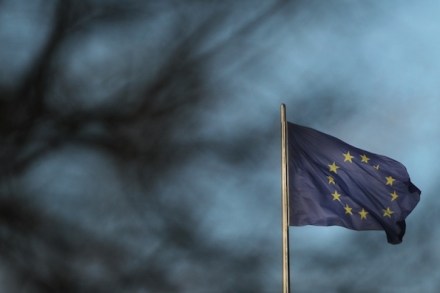
Cameron’s odd behaviour over Europe

Europe, as everybody knows, is one of those issues on which a Tory leader needs to pay particular attention to the words he uses. This makes David Cameron’s behaviour in recent weeks all the odder. First, we had that Brussels press conference in which Cameron sounded rather too enthusiastic about the EU for his own side’s tastes. This was followed by his Sunday Telegraph piece in which he stressed that ‘the two words “Europe” and “referendum” can go together’ for him. Now, those close to Cameron complain that the two positions were perfectly compatible and that in the first instance he was quoted selectively.

How long can the government ignore demands for free grammar schools?

The argument about grammar schools had been stuck in a rut. Opponents argued that the division between grammar schools and secondary modern was too binary. But with the advent of free schools this argument has lost its force. There is now a diversity of provision meaning that there’ll be no return to the old stark grammar/secondary modern split. Free grammars would also boost the number of state school children going to our best universities and unleash a new wave of educational philanthropy.

Consulting on consultations

We’re approaching that point in the government’s life cycle when ministers begin to worry about whether they’ll be able to get things done before the next election. One Tory was complaining to me yesterday that the civil service will simply be able to run down the clock with any new ministers after the next reshuffle. This nervousness about their ability to get things done is reflected in the fact that, and don’t laugh, the government is holding a consultation on whether its consultations need to go on so long. Eric Pickles has long been pushing for this, arguing that the 12 week consultations were excessively cumbersome. They certainly mitigate against any rapid government action.

Cameron must carry out a thorough reshuffle

With Parliament heading off for recess, politics will — barring some unforeseen event or the Eurozone crisis moving into one of its acute phases — be dominated by the Olympics for the next few weeks. David Cameron will be hoping that the global CEOs arriving in town will bring some good investment news with them. Boris Johnson, meanwhile, will revel in the global media attention. Indeed, Boris is already demonstrating an ability to brush off the organisational hiccups that other politicians can only envy. But most ambitious Tories will spend the summer thinking about the reshuffle, currently pencilled in for the third of September ahead of a Tory parliamentary dinner on the fifth.

Cameron and Clegg push the pro-coalition line

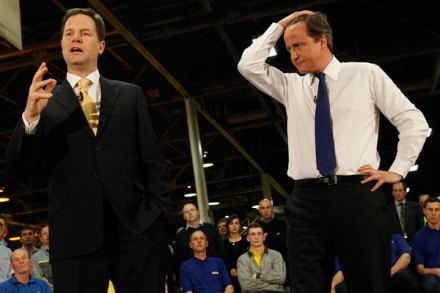
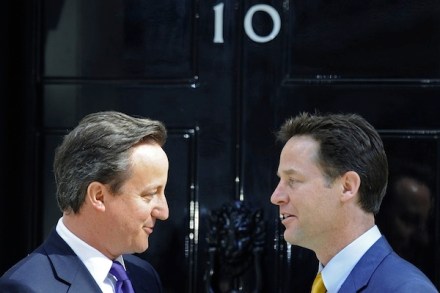
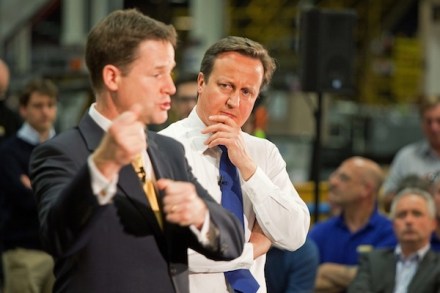
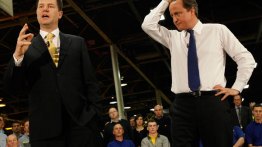
This morning’s press conference by David Cameron and Nick Clegg marked an attempt to scotch all the talk of the coalition moving to confidence and supply sometime before the next election. Cameron declared that he was more committed to the coalition than he was back in 2010. He also stressed that he believed Britain needed stable government ‘throughout this term’, an implicit rebuke to all those Tories talking about a move to minority government in 2014. Nick Clegg, for his part, spoke about how this was going to be a ‘proper coalition government for a full five years’.

The post-‘Cuban missile crisis’ coalition compromise

At the top of the coalition there’s a concerted effort to calm tensions, to de-escalate after its ‘Cuban missile crisis’. As part of that, I understand that David Cameron has indicated privately that if the Lib Dems do not get their elected peers, he won’t push the matter of the boundary reforms. I’m told he has no desire to end up in a situation where he’s sacking Lib Dem ministers en masse for voting against the government. Although, officially Number 10 is still stressing that it expects government ministers to vote for them when they come back to the House of Commons.

Rejecting the idea of coalition

Perhaps what most depressed the Liberal Democrats this week was the sense that the two main parties were rejecting the idea of coalition. One described to me how depressing he found it during the Lords reform debate to watch the Labour front bench revelling in every Tory intervention on Nick Clegg. At the top of the Lib Dems, there’s now a real worry that both Labour and the Tories would try and govern as a minority government after the next election if there’s another hung parliament rather than form a coalition. This would lock the Liberal Democrats out of power.  All of this makes Andrew Adonis’ comments in The Times today particularly striking.

Does the end of Lords reform mean the end of coalition

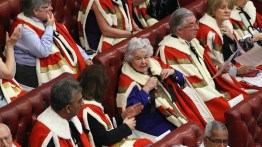
With this government, it is not ‘crisis, what crisis?’ but ‘crisis, which crisis?’ We now have a coalition emergency prompted by the fact that Lords reform has been dumped in the long grass despite being in the programme for government. We have a Tory party crisis occasioned by the biggest rebellion of David Cameron’s leadership and a Liberal Democrat crisis caused by the fact that their first period in office in more than 70 years now looks likely to bring no progress on the constitutional issues about which they care so deeply. It hasn’t been the usual Liberal Democrat suspects sounding off against David Cameron this week.

The odd omissions from the banking inquiry

The difficult birth of the parliamentary inquiry into Libor and banking standards continued today with a controversy over which members of the Treasury select committee have been appointed to it. To general surprise, Andrea Leadsom, one of the better questioners on the committee, has been left off. This is particularly odd given that she is a former banker with real knowledge of the industry. John Mann, the pugnacious Labour MP, has also not made the cut. He has responded by labelling the coming inquiry a ‘whitewash’. What makes Leadsom’s omission particularly odd is that the Tory MP selected to join Tyrie on the inquiry is Mark Garnier, who is also a member of the 2010 intake. So, this is not a question of parliamentary seniority.

Failing to build another runway is economic self-harm

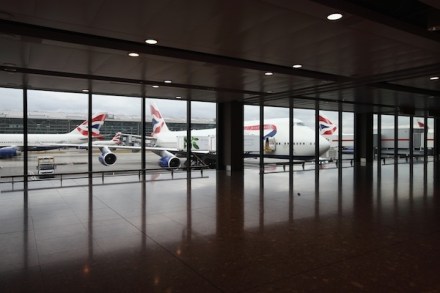
The continuing failure to build another runway in the south east, let alone a new airport, is an act of economic self-harm. Trade used to follow the flag, it now follows the flight path. This makes it particularly depressing that the government is pushing back its aviation strategy yet again. As one Tory MP said to me earlier, ‘if we’re not serious enough about growth to build another runway we should just go home’. David Cameron needs to do what it takes to get another runway through. If that means moving Justine Greening, a long-time opponent of a third runway at Heathrow, from transport then he should do it. Indeed, Greening — good on the media and not a ‘posh boy’ — would be a good choice for party chairman.

Cameron tries to calm troubled waters at the 1922 committee

By tradition, David Cameron stands outside meetings of the 1922 waiting to be summoned in. This meant that several late-arriving rebels had to walk past him on their way in. By and large, things were fairly cordial. But there was some tension at various points. Cameron started with a tribute to the Chief Whip, which got the MPs banging the desks. Some are taking this as a signal that Patrick McLoughlin is to be retired in the reshuffle. But those present thought it was more of a public admission that the whipping problems of the last few weeks have not been caused by the Chief but by Number 10 and coalition. There was, as usual, much talk of taking the fight to Labour.

Miliband gets under Cameron’s skin at PMQs

Ed Miliband enjoyed Prime Minister's Questions today. For the first time, he tried to bully Cameron. His questions were all designed to get under the Prime Minister’s skin. Once he had got the requisite rise, he joked about Cameron: ‘The redder he gets, the less he convinces.’ In a sign of what the general election could be like, Cameron’s response was based on Labour’s record in office. He declared ‘we will never forget what we were left by the party opposite’ and ‘never forgive them for what they did'. Miliband, for his part, concentrated on the recession and the Tories' decision to cut the top rate of tax. Perhaps, the most interesting thing about PMQs, though, was the reaction of Tory benches.

Cameron will pick party over coalition on Lords reform

The government’s apparent decision to pull the programme motion on the Lords Reform Bill is an admission that it would have lost the vote tonight, and heavily. The rebel numbers have more than held up today and by mid-afternoon even previously loyal MPs were contemplating jumping in to the rebel camp. The question now is what the coalition does next, does it plough on with the bill and try to guillotine it at a later date or quietly drop it. Certainly, the Tory opponents of the bill are in no mood to back down. They are making clear that even if the government comes back offering twenty days of debate they’ll still oppose it.

Lords reform is in the long grass

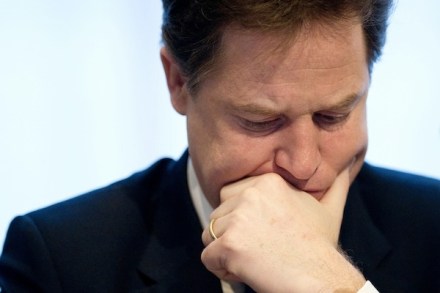
The look on Nick Clegg’s face as he entered the chamber to hear Sir George Young announce the withdrawal of the programme motion said it all. The Deputy Prime Minister knows that Lords reform is now in the long grass and it will only come out of there if either the Tory rebels back down or Labour agree to a programme motion, both of which are unlikely scenarios. Source close to Nick Clegg say that the Prime Minister informed the Deputy Prime Minister today that he needed more time to build consensus on his own side. The public plan is now to try for a programme motion again in the autumn. But I understand that this is dependent on the Tory rebellion crumbling, or at least reducing in size — something that seems unlikely at present.

Charlotte Leslie becomes the latest 2010 MP to oppose Lords reform

Charlotte Leslie becomes the latest star of the 2010 intake to come out against the coalition’s version of Lords reforms. Explaining her decision, she emphasised to The Spectator her concerns that while the new Lords would be elected ‘they would not carry the great benefit of democracy, accountability'. As Leslie points out, this means that a Lord ‘could get elected on a myriad of populist promises, then fail to honour any of them'. She also has worries about the loss of expert knowledge from the chamber when it is elected. But her objections are, perhaps, best summed up by her attack on the argument that Tories should vote Lords reform through for the sake of the coalition: 'This is not about our inter-relationship in the next 800 or so days to come.

What Mark Harper isn’t telling us

Mark Harper is touring the broadcast studios at the moment making the case for the coalition’s Lords reform bill. Being Nick Clegg’s Conservative deputy is not an easy job. But there is something particularly disingenuous about one of the arguments that Harper is using.   Harper said On Sunday, as Conservative Home reported, that: ‘It’s been Conservative policy to have a mainly elected House of Lords since 1999. I stood on the last three elections on that manifesto and the Coalition Agreement does no more than ask both the Coalition parties to deliver what was in both of our manifestos’. What this ignores is that in 2007, Harper voted against a fully elected Lords, an 80% elected Lords, and a 60 percent elected Lords.

Is Lords reform heading for a slow or quick death?

At the end of last week, Number 10 was optimistic that it and the whips were having some success in limiting the rebellion on the Lords. Some were even suggesting that the vote on the programme motion was winnable, after all. But that feeling has evaporated this morning. First, the weekend ring round by various senior figures did not meet with great success. Second, the 'dear colleague' letter signed by 74 MPs means that the programme motion is now pretty much certain to be defeated. Indeed, the rebels number considerably more than 74 when you include the PPSs who are planning to vote against it, the backbench opponents trying to fly under the radar and the Chairman of the 1922 Committee Graham Brady, who is also opposed but has not signed the letter.

Clegg takes a hammering over Lords reforms

Nick Clegg was standing at the despatch box to move the second reading of the coalition’s Lords reform bill. But the reception he got was reminiscent of what used to happen to Lib Dem leaders at PMQs. He was barracked mercilessly by both Labour and Tory benches while his own benches remained oddly silent, only one of his MPs intervened on his behalf.   Watching the Tory benches during Clegg’s speech it was hard not to imagine a considerable rebellion tomorrow night. At one point, the interventions were coming in so thick and fast that Clegg appeared to be almost ducking at the despatch box. The Tories seemed to be relishing the trouble that the Deputy Prime Minister was in. Even as sober a figure as Malcolm Rifkind was chuckling at one point.

The Tory troublemaking begins on Lords reforms

One instructive way to think about Tuesday’s vote on Lords reform is, do you want to have proportional representation used to elect people to the Westminster parliament? I suspect that most people on the centre-right would answer no to that question, and with good reason. In the current British system, PR would work against the centre-right’s political interests.   It is for this reason that the term rebel is a bit of a misnomer for those Tories trying to thwart the coalition’s plans for Lords reform. The likes of Andrew Griffiths, an adviser to Eric Pickles when he was party chairman, and Angie Bray, a former Central Office staffer, are party loyalists far more than they are rebels.