Isabel Hardman

Isabel Hardman

Isabel Hardman is assistant editor of The Spectator and author of Why We Get the Wrong Politicians. She also presents Radio 4’s Week in Westminster.

Exclusive: Under-fire minister explains to local party why he’s missing HS2 vote

While some ministers have mysteriously disappeared today so that they don't have to vote in favour of the high-speed rail line that will cut through their constituencies, Minister for Civil Society Nick Hurd is busy explaining to his disgruntled local party why he isn't turning up to vote on legislation which affects his constituency of Ruislip, Northwood and Pinner but which he supports. I understand that Hurd has told local party members that though he thinks HS2 may be in the national interest, he understands their concerns about the link, and wants to try to get the very best deal for his constituents on compensation and the environmental impact of the line.

Tory HS2 rebel: We need a plan in case Labour drops support

Whether or not key ministers whose constituencies are affected by HS2 turn out to vote at today's second reading of the legislation introducing it, the bill will pass this stage with a big majority thanks to cross-party support. Between 20 and 30 MPs are expected to defy the whip and either vote for a motion declining to give the Bill a second reading, or against the second reading itself. What will be interesting over the next few months is how many concessions critics of the Bill are able to eke out of the government, and whether this buys them off or not. When I spoke to Cheryl Gillan about her proposals for a longer tunnel under the Chiltern area of outstanding natural beauty, she told me that 'I'm not changing my position on the basis of that in any way, shape or form.

Is it fair that anti-HS2 ministers could disappear for key votes?

Where will the ministers whose constituencies will be affected by HS2 be when the legislation reaches its key votes in the Commons? As I said on Friday, the chances are that some of them might suddenly find they need to travel overseas quite urgently when MPs vote at second reading on Monday, and again at report stage and third reading later on. The ministers in question are as follows: David Lidington – Con – Aylesbury and Buckinghamshire. Minister of State for Europe. Dominic Grieve – Con – Beaconsfield. Attorney General. Jeremy Wright – Con – Kenilworth and Southam. Minister for Prisons and Rehabilitation. Nick Hurd – Con – Ruislip, Northwood and Pinner. Minister for Civil Society. Andrea Leadsom – Con – South Northamptonshire.

Whips relaxed as HS2 bill faces small rebellion at second reading

The High-Speed Rail Bill pops up in the Commons on Monday - with two attempts to kill it off planned. Michael Fabricant and Cheryl Gillan - whose constituencies would both be affected by the proposed route - have both drawn up motions which call for the House of Commons to decline to give the Bill a second reading. Fabricant was sacked from his position as Vice Chair of the Conservative party for pushing ahead with his motion (and a number of other things, too) and has the support of Sir Edward Leigh, Jeremy Lefroy, David Davis, David Nuttall, William Cash, Caroline Spelman, Bob Blackman, Chris Kelly and Andrew Turner.

Why the local elections matter more to the Tories

Forget the European elections, which everyone (particularly those who fancy causing a bit of grief for David Cameron) expects to produce humiliating results for the Conservatives. The elections that have a longer-lasting impact that take place on the same day are the local elections. I look at the emphasis the Tories are putting on campaigning in the locals that goes over and above anything they're doing for seats in Brussels, in my Telegraph column today. But even those areas that don't have concurrent local and European polls on 22 May aren't exhausting themselves on campaigning for the European elections. Last year, the Conservatives tried to manage expectations by suggesting at one point that they would lose up to 750 seats - in the end they lost 335.

Labour’s unimpressive ‘zero hours’ announcement

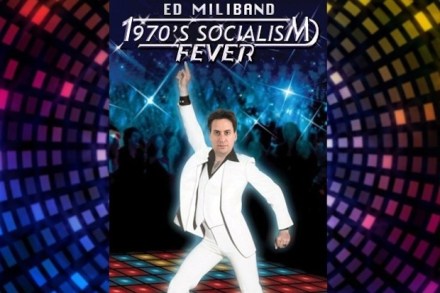
Labour's announcement on zero hours contracts today as the Shadow Cabinet visits Scotland is supposed to be a demonstration of how much better the UK can be by staying together. Ed Miliband's reasoning is that a border between Scotland and rUK would mean a 'race to the bottom' between the two countries, who would come under pressure from 'powerful interests' to 'worsen wages and conditions for everyone else'. It's part of Labour's 'positive case' for the union which the party wants to make today, and the reasoning does, if you're a Labour type, make sense. The only spanner in the works is the policy that he's announcing, which will hardly set the soul on fire if you're a Labour type who has been expounding on the evils of these contracts.

Doing God works well for Cameron

David Cameron's decision to hug-a-Christian seems to have worked pretty well, judging by the political response he's provoked. For starters, his comments about Britain being 'evangelical' about its status as a Christian country managed to enrage the sort of people who also might annoy the churchgoing conservatives he needs to win back after the row over gay marriage. Today, he - and the secularists - got a response from the Archbishop of Canterbury who wrote on his blog: 'It's all quite baffling and at the same time quite encouraging. Christian faith is much more vulnerable to comfortable indifference than to hatred and opposition. It's also a variation on the normal "Sword and Grail discovered" stuff that seems to be a feature of Easter week news.

What does new Number 10 hire mean for stop-and-search reform?

As James revealed on Coffee House earlier, Max Chambers will take over from Patrick Rock on the home affairs brief in the Number 10 policy unit. One thing that will be particularly interesting to watch is whether Chambers' appointment leads to a shift in Number 10's stance on stop-and-search. Rock had been one of the key figures blocking Theresa May's reforms to the power for the police, for fear that it would make the Tories appear soft on crime. So will the new adviser be more amenable to change? I am told that Chambers is open to ideas on reform of stop-and-search and is keen to see more evidence of the need for changes.

Who tells Ed Miliband when he’s made a mistake?

Dan Hodges' piece in this week's Spectator on the team around Ed Miliband is a must-read (and we've posted an even longer version online here). As he runs through those working with the Labour leader, a clear pattern emerges. There doesn't seem to be a Lynton Crosby equivalent working with Miliband. One of the many things that make Crosby so important to the Conservative party is his ability to swear at them and tell them they're doing something wrong. Miliband doesn't have a Crosby-esque character in that respect. Instead, all those around him seem keen to either demonstrate that they are the most loyal, in a Uriah Heep-esque display of servility, or to bolster Miliband confidence.

Michael Gove’s campaigning job

Who will go where in the forthcoming reshuffle? Guido suggests that Michael Gove could be in for a move to party chairman, given all his major reforms have either been implemented or blocked by the Lib Dems. Number 10 has certainly told Gove that he will be playing an increasing role in the general election campaign: I understand this was made clear to him in the winter of last year, which would explain why David Cameron was quite so cross about the Education Secretary's comments to the FT about Etonians. Cameron recognises that Gove is a smooth media performer who doesn't wilt under the heat of the studio lights, or under the heat of a grilling from top interviewers.

Can Labour really resist class war?

There's something quite amusing about a party that majored on the number of Etonians in the Cabinet as the substantive part of its response to the Budget briefing the Independent that it won't stoop to 'class war' in its 2015 election campaign. Labour, apparently, will occupy the moral high ground next year, which suggests the party will have to change its messaging quite significantly from this: 'What do this lot now call themselves? They call themselves the workers’ party. Who is writing the manifesto for this workers’ party? We have a helpful answer from one Conservative MP: “There are six people writing the manifesto…five…went to Eton”.

Alex Salmond’s reassuring St George’s Day address

St George's Day is one of those festivals that politicians are particularly earnest about, for fear someone accuse them of being ashamed of England. But today's most interesting pointed St George's Day celebration comes from a man more accustomed to suggesting that Englishness is something he is quite separate from. Alex Salmond is hopping across the border to give a speech in Carlisle. The SNP leader wants to reassure English people on St George's Day that they can still be chums with the Scots. They're not going to become surly dragons after independence. Instead, Salmond will say Scots and English people will still cross that border to work and to marry, and will continue to watch many of the same television programmes.

What Cameron and Osborne’s rare joint appearance tells us about their relationship

David Cameron and George Osborne managed to garner more attention for their infrastructure announcement (or re-announcement) today by organising their first joint appearance alone together in four years - and making sure the media were aware that this was the case. The pair haven't appeared together in public for a while partly because they fear doing so would suggest to voters that the government was run by two chaps from very similar backgrounds; better to dilute it by pitching up with other ministers, hopefully with vaguely different backstories. But it is also quite impressive that the two men haven't felt the need to do these joint appearances after questions about splits between them. That's because those questions rarely arise, and when they do, they're rarely valid.

Why David Cameron has ditched a free vote on hunting

David Cameron has, according to this morning's Times, U-turned on his Coalition Agreement promise to hold a free vote in the House of Commons on repealing the Hunting Act. This wasn't a great surprise - what had annoyed rural Tories more was the failure of the two Coalition parties to agree on a very limited relaxation of the act to allow upland farmers to use up to 40 dogs to flush foxes out of their dens for shooting to prevent them savaging lambs. But why has the Prime Minister, usually rather finicky about not breaking promises, U-turned on the promise of a free vote? The reason is that the pro-hunting lobby know they will lose the free vote if it is held before 2015, and fear that this would set back their cause by showing that parliament has a view on keeping the Hunting Act.

Ukip is already winning the immigration debate without controversial posters

Another day, another bad-tempered debate between two diametrically opposed politicians on immigration. This morning's ding-dong on Radio 4 between Ukip's Paul Nuttall and Labour's Mike Gapes fell into the category of Debates That Won't Change Anyone's Mind But Will Make Them Grumpy Before 9am - a modern-day Sisyphean punishment. listen to ‘Mike Gapes and Paul Nuttall discuss Ukip's new poster campaign’ on Audioboo The pair were discussing Ukip's European elections, which in case you decided to take Easter off from being habitually outraged, are below: Nuttall was arguing that his party was on the side of the British people on this issue and that the posters were simply presenting the facts.

Parliament unusually full of women

It's quite easy to grow quite used to the way things are, and only realise that they're a bit odd when there's a momentary shift. Today Parliament is packed with women, which is a bit of a shock to the system. They're in New Palace Yard to film scenes from 'Suffragette', rather than as part of a new influx of female MPs or journalists. I have to admit that I often don't notice how masculine this place is: you just get used to it and by and large Parliament is a very pleasant place to work indeed. It was only when a visiting female journalist remarked after the post-PMQs huddle this week that the discussion had been dominated by blokes asking about the gender balance of the new Cabinet that I realised how few women journalists had been present - and how many men.

Osborne banks the recovery – and whacks his critics

A few months ago, colleagues of George Osborne were worried the Chancellor risked 'banking the recovery' too early. If they're still worried about that, then Osborne certainly isn't. Today he's delivering a speech attacking economic pessimists who he says can be proven wrong: 'Our nation's best days lie ahead'. He will say: 'The evidence increasingly shows that monetary policy, broadly defined and effectively deployed, can work but with two caveats. Banks need to be well capitalised so that the monetary transmission system is working. And there needs to be credible fiscal policy.' His speech will also characterise what 'proponents of secular stagnation' argue for: 'further fiscal stimulus and higher government debt'. Who is the Chancellor talking about here?

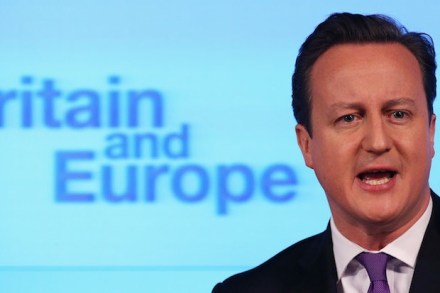
David Cameron: Trust me to change EU, not Ukip

David Cameron launched his party's European and local elections campaign in Manchester today. After weeks of polarised debate between Nick and Nigel, the PM had a task in suggesting that there could be some nuance between In and Out which involves a bit of shake-it-all-about. He repeated his line that both the Lib Dems and Ukip took an 'extremist' stance on the EU, saying: 'Looking at the other parties, there are effectively two extremist camps. One says: “we love the European Union.” The other says: “we hate the European Union.” One says: “we want things to stay the same.” The other says: “let’s just walk away from the EU.

Michael Fabricant sacked: what about other HS2 opponents?

It's difficult to know what astonished people more about Michael Fabricant's sacking: that he has lost his job or that he was still in a role that required some semblance of collective responsibility. Shortly after assuming the role of Vice Chair of the Conservative Party, he called for a pact with Ukip. Some of his tweets have raised eyebrows. He said it was 'about time' that Maria Miller resigned.

Andrea Leadsom joins the Treasury

After excited rumours flew around the Conservative party that she was finally getting a promotion, Andrea Leadsom has been confirmed as the new Economic Secretary to the Treasury. She was on the Number 10 policy board, but should have risen much sooner - had she not offended George Osborne by suggesting that he should apologise to Ed Balls for these comments to the Spectator about the Libor scandal. Offending the Chancellor is the political equivalent of getting a black spot from a pirate. But now Leadsom has the promotion she deserves, having impressed in a number of roles. She co-founded the Fresh Start Project, which visits European capitals making the case for reform of the EU and feeds back to the Foreign Office.