Ido Vock

Ido Vock lives in Berlin. He was previously a senior journalist at the BBC

Merz’s chaotic election is a win for the AfD

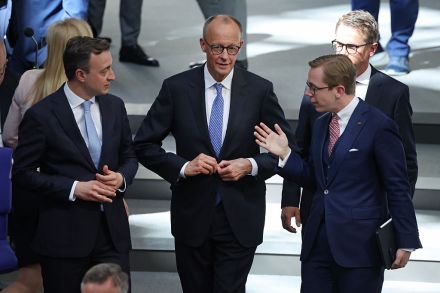
Friedrich Merz has been elected German chancellor at the second time of trying – the first time someone in his position has failed to be elected on the first attempt. The centre-right Christian Democratic Union (CDU) leader received 325 votes, nine more than the 316 that constitute an absolute majority in the Bundestag. In the first vote this morning, Merz received just 310 votes. That was despite his coalition with the centre-left Social Democrats (SPD) holding some 328 seats in parliament. Like many recent political developments in Germany, it was a first for the Federal Republic.
Is Friedrich Merz up to the task of fixing Germany?

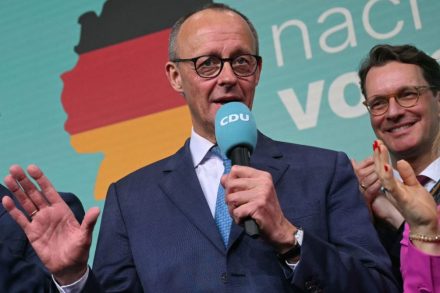
As was widely predicted, Friedrich Merz’s Christian Democratic Union (CDU) has won Germany’s federal elections with around 28 per cent of the vote. For the first time since the formation of the Federal Republic in 1949, a far-right party – the Alternative for Germany (AfD) – has come second in a national election, winning an unprecedented fifth of the vote. The AfD surge seen tonight will dominate politics for the next four years. The party has pulled off an historic upset in the face of near-universal hostility from other parties and the media. The far right benefited hugely from a campaign largely focused on migration, its core issue.

Will Austria’s asylum seeker surveillance plan backfire?

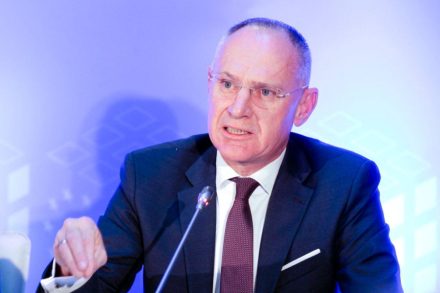
Austria’s interior minister has announced plans for mass surveillance of Syrian and Afghan asylum seekers in response to a terrorist attack. The incident, which took place on Saturday, saw a Syrian allegedly stab one person to death and injure five others in Villach. According to police, the man –whose rampage was cut short by another Syrian man who intervened – was a legal resident in Austria and not known to authorities.  Gerhard Karner, known for his hard line on security, said 'mass checks without cause' of 'asylum seekers with Syrian and Afghan backgrounds' were needed to ensure public safety. He said that because the alleged attacker was unknown to authorities, there was no alternative to indiscriminate checks.

Will the Munich attack lead to a crackdown on asylum seekers?

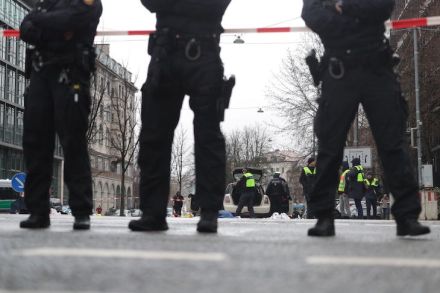
Another day, another apparent attack by an asylum seeker in Germany. In Munich, a 24-year-old Afghan is alleged to have driven a Mini Cooper into a trade union demonstration. At least 28 people have been injured, 11 seriously, according to police. The alleged driver of the car, Farhad N, reportedly came to Germany in 2016 Bavarian Premier Markus Söder called the crash a “presumed attack”. Police say they don’t know whether there is a link to the Munich Security Conference, which is taking place in the city. The alleged driver of the car, Farhad N, reportedly came to Germany in 2016. His asylum application was rejected but he was issued a staying order suspending his deportation. Authorities say there are “indications of an extremist background”.