Howard Jacobson

Howard Jacobson’s Mother’s Boy: A Writer’s Beginnings is out now.

Howard Jacobson: Howl

38 min listen

My guest in this week’s Book Club podcast is the Booker Prize-winning novelist Howard Jacobson, whose new novel Howl emerges from his rage and despair at the response to the 7 October massacre. He tells me what the novel can do that journalism can’t, why being funny is essential even in the darkest times, and why Zack Polanski isn’t the man he used to be.
Howard Jacobson: Howl

Don’t judge a book by its author

I am entombed, like Edgar Allan Poe’s prematurely buried man, listening through headphones to a contemporary Russian fugue for organ and bagpipes. I had asked for a soothing Schubert prelude, but the radiologist couldn’t lay hands on one. The headphones have no volume control I can locate – only on and off, and off will expose me to the diabolic clang of magnetic resonance. Hell will be an eternity inside an MRI machine, praying for deafness. There is a little sponge ball I can press if I can take it no longer. I give it 17 minutes, then press. Shame overwhelms me. I overhear the radiologists whisper: ‘So it works then.’ Which means that in the time they’ve had this machine I am the first person to beg to be released.

The moment I realised the study of literature was over

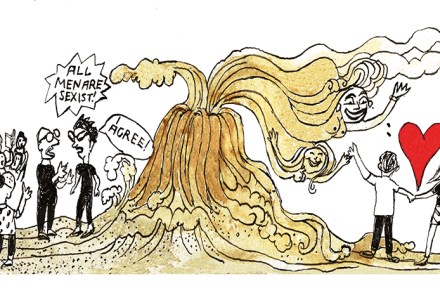
I’ve run away. I’m not saying where I’ve run to because then they’d be able to find me. I’m not saying who ‘they’ are either. So far no one has noticed I’m missing. I shuffle along with my head down, my old-geezer Woody Allen bucket hat sheltering my face, my hands shoved deep into the pockets of my shorts. Damn! The mention of ‘shorts’ gives away that I’m somewhere hot. You have to be careful writing a clandestine piece. Fearing I’ve been spotted, I veer off the path, clamber over rocks and find myself on a black volcanic beach. It’s like walking on a fire that everyone hopes has gone out. That’s another clue. Which volcano? Anyone would think I want to be found.

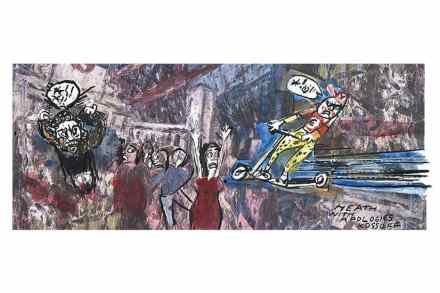
How is humanity served by the e-scooter?

In Hatchards for the launch of Andrea Rose’s catalogue raisonné of Leon Kossoff’s oil paintings. It’s bad for the morale of writers to frequent bookshops: too many shelves without their books on them. But I’m here to talk about Kossoff, not me. Whether he shunned galleries that showed him scant respect — one of the country’s greatest painters, yet for many years one of the least-known — I have no idea. But he was a modest, principled man who put the making of art before making a name or a fortune, so I choose to believe he didn’t care. He reminds me, in his quiet refusal of flamboyance, of Wordsworth. Like Wordsworth, he found his inspiration in ‘everyday appearances’ and the fleetingness of things.

Offence-taking has ruined comedy

I’m watching television more uncritically than usual but still can’t stomach the format of Live at the Apollo. It features some clever comedians, but its artificiality, cutting to the audience to show canned hilarity — or worse, canned celebrity hilarity; or worse still, genuine hilarity — is a turn-off.  It’s not the comedians’ fault that producers choose to show people helpless with laughter at a not very amusing joke, but the practice alienates you from their material. If that shower thinks they’re funny then they can’t be.  We laugh too easily today. Laughter used to be like virtue. It wasn’t something we were willing to give away on a first date. Now we’re anybody’s.

The bluff and bluster of Boris’s bland boy Brexiteers

From the balcony where I take my daily exercise there is a view of the commercial centre of London that is so susceptible to changes of the light you feel you are in a different city every day. When the dying sun is reflected in its glass towers, the city looks like Las Vegas burning. Under a dark sky it could be Pittsburgh. The other day was so louring that I saw Moscow. ‘I’m looking at the Kremlin,’ I shouted in to my wife. She’s been worrying about me. She thinks it’s time I relaxed the promise I made myself not to go out until the virus has gone and the world is more to my liking. ‘You’ll have a long wait,’ she says. She knows I’m being ironical.

Diary – 6 September 2012

In Edinburgh to speak about my new novel Zoo Time at the book festival. I love it up here, watching the rain lashing the austere grey terraces, dodging the street clowns who don’t really belong in so serious a place, visiting the Victorian dead in the marvellously voluble Dean Cemetery (it’s the stones that do the speaking, not the dead), and enjoying the view of Fettes from the window of my hotel. Built in the grand Scots baronial style to educate orphans and the poor, Fettes looks more like a lunatic asylum than a school. If I had a telescope I believe I’d be able to spot Mrs Rochester roaming through those spires, spitting and setting fire to herself. Tony Blair, who coincidentally referred to Gordon Brown as the mad wife in the attic, was a pupil of Fettes.

Diary – 6 September 2012 | 6 September 2012

In Edinburgh to speak about my new novel Zoo Time at the book festival. I love it up here, watching the rain lashing the austere grey terraces, dodging the street clowns who don’t really belong in so serious a place, visiting the Victorian dead in the marvellously voluble Dean Cemetery (it’s the stones that do the speaking, not the dead), and enjoying the view of Fettes from the window of my hotel. Built in the grand Scots baronial style to educate orphans and the poor, Fettes looks more like a lunatic asylum than a school. If I had a telescope I believe I’d be able to spot Mrs Rochester roaming through those spires, spitting and setting fire to herself. Tony Blair, who coincidentally referred to Gordon Brown as the mad wife in the attic, was a pupil of Fettes.