Hamish Macdonell

The SNP is a strong fighting force. Is May prepared for what lies ahead?

Nicola Sturgeon’s announcement may have taken Westminster by surprise but it wasn’t a shock to her party leadership. Indeed, by the time the First Minister left her Bute House press conference this afternoon, a new Yes campaign website was already up and running with appeals for money, campaign material and a video from Ms Sturgeon explaining her decision. That should be another sharp reminder to the unionist parties that they are dealing with a very, very competent electoral machine in the SNP. This is a party, after all, which has wiped the floor with its opponents in all recent elections and which, crucially, has learned its lessons from its failed independence bid in 2014. One of those lessons was evident on its new website which is called ref.scot.
The SNP now want a ‘semi-detached’ Scotland. Could it work?

The SNP appears to be on the verge of changing one of its core beliefs – full membership of the European Union. Senior party figures have revealed, in a piece in the Times today, that there is a desire in the higher echelons of the SNP to ditch this long-standing tenet of party policy. Instead, they want the party to adopt a Norway-style model. This would see an independent Scotland outside the EU but inside the single market, after Brexit. Scotland could then join the EU at a later date, if it wished to do so but it would not immediately join the back of the queue for EU membership, as has always been assumed. It would be a policy earthquake for the party to ditch something like EU membership that has been central to its message since the 1980s.

May just made another Scottish referendum ‘more likely’, says Sturgeon

Nicola Sturgeon inched Scotland closer to a re-run of its independence referendum today by reacting angrily to Theresa May’s Brexit speech. Having already put indyref2 'on the table' – but not for this year – Scotland’s First Minister said the Prime Minister’s speech today had made another independence vote 'more likely'. 'The UK Government cannot be allowed to take us out of the EU and the single market regardless of the impact on our economy, jobs, living standards and our reputation as an open, tolerant country, without Scotland having the ability to choose between that and a different future,' the First Minister said. And she added: 'With her comments today, the Prime Minister has only succeeded in making that choice more likely.

Nicola Sturgeon’s Brexit plan is flawed

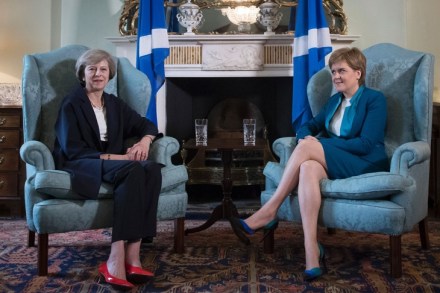
There is a smart, hi-tech media room in the Scottish government building which overlooks Holyrood – but it has been all but abandoned since Nicola Sturgeon took over. That’s because Scotland’s First Minister prefers Bute House, her official residence in Charlotte Square, for announcements that have a chance of attracting a decent TV audience. She knows the Georgian grandeur makes her look authoritative - even presidential - and there she was again this morning when she unveiled her plans for a separate Scottish Brexit deal. It was no surprise that she was flanked – yet again - by just the Scottish saltire and the European flag. The Union flag was nowhere to be seen. It makes her look powerful, commanding and very un-British.

Sturgeon takes another tiny step towards Scottish independence

It has become one of those journalistic clichés to talk about 'firing the starting gun' in politics. There has been some debate among the hacks at Holyrood as to whether or not Nicola Sturgeon has already 'fired the starting gun' on the next Scottish independence referendum campaign. So, to do justice to that cliché (and to mangle it completely), I suggest something like this: today the First Minister reached for the key to the cabinet holding the starting gun, which would launch a second Scottish independence campaign. She hasn’t yet opened the cabinet but she has the key in her hand, should she decide to place it in the lock and turn.

Brexit has made a second independence referendum more likely

Just look at the map on the BBC website, there are eerie comparisons with the 2015 general election – Scotland has been painted yellow: again. This time, though, there is a difference. This time the whole of Scotland is yellow. There are no patches of any other colour to break up the picture. And that is the crucial point. The whole of Scotland voted Remain: the whole of Scotland without exception, including those areas, like the Western Isles, which voted to leave the EEC last time round. That sends a very powerful message. Nicola Sturgeon knew that, if the UK was going to vote for Brexit, she needed the point of difference between Scotland and England to be as big as possible – and she has got it.

At long last, the Scottish Conservatives are back

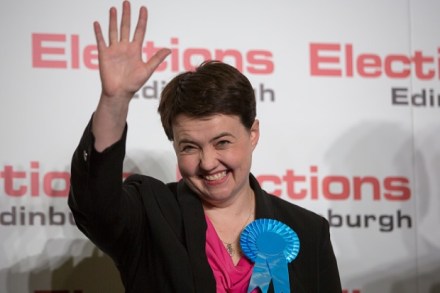
The Tory achievement in Scotland was delightfully encapsulated in one sharp moment during the BBC’s overnight coverage. Jackson Carlaw, the Scottish Tory deputy leader, turned to Alex Salmond, pointed his finger and said: “Alex Salmond said we deserved to stay in purdah, well, we are not in purdah any more.” That retort summed up the frustration built up over decades of defeat and put-downs from the SNP and Labour. Mr Carlaw’s message was simple: the Tories are back in Scotland. In many ways, he was right. Remember the 1997 wipe-out? The election when the electorate came together to kick out every Tory MP in Scotland? Now the party is the official opposition in Scotland.

The SNP manifesto reveals a new approach to Scottish nationalism

Do you want to know what it looks like when one party has become the most dominant force in its country’s political history, when one in every 30-odd voters is a member of that party and when it is regularly topping 50 per cent in the polls? Then look no further than central Edinburgh this morning where Nicola Sturgeon was launching the SNP’s Holyrood election manifesto. The queues to get in to the Edinburgh International Conference Centre stretched back for several streets as supporters and party members waited eagerly in the warm spring sunshine for the chance to hear, and see, their leader in person.

Children’s rugby can be saved by tackling the tackle

My son is only 12 yet he has already suffered a fractured skull and a concussion from playing rugby. After his second serious head injury last year, I told him he had to stop playing. That was hard, both for him and for me but I was adamant: I wasn’t going to let him risk another serious head injury, not at his age when his skull was still growing, his brain was still developing and we had no idea what the long-term effects of such injuries might be. But don’t, please, leap to the conclusion that this is another one of those articles bemoaning the dangers of rugby and calling for tackles to be banned or for the game to be sanitised out of existence, because it isn’t. I played rugby for 15 years.

What a change – Cameron can actually look forward to his visit to Scotland

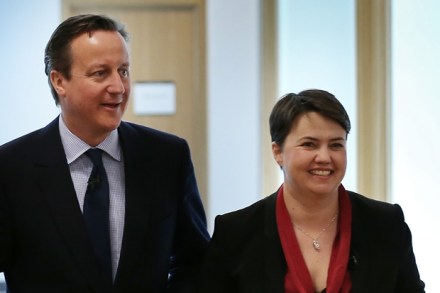
With the exception of Gordon Brown – and he was always so dour it was impossible to tell what he was thinking – there hasn’t been a Prime Minister in living memory who has actually enjoyed coming to Scotland. Margaret Thatcher became spiky and aggressive when she crossed the border – well, more spiky and aggressive than normal. John Major seemed to regard it as a duty he had to endure, while Tony Blair made no pretence about it: he just hated it. David Cameron, though, has always tried hard when in Scotland. Perhaps, deep down, he would consider it ill-mannered not to be as engaging and courteous as he can be, wherever he goes.

Who won in the fiscal framework battle?

It wasn’t quite David Cameron and his down-to-the-wire talks with the EU leaders, but it’s as close as we get in Scotland. For the last eight months, the Scottish and UK governments have been trying to secure agreement over the financial settlement which will underpin the new tranche of powers to come to Holyrood – the so-called ‘fiscal framework’. After weeks of torpor and inaction suddenly, this afternoon, we got a breakthrough. Nicola Sturgeon announced the deal to the Scottish Parliament this afternoon, confirming that everything had come down to one crucial, central point. The Scottish Government favoured one model to work out Scotland’s funding from the Treasury for the future and the UK Government favoured another.

Scottish Labour attacks SNP from left with tax rise plans

Those of you who live in the rest of the UK will have no idea what a relief it is for us Scots to have some real politics to deal with at last. Scottish Labour’s announcement today that it wants to raise income tax for everybody in Scotland is terrific - simply because it means that this year’s election will be a real contest about real policies. For the first time in years we are going to get an election which is not about the constitution. The tax powers which Scotland is going to get in April are fairly inflexible. A lock-step has been imposed which means that, if you want to raise one of the rates, you have to raise them all.

Kezia Dugdale appeals to the Left with personal speech about her past

Jeremy Corbyn really has made socialism trendy – at least in Scotland. We can take that from the speech that Kezia Dugdale, Labour’s Scottish leader, will make a today focusing on the ‘s’ word - something she is unlikely to have done had Mr Corbyn been languishing in the polls. Indeed, it was only a few weeks ago that Dugdale warned that a Corbyn victory would leave Labour ‘carping on the sidelines’. Then, as he started to edge ahead in the race, she started to move, first insisting they shared some similar policies and then meeting him privately at a rally in Edinburgh. Today she will edge even closer to his agenda by getting really passionate about inequality and poverty.

Ed Miliband is being pushed to the left by the SNP

At last, the picture is becoming clearer. We now have a better idea of what the SNP will demand in return for its support to put Ed Miliband in Downing Street. Nicola Sturgeon didn’t use the term ‘red line issue’ but this was the clear message underlying both the broadcast interviews she made this morning and her keynote speech at UCL. We have known for some time that the SNP leadership does not favour a formal coalition with Labour. Rather, it would look for a ‘confidence and supply’ deal, backing Labour’s Budgets and opposing no confidence motions and expecting concessions in return. And now there appear to be two ‘red lines’ - concessions which the SNP would expect from Labour.

UK and Scottish governments already at each other’s throats over extra devolution

It didn’t take long. In fact, the tweet from Nicola Sturgeon appeared soon after Alistair Carmichael had started speaking this morning. Smith clauses publication welcome - but doesn't include a general power to create new benefits in devolved areas as was promised 1/2... — Nicola Sturgeon (@NicolaSturgeon) January 22, 2015 2/2...and gives UKG effective veto over changes to universal credit, including bedroom tax. @scotgov will work to secure improvements — Nicola Sturgeon (@NicolaSturgeon) January 22, 2015 The Scottish Secretary was in Edinburgh with fellow Scot Danny Alexander to launch the UK government’s blueprint for more devolution for Scotland.

Nicola Sturgeon’s plans for the Crown Estate — my response to the Scottish government

My article about Nicola Sturgeon’s plans for the Crown Estate caused some excitement within her administration. All untrue, they say. They have written a response (below). So what could have happened? It’s worth look at in some detail, as it gives an insight into how government works. The Crown Estate is in the news because Lord Smith’s Commission into extra powers for the Scottish Parliament recommended that Crown Estate assets in Scotland – and their profits – be handed over to the Scottish Parliament. And, in his report, Lord Smith added: 'Responsibility for financing the Sovereign Grant will need to reflect this revised settlement for the Crown Estate.

Nicola Sturgeon shows how she means to go on by picking a fight with the Queen

Downing Street, we are told, wants to 're-set' the relationship between Westminster and Holyrood after the referendum. UK ministers apparently want an atmosphere of 'co-operation; to exist between the two governments. Well, that’s great but it only seems to be going one way. Just take a look at what Nicola Sturgeon has decided to do over the funding over the Royal Family. Under the Smith Commission proposals, Scotland is going to get control over all Crown Estate assets north of the border. At the moment, the Crown Estates profits are used to fund the Royal Family. So, if the Crown Estate loses a chunk of its assets, it will lose a chunk of its profits and the Queen will lose out.

Labour invented Scottish devolution. Why can’t it devolve?

One of the greatest ironies of these past 15 years of Scottish home rule is that Labour never really got devolution. Sure, it talked a good game. From Donald Dewar all the way through to Johann Lamont, the Scottish Labour Party championed its achievement in creating the Scottish Parliament as if that, in itself, proved its passion for the cause of devolution. But there has always been a big gap between what Labour said – "we are the party of devolution" – and what it did. Its real attitude was exposed in the contempt with which the party treated the very first parliament, in 1999. Those who had hoped for a new parliament of fresh Scottish talent were sorely disappointed.

The Yes camp is gaining ground in the Scottish independence referendum

The Yes camp is closing the gap. That is the clear message from two new opinion polls published this morning. Both polls – ICM for Scotland on Sunday and Panelbase for the Sunday Herald – show that the undecideds are, at last, starting to make up their minds. But in doing so, the undecideds are going to Yes in greater numbers than they are to No. [datawrapper chart="http://static.spectator.co.uk/zNI3m/index.html"] That trend is clear, it is helping Yes to close the gap but it has not, as yet, given Yes anything like the support it needs to win the referendum in a month’s time. In the ICM poll, the undecideds are down from 21 per cent in July to just 14 per cent now.

Alex Salmond fails to land the blow he desperately needed

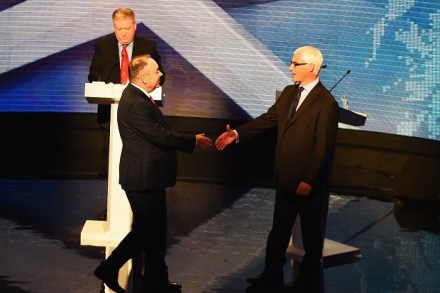
Many people, I’m sure, will already be calling the first TV debate in Alistair Darling’s favour. That is a fair point to make but it was not quite as straightforward as that. I think a truer reflection would be this: Darling won on substance but lost on style, while Alex Salmond won on style but lost on substance. That may seem a bit pedantic, but it matters. First, the question of style: Salmond was – as we knew he would be – calm, composed and articulate. Darling was – as many in his camp feared he would be – anxious, shouty and irritable. The former Chancellor looked nervous. He had trouble getting his message across. Indeed, even his eyebrows kept darting up and down as if constantly looking for a way out.