Freddy Gray

Freddy Gray

Freddy Gray is deputy editor of The Spectator and the editor of the US edition. He hosts Americano on YouTube.

Donald Trump pulls out of the Iran deal. Is anyone surprised?

Did anybody really think President Donald J Trump wasn’t going to pull out of the Iran deal? He’s said all along he would and this Commander-in-Chief’s number one public image rule is that, unlike most politicians, he honours his word. Trump’s other big rule is that anything Obama has done he’ll undo. And Obama’s biggest achievement, according to his admirers and former staffers, was the Iran deal, which – in theory anyway -- stopped Tehran from acquiring nukes while strengthening democratic forces within the troubled Muslim state. The pride with which Team Obama held up the deal was precisely why Team Trump wanted to destroy.

What was it really like to work for Cambridge Analytica?

From 2009 to 2010 Sven Hughes worked for SCL group, the parent company of the controversial — now deceased —  Cambridge Analytica. SCL/Cambridge Analytica and its CEO Alexander Nix have been in the news a lot lately, chiefly because of their role in the Trump campaign. The fall of Cambridge Analytica was prompted by a Channel 4 documentary in which Nix boasted about running ‘counter ops’ — sting operations and so on — against political opponents. The firm shut down on Wednesday.

Is Rudy Giuliani all there?

From our US edition

It’s unkind to speculate over somebody’s mental health. Still, given the stakes, it seems worth saying what everyone is thinking – that Rudolph W. Giuliani’s extraordinary performance on Fox News last night suggests he is a man not fully in control of his mind. The former New York Mayor, 73, who was hired as Trump’s lawyer less than two weeks ago, dropped a news bomb on Sean Hannity’s show. Giuliani said that Donald Trump repaid $130, 000 hush money that his personal lawyer, Michael Cohen, had paid to ‘some Stormy Daniels woman’ over her alleged affair with the now president of the Unites States. Rudy Giuliani: Trump reimbursed Michael Cohen $130K for expenses, but it was not campaign money pic.twitter.

Michelle Wolf’s disgusting White House Correspondents’ dinner routine is another PR win for Team Trump

From our US edition

A lot of Washingtonians think that, were it not for the White House Correspondents’ Dinner, you wouldn’t have a Trump presidency. It sounds hyperbolic, and the theory has been disputed, but Trump watchers still believe that President Obama’s roasting of Donald Trump at the correspondents' dinner in 2011 spurred Trump to seek the Republican nomination. Trump’s epic pride was so wounded by Obama’s barbs that it made him determined to take revenge. And he did. This year the Correspondents’ dinner has given Trump’s power another boost. I’m sure Michelle Wolf wouldn’t have wanted to help the 45th President: she probably just wanted to make herself more famous.

michelle wolf

Donald Trump’s visit is good news for Britain – even if you don’t like him

From our US edition

President Donald Trump and Brexit Britain have a spooky synergy. After all, the last time Donald Trump came to Britain was the day after the Brexit vote. Was it a coincidence? A shrewd bit of PR? Or destiny? Trump himself seem to believe it was written in the populism stars. ‘I think I see a big parallel,’ he said, speaking of himself and Brexit. Now, as Theresa May’s pro-Brexit government struggles, he’s confirmed that he will – at last! – be visiting Great Britain. And it’s on Friday 13th July, when there’s going to be a partial solar eclipse. Spooky, as I said. This trip is far too late, given that Britain and America have been great allies for a long time.

The new identity politics is conservative

From our US edition

Celebrity opinion, that awful juggernaut, is beginning to shift. It could take another 30 years before we see any great turn. Yet slowly, slowly, famous people are realising that intense political correctness isn't working. Old fashioned identity politics now bores the fans. One by one, celebrities are starting to reposition themselves. The stars are working out that the new rebellious move is to posture against the politically correct left. The real mavericks, to use Emmanuel Macron’s new favourite word, know that in the 21st century, true radicalism – or the appearance of true radicalism, and the fame game is always only about appearances – comes from the right. Radicalism means looking like one is prepared to stand up to authoritarian progressivism.

Parliament got Syria right in 2013 – it deserves to vote again

As I’ve said before, but it needs saying again because these people never stop — the let’s-bomb-Syria brigade has never quite gotten over the horror of being rebuffed by Parliament in 2013. And this week, what with the latest reported use of chemical weapons by Assad in Syria, they’ve got their tails up again. We don’t need Parliamentary approval for military action, they say, and Parliament got it wrong last time so go go go! George Osborne’s Evening Standard is adamant. So are Tom Tugendhat MP and Nick Boles MP. So is Johnny Mercer, who says that voting against military action is a ‘vanity vote’, which is itself a vain statement. Their line of argument is all too familiar.

En marche

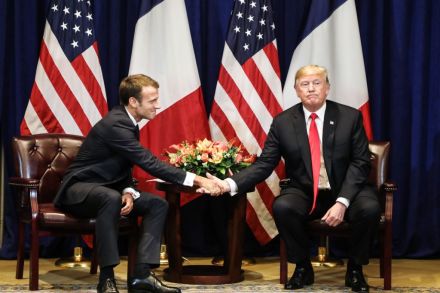
Remember the never-ending handshake? It was 14 July 2017, Bastille Day, and Emmanuel Macron and Donald Trump opened their formal relationship as leaders of their respective countries by interlocking palms and refusing to let go. They kept at it for a good 30 seconds. They didn’t release even as Trump began kissing Macron’s wife. It looked like the beginnings of a bitter rivalry. But Trump and Macron weren’t clashing. They were flirting. The night before, the two men — plus wives — had had an intimate dinner in the Eiffel Tower, and they bonded. A great bromance had been born. For all his posturing, Macron treated the US President like an emperor in Paris.

On foreign policy, Trump is far more like Obama than either would admit

You could call it the John Bolton effect. The President’s new National Security Adviser has only been in the job a few days, and already Donald Trump is threatening war with Russia on Twitter: https://twitter.com/realDonaldTrump/status/984022625440747520?ref_src=twsrc%5Etfw SMART! One can almost imagine Bolton’s moustache brushing Trump’s ear on that one. Trump didn’t talk about Russia like that before. But Trump’s new found bellicosity is also down to what could be called Obama syndrome. On foreign policy, you see, President Trump and his predecessor in the Oval Office are far more alike than either man would admit. They have both found themselves struggling over the problem of China’s rise, only then to get distracted in the Middle East.

A trade war with China sounds terrifying – but the US is doing the right thing

Nobody likes the sound of trade war, and rightly so. China’s new retaliatory tariffs moves against US products feel like the beginning of something bad: an escalating tit-for-tat trade conflict between the world’s richest countries which could choke the global economy. But there are good reasons to think that, far from being another silly move by a hothead president, Trump’s right about trade with China and that, as he has with North Korea, he is grasping a dangerous nettle that other presidents dared not touch. It may be scary, but it needs to be done. And it’s not just necessary for America, but perhaps the rest of the world as well. China is deeply protectionist, and is rapidly becoming the most powerful country on earth.

The citizenship game

The Cambridge Analytica story is full of hot air. Everybody delights in talking about how scary Facebook is, and lots of people believe the Donald Trump and Brexit campaigns somehow hoodwinked whole electorates — because, well, how else could they have won? We hear about creepy and sophisticated--sounding techniques such as ‘micro-targeting’ and ‘psychographics’. But there is a far bigger story, which goes beyond the antics of Cambridge Analytica or its parent company, Strategic Communications Laboratories (SCL Group), and other such businesses. It’s about how organisations from the developed world exploit small countries to advance dubious interests and make masses of money. Take passport-selling.

Revealed: Cambridge Analytica and the passport king

The Cambridge Analytica story is full of hot air. Everybody delights in talking about how scary Facebook is, and lots of people believe the Donald Trump and Brexit campaigns somehow hoodwinked whole electorates — because, well, how else could they have won? We hear about creepy and sophisticated-sounding techniques such as ‘micro-targeting’ and ‘psychographics’. But there is a far bigger story, which goes beyond the antics of Cambridge Analytica or its parent company, Strategic Communications Laboratories (SCL Group), and other such businesses. It’s about how organisations from the developed world exploit small countries to advance dubious interests and make masses of money. Take passport-selling.

Did Trump appoint John Bolton to distract from his spending bill failure?

Another massive America news blizzard yesterday: Trump lawyer quits, tariffs tariffs tariffs, stock-market slide, former alleged mistresses of the President speaking out, McMaster out (finally), Bolton in (finally). And then, as a night cap, the Senate approves a whooping $1.3 trillion spending plan to prevent a government shutdown. The Bolton news has, so far, been the most headline grabbing, even though people in the know — and readers of Spectator USA — have known it was about to happen for weeks now. Trump has rather sweetly let it be known that he has hired Bolton on the condition he didn’t start any wars: ‘now now John, don’t go nuking’ but people who cherish world peace are right to be alarmed.

Cambridge Analytica’s use of Facebook is straight from Obama’s playbook

Every few weeks, it seems, Carole Cadwalladr drops a long piece for the Guardian or the Observer about how the Trump and Brexit campaigns mind-hacked democracy. On both sides of the Atlantic, people who don’t like Trump or Brexit share these pieces and shriek. The latest article, which lit up the political internet at the weekend, has the added spice of a whistleblower – a pink-haired ‘data science nerd’ straight out of science-nerd central casting. He’s called Christopher Wylie and Cadwalladr reveals that he has been the source for her much-vaunted scoops on Cambridge Analytica, the data firm who worked with the Trump and Brexit campaigns.

Is Steve Bell pastiching Nazi propaganda? Or plagiarising it? 

My objection to Steve Bell, the Guardian cartoonist, is not that he is risqué. Nor is it that he’s rabidly anti-Tory. It’s that his cartoons are often unfunny to the point of being humourless. I’m not exactly his target audience, though, so I would say that.  But a friend has pointed out that his drawing this week on the May-Russia story takes direct and obvious inspiration from Nazi propaganda:  https://twitter.com/guardianopinion/status/973982860917944322?ref_src=twsrc%5Etfw [caption id="attachment_10057942" align="aligncenter" width="365"] An anti-communist poster from 1940[/caption] Now, let’s not be all inverse-Owen Jones. Let’s try not to scream ‘offensive’ before we’ve understood the joke.

Boris Titov doesn’t want to be president but he’s still taking on Putin

Boris Titov is running to be president of Russia, but he’s eager to talk himself out of the job. ‘I am not a good politician,’ he says, over breakfast at the Lanesborough hotel in Knightsbridge. ‘To be a president means you need to be wise, a big politician like Thatcher, Deng Xiaoping, Lee Kuan Yew. Russia needs a tough politician in the presidential chair and I am not that man.’ Titov knows that on 18 March, Vladimir Putin, the toughest politician of our age, will be re-elected as Russia’s Supreme Commander-in-Chief. ‘Everybody understands that,’ he says. ‘We are not stupid. I have common sense.’ Which prompts the question: why run?

Meet Boris Titov: the man who wouldn’t be president

From our US edition

Boris Titov is running to be president of Russia, but he’s eager to talk himself out of the job. ‘I am not a good politician,’ he says, over breakfast at the Lanesborough hotel in Knightsbridge, London. ‘To be a president means you need to be wise, a big politician like Thatcher, Deng Xiaoping, Lee Kuan Yew. Russia needs a tough politician in the presidential chair and I am not that man.’ Titov knows that on Sunday, Vladimir Putin, the toughest politician of our age, will be re-elected as Russia’s Supreme Commander-in-Chief. ‘Everybody understands that,’ he says. ‘We are not stupid. I have common sense.’ Which prompts the question: why run?

Rex Tillerson’s sacking isn’t about Russia

Sometimes it’s almost as if Donald Trump wants the world to think he’s a Russian patsy. Yesterday, Rex Tillerson, as Secretary of State, warned Putin that Russia’s alleged assassination attempt on British soil would trigger ‘a response’. Today he’s been sacked. https://twitter.com/realDonaldTrump/status/973540316656623616?ref_src=twsrc%5Etfw But the sacking almost certainly isn’t about Russia. It seems Trump asked Tillerson to go on Friday, a day after Trump agreed to meet Kim Jong-un. So the more likely cause of Tillerson's departure is the most obvious: the sudden rapprochement with North Korea. Tillerson was reportedly blindsided by the announcement that Trump would meet Kim Jong-un.

No, Britain shouldn’t invoke Article 5 of the NATO treaty

Theresa May might regret using such strong language in her statement on the Skripal case last night. Saying that there had been the 'unlawful use of force' on British soil and that a response would be imminent has led to a lot of people invoking Article 5 of the NATO treaty - something mentioned in newspapers today. Lord Ricketts, a former UK national security adviser, is one of many to say that this 'unlawful' act warrants the use of NATO. For its part, NATO has released a statement saying 'the UK is a highly valued ally and this incident is of grave concern to NATO'. May did not say ‘armed attack’ - the condition to invoke Article Five - but ‘unlawful use of force’, which is different. It’s all hot air, though - and will be seen as such by the Kremlin.

Welcome to Spectator USA

It’s an exciting day at the office. We’ve just launched Spectator USA, a new website from the world's oldest weekly magazine. For 190 years, The Spectator has been producing some of the sharpest, funniest and best-written journalism. Now we want to do more of the same for an American audience. Spectator USA will cover politics, culture and life in America. We’ll also offer American readers the best articles from the British Spectator on world affairs.