Fraser Nelson

Fraser Nelson

Fraser Nelson is a Times columnist and a former editor of The Spectator.

How close is too close?

David Cameron acquitted himself well at Leveson yesterday, as he does in all such events.  But it was odd to hear him say that there should be ‘more distance’ between politicians and the press. The implication of his comment is that he has been sucked into the brutal realpolitik of the newspaper industry; that he had to spend weekends with Rebekah Brooks or face electoral oblivion; and that the only question for Lord Justice Leveson is why politicians are left in such a position. I look at this in my Telegraph column today.   No one forced Cameron to get on LOL-terms with the editor of The Sun. Certainly, he wanted better media relations — especially after the near-death experience of the election-that-never-was in 2007.

How not to create jobs

The Keynes vs Hayek debate is at its sharpest on the issue of employment. Can government create jobs (as Balls says)? Or does large public sector employment simply displace economic activity that would happen elsewhere (as Osborne says)? A fascinating study has been released today by the Spatial Economics Research Centre at the LSE showing the damage done by public sector employment to the real economy. Drawing on a huge amount of local-level data over an eight-year period, it’s a serious piece of research that is worth looking into and deserves to impact our economic debate. 1. First, what is seen. In the short term, hiring someone to work for the government means another worker, who in turn spends.

The parable of Cameron’s kids

Will The Sun’s story about David Cameron leaving his daughter in a pub be politically damaging? Not in the least, I suspect. These stories only hurt if they seem to fit a trend of behaviour, or confirm what everyone suspects. But no one, even the prime minister’s harshest critic, could accuse him of neglecting his family or failing to prioritise his children. Those who have seen him around his kids usually come away feeling amazed, and envious, by the way he can just flick a switch, no matter how tough things are politically, and go into ‘family mode’: baking cakes, playing Star Wars games, being the model father.

Osborne’s blame game

George Osborne writes in the Sunday Telegraph today that the British recovery ‘is being killed off by the crisis on our doorstep.’ This sounds uncannily like Gordon Brown’s ‘it started in America’ excuse, and it's only mildly more convincing. While Osborne blames Europe, and Balls blames cuts, there is no doubt that the British economy isn’t recovering, which is not good news for a chancellor whose re-election strategy was based on recovery by 2015. But, by attributing blame to Europe Osborne risks blinding himself to a major problem in Britain. The economic headwinds are certainly strengthening. But the euro’s slump doesn’t appear to have halted recovery in countries that have delivered supply side reform (tax cuts, deregulation etc.

The ladder to fulltime employment needs a bottom rung

I know it’s wrong to take John Prescott seriously, but his attack on the government’s work experience programme epitomises a sneering attitude that is quite widespread. It was most egregiously displayed by the BBC Today Programme in its flagship 8.10am report about those who volunteered to steward the Jubilee celebrations — except the BBC report never once used the word ‘volunteer’. There’s going to be a lot more of these work experience offers, thank God, and we can expect the government’s critics to ask if the labour market is ‘receding into the 19th Century’ with ‘Dickensian’ tactics (to use the BBC’s disgraceful language).

Exclusive: Cameron’s offer to Scotland

Ed Miliband laid out his vision for Scotland today, which didn’t quite set the heather alight. But word reaches me about what David Cameron is planning. He has already said that if Scotland votes ‘No’ they’d get a special something as a thank-you. But he did not specify what that something was. A bluff, says Alex Salmond, the same lies that Jim Callaghan sold Scotland in the 1970s and the special something was 18 years of Tory government! But Cameron is working on an offer. Soon, the &"Scottish government” (as Salmond calls his half-government) will control 30 per cent of all money raised in Scotland. Cameron is thinking that, after a ‘no’ result, he’ll raise it to 70 per cent and throw in complete control of income tax.

A fond farewell

To those of you who are discovering our new website: welcome. The aim is for it to be leaner and faster, but in the rejig we have had to drop some items that we'll miss. One I will particularly miss is Night & Day, the Spectator Arts Blog, which was brilliantly run by Simon Mason and Scott Jordan Harris. I'd long admired their blog before if became part of The Spectator. Simon was a pioneer of Twitter commissioning, by which he’d he follow writers he likes and, when they expressed a view on arts and books, he’d ask them for a blog. Such is his charm that they usually oblige. He came under our umbrella for very little pecuniary gain, and soon put together an all-star cast for the site, and particularly Night & Day's excellent Spotify Sunday feature.

The dangers of Osborne’s latest trick

Can George Osborne recover? Much depends on how the Chancellor confronts the twin crises he faces: the lack of economic growth (or any prospect of it) and his personal reputation for competence after his shambolic Budget. Today, we have alarming news. The Independent says that Osborne is offering ‘growth bonds’. These appear to be a debt concealment trick that even Gordon Brown didn’t think of. The Chancellor is looking at British savings accounts with envious eyes, it seems, and plans to ask people to lend money to his government if it promises to spend more on infrastructure. This makes little sense: right now, due to the bond bubble and QE, the British government is able to borrow at rock-bottom rates, as Osborne never tires of reminding us.

The Jubilee concert: 8/10 for cheering the nation up

'Ten years ago, if you’d been asked what Gary Barlow would be running now, you’d have said a Little Chef off the A32.' This, from Lee Mack, was one of the best gags of the night, which isn’t saying much. The music outstripped the comedy but Mack raises an important question: did Barlow get it right? This was his show and the mission was to pitch the concert at a mass audience of all ages and make it a global entertainment spectacular. From my seat (I was lucky enough to get one, a few rows down from Ed Miliband) I’d give Barlow an eight. And here, for what it’s worth, is my verdict. https://www.youtube.com/watch?v=s5l1-jlU5Lc Robbie Williams, still one of the greatest showmen in pop, was the perfect opener and follow-ups from Will.i.

Inside our Jubilee Special

The rain makes today's Jubilee celebrations a truly British event. We didn’t want any of this continental sun, anyway. The flotilla is making its way through the drizzle, and as we have to celebrate indoors due to the weather then there's the perfect accompaniment: the new Spectator double issue, out today, which is overflowing with holiday reading. We have Robert Hardman saying how – policing aside – the bill for these four days of celebrations has been £1 million which works out as half an Olympic volleyball pitch. The queen is remarkable value. At my church this morning, we heard from a parishioner a little older than the Queen who was involved in making the dress for her coronation.

Rain and royalty

This picture, to me, sums up today’s Jubilee flotilla: drenched Royal College of Music students cheerfully singing Land of Hope and Glory at the end of a spectacle attended by over a million people. The rain, far from ruining the event, made it even more memorable and didn’t seem to deter the crowds. As the choir’s conductor put it: 'freezing cold, wind, and rain but euphoric and unforgettable'. Sky News captured the spirit by covering its real source: the onlookers. 'Even on the train down, people were talking to each other,' a member of the public said. 'It’s been amazing seeing the princess and the queen, I loved it,' said a four year old. Sky seemed to have mobilized its entire staff, from every point on the Thames to street parties in (sunny) Devon.

Osborne versus wind farms

Here’s a U-turn that we can all welcome: felling the wind farms. Matt Ridley described, in a Spectator cover story some while ago, how George Osborne has turned against them. Today, the Observer has more details, saying that Osborne is:     As Ridley argued, wind farms are a ‘monument to the folly of mankind’, representing the triumph of ideology over reason. We could not afford them in the boom years, and we certainly can’t now. The subsidies make a small number of rich people even richer, and a huge number of companies are doing very well from the renewable energy racket. But if you apply rational analysis to it — ie, how much energy does it produce for the money it costs? — there is no reason at all. They generate just 0.

The politics of international rescue

A visibly relieved David Cameron gave a statement outside No. 10 earlier today about the successful rescue of four aid workers from a cave on the Afghan/Tajikistan border, including a Northern Irish aid worker, Helen Johnston. The Prime Minister said he had personally authorized the operation, which must have been some decision given the recent history of such rescues. He praised British troops, and gave a brief mention to American ones for carrying out ‘a related operation’. But I was struck by the difference in emphasis between Cameron’s video statement and that of the British commander in Kabul, for whom the main point of the rescue was its multinational nature.

The end of an era | 2 June 2012

We baristas at Coffee House tend not to write about each other, but today I’d like to make an exception and say a little about Pete Hoskin, who is going freelance after four years running this blog. Regular CoffeeHousers will know about his rare combination of insight, humour and his gentle writing style which only adds to the force of his comment. But writing is only the most visible part of his job. His job for the last few years has been Coffee House editor – which not only means protecting the blog’s character and sense of fun, but working on the copy filed to him. As someone who has had several hundred pieces improved by Pete’s editing, I perhaps owe him more than anyone else at The Spectator.

Osborne’s falling star

It’s tempting to see comedy in the government’s 30th U-Turn, but there’s a more serious side to this. It fits a pattern: act first, think later. The lack of special advisers in government is part of the problem. Even in the Labour days, I argued for more and better political appointees to help a reforming government get its agenda through. But the problem this time was George Osborne’s chillaxing approach to being Chancellor, coupled to what seems to be a casual disregard for detail. This approach was embodied in his decision to join Cameron on White House jolly the week before delivering his shambolic Budget. It makes you wonder if his growth strategy (or what purports to be his growth strategy) has had enough thought put into it.

How did it all get so complicated?

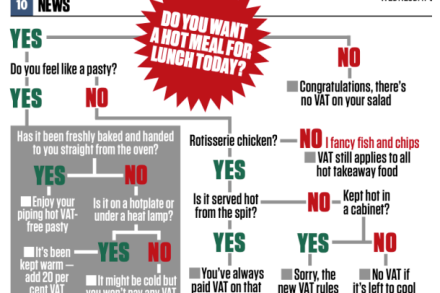
Further to Pete's blog on the new rules about pasties and VAT, the below graphic from today's City AM sums it up perfectly. It does, of course, make the case for tax simplification — which is what George Osborne was trying to do in the first place.

Let’s show Eurovision some respect

There are calls for Britain to pull out of the Eurovision Song Contest, after Engelbert Humperdinck finished second-last on Saturday, with Norway bottom. The Mayor of Leicester has today denounced Eurovision, saying: ‘The politics of Europe — which countries are friendly with which others — has a lot more to do with it than the quality of the songs.’ I agree: politics are involved and it is outrageous. Had George Osborne not given Ireland that £3.2 billion loan we would not have had its four points and Britain would be where it deserved: at the very bottom. We were dismal, and in the eyes of half a billion people. But the solution is not to withdraw from Eurovision. The solution is to properly compete.

The coalition’s new idea for more debt

How best to help British business? More debt, of course — varieties of this answer come time and time again from this government. This time it's Lord Young proposing £2,500 loans for young people, copying a successful model of the Prince's Trust. The latter point should give reassurance, as the Trust has quite a striking success rate. But what would really help business grow is to abolish regulation on firms with 200 employees or fewer, to cut payroll tax — the 'jobs tax' as Cameron called it before he increased it — or cut corporation tax to the 15 per cent that (as Ben Brogan revealed) Steve Hilton proposed before he quit. You can't really get a substitute for this supply side reform.

Gatwick competes in the disgrace Olympics

Heathrow Airport's passport control already offers a notorious welcome to Britain, but Gatwick is now offering hot competition. Gatwick Express, the rail artery connecting the airport to London, installed new ticket gates at the airport a few months ago ending the old system where you could buy a ticket on the train. But they failed to install enough ticket machines to cope with the summer demand, leading to absolute bedlam which I've just witnessed. The staff are mortified, and can only apologise to the Greeks and Spanish visitors who arrive here appalled at the kind of scenes that would disgrace any country - far less the fourth richest in the world. Screaming children, exhausted passengers, baffled visitors ('I don't understand, you have the Olympics...

Why reason doesn’t apply to the Eurozone

The Eurozone is a kind of lunacy if you look at it as an economic project. But this isn’t about economics, or rationality — it's about emotion, as the leader in today’s Telegraph says. The Brits and Americans often fail to understand this fully because we judge a currency union in terms of its economic merits. But many European nations see it as part of another, wider, agenda. For the Spanish and Portuguese it’s about not going back to dictatorship. For Greece it’s about being Western rather than Eastern (and not being run by the military).