Fraser Nelson

Fraser Nelson

Fraser Nelson is a Times columnist and a former editor of The Spectator.

Ed Miliband, Olympic winner

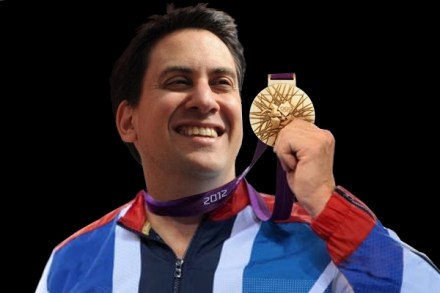
Before the last election, I had dinner with a Labour minister who told me her number one fear about the Tories getting in would be seeing David Cameron lap up the Olympic limelight. The Olympics, she feared, would hugely benefit whoever happened to be in power - and that was, she feared, going to be Cameron. She needn't have worried. The Prime Minister was barely visible during the Games (to his credit, he's not the type to hog limelight). Boris was Boris. But now the games are over, which party leaders have benefited the most? Oddly, all of them - and Ipsos-Mori polling suggests the number one winner was Ed Miliband. The percent having confidence in his ability to do his job properly has jumped eight points,  to 41 per cent.

Britain: the country of Mohammed

With apologies to his Royal Highness, the most popular boy’s name isn’t Harry -  in spite of what you will have read in the papers this week. It’s Mohammed, under various spellings. The Guardian hasn’t even worked this out, in spite of its pretty data table. Table 6 on the ONS results shows: some 8,018 baby Mohammeds came kicking and screaming into the world last year, well clear of Harry (7,523) and Oliver (7,007) Harry had his turn, and John was the most popular name for decades. We are now living in the age of Mohammed, a name that has been growing (on average) for 5 per cent a year. Here’s the trajectory. Does this matter? Not to me.

How students are mis-sold the benefits of university

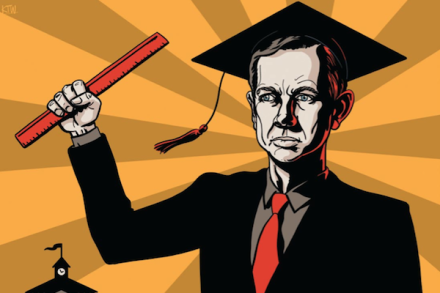
What do you say to an Arts graduate? ‘Big Mac and fries, please!’ I used to laugh at that joke until I was served a Junior Whopper by one of my fellow arts graduates in Edinburgh and ever since then I’ve been suspicious of the story I was sold at school: that going to university takes you into a new league of earning potential. The A-Level results came out yesterday, and anyone who has opened an exams envelope will be familiar with the feeling. That you may as well have the results tattooed on your forehead because they will define the trajectory of your life. But in the 22 years since I left school, the government has added to the pressure. It has made a switch from providing university education to actually selling it.

Sales of The Spectator: 2012 H1

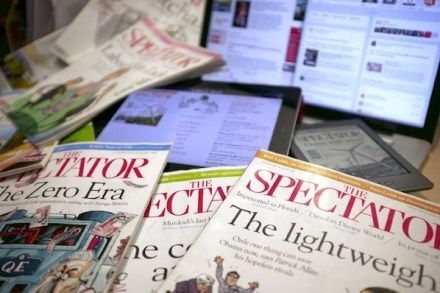
The Spectator’s sales figures are out today, with digital sales included for the first time. I'm pleased to report that, in a pretty murderous market, our sales are still rising — and, thanks to our new digital readers, rising at the fastest rate in ten years. The red line shows our print sales. It’s not exactly boom times for the printed word. Some publications have resigned themselves to terminal print decline, and have switched their focus entirely to digital. That’s not the way we see it at The Spectator, the oldest magazine in the English language. We love the printed magazine, which is why two years ago, we refreshed its design. Since then, print sales have stabilised, and even grown in the first half of this year.

An Olympic triumph

What a superb closing Olympic ceremony. Normally, government chokes the life out of any arts project it takes on and I’d expected the Olympic Stadium ceremonies to be the Millennium Dome Live. How wrong I was. The gathering of the thousands of athletes reprised the theme of the opening ceremony: that this is about people, not a massive Chinese-style display of state power. And the concert was not about musical purity but entertainment, of which there was plenty - from the Spice Girls’ surprisingly strong performance to the Boris Dancing (now trending on Twitter as #BorisBoogie). There was, or course, plenty I could have done without. George Michael's dire new single.

Chariots of fire

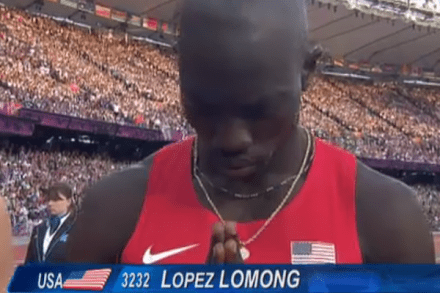
When the contestants were lining up for last night’s sensational 5,000 metre race, both of the American contestants waited until the cameras were on them, then crossed themselves and held their hands in prayer. It’s quite some sight to secular Brits, where religious language (even ‘God bless’) and mannerisms have dropped out of our national life and vocabulary. But to quite a few of the Olympians, their faith is of crucial importance, which we have seen this year through their Twitter feeds. Mo Farah, a Muslim, prayed on the track after winning both of his Golds. After Usain Bolt broke the Olympic record for the 100 metres, he did likewise.

Ministers vs the curriculum

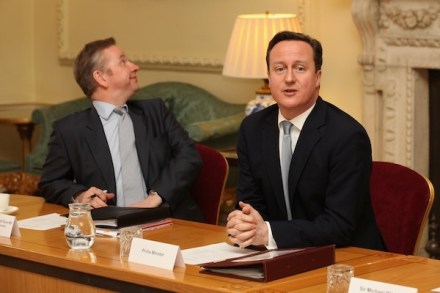
David Cameron has not sought to seek personal or political capital from the Olympics, for which he deserves much credit. It doesn't take much to imagine how Gordon Brown would  have behaved had he been in power. But this is politics, Cameron is under pressure to establish an "Olympic Legacy" so he will today announce two hours of competitive sport every week in schools. In so doing, he highlights the contradiction in his education policy. On one hand, he wants to devolve power to schools and get politicians out of the education process. But like his predecessors, he also can't resist pulling the levers of power and telling head teachers what to do.

The 2012 Shiva Naipaul prize

When I won the first Shiva Naipaul Memorial Prize, it was gratifying for me on every level. It helped me find a market for my work in the national press, and gave me the confidence to regard myself as a full-time writer. - Hilary Mantel. The Shiva Naipaul prize is awarded to the writer best able to describe a visit to a foreign place or people. The award will not be for travel writing in the conventional sense, but for the most acute and profound observation of a culture alien to the writer. Such a culture might be found as easily within the writer’s native country as outside it. The winner will receive a cash prize of £3,000. The winning entry will be published in The Spectator.

How the Lib Dems could be truly mature in government

Nick Clegg's decision to scupper boundary reviews in retaliation for the failure of his Lords reform programme is the very opposite of 'mature' government. It is the politics of the sand pit: you have annoyed me, so I'm going to kick your sandcastle down. It's his way of putting a horse's head in Cameron's bed, and the public will be appalled. The coalition has entered a new, destructive phase where Lib Dems will now pride themselves on what Tory measures they can frustrate or destroy (O Levels, profitmaking schools etc).

Wanted, books to read

I’m off for my annual digital detox: no ConservativeHome, no PoliticsHome, just my wife’s family home in Stockholm and swapping my Blackberry for a primitive mobile with a battery that lasts a week. But before I sign off completely, I’d like to abuse my position to ask CoffeeHousers for book recommendations. I’ve done this for three years now, and each year the results pretty much give me a reading list for the next 12 months. I’ve only now finished the last of summer 2010’s suggestions (Exodus, by Leon Uris.) I’m midway through Max Hastings brilliant All Hell Let Loose, which I’m interspersing with the restored World at War on DVD (a Pete Hoskin recommendation). They go brilliantly together.

We need a minister to defend the City of London

Is the City of London worth defending? Not many in the government seem to think so. Vince Cable, the Business Secretary, calls it a 'cesspit'. George Osborne blames the financial sector for causing the crisis – the Barclays Libor scandal, to him, was not an isolated incident but indicative of the whole rotten system, ‘the epitaph to an era of irresponsibility’. The City’s global enemies look on, amazed. Not even the Brits are prepared to stand up for their extraordinary financial sector. As I say in my Telegraph column today, now is their time to strike. As the Americans are pointing out, much Wall St woe can be traced back to London. AIG, Lehman and Bear Stearns all collapsed after trades made by their London divisions.

The Olympic censorship row

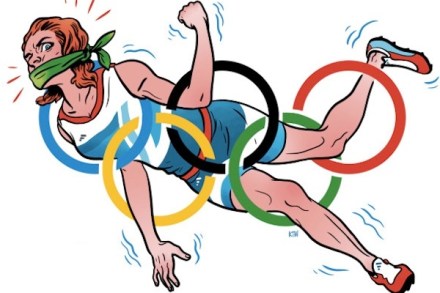
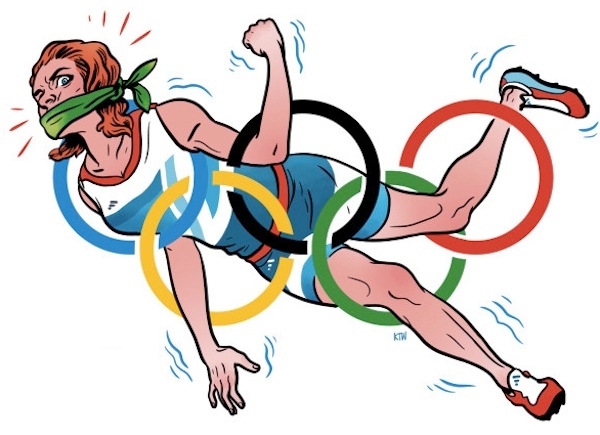
Nick Cohen’s Spectator cover story on Olympic censorship has been a smash hit, and is still being tweeted all over the world. It was followed up this morning by BBC Radio 4’s Today programme on its 8.10am slot, and CoffeeHousers who missed it can listen again here. Freddy Gray, assistant editor of The Spectator, is quoted at the beginning on the appalling heavy-handedness of it all. Even the Cubans didn’t copyright the now-famous Che Guevara image (which was drawn by an Irishman in any case). A liberal society like Britain should let people do what they want with words and images of major people and events. Including words like 'Olympics' and those rings.

Who’s afraid of the Lib Dems?

James Forsyth’s Mail on Sunday column is my first read every Sunday, and it’s choc full of details as ever. Here is his account of the Liberal Democrat reaction to last week’s House of Lords defeat:   On Thursday morning, Nick Clegg and David Cameron agreed a new phase of the Coalition after what one No 10 insider called ‘the Coalition’s Cuban missile crisis’.  Tensions were so high amid the vote on Lords reform that some feared the Coalition would implode, but things have now begun to ease.  Both sides stress ‘this  isn’t back to the rose garden’, and what is needed is not  ‘an idealised romance but cold, hard purpose’.

Friedman’s genius

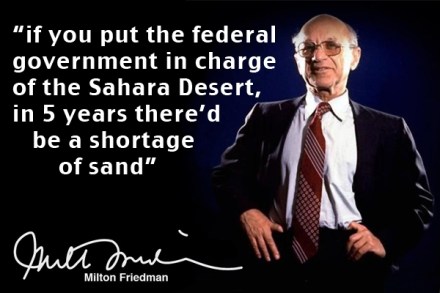
Milton Friedman would have been 100 later this month, and there is likely to be much commemoration - much of it nostalgia for an era where the right had a clear idea about how to get out of the mess the left had left. I always believed that Friedman's ability to articulate - his gift for aphorisms and jokes - was his greatest single talent. The arguments for the basics of human liberty are made all the time, but no one has quite made them with as much force and effectiveness as Friedman. His 1970s series Free to Choose remains, in my view, the most powerful TV documentary ever filmed - and the episode about school choice is horribly relevant to the mess we're in now.

Dirty, ugly things

Sometimes fiction can be more accurate than published facts. Ten years ago a film, Dirty Pretty Things, told about the plight of illegal immigrants into Britain and the least-explored scandals of all: the black market trade in human organs. It was an aspect of Britain’s secret country, the black market occupied by a million-plus souls that produces a tenth of our economic output. Most of these people work illegally, perhaps in criminal endeavour or perhaps honestly, but in fear of immigration police. It is, by definition, an unregulated environment in which all manner of evil can be incubated. It is becoming clear now that one of these evils is the return of slavery.

The battle with the Olympic censors

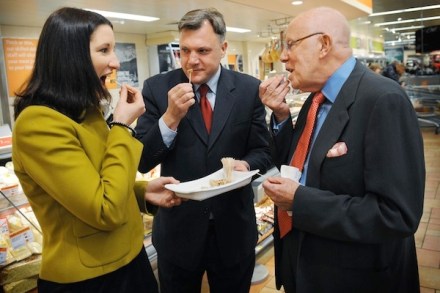
At 7am this morning, The Spectator’s managing director emailed me to say the new magazine is on sale at WH Smiths at Victoria station – a good sign, he said. But why shouldn’t it be? Because this week, we’re running a cover story by Nick Cohen lambasting the thuggish Olympic censors, the people who are stopping chip shops selling chips because the Olympics is sponsored by McDonald’s. And it’s still not quite clear, this morning, if that means we’ll be taken off the shelves. A few weeks ago, I was emailed advice – not from our lawyers, but from someone else in the magazine world - that The Spectator should not refer to the Olympics for the duration of the Games otherwise we 'could be taken off newsstands (and also liable to prosecution)'.

Cameron should be proud of jobs rise

David Cameron said in Prime Minister's Questions today that there have been 800,000 more private sector jobs under his government. This is almost true, and — I thought — worthy of elaboration. Government cannot, of course, ‘create’ jobs — all it can do is move jobs from the private to the public sector. Every penny of public sector salary is taken from the real economy, and is a penny that someone isn't being paid (or isn't being spent). Now, if you're the BBC it doesn't seem that way. It seems like the sky is falling in, because your own state-mandated budgets are being cut.

The free-school ‘scandal’ ignores parents and pupils

The Guardian has published a piece on school reform which perfectly expresses the attitude which has condemned children of lower-income parents to dismal education for years. The introduction of the story goes as follows:   There are around 10,600 empty school places in Suffolk. Or, to put it another way, if 10 average-sized secondary schools were closed down, there would still be a place for every child living in the county who needs one. Which made it somewhat surprising, therefore, when the Department for Education approved four free schools in the county, with a further two in the offing. 'The Suffolk free school scandal', as local campaigners are calling it…   Behold the bureaucratic mindset: why open a new school if there are places to fill in bad ones?

Yellow dove down

The Lib Dem dove has been shot by a well-aimed Tory arrow tonight, and you can bet that more than a few of Nick Clegg’s allies will feel deeply betrayed. The Lib Dems walked on the coals of the tuition fee rises, and for what? The Tory leadership cannot really claim to be giving its full backing to Lords reform. Yes, William Hague was sent on the radio this morning – in theory to urge obedience over the reform. But when the Foreign Secretary started laughing you had the feeling that he did not quite take his mission very seriously. Every Tory MP knows that the whips have given mixed messages, and did not tell them that there was no way back if they rebelled. You can't send the majority of your backbenchers to Siberia.

Is the Work Programme working?

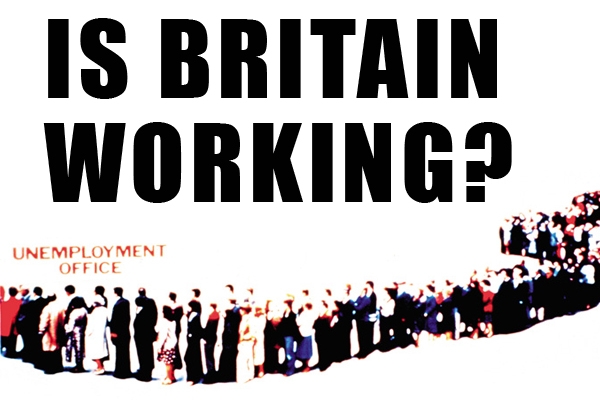
School and welfare reform are the signature missions of David Cameron’s government – but is welfare going wrong? Labour is crowing that today’s figures from the Work and Pensions department on welfare-to-work show it’s a failure. I’ve just come back from a DWP briefing with Chris Grayling, the minister responsible, and thought Coffee Housers would be interested in his take. It was Labour who first involved private companies into welfare-to-work, and the coalition has continued it – but pressed the reset button. Their scheme is called the Work Programme, the largest welfare-to-work programme on the planet with 750,000 clients. It means the government pays a £4,000 fee to a company that can place someone with a job for 18 months.