Fraser Nelson

Fraser Nelson

Fraser Nelson is a Times columnist and a former editor of The Spectator.

Miliband’s speech showed he couldn’t care less about leading ‘one nation’

From our UK edition

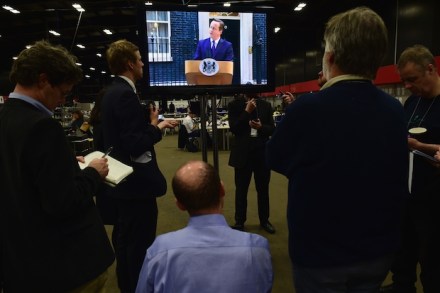
I think I’m about the only journalist to have watched Ed Miliband’s speech and think it wasn’t awful. Here in Manchester, the consensus seems to be that this was as bad as a speech could be. And, admittedly, even I was tweeting rude things about it all of the way through (since when does anyone need a 10-year plan? Britain won a world war in six years). You may not like the politics but his speech was intellectually coherent, even pugnacious in parts. Sure, it was about an hour too long and had some worrying lacunas. His decision not to mention the economy was wise because he has nothing to say.

Why the Tories can’t really criticise Rachel Reeves on debt

From our UK edition

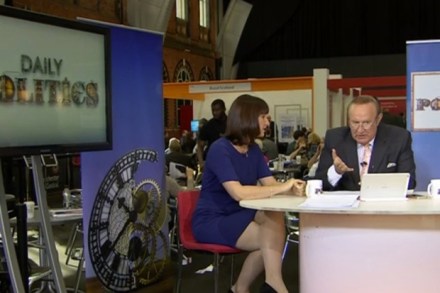
Rachel Reeves’ interview on BBC Daily Politics may have been excruciating at times (below), but was it really the ‘car crash’ that the Tories are today claiming? Matthew Hancock is crowing that she pointed out the conditions necessary for reducing debt. She said:- 'We are planning to get the national debt down, which means you have to be running a surplus to be able to do that. If you are going to have national debt falling you have to have a surplus overall... To get debt falling you have to have a surplus on overall spending.’  Whether wittingly or not, Reeves went further than Ed Balls. She said she wants a "surplus overall," as distant from the surplus on the chunk of the budget defined as 'current spending'. This is the same as the Tory policy.

Where Labour and The Spectator agree on social mobility

From our UK edition

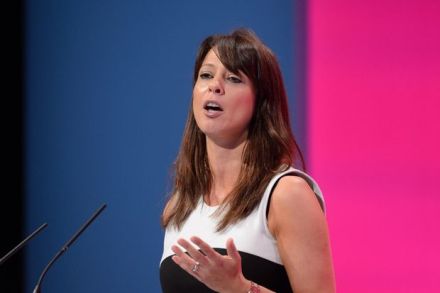
The Labour Party conference has got off to a very promising start, with The Spectator being complimented from the stage and applauded in the hall. 'Here’s a publication you don’t hear praised that often at a Labour Conference: the Spectator,' started Gloria De Piero, its equalities spokeswoman. But she did not, alas, go to quote our editorial ‘The false promise of "equality."’ She was instead praising our working with the Social Mobility Foundation for summer internships – something that a lot of publications do, including the New Statesman. Her speech is above. It's good to see both left and right agreed in the need to address declining social mobility in Britain.

Will the English welsh on the Scots?

From our UK edition

A few days ago Cameron, Clegg and Miliband made a 'vow' to Scottish voters - if they rejected separation, far more powers would be transferred to the Edinburgh parliament. Gordon Brown was sent to flesh this offer out, apparently with the backing of all three party leaders. With the 'no' vote now in the bag, this 'vow' and the timetable (it'd be done by Burns Night, said Brown) looks shaky: I'm told that Cameron has no intention of transferring any powers before the election and that he says Brown was freelancing. (He didn't make this point before the referendum). Some Tory MPs, in turn, say that Cameron did not have their authority and were freelancing - there is talk of rebellion.

Audio: Scottish teenagers on why the independence battle is just getting started

From our UK edition

Will there be another Scottish independence referendum? I went back to my hometown, Nairn, yesterday to gauge the mood after the 'no' win. Highland Region split 53/47 for 'no', tighter than I imagined. I was also interested in the younger voters (and the newly-enfranchised 16 and 17-year-olds) - because their interest (or lack of it) may determine whether the issue of secession stays with us. Canadian PM Stephen Harper told me last month that Quebec's youth got bored of the subject of secession, which is why the issue has cooled.

In praise of Alex Salmond

From our UK edition

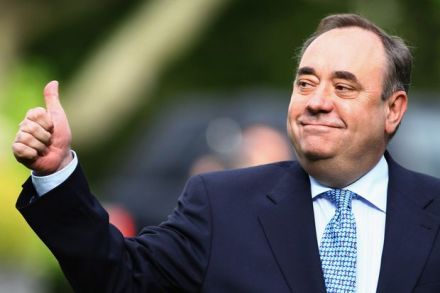
Alex Salmond has proved himself the most effective party leader in Europe, let alone Britain. He has just run a terrifyingly effective campaign, perhaps the best I will ever witness. I could not disagree more with his aims, but to me that makes his achievement all the more remarkable. I doubt any other politician could have sold such a bad idea to 45 per cent of Scots. He ran rings around his opponents, outsmarting them all. He was so damn infuriating because he was so damn good: able to use humour, anger, audacity and caution when each was required. I can't think of many politicians with his versatility. As a unionist, I'm delighted that the sharpest fang in the SNPs mouth is being extracted. Or is extracting himself.

Podcast: the night Britain holds its breath

From our UK edition

Well, it's going to be a nail-biter. The voting has closed, and I've just spoken to Hamish Macdonell and James Forsyth for the podcast: both sides think that they have won. Why? The polls show it's too close to call, so each side is going on anecdote – and risks a positive feedback loop. I'm in Inverness, near my hometown of Nairn, but the joy of being back in the Highlands is tempered by the chat. In the bar I was at (Hootananny, the city's best venue for folk music) the punters were swapping stories about getting their friends and family out for 'yes'.

Whoever wins Scotland’s referendum, the ‘yes’ side has emphatically won the campaign

From our UK edition

As I left Edinburgh this morning, en route to Inverness, I passed about four ‘yes’ activists cheerily wishing me good morning, asking if I have voted and would I like a ‘yes’ sticker if I had. It worked: on the way to Waverley, people were wearing the ‘yes’ stickers with nary a ‘no’ to be seen. If I were a 'no' voter heading for the polling station, I may wonder if I was actually on the wrong side of history. That a party was happening in one room, and I was heading to another - but that there was still time to change my mind. You have to hand it to the ‘yes’ team: its discipline, messaging, voter targeting and morale have been a sight to behold.

The Union is saved – but at what cost?

From our UK edition

The worst has not happened; Scotland has not seceded from the United Kingdom. But David Cameron will have known some time ago that, whichever side won in the referendum, there would be no victory. This morning, the United Kingdom wakes up to one of the biggest constitutional messes in its history. Given that the unionists had the best product to sell — Britain — it is alarming that they were supported by only 55 per cent of Scots. For months, the opinion polls had suggested far bigger support. The unionists may have won the election, but the separatists emphatically won the campaign. The Prime Minister had to turn to Gordon Brown, and seemingly give him the authority to redraft the constitution at will. He must now accept the consequences.

The Scottish jobs miracle is an argument for Union, not independence

From our UK edition

One of the more bizarre aspects of the Scottish independence debate is the idea that UK welfare reform somehow doesn’t fit Scotland. On the contrary, it was designed for Glasgow – the Easterhouse housing scheme, to be specific, after a visit which changed Iain Duncan Smith’s whole career. And the other point about these reforms is that they’re actually working. Today’s figures show that the number of Scots in employment is rising by almost 500 a day. A grand total of 2.62 million are now at work in Scotland – never in the country’s history has it had so many in work. And why? It's the same phenomenon that you see in England: the number of people available for work is rising far faster than the working-age population.

Pictures: the UK unity rally in Trafalgar Square

From our UK edition

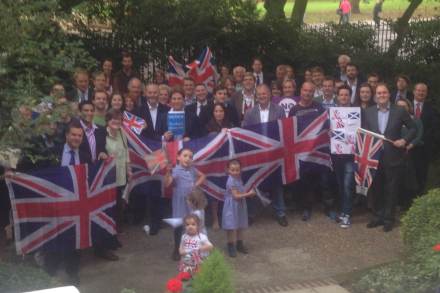
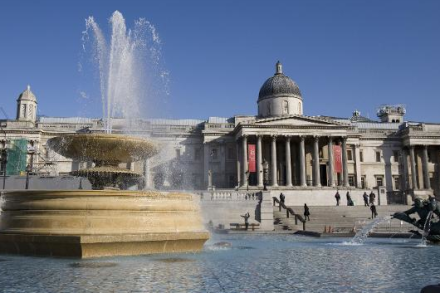
The point of being British is not banging on about being British. But when your country is three days away from being dissolved - in part because the emotional case for the UK has not been made properly - then people do start to say what their national identity means to them. The long list of Spectator readers' letters was one example, and we were delighted to welcome a bunch of them for tea in the garden of at 22 Old Queen Street this afternoon. [caption id="attachment_8867252" align="aligncenter" width="550"] Spectator readers (apart from ones in front of the flag: they're soon-to-be-readers)[/caption] As you can see, we had four younger readers - this kind of captured the spirit of the rally.

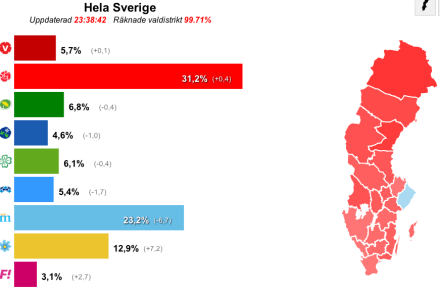
Shock election in Sweden as the Sweden Democrats become no3 party

From our UK edition

Yes, Britain is on the point of breaking up - but there are more ill winds blowing in Europe right now. The National Front is polling so strongly in France that Marine Le Pen would be president if an election was held tomorrow. And as I write, the populist Sweden Democrats seem to be the only real winners of the general election held there today. As far as I can tell, this hasn’t been picked up by the English-language media yet - they're focusing on the power transfer to the Social Democrats (this isn't the same as a victory: a victory means you actually win more voters). What follows is from the Swedish TV and websites, so please forgive the dodgy translation. The conservative Prime Minister, Fredrik Reinfeldt, is out*: but we knew he would be.

It’s on! Come for tea at The Spectator before the 6pm #unity2014 rally in Trafalgar Square

From our UK edition

Okay, so it’s going ahead: The Unity rally in Trafalgar Square, where people will come together to say how much the United Kingdom means to them, will take place 6pm Monday 15h September - Battle of Britain day, an appropriate time for the battle for Britain. And Spectator readers are welcome to come by for a cup of tea in the garden of our office at 22 Old Queen St, before we walk up together. Our garden isn’t massive (as anyone who has survived the crush at our summer party will attest) but if you'd like to come along, email editor@spectator.co.uk.  I know not everyone can get away at that time, and many would love to join us but can’t be in London.

Deutsche Bank: Scottish independence would bring austerity on a scale never seen before

From our UK edition

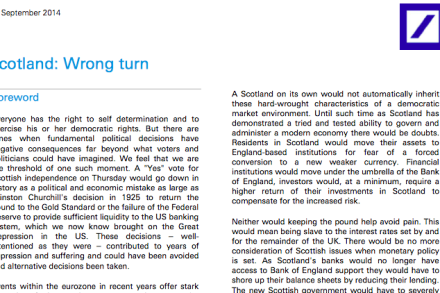
Many voters in Scotland moan about the media: half of the country wants separation, according to the polls, but almost all newspapers are against it. So where to turn, for dispassionate analysis? As James Forsyth says in his brilliant political column this week, there’s no one left to tell the truth. That’s why private advice, issued by financial analysts to their clients, is interesting: these guys have no interest in spin, only accuracy. If they issue duff advice, their career is over. The analysis of Deutsche Bank (pdf) has been flying around Twitter, but not many are inclined to read long PDFs. So the below is an edited extract. It’s from David Folkerts-Landau, its chief economist.

UK #unity2014 rally announced: Trafalgar Square, 6pm on Monday

From our UK edition

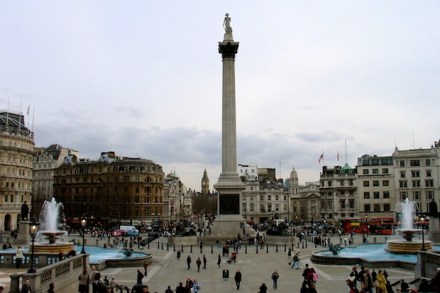
Great news: a Unity rally has just been called in Trafalgar Square for 6pm on Monday. It’s for those who love Britain and don’t want to see it snapped in two. It’s all very last minute, but even if there is a happy few of us it can make a difference. What's the point of holding a rally in London? It's true that no one there will have a vote, but this is for those who still love this county and can't bear to sit back and watch it fall apart. Those who want to do something, no matter how small. The rally should enforce a point : that the UK is an extraordinary union of peoples, and that those outside Scotland do hope they'll vote to stay.

Jim Sillars’ threat of a ‘day of reckoning’ exposes the darker side of nationalism

From our UK edition

Only yesterday, Jim Sillars was being paraded by Alex Salmond as a nationalist heavyweight who has been taken back into the fold. He had once fallen out with the Alex Salmond but the two were, apparently, good friends again. A photoshoot, above, consummated this reconcilliation. Sillars is a former SNP deputy leader but now not part of the apparatus-  so he can speak freely. All too freely, as it turns out. Here’s what he has said today. “This referendum is about power, and when we get a Yes majority, we will use that power for a day of reckoning with BP and the banks. The heads of these companies are rich men, in cahoots with a rich English Tory Prime Minister, to keep Scotland’s poor, poorer through lies and distortions.

How Scotland’s ‘yes’ side mastered the art of mob politics

From our UK edition

While distributing free Spectators in Glasgow yesterday, I came across a Labour rally and ended up standing about two metres away from Ed Miliband as he gave his speech. But no one could hear a word he said because the ‘yes’ crowd were eyeballing him, chanting and looking as if they were about to eat him. Compare this to the serenity with which Alex Salmond makes all of his speeches: where are the ‘no’ heavies shouting him down? They don’t exist: you may get the odd heckler, but the tactics deployed by the two sides are fundamentally different. This underscores an important point, a trademark of this campaign: how the 'yes' side mastered mob politics.

The young (and the English) have restored Scotland’s ‘no’ lead

From our UK edition

No unionist should breathe easily after last night’s YouGov poll putting the ‘no’ team on a six-point lead. The race remains too close to call. And the poll also suggests a degree of volatility quite unlike that seen in general elections. Michael Sauders from Citi has dug deeper into the figures (pdf). You need to treat all Scottish polls with caution, due to the sample size and the fact that the turnout may be high enough to include people who polling companies don't know exist. But YouGov found that the under-25s (the ones more likely to vote on the day, rather than by post) have switched form a 20-point lead for ‘yes’ to a 6-point lead for ‘no’ in under a week.

Stay, Scotland – the Spectator readers’ message

From our UK edition

[audioplayer src="http://traffic.libsyn.com/spectator/TheViewFrom22_11_Sept_2014_v4.mp3" title="Fraser Nelson, Tom Holland and Leah McLaren discuss how we can still save the Union" startat=50] Listen [/audioplayer]I’ve just arrived in Edinburgh, where I’ll be handing out copies of the new magazine on Princes St from 8am tomorrow morning (helped by two readers, who kindly answered my appeal on Twitter). It’s a rather special edition: for the first time our 186-year history, the cover story has been written by the readers. We asked them to write a letter to Scots, telling them what they thought – rather than rely on the message being conveyed by the politicians. The volume and quality of the replies has been remarkable.

Devolution has given power to politicians, not people. Independence won’t change that

From our UK edition

Gordon Brown has spoken, and the unionist parties are in agreement: if there’s a ‘no’ vote then more powers will be given – we’re told – ‘to Scotland’. There’ll be another commission and another Scotland Act. This so-called Devo Max should have been offered six months ago; to offer it in the last few days of the campaign smacks of panic. By moving more towards Salmond’s territory, the unionists conceded the premise: that more powers to the Edinburgh political elite is somehow the same as more powers to ‘Scotland’. And who could be against more power to Scotland? Not a single party, it seems, is questioning the premise: that the more the MSPs get up to, the better for Scotland.