Fraser Nelson

Fraser Nelson

Fraser Nelson is a Times columnist and a former editor of The Spectator.

Lucy Powell confirms: debt-addicted Labour has no plan to balance the books

From our UK edition

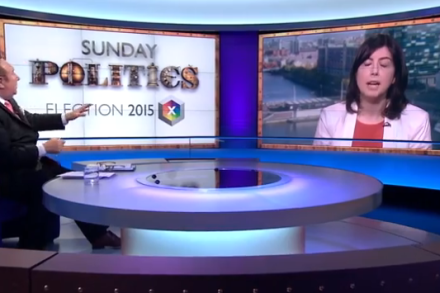
'You aren't listening to what I'm saying,' said a rather rattled Lucy Powell, Labour's election chief, whom the party put up for BBC Sunday Politics today. I suspect that, by now, she'll have wished that we weren't listening. Because in a commendable moment of candour, she admitted that the Labour Party intends to keep debt rising should it win power – and has no real deficit reduction strategy. Ms Powell dispensed with Ed Balls tricksy language and told it how it is. Here she is, talking to BBC Sunday Politics (11 mins in, after complaining about a 'Paxo-style interview'). 'Andrew Neil: You would borrow more, wouldn't you? Andrew Neil: To bridge the deficit you have to borrow more.

YouGov/Sunday Times poll puts Labour 4 points ahead. Be afraid.

From our UK edition

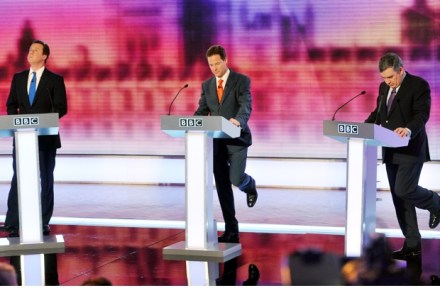
Just two weeks ago, senior Conservatives were saying that 'crossover' had been reached: that the Tories were ahead in the polls and that the lead would slowly build. Last week, the lead evaporated. Tomorrow, a YouGov/Sunday Times poll puts Labour four points ahead. Cameron's bizarre pre-resignation on Monday and a rather lacklustre performance in what passed for the television debate on Thursday seems to have had an effect. Sure, they were watched by only 3 million people vs. 10 million for the 2010 debates - but the word gets out. Jeremy Paxman performed very well, Ed Miliband quite well, Cameron less well. And yes, that's the Cameron already talking about his retirement, as if he has already mentally checked out.

Alex Salmond sets out his terms for Ed Miliband

From our UK edition

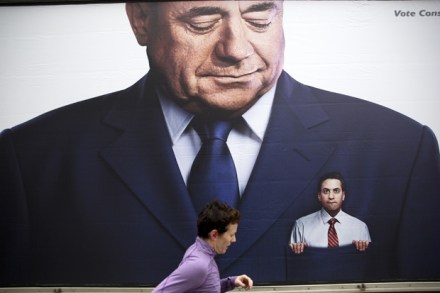
‘Would you like a glass of pink champagne?’ asks Alex Salmond at 3.30 p.m., sounding very much like a man settling down for the afternoon. It’s Monday and Scotland’s former first minister has cause to celebrate. He spent the previous day musing on television about the price he’d demand for the SNP supporting Ed Miliband in the Commons, and his thoughts dominate the front pages. There’s plenty of outrage at the idea of the SNP toying with England, and outrage is just what he wanted. So champagne it is. He has found himself an unlikely star of the Tory election campaign; the party this week released a cartoon showing him playing a whistle while Miliband dances.

Exclusive: Alex Salmond says SNP will back Labour unconditionally

From our UK edition

“Would you like a glass of pink champagne?” asks Alex Salmond at 3.30pm, sounding very much like a man settling down for the afternoon. It’s Monday and Scotland’s former First Minister has cause to celebrate. He spent the previous day musing on television about the price he’d demand for the SNP supporting Ed Miliband in the House of Commons, and his thoughts dominate the front pages of the newspapers. There’s plenty of outrage at the idea of the SNP toying with England, and outrage is exactly what Salmond wanted. So champagne it is. Salmond has found himself an unlikely star of the Tory election campaign; the party this week released a cartoon showing his playing the whistle while Miliband dances.

What cost of living crisis? CPI inflation falls to zero for first time on record

From our UK edition

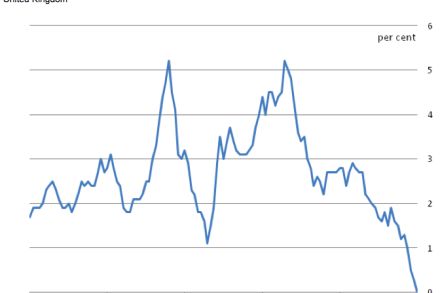
So much for Ed Miliband's 'cost of living crisis'. UK inflation, as measured by the CPI index, has just fallen to zero (pdf). Even this figure masks better news: food prices are actually falling, by 3.4 per cent over the last 12 months. The cost of motor fuel is down by 17 per cent, mainly thanks to collapsing oil prices. Crucially the price of such essentials should keep falling - as the below forecast from Citi (pdf) shows:- Now, should we worry about 'deflation'? There are some economists who say this is a real problem because if things get cheaper than punters put off purchases. There is zero evidence of this happening in the UK. Indeed, according to Citi (pdf) ...

David Cameron: this will be my last election. Theresa, George or Boris may succeed me

From our UK edition

With just days to go until the general election campaign, David Cameron has declared that this is last time he's leading his party into battle. It's not clear why he felt the need to make this announcement, a tactic normally used by unpopular and besieged leaders to buy time. He says he will stand for a 'full second term' but won't serve a third. His party has lots of talent, he said - a comment that all party leaders make from time to time. But what's unusual is that Cameron actually picked out three potential successors: Theresa May, George Osborne or Boris Johnson (in that order). Which will set all kinds of hares running.

Internships at The Spectator for summer 2015

From our UK edition

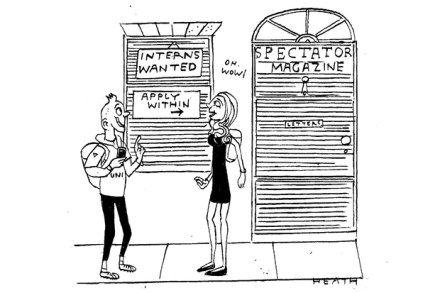
Due to the large amount of applications received we have decided to close the application process sooner than planned. Please do check back for future opportunities. Summer’s coming, and we’re looking for interns at The Spectator. We’re looking for digitally-savvy lovers of good writing with fresh ideas to spend a week or two with us at 22 Old Queen St. The position will be paid (but not paid very much). We don’t mind where or whether you went to university; Frank Johnson was a superb editor of this magazine and he had no formal education to speak of. What matters is flair, imagination and enthusiasm. Skills that you can't really learn in any classroom. So leave education off your CV - if you send a CV at all.

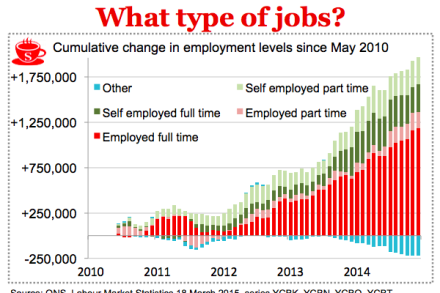
A jobs miracle is happening in Britain, thanks to tax cuts. Why don’t the Tories say so?

From our UK edition

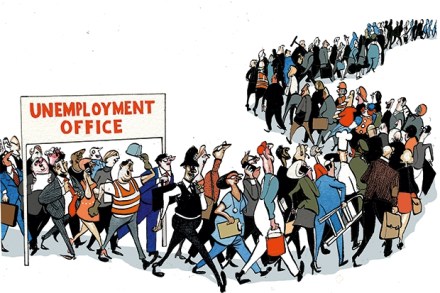
Feeling the genitals of freshly hatched chickens may not be the most glamorous job in the world but at £40,000 a year it’s not badly paid. It requires some stamina: you pick up hundreds of chicks a day and check their ‘vent’ for boy parts. If it’s a baby hen, then she’s sent off for a life of corn and egg-laying. If it’s a baby rooster — well, best not to ask. Almost nobody in Britain wants to do it, so vacancies go unfilled. The poultry industry, in desperation, has asked the government to add ‘chicken sexer’ to its growing list of seemingly unfillable jobs. This fits a trend. In five short years, Britain has gone from having mass unemployment to jobs galore.

Budget 2015, explained in ten graphs

From our UK edition

As ever, the story of the Budget was hidden in the small print. There are no hidden tax rises, but the story isn't really in the tax. It's about the cuts to come, the incredible jobs recovery and the games already being played for the general election campaign. Here's my take:- 1. The rollercoaster of cuts to come:- The OBR has rather huffily pointed out the weirdness of the cuts planned for the next four years: a ‘rollercoaster,’ it says, devoid of logic. After the election, cuts will be four times sharper than those implemented in this (election) year. Then most weirdly of all, right at the end, spending soars.

Budget bloopers – five graphs that George Osborne won’t be sharing on Wednesday

From our UK edition

George Osborne is the most political of Chancellors, and his Budget today will doubtless read like a party political broadcast. The economic momentum is on his side: soaring employment, plunging inflation, fuel prices down. But he has had more trouble with the public finances than he expected (as things turned out he could afford it, as global borrowing rates have plunged). But in the interests of balance, here are a few economic bloopers that he won’t be boasting about. 1. The deficit plan: the single biggest disappointment of his five years. Once, he defined himself by his ability to abolish the structural deficit by the 2015 election. Now, it’ll be 2018-19 before the books are balanced.

Eurovision in sign language

From our UK edition

I was at the hall of Swedish Church in Marylebone last night to watch the final of Melody Festival – the bar was selling dill crisps, pear cider and plenty merriment. As I expected, 'Heroes' won. But the show itself was a masterpiece of entertainment, an example of how Swedish TV is now vastly superior to the BBC in spite of having a fraction of its entertainment budget. The show was played to a 28,000-strong crowd (a panel of six BBC bureaucrats choose the lamentable UK entries) Melody Festival opened with a version of Final Countdown (a Swedish anthem) sung in swing time by Conchita, last year's Eurovision winner.

The Lib Dems are getting desperate (but it didn’t have to be this way)

From our UK edition

I do feel sorry for Danny Alexander. He’ll have been worked off his feet for the Budget due next week but his party then dispatches him to butter up a would-be donor – or, in this case, an undercover reporter from the Daily Telegraph. Not that he said anything incriminating, but the idea of him being sent to press the flesh of a donor who had delivered just £7,650 reflects their panic. (The Tories charge £50k to meet a quad member.) It doesn't show that the party is corrupt, just that it's desperate, as you might expect from its poll rating (above). I look at this desperation in my Daily Telegraph column today. Power has brought the Lib Dems cash: it raised £8.2m last year, twice as much as it raised the year before the last election.

If Alex Salmond thinks posh boys are cowards, he should visit Eton’s war memorial

From our UK edition

 Alex Salmond’s brand of populist nationalism involves portraying the Tories as the party of the class enemy. But his latest attack on David Cameron and the TV debates has crossed the line of decency. 'Like most posh boys, given half a chance, he'll run away from a fight,' he said yesterday.  This is bigotry, pure and simple, and Salmond disgraces Scotland with such inverted snobbery. Would he (or anyone else) talk about ‘poor boys’ in such a way?  If Salmond intends to use this line in the general election campaign he will find, as Labour found, that Britain does not share the prejudice which animates some of its politicians. Voters don’t really mind if a politician is poor or posh: it’s what they say that counts.

A deserving winner – and undeserving losers – from last night’s UK Press Awards

From our UK edition

Last night’s UK Press Awards stood out for deserving winners - and some undeserving losers. Andrew Norfolk of The Times won two gongs for his extraordinary investigation into child abuse in Rotherham, which exemplified what good journalism can achieve. Norfolk ploughed away at this for years, often as the only journalist in the courtroom putting together a picture that the authorities did not want to see: Muslim men abusing white girls. His investigation triggered an inquiry which exposed a crime and some 1,300 victims. It's lonely work, and pretty depressing to spend months on end acquainting yourself with every detail of a story that involves the basest human behaviour.

With proper support, state-educated kids beat the privately-educated. Here’s the proof

From our UK edition

The Sunday Times today reports proof of what many have long suspected: that if you give bright disadvantaged kids the same support that pupils get at private schools and they beat their privately-educated rivals at top universities. Get three decent A-levels at a private school and you've a 65 per cent chance of going to a Russell Group elite university. But state school kids helped by the Social Mobility Foundation have a 70 per cent change, according to a report from the Institute for Fiscal Studies (pdf). We at The Spectator are great supporters of the Social Mobility Foundation (I recent joined its advisory board). It identifies some of the brightest and most determined young people in Britain; we have hired two SMF alumni so far.

TV election debates don’t fit the UK democratic system. Hence the chaos

From our UK edition

I wish I could get worked up about the televised election debates (or lack thereof). I can understand that it's a very important to the broadcasters, who don't mind reducing the campaign to three US-style standoffs. But if they don't go ahead, is it really an outrage? Is our democracy really the poorer for it? When broadcasters are angry, they have a platform to vent - which is why the furore is been given disproportional coverage. But without the debates, the election will go on in the way that every election before 2010 went on. And I rather welcome that. The TV debates do make good entertainment but they do rather take over the campaign - and put the whole thing a little more in the hands of the political and media elite.

Justin Forsyth has far more to apologise for than Tony Blair’s Save the Children award

From our UK edition

You almost have to admire Justin Forsyth’s brass neck. He is a former Gordon Brown spin chief earning a Prime Ministerial £138,000 for running Save the Children. Or, rather, transforming it into Save the Labour Party with various attack ads claiming that kids need to be rescued from wicked Conservative austerity. Here's an example of its handiwork: https://www.youtube.com/watch?v=3eKJ972iZ-U You’d think that Forsyth would be rather embarrassed about abusing the charity’s resources in such a way, but last year Save the Children went one further and gave an award to Tony Blair. That really was too going far.

Måns Zelmerlöw’s ‘Heroes’ shows why Sweden rules the pop world

From our UK edition

This is a blog written after the first screening of Måns Zelmerlöw's Heroes, which went on to win the Swedish nomination and the 2015 Eurovision Song Contest. The world’s most-watched cultural event is some time away, but for Eurovision affectionados the entertainment has started already. Britain and Sweden are the continent’s two greatest exporters of pop music, but the UK Eurovision contestant is annointed by the BBC whose institutional snobbishness and soft xenophobia prevents it from understanding the contest. Sweden asks Swedes to choose from one of 28 entries in a six-stage event called Melody Festival, now in full flow. For MelFest, a song starts with songwriters.

England’s university tuition fees are working – to prove it, look at Wales

From our UK edition

I've just seen a poster from the NASUWT teaching union at a stall they have taken at this year's Welsh Tory conference in Cardiff (where I am today). It suggests that the poor have it easier getting to university in Wales than in England because of the wicked 'Westminster Coalition Government.' This is an utterly dishonest poster. The poor, in Wales, have it worse – precisely because they rejected the redistributive policy of tuition fees. The poster espouses the facile logic that Ed Miliband has regurgitated today – that tuition fees somehow make the poor less likely to apply.

How Cameron’s jobs miracle ate his immigration target

From our UK edition

The embarrassing truth is that David Cameron did not think carefully about this pledge to take net immigration into the 'tens of thousands'. The pledge originated in a Thick-of-It style farce: it was an aspiration mentioned by Damian Green, then immigration spokesman, that caught media attention. The Tories didn’t want to make a fuss by disowning it, so this pledge ended up becoming party policy and then government policy. Absurdly so: a country can only control who comes in, not who goes out. So immigration, not ‘net immigration’, should have been the target. And even then, it should have been immigration from outside the EU – which Theresa May has done a reasonable job controlling. But the not-so-embarrassing truth is that this is a problem of success.