Fraser Nelson

Fraser Nelson

Fraser Nelson is a Times columnist and a former editor of The Spectator.

Making debt a real, human issue

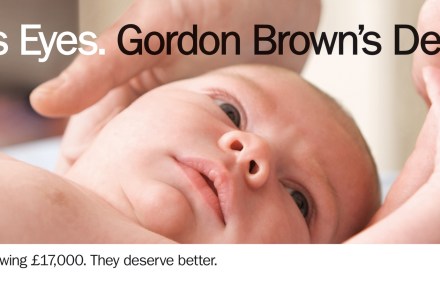
Superb poster by the Tories which makes debt into a real, human issue (just as Coffee House urged him to in November) - a picture of a baby with the words "Dad's nose, Mum's eyes, Gordon Brown's debt". It calculates that a baby born today will owe £17,000 - and there is no exaggeration here. Brown repeatedly claims to have reduced debt, such a whopper that he's seldom contradicted by interviewers. The truth: in 1996-97 the UK debt was £347bn. By the end of the boom in 2007-08 it had soared to £527bn and is forecast to  hit £1.02 trillion in 2012-13. And this is using Brown's method: ie, not including the nationalised banks or the debt hidden in PFI contracts.

Davis / Purnell

James Purnell is the welfare and pensions secretary – the title ‘work and pensions’ is a bit of a euphemism. Britain isn’t a planned economy, the government doesn’t set employment levels, so the ‘jobs summit’ today is based on a false premise. We ain’t Cuba. Yet Brown wants to play up to the narrative that he is ‘taking action’. So poor old Purnell needs to speak about jobs, and did so in interview with Evan Davis on the Today programme earlier. It brought up some interesting points… 1. How bad can this get, asked Davis. “Governments don’t forecast unemployment, that has been the case for some time,” said Purnell.

Obama’s stimulus looks nothing like Brown’s – whatever our PM might say

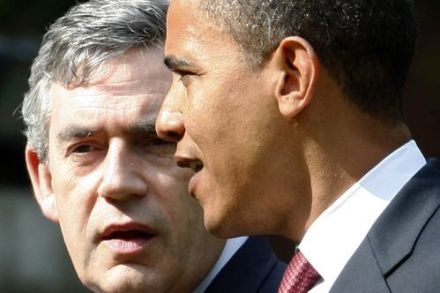
Gordon Brown’s trick is setting the parameters of debate, and fooling the opposition into accepting them. And in the next few weeks, he has a mission: to define the Obama bailout for the British media. He must teach them to see it as a Brown-style stimulus – thus allowing him to be quoted, without criticism, saying “this is almost exactly line by line what we are doing”. He wants to present himself as the master, and Obama as the young pupil. It's not true, of course. Obama is focusing far more on tax cuts than many sceptics (including myself) would have predicted – the scale of them is at least three times bigger than he indicated in his election campaign. He is now drawing fire from Paul Krugman – and that can only be a good thing.

Britain, by Ayn Rand

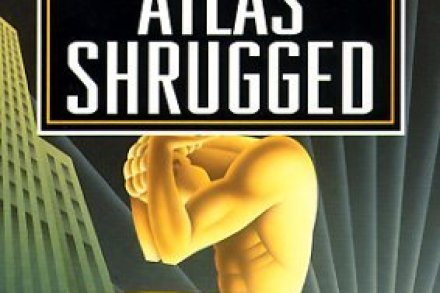
Even though it's deemed America's second most influential book, there are plenty in Britain who haven't heard of Atlas Shrugged - or Ayn Rand, its Russian-born author who had such a profound impact on American conservatism. Now is a very good time to read it, because - as Stephen Moore argues in the Journal today - the reader would find plenty of chilling analogies for the current economic collapse. It's a story of an American recession, during which the state starts to nationalise various industries - which in turn collapse under bureaucratic control - and keeps on going until there's nothing left. The heroes are those with an entrepreneurial spirit: from the homeless to the steel magnate.

McDonald’s take-away a Tory aide

More defections from Tory HQ: Natalie Kirby, Cameron's assistant head of media, is off to run the press at..... McDonald's UK. Before Coffee Housers snigger, I'd like to point out that McDonald's corporate debt has a lower risk rating than UK government bonds, so the markets are in no doubt about which is the dodgier institution. I’m not joking: McDonald's has a credit default swap rating of about 70 while the UK government’s is about 100. This means that the market genuinely thinks that quarter-pounders are a safer bet than pounds. Cameron will argue that as companies prepare for a change of government, its inevitable that Tory staff will be headhunted. But I can't help noticing that the flow of high calibre staff does seem to be leading out of, not into, its Millbank HQ.

What options remain after rate cuts?

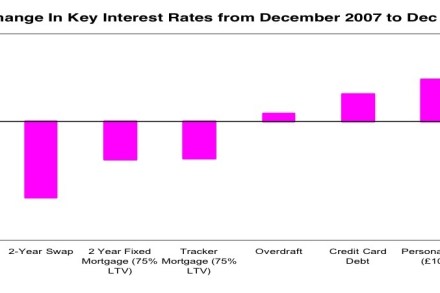
As expected, base rates are down half a point to 1.5% - so, yet again, drinks are on those lucky few with variable mortgages. I suspect they'll hit 1% before Easter. Then what? "Nobody is talking about printing money" says Alistair Darling - but this is a little Brownie. Quantitative Easing - the equivalent of printing money - is being spoken about by everyone and can come in many forms. The Bank of England can start buying stuff - Treasury IOU notes, company bonds, or even shares. So you'd attempt to lower market interest rates by boosting asset prices. Darling is right: he can fund the deficit through issuing gilts, then have the BoE buy the gilts without another banknote printed.

Ed Balls debuts the apprenticeships Brownie

Ed Balls never gets enough credit for the Brownies that he cooks up. One was served today, when he spent an interview with the Beeb denouncing those Tory plans to axe 220,000 apprenticeships. As he put it: "There is a choice for our country - a choice between a Government which says we must act to get through difficult times and the Conservatives, who on Monday announced cuts in public spending which would mean over 200,000 apprenticeships cut. In fact, it would mean almost no apprenticeships for young people at all." Except there are no Tory plans to axe apprenticeships. Not one. It was concocted by Mr Balls, on the grounds that if you lie in politics via figures, you get away with it. What Labour have done is do their own fake Tory budget-tightening exercise.

Lib Dem MEP: Israeli government fundamentally racist

With neither Labour nor the Tories saying much about Israel, Nick Clegg spotted an opportunity in venting outrage today. His party love it - but a little too much. Here is an extract from the blog of Chris Davies, a Libdem MEP: "It is time for Liberal Democrats to call a halt to the attempt to ride two horses and to try not to upset the Israeli lobby. Our support for the Palestinian cause is well enough known amongst those (by no means all!) in the Jewish community in the Jewish community who will not countenance criticism of Israel. It is not well enough known amongst the majority who are appalled by Israel´s behaviour.

Will Brown benefit from the interest rate cuts?

The VAT cut may have been economically and electorally irrelevant, but might all these interest rate cuts deliver for Gordon Brown? History will be made tomorrow when the Bank of England cuts rates to the lowest in its 315-year history - probably by half a point, to 1.5%. And even that will probably fall to 1% before Easter. A friend emails to say he has become a "reluctant buyer of Gordon Brown stock" - his mates are getting cheap mortgage deals, at 4% or 4.5%, saving hundreds a month. This will create a feelgood factor amongst a certain group. Once rates do fall to 1%, of course, the Monetary Policy Committee will have run out of ammo. That's when things like printing money, or quantitative easing to give it its euphemistic name, come on to the agenda - and sterling (now back up to 1.

Politics | 7 January 2009

Only when Tony Blair popped up on the airwaves did it become clear just how different it is this time. Israel is again at war — yet, unlike 2006 there are no MPs clamouring for Parliament to be recalled. There is no Prime Minister who regards himself as a peacemaker offering his opinion to the world. Nor is there even an opposition seeking to outflank the government by using loaded phrases like ‘disproportionate response’. There is a recession on — and strong opinions on the Middle East seem to have fallen victim to the credit crunch. When asked, Gordon Brown says he is alarmed by Israel sending troops into Gaza. But he’d rather not be asked.

Wedgwood’s contribution to the abolition movement

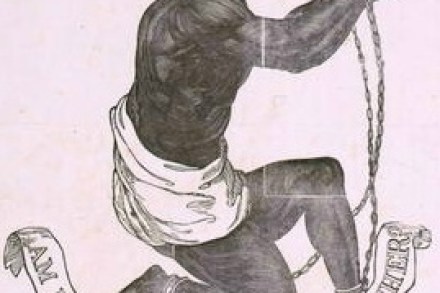
As Waterford Wedgwood goes bust and its obituaries written, it’s worth noting its contribution to an area for where it gets little credit: outlawing the slave trade. Much rot is spoken about the abolition campaign, mainly due to the vanity of MPs who like to portray it as the result of a parliamentary initiative. Rather, it was a grassroot social movement – in many ways a viral campaign which owes much the marketing genius of Josiah Wedgwood, the company's founder, who joined the anti-slave trade campaigners in 1790. He had a genius for what is today called product placement. He’d find ways of getting his vases into famous paintings, for example, and figured he could deploy the same techniques in a political campaign.

Cameron’s plans crash into Brown’s debt mountain

Like James, I applauded Cameron's tax-cutting plan - the right cut, in the right direction, for the right people. But there is one slight hitch. It is promised only if there's an election this year. The 2009-10 budget starts in April, by which time Cameron probably wont be in power. If there's an election next year, as is more  likely, then the plan will not materialise because there won't be the money. All these headlines that he hopes to generate will be for nothing. The Tories don't say so in terms. But I asked Cameron afterwards if his tax cut offer is valid in 2010-11 when he's more likely to be in power - and he answered that he can't tell what the public finances will look like by then. That sounded like a 'no' to me.

Another Brown job

Will anyone take Gordon Brown’s claim to create up to 100,000 jobs seriously? As a statistician will tell you, “up to” includes the number zero. And as any economist will tell you, government can’t create jobs. The best it can do is move jobs, from the private to the public sector via tax – or from the future to the present, via debt. And in this case, I suspect it’s all a hoax anyway. Sure, Brown can hire some builders to renovate schools. But first of all, how many of his 100,000 were going to be hired by the state anyway? And of those who weren’t, can he be so sure they were all otherwise heading for the dole queue?

The sterling turning point?

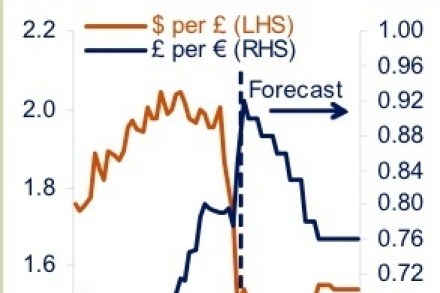
I'm fairly pessimistic about the prospects for sterling - or the GBPeso as some CoffeeHousers have dubbed it. But as a counterbalance to the stuff I've been posting recently, here is a forecast from Royal Bank of Scotland which reckons sterling has been oversold, the turning point has arrived and that we will be able to afford to go on holiday after all. Our pounds will be buying €1.20 by next Christmas and €1.30 by Christmas 2010, but we can forget about those $2 pounds. Here is its graph (below). RBS inverts things, and asks how many pence a Euro will buy. RBS reckons the BoE will cut rates to 1% by Easter and keep them there - but nonetheless argues sterling is "cheap by historic standards" and "eventually, this should tempt foreign investors to move back into sterling".

New year; same old Gordon Brown

No.10 has come up with an ingenious solution to what could have been a yearly presentational problem: to have Gordon Brown's New Year's Message as a disembodied voice, with no video at all.  You can listen to it here. And that voice observes that an “old era of unbridled free market dogma was finally ushered out”. Remind us, who was Chancellor during the last ten years? It’s typical of Brown’s pettiness that he also includes in his New Year message a stab at the Tories, saying “The failure of British governments in previous global downturns was to succumb to political expediencsy and cut back investment across the board thereby stunting our ability to grow and strangling hope during the upturn. This will not happen on my watch.

Sterling slip-slides away

Another day, another plunge for sterling - it's at E1.022 and the slide shows no sign of tailing off. The world is beginning to worry that the kids are running the sweet shop in the British economy - and that mum has gone to Iceland.  Well, not quite, but the Reykjavik-on-Thames scenario - while still very unlikely - is becoming vivid enough to cause alarm. So far this month, sterling is off 13% against the Euro and 16% against the Swiss Franc (probably the most stable currency right now). And today's 1.43 US$ to the pound is still far removed from the $2.00 we had until August.

Politics | 29 December 2008

When David Cameron agreed last June to let his chief strategist work from California for six months, it seemed a timely break from what was threatening to become a dull job. Gordon Brown looked finished, and his party too weak to depose him. British politics threatened to be a comedy of errors stumbling on until the middle of 2010 — leaving plenty of time for Steve Hilton to go abroad, get married and send email advice from beside the swimming pool. From there, he must have watched in horror as British politics changed utterly. Even his fortnightly flights home will not have been enough to keep up with the bewildering speed of the Brown bust.

Looking ahead to 2009

As Matt says in his column today, only fools or knaves make predictions nowadays. So it's with the caveat that prediction is a mug's game that I make an A-Z of predictions for 2009 in my News of the World column today. Having said that, it's by no means a pointless exercise to say how the future looks now. In City terms, the fact that futures markets are wrong doesn't make them useless. What people do today depends on what they think will happen tomorrow. As Anthony Wells brilliantly shows, it's the expectation of an economic recovery that lifts Brown's poll lead. When this expectation goes, as it will when confronted with reality, the Tories should find their lead returning to them.

Why VAT cuts help the poorest least

I said that Gordon Brown's VAT cut was too small to notice - yet I have just saved £15 on furniture imports from Bali. Of course, £15 is a serious, noticeable amount of money. Problem is, it only helps people who have £600 to fork out on furniture. And here this is another defect of Brown's useless VAT cut: it helps people like me - who are saving like mad to atone for their borrowing sins - instead of helping the lower-income groups who are most likely to spend extra money. The VAT and duty cuts announced in the last pre-Budget report are, in fact, perfectly regressive - helping the richest the most and the poorest the least. This should not be so - at least not in theory.

No, Prime Minister

It’s not just the Germans. The IMF today has poured scorn on Gordon Brown’s useless VAT cut for reasons that any corner shop owner could have explained to the Prime Minister. Here is what Olivier Blanchard, the IMF chief economist, said today. “Temporarily cutting VAT, a measure that was adopted in Great Britain, does not seem to me to be a good idea - 2 percent less is not perceived by consumers as a real incentive to spend." Blanchard joins a small but growing chorus of international officials criticising Brown. Last week, I gave a list of other countries that are trashing Gordon Brown’s attempt to borrow his way out of debt.