Fraser Nelson

Fraser Nelson

Fraser Nelson is a Times columnist and a former editor of The Spectator.

Not a patch on our scandals

Inspired, perhaps, by The Spectator's list of the top 50  political scandals, Bloomberg has run a list of the ten best American ones. I have to say, these prudish Americans just don't do scandal like us. The list has a common theme: moralising politician caught having an affair! Please. Where are the Russian spies, the society whoremongers, the russian oligarchs, the Corfu taverns? Okay, I'll accept that the boy Clinton did them proud - but the rest of the list makes you think either America is squeaky clean or that its political class get away with far too much. Anyway, here are Bloomberg's choices, with my comments: 10 ‘Family Values’. Spitzer was New York governor, and resigned on threat of impeachment.

Politics | 11 July 2009

The debate over the 10p tax controversy on Tuesday was more like a requiem for the Labour party than a rebellion. MPs spoke mournfully about how — yet again — their government would hit the poorest hardest. Gordon Brown had used the 2007 Budget to trick newspapers into reporting that he had lowered the basic rate of tax — when, in fact, he had doubled the 10p starting rate, and left millions of low earners worse off. The Prime Minister had chosen deceit over principle, and Labour MPs had gathered, once more, to discuss what this said about their party. Why, David Drew, MP for Stroud, asked, is the government causing such ‘hurt amongst core Labour supporters?

Brown’s legacy of inequality, poverty and joblessness

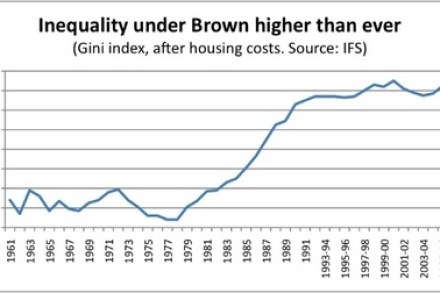
We all know Labour has failed to run an efficient economy or public services, but what’s little discussed is its failure to achieve even its own goals. Had Brown bankrupted the country but, say, made the poorest much better off, then Labour members might not be facing such an existential crisis. As it stands they won three victories, trebled health spending, redistributed some £1.5 trillion – and will end up with a society even more ‘unequal’ than it ever was under Thatcher. I look at this in my column today, and thought I’d share a few of the points with CoffeeHousers. First, equality. This (rather than making the poor better off) is the great leftist goal – and it can be nominally achieved by hurting the rich.

Harman’s debt calculator is broken

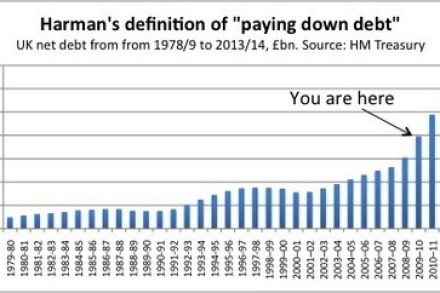
I know Harriet Harman is not supposed to be taken seriously, so I’m prepared to believe that she just struggles with numbers and didn’t knowingly mislead MPs today. But it’s worth correcting the record on one crucial point. “We have paid down debt,” she says. Actually, if you take the last Budget into account – it ranges to 2013/14 – decisions taken by her government will have increased national debt by more than every government since the Norman Conquest. Put together. If this is her definition of paying down debt, I’d hate to see her overdraft. Don’t they teach them anything in St Paul’s?

A welcome rejection of assisted suicide

I'm delighted that Lord Falconer has just failed in his attempt to legalise assisted suicide for people sending friends and relatives to Swiss death clinics. This is a topic which I suspect even CoffeeHousers will be evenly divided on, but to me the whole idea is just wrong - and it goes straight to the heart of how we, as a society, regard the disabled and the elderly. For those who haven't been following the debate, Falconer used the Coroners and Justice Bill to propose a new law to make it legal to help one's friends and relatives be killed in the Swiss death clinics. He proposed that any two doctors can be "of the opinion in good faith" that someone is terminally ill, yet mentally coherent enough to make the decision to go to Switzerland for the lethal injection.

Why the Tories’ Californian strategy should be taken seriously

A few months ago, I wrote a story about the “California Tories” and the extent to which Silicon Valley has affected the thinking of the people who will be running our country this time next year. I was teased about it later: what a pile of junk it all is, said a few right-thinking friends; why devote so many words to such a fluffy idea? My response: because the Tories take it so seriously, and because there might just be something in it. In my piece, I dropped in the fact that the Tories were thinking about swapping the NHS supercomputer idea for the free-to-use Google Health – and Sam Coates from the Times has much more on this today.

Pure Balls | 5 July 2009

According to the Sunday Times, poor old Shaun Woodward is getting the blame for inspiring Brown’s mendacious “Labour investment v Tory cuts” line. As if. This is the work of Ed Balls, and his trademark belief that the public can be easily fooled on such issues because their eyes glaze over when you mention statistics. A quick chronology: when the 10 percent figure came out in my Daily Telegraph piece it was Ed Balls who seized on it (his wife did so earlier that day with the Standard) and used it in a letter to Michael Gove demanding where those 10 percent cuts would be made. He used my figure as if it were official Tory policy.

One crisis after another

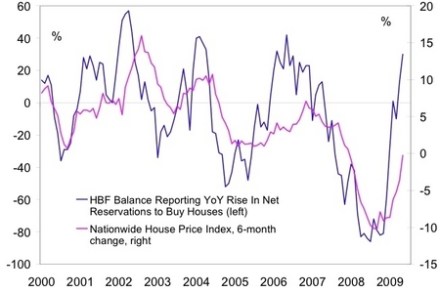
Many CoffeeHousers will give a horse laugh to the idea of “green shoots” – especially the idea of Gordon Brown winning a fourth term because a grateful nation will thank him for a recovered economy. It’s a delusion, nothing surer, and the same one Callaghan and Major suffered from. In both cases, there were firm signs of an economic recovery – but the electorate never forgave the government which landed them in the mire. But is Britain recovering? We’ve seen a few developments lately which, given the fun and games elsewhere, have gone unnoticed. So here’s a catchup. Pick up the financial pages, and you’ll find numerous stories of success: bonuses are back, the corporate debt market has recovered, house prices are moving.

It’s all backfiring on Gordon

I’ve just been on the BBC1 Breakfast sofa doing the “Brown lies on spending” debate with Nick Watt of The Guardian. That they invited us on a mass audience programme to discuss statistical fibs is an indication of how badly all this is backfiring on Gordon Brown. This debate may have started in the blogosphere but it is spreading to the mainstream. Brown himself upped the ante during that BBC package yesterday, telling Nick Robinson “I always tell the truth,” and (to me) sounding uncannily like Bill Clinton saying “I did not have sexual relations with that woman”. People who tell the truth never say “I tell the truth”. They don’t have to. It’s never in question.

The back-pedalling begins in earnest

How do you explain what a “zero per cent rise” is? Michael Ellam, Brown’s outgoing press secretary, had this task earlier today and I went along to the lobby to hear him. His answer hints at what I suspect will be an almighty U-turn from the government on cuts. Brown was “interrupted” he said – he meant to say 0.7% but was cut off after zero. As if. When it was pointed out to him that Brown said “zero percent rise in 2013/14,” and wasn’t interrupted at all, Ellam basically admitted that Brown misspoke and apparently corrected himself in his next sentence by saying he was referring to 0.7% growth in current (as opposed to capital) spending. But what Ellam said next really caught my attention.

Brown’s “0 percent rise” – UPDATED

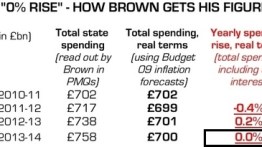
“We can do this the easy way or the hard way” Cameron said on Monday – and today, Brown finally agreed to do it the easy way. He seems to have dropped his Big Lie - that public spending will rise after the election. He’s doing it in stages, so today we had the rather wonderful claim that in 2013/14 it will rise “by 0%”. How does he produce this? We at CoffeeHouse aim to serve, and reveal the trick behind his latest Brownie here: I gather there was a discussion about this in Cabinet yesterday where Brown was basically told to drop his lie because no one believes it and no minster wants to repeat it (I’m trying to get more info, and will update you as and when). Now, no-one should claim victory – Brown could always revive the lie later.

In Brown’s debt | 1 July 2009

In the FT, John Kay has written one of those columns that quietly sums up the calamitous cost of Brown/Balls fiscal model. He concludes that we'll have to raise some £70bn of taxes and then inflate our way out of debt—and this is a theme worth looking at in greater detail because I suspect it is what George Osborne will end up doing.  "This year, Britain is likely to incur a fiscal deficit of more than 12 per cent of national income," Kay starts. "This figure is completely outside the normal experience of developed countries in peacetime. How did it happen and what are its implications?" How it happened is that Brown and Balls used their verbal tricks to conceal their reckless leveraging up of the British economy.

Politics | 1 July 2009

The sun-capturing atrium of Portcullis House is no substitute for the Californian coast but it may at least help Steve Hilton acclimatise. He is now back from his year-long absence — though he is still dressed as if he is heading for the beach. It is a reminder of the inverted sartorial hierarchy of the Conservatives. The lowly MPs wear suits and ties. The party’s senior officers are resplendent in open necks. And anyone dressing as scruffily as Mr Hilton signals the status of three-star general. There are precious few more reliable methods of working out who’s who in the Tory high command. David Cameron works with a semi-formalised network of relationships in which people’s official job titles give little idea of their true power.

Talking Balls

Ed Balls has just called me up about my post from this morning , hopping mad. He instructed me to "take that post down now". I thought he was joking: has there been some change to the constitution where ministers now have power over the media? But he was deadly serious. "You should not call me a liar," said Balls. I told him that if he doesn't want to be called a liar, “he shouldn't tell lies”. His defence is that his point about debt is a Brownie, not a lie - okay, he didn't put it quite like that. But when he said "debt" he referred to the "ratio of national debt to gross domestic product" which is forecasted in the Budget to start falling in eight to nine years time. Now the Budget, of course, has a "horizon" running out in 2013/14: there are literally no plans beyond that.

Balls lies

Ed Balls has been sounding increasingly desperate since his thwarted attempt to become Chancellor. He has started to hijack radio interviews, splurging out concocted claims about the Tories no matter what he is asked. But this morning, he used outright lies. People exaggerate in politics, they interpret and even stretch the truth until the elastic snaps. But rarely are outright, downright lies told. That was until now. Team Brown is adopting a new strategy: repeat a lie, as often as possible, hoping the interviewer will not stop or correct you. Here is the Balls Lie on the Today programme this morning. LIE no1: “We have acted in the downturn, that will mean that the economy is stronger, we’ll have less unemployment, less debt…” Less debt?

Cameron is taking the fight to Brown

Here is my top half dozen points from Cameron’s angry, feisty, Brown’s-a-liar press conference today.   1.     GO AHEAD, BROWN, MAKE MY DAY “We can do this the easy way or the hard way. I can just go on and on, question time after question time, revealing the cuts that he himself is planning. Or he can recognise this is the wrong approach not only for his party but the country.” Cameron devoted the last two PMQs to cuts. Is he threatening here to keep doing it every week? I think he should, and agree with Matthew Parris that he should be ruthlessly boring about this topic. Not only because a Prime Minister in a democracy should not be allowed to lie as Brown is lying, but because this strategy deploys a little political jujitsu.

Brown’s big lie

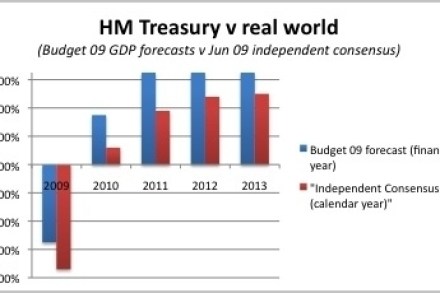
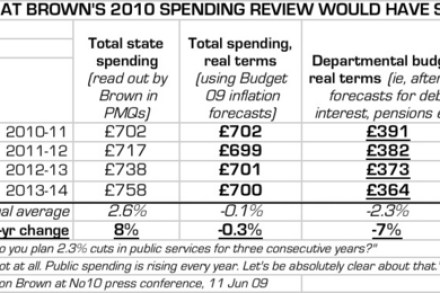
How long can a Prime Minister in a democracy lie to his country and get away with it? Gordon Brown is trying to find out.  His Big Lie - that his published plans do not involve a cut in public services - would not have withstood a Spending Review, which would have spelled out departmental budgets from April 2011-April 2014. So, it has been postponed. Current sending is being run on budgets set out in the 2007 review (itself delayed) which lasts until 2010-11. Since it was drafted the forecast for 2010-11 tax revenue has fallen by some £150bn. So should not budgets be altered to reflect the (to put it politely) changed economic conditions? Of course. But Brown is delaying this, as it would expose his lie: that public spending will continue to rise under him.

Immigration facts and figures

As promised, here’s the full story of those immigration statistics that I obtained from the ONS. In our new e-world, I can pass on all the results  to you – and they’re worth discussing. The figures show the extent to  which Brown’s “boom” was a mirage built not just on debt, but foreign labour. Most seriously, we can see a deep dysfunctionality in the UK labour market. Our system keeps millions on benefits (never less than  5 million have been on some kind of benefits since 1997) while meeting the needs of expanding the economy with a limitless supply of industrious immigrant labour. This means that the direct link between a growing economy and combating poverty is broken – and this is a serious development that demands attention.

The don’t ask, don’t tell approach to immigration is what has given the BNP an opportunity

Does it matter if immigrants have taken (or created) all the new jobs in the British private sector? I reveal this in my News of the World column today, as the key fact from a data request I made from the ONS. It’s a divisive topic, and even exploring it make ministers feel uncomfortable. But this ‘don’t ask, don’t tell’ approach to immigration has not just given the BNP the political space needed for its electoral breakthrough three weeks ago, but left ministers ignorant about what’s going on in our labour market. Between Q1 of 1997 and Q1 of 2009, immigrants account for 106% of new jobs in the private sector – ie, there are more new workers (1.55m) than new jobs (1.47m).

Politics | 27 June 2009

There was no mistaking the sadistic zeal with which Labour MPs bounded into the lobbies to vote for John Bercow on Monday. The whole election had been an unexpected gift to them: a chance to foist on David Cameron a Speaker who is loathed by the Conservative party. When Mr Bercow promised to serve ‘no more than nine years’, the scale of the prize became clearer still: a trick played upon the Tories that could last until the summer of 2018. It was scarcely plausible that Margaret Beckett would occupy the post for so long. From that moment, the race was Bercow’s. History has been made, insofar as Mr Bercow is perhaps the first Speaker ever to be chosen on account of his unpopularity and lack of authority.