Fay Maschler

A History of English Food by Clarissa Dickson Wright

It is where cookery is involved that tele-vision gives perhaps the greatest succour to the book trade. After Jennifer Paterson’s death in 1999, the remaining ‘Fat Lady’ barrelled into view with Clarissa and the Countryman, Clarissa and the King’s Cookbook, as a gamekeeper in an episode of Absolutely Fabulous and as presenter for a documentary on her soul-mate Hannah Glasse. Such exposure, combined with an unapologetic mien and candour that have attracted the somewhat patronising description ‘national treasure’, could only have helped her autobiography Spilling the Beans scale the heights of the bestseller lists and allowed the next manuscript, a year-long diary and rant called Rifling through My Drawers, to be published.

Bookends: Not just for Christmas

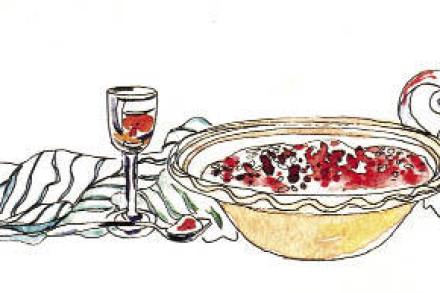
Sticky at Christmas, packed in serried rows around a plastic twig in an oval-ended paper-wrapped box with a picture of a camel train; dates in childhood were exotic. The mystery words Deglet Noor were as sweet to roll around the mouth as the fibrous fruit. But we learn from Dates – A Global History by Nawal Nasrallah (Reaktion Books, £9.99) that they are a staple food, comparable to wheat, potatoes and rice. The Edible Series focuses on one foodstuff per book. The result can be like an answer in a Chinese exam where everything known is written down, here in a prose style reminiscent of Wikipedia.

Bookends: Not just for Christmas | 1 July 2011

Fay Maschler has written the Bookends column in this week's magazine. Here it is for readers of this blog. Sticky at Christmas, packed in serried rows around a plastic twig in an oval-ended paper-wrapped box with a picture of a camel train; dates in childhood were exotic. The mystery words Deglet Noor were as sweet to roll around the mouth as the fibrous fruit. But we learn from Dates – A Global History by Nawal Nasrallah that they are a staple food, comparable to wheat, potatoes and rice. The Edible Series focuses on one foodstuff per book. The result can be like an answer in a Chinese exam where everything known is written down, here in a prose style reminiscent of Wikipedia.

Bookends: The voice of the lobster

In existence for over 250 millions years, lobsters come in two distinct varieties, ‘clawed and clawless’. Human predators tend to the flawed and clueless as they overfish and — since lobsters must be cooked live — kill them heartlessly. In existence for over 250 millions years, lobsters come in two distinct varieties, ‘clawed and clawless’. Human predators tend to the flawed and clueless as they overfish and — since lobsters must be cooked live — kill them heartlessly. Part of ‘the Edible Series’, dedicated to the global history of one type of ingredient, Lobster by Elisabeth Townsend (Reaktion Books, £9.

Bookends: The voice of the lobster | 20 May 2011

Fay Maschler has written the Bookend column in this week's magazine. Here it is for readers of this blog: In existence for over 250 millions years, lobsters come in two distinct varieties, ‘clawed and clawless’. Human predators tend to the flawed and clueless as they overfish and — since lobsters must be cooked live — kill them heartlessly. Part of ‘the Edible Series’, dedicated to the global history of one type of ingredient, Lobster by Elisabeth Townsend considers the creature that inspired mosaic artists in ancient Pompeii, reclined like a cardinal in still life paintings, gave Salvador Dali a telephone handle, fed the indigent poor and later the spoiled rich and became a partial success in shellfish farming.

A clash of commerce and culture

Other People’s Money — and How the Bankers Use It by Louis D. Brandeis was a collection of articles about the predatory practices of big banks, published in book form in 1914. Nearly a century later, it remains in print. In 1991 Danny de Vito starred as ‘Larry the Liquidator’ in the film Other People’s Money. The wanton boys of banking sport with us in life and art and in Justin Cartwright’s latest novel. Other People’s Money — and How the Bankers Use It by Louis D. Brandeis was a collection of articles about the predatory practices of big banks, published in book form in 1914. Nearly a century later, it remains in print. In 1991 Danny de Vito starred as ‘Larry the Liquidator’ in the film Other People’s Money.

Bruising times

In a market town in Kent at the time of Thatcher’s Britain, Charles Pemberton attends the town’s minor public school where his businessman father is a governor. In a market town in Kent at the time of Thatcher’s Britain, Charles Pemberton attends the town’s minor public school where his businessman father is a governor. Back in the 1930s, his grandfather Clarence had had ‘the right idea’, which was to build an eight-foot wall across a residential road in Oxford to separate his family home from newly built council houses. There is no such fortification available against the arrival at the school of Clark Rossiter, ‘a London chuck-out’ from a fringe estate, thanks to his sports scholarship, boxing being just one of his talents.

Wonders of the world’s fare

It was a slender hope, a moment of lunacy really, but I picked up Reinventing Food – Ferran Adrià: The Man Who Changed the Way We Eat by Colman Andrews (Phaidon, £19.95) thinking that the improbable claim in the subtitle might in future serve to stem, or anyway divert, the tide of cookery books published every year. So remorseless is it that we now expect — and get — Christmas ‘annuals’. (In 2010 the best by far of the adult cook’s version of Dandy or Oor Wullie is Nigel Slater’s Tender, Volume II: A Cook’s Guide to the Fruit Garden (HarperCollins, £30).