Ed Howker

Politicians have jilted a generation – it’s wrong to say that young people have never had it so good

Is there something outrageous about Britain's younger generations complaining that society is failing them? That's the question posed by the title of a forthcoming Spectator debate, but I get the impression that some in this magazine's stable already have an answer. In 2011, one writer, senior in both senses, decried chippy youngsters as selling ‘the politics of envy’. Another – the editor – called those who rabbit on about youth unemployment, housing problems and tuition fees ‘generational jihadists’. In 2010, I co-wrote a book called Jilted Generation: How Britain has bankrupted its youth, so I guess that Fraser Nelson was talking about me. I have been called worse names – but not as wittily. How nice it is to make trouble.

… in the battle for London

Charlatan, fornicator, liar, inebriate, pugilist, Marxist, anti-Semite; Ken Livingstone has been called many things but never a writer. Actually, that’s a shame because his words following the 2005 London bombings were brilliantly defiant; perhaps the most powerful speech by a British politician in the last decade. He can be witty — the former leader of the Greater London Council abolished by Margaret Thatcher began his speech accepting the Mayoralty with the words: ‘As I was saying before I was so rudely interrupted 14 years ago ...’ Even Tony Blair, who effectively forced Livingstone to leave the Labour party in order to stand, eventually admitted his misjudgment.

The Winter Fuel Allowance is indefensible

Freed from the shackles of elected office, Steve Norris remains an electrifying speaker. He is also refreshingly honest. So, when I met the 66-year-old former mayoral candidate at a Tory conference fringe on the future of London, he was only too happy to admit how spent his Winter Fuel Allowance: "I'm amazed by the Chancellor's annual gift. I spend it on Claret," he said. In fact, he said that when paid to the wealthy, the allowance is "a complete waste of money" and "a bribe to older voters". I mention this only because the Allowance was referred to again in a different context this week: during David Cameron's own address.

Boris’s last chance to show imagination

Back in 2008, one Mayoral candidate explained that it would require imagination to solve London's housing problems. The candidate developed a manifesto that suggested a new form of “democratic” home ownership, which which would "help build stronger communities", and which would allow houses to "remain affordable for future generations". He said he would "create a network of Community Land Trusts, managed by cooperatives to give homes to people who are indispensable to this city." His name was Boris Johnson and since he was elected not a single Community Land Trust has materialised in the capital. This is a quiet tragedy. Just like Ken Livingstone, Boris has spent huge amounts of time and resources promoting New Labourish 'affordable housing'.

Alan Greenspan doesn’t exist

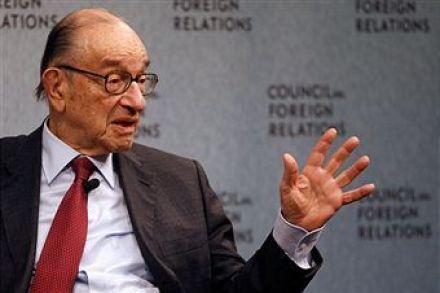
Five years have passed since Alan Greenspan stepped down from the most influential banking job in the world. (Now that’s how to leave at the right time.) Described in books, interviews and profiles too numerous to mention as ‘the most powerful regulator/person on earth’, he served as Chairman of the Federal Reserve for 19 years. For reasons of sheer longevity, perhaps Greenspan deserves to be called the architect of the modern global economy more than any of his elected contemporaries.

Exclusive: Gove’s free school policy gets Labour support, finally

This week's Spectator reveals the rather tantalizing fact that Peter Hyman, Tony Blair's former director of strategy, is setting up a Free School in East London. This – I kid you not – is a very good thing. Newham School 21 will teach kids between the ages of 4 and 18 – an ambitious span of ages – and will open its gates in September 2012 if all goes to plan. Whatever you think about Blair, Hyman is a quietly impressive figure, coining the phrase "Education, Education, Education" and then leaving Downing Street in 2003 to become a teaching assistant. Now, as the deputy head of a school in Ealing, Hyman could not be better placed to start a "free school" and his plans have the blessing of those at the very highest levels of Labour politics, I'm told.

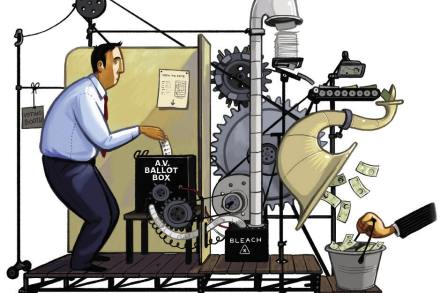
Exclusive: Yes to AV leaflets printed on ballot machines

Chris Huhne’s decision to threaten the Prime Minister with legal action — as I mentioned earlier — is particularly curious because he must be well-aware of the conflicts of interest at work in the Yes campaign. After all, his partner, Carina Trimingham is a director of Yes! and the Electoral Reform Society. She has been involved in this referendum from the start. And Mr Huhne must, therefore, know why Conservatives, and plenty of others, feel nervous about the relationships between the Electoral Reform Society who are running the Yes campaign and their business arm, Electoral Reform Services, who are financing the Yes campaign.

A question for Chris Huhne

You know a political campaign has gone terribly wrong when a Cabinet Minister threatens defamation proceedings against the Prime Minister. And that is precisely what happened this weekend, when Energy Secretary Chris Huhne began snarling in the Sunday papers. Stating that the Tory claim that the AV electoral system would cost more was “demonstrably untrue,” Huhne said: “It is frankly worrying if you have colleagues, who you have respected and who you have worked well with, who are making claims which have no foundation in truth whatsoever. If they don't come clean on this I am sure the law courts will.

Different class | 26 March 2011

 I’ve always found Britain’s education system ­bewildering. Our public schools are private; our church schools take the children of committed ­atheists; and ‘distance learning’ happens at home. My old school, Bradford Grammar School (BGS), is not a ‘grammar school’ in the way most ­people would imagine. It is a member of the Headmasters’ Conference and it charges fees. That a school’s name tells you next to nothing about what it does reflects decades of bizarre and often contradictory political reform. Almost every piece of school legislation after Rab Butler’s 1944 Education Act, which created grammars, has meant trouble for my old school.

EXCLUSIVE: The Yes2AV campaign’s dysfunctional strategy

A few weeks ago, I revealed the curious conflict of interest faced by the organisation funding the case for electoral reform. Now, it seems that ‘Yes to Fairer Votes’ (YTFV) has adopted a very peculiar new tactic: let’s call it the ‘erectile dysfunction strategy’ - certainly, it’s one worthy of the most unscrupulous online pharmacists. The pro-AV gang have taken to spamming innocent members of the public and, worse, seem to be claiming that those they spam are ‘registered supporters’. Earlier, I spoke to Henry Chance who sits on Bitterley Parish Council in Shropshire. Though he never signed up to their campaign, he has been inundated with pushy correspondence from YTFV.

Getting the balance right

Branko Milanovic is the lead economist at the World Bank’s research department, a professor at the University of Maryland and a grand fromage at the Carnegie Endowment for International Peace too. Branko Milanovic is the lead economist at the World Bank’s research department, a professor at the University of Maryland and a grand fromage at the Carnegie Endowment for International Peace too. He is not, it turns out, a very light-hearted man and that’s a particular misfortune because The Haves and the Have-Nots was clearly designed to be the easy-reading version of his far more weighty tome on global inequality, Worlds Apart.

The alternative story

What the Electoral Reform Society doesn’t want you to know In ten weeks’ time, Britons will be asked to vote on arguably the dullest question ever put to a referendum: whether to adopt the Alternative Voting system in our general elections. Under AV, instead of picking one MP, voters would list their first, second and third preferences. Our elections would be made infinitely more complicated. Counting extra votes means extra bodies, computers, and so on. And that, in turn, means lots of money can be made. The additional cost of switching to AV could be as much as £120 million, since this complex system may require voting machines. Little wonder Britain’s largest provider of voter-counting software is pouring cash into the ‘Yes to AV’ campaign, then.

EXCLUSIVE: What the Yes to AV campaign doesn’t want you to know

For this week’s magazine (subscribers click here or follow this link to subscribe from £1/week), I have been on the trail of the ‘Yes To Fairer Votes’ (YTFV) campaign, attempting to discover the real source of their funding. What I found reveals a catalogue of undeclared donations, hidden money trails and one massive conflict of interest of such comical proportions that even Berlusconi would blush. It shows, in effect, that the largest single donor to the 'Yes' campaign is Britain's no1 vendor of ballot papers and vote counting services – a massively profitable outfit whose commercial interest in a new, complicated Westminster voting system is clear.

What’s the big idea?

If you’re not quite sure what the Prime Minister means when he talks about the big society, you’re not alone. If you’re not quite sure what the Prime Minister means when he talks about the big society, you’re not alone. Before the election, a poll found that most people hadn’t heard of it and only very few who had knew what on earth it meant. Even some Tories deride it as ‘BS’, though Jesse Norman is not one of them. A former banker and academic, Norman was elected MP for South Herefordshire this year. And, as the author of two serious texts on the future of conservatism, he’s well-placed to clarify what this tricky big society notion is all about. The story begins at David Cameron’s Hugo Young lecture, delivered last year.

Revealed: The Olympic cash-in

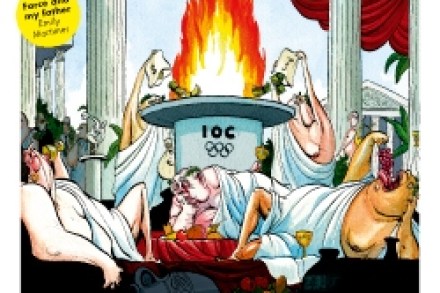
It’s costing more than the government cuts in welfare, more even than the UK’s Irish bail-out, but what exactly is all that money set aside for the 2012 Olympic Games actually being spent on? You might be surprised. In this week’s Spectator, Andrew Gilligan and I disclose, for the first time, all the petty, legally-binding demands made by the 115-member International Olympic Committee (IOC) of London. This is information that the government, the mayor and the London Olympic organisers never wanted you to see – even though it forms a binding part of the Host City Contract signed when we won the right to host the games in 2005. Paul Charman, a researcher in East London who contributes to the website GamesMonitor (www.gamesmonitor.org.

Exclusive: the fee hike won’t create a market

The fee vote really comes down to two questions. First, will the fee hike proposed by the coalition government actually create an internal market in higher education? Second, what will be the effect on the public finances? There is good reason to be doubtful.   First, the market: the idea, I suppose, is that world-class universities might charge higher fees than second and third tier ones. But, in the last few days, I've spoken to several very senior higher-education sources who privately report that universities like Leeds Met, Bolton and Worcester are very seriously considering charging the full £9,000 tuition for their courses once legislation is in place. The government is extremely concerned.

Phil Woolas, four investigations and a funeral wreath

It may take another week to discover if Phil Woolas has the right to challenge the election court ruling that destroyed his career. To the delight of his cadre of supporters in the House, judges have said there are "difficult questions to resolve" - not about the evidence of Woolas' campaign making "false statements", but about the specific application of the Representation of the People Act (RPA). Before the last die is cast, here are two quick contextual points. First, it is not just Harriet Harman who is keen to shut down this episode - many folks on all sides of the House of Commons would like to pretend skulduggery of this kind is exceptional. It is not - Phil Woolas' behaviour is far from untypical of northern politics.

Cameron’s clearances

James Cummings could never refuse a drink. Even after his boss — a Watford publican — threatened him with the sack he couldn’t lay off the bottle. He’d worked his way through the profits of a family business, two houses and a marriage by then. He eventually awoke in a tunnel under the Elephant and Castle three weeks after he was sacked from the pub. That was the winter before last. Now, having recovered sufficiently to rent a flat, fight his addiction and get some qualifications, James is doing everything we expect of those on unemployment benefit. He is teetotal and has avoided debt; he does voluntary work with other addicts and is applying for jobs.

EXCLUSIVE: What about those who aren’t pulling a housing benefit scam?

Most sensible taxpayers think Britain’s current housing benefit costs to be a terrific scam. In the last five years the bill has risen by 25 percent. We now pay £21billion each year, a good chunk of which flows private landlords turning a healthy profit from the state’s responsibility to the poor. We all know by now that a slew of reforms designed to cut the bill by at least £2bn will stop the indefensible abuses of taxpayers’ money like this and this. That’s why Danny Alexander, among others, claims that the coalition must be ‘brave’ on housing benefit. But cast aside the most extreme exploiters of the system and ask what happens to the rest. The effects of the reform will to be much more widespread.

Spectator Exclusive: Britain’s welfare ghettos

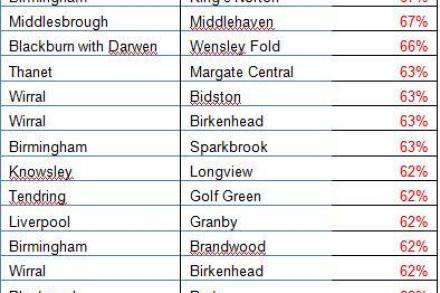
Today we are releasing a brand new picture of the nation’s welfare ghettos. Our research gives a disheartening insight into the extent of dependency in England and Wales. The top line: things are getting worse. This is much more detailed and useful information that the statistics often bandied about by politicians. It is well known, for example, that nearly 2 million people have been claiming out-of-work benefits for more than five years. But what does that look like?