Dot Wordsworth

Trooping the Colour

From our UK edition

Language is a weapon to do down others. ‘He calls the knaves, Jacks, this boy!’ said Estella disdainfully of Pip in Great Expectations, while noting how coarse his hands were. Words like the and of are also useful shibboleths to show someone doesn’t belong to our club. ‘No denim’ says the advice for entry to today’s Queen’s Birthday Parade, on pain of entry being refused. It is the occasion of Trooping the Colour. Of course my husband, especially, and I too call it, Trooping the Colour, never interpolating the fatal of. The ceremony is said to go back to Marlborough, but one of the earliest references cited by the Oxford English Dictionary, from 1816, calls it the trooping of the colours.

Not bloody likely

From our UK edition

In My Fair Lady, which came out as a film in 1964, 50 years after Shaw’s Pygmalion, they decided to update Eliza’s exclamation of ‘Walk! Not bloody likely. I am going in a taxi’, which, on the first night in 1914, had ‘brought the house down’ on the lips of Mrs Patrick Campbell, according to the Daily Telegraph review. So at Ascot, Eliza in the film shouts at her favoured horse: ‘Move yer bloomin’ arse.’ In the Pygmalion version, half the joke is saying bloody in a duchess’s accent, but Audrey Hepburn’s Eliza falls out of her trained accent in excitement and shouts in Cockney.

Reference

From our UK edition

When Dickens wanted to buy a house in 1837, he wrote to Richard Bentley, who had started the magazine in which Oliver Twist was to be serialised, saying he had mentioned his name ‘among those of other references, to testify to my being “sober and honest”.’ Some people seem to think it was this kind of reference that was meant by the remarkable president of Magdalen College, Martin Routh, who stayed in office until his death aged 99 in 1854, shortly before which, on being asked what advice he would give to a young don, said: ‘You will find it a very good practice always to verify your references, sir!’ But he didn’t mean the kind given by a maid — or Dickens — but the references given in footnotes of learned books.

Goof

From our UK edition

Susie Dent has been trying to make us love Americanisms on Radio 4. Now Miss Dent knows far more about language than she has had much chance to express during her 25 years in Dictionary Corner on Countdown. She is quite aware that there is no such thing as an Americanism tout court (or perhaps one should say ‘an Americanism period’). It is true that British speakers of English are annoyed by hearing their compatriots use an American word for something already covered by a perfectly good British word. A Briton would have to be cracked to use hood for bonnet; sidewalk for pavement; mad for angry; diaper for nappy. But American words for American things are welcome: big business (1905); jazz (1909); commercials (on the radio or television, 1935).

Anniversary

From our UK edition

‘It’s like Pin number,’ said my husband, drifting into lucidity. So it is, in a way. The construction under discussion was one-year anniversary. Just as Pin embraces personal identification number (making the addition of number pleonastic), so the concept of a year is plain in anniversary, rendering the cobbling on of year redundant. I am sorry to say there is bad news for all of us who think one-year anniversary and its family repugnant. The construction is so rampant and widespread that we are stuck with it. It’s worse than ground elder. No one can dig up all the language and remove the virulent white roots that spread the usage. We’re lumbered with this new hybrid. It is everywhere in the newspapers.

Progressive | 11 May 2017

From our UK edition

I laughed, in a sympathetic way I hope, when I read a letter in the Daily Telegraph pointing out that Steve Hewlett, the media commentator who died this year, had admitted ruefully that when he had heard that his cancer was progressive he had thought for a moment this was a good thing. The progressive alliance is this election’s equivalent to the old ‘broad left’, which once inserted foaming revolutionaries into respectable politics. I complained about this label progressive before the 2015 election. Progressive politicians tend to favour progressive taxation, even though the term is merely technical, indicating that the higher the sum taxed (above £80,000 income, say), the greater the rate of tax on it.

Compliance

From our UK edition

Ralph Bathurst was accused shortly after his death in 1704 of being ‘suspected of Hypocrisy and of mean Complyance’. I am not quite sure what particular hypocrisy was meant, but the accuser was Thomas Hearne, a cranky but principled antiquary in the mould of Anthony Wood. Hearne resented not being able to accept appointments such as librarian of the Bodleian because he would not take the oath to King William after he took the throne in 1689.

Jane

From our UK edition

‘What are you laughing at?’ asked my husband in an accusing tone on Monday morning last week as he unloaded supermarket bottles from a carrier bag into the drinks cabinet near his armchair. The answer was, to my surprise, Woman’s Hour, on which Jane Garvey had entertainingly been discussing names – ‘first names’, mostly, which we used to call Christian names, just as we used to talk of Red Indians. No longer. Jane Garvey doesn’t, it transpired, much care for Jane, which is popularly associated with plain.

Envelope

From our UK edition

One can push many things — a pen, one’s luck or (up) daisies. But the MP Dominic Raab told the Daily Telegraph last week that Theresa May and Boris Johnson ‘are demonstrating courage in pushing the diplomatic envelope’. Since the most famous envelope recently enclosed Mrs May’s letter to Donald Tusk, this figure of speech might have obscured rather than illuminated his meaning. I don’t mean to write about pushing the envelope, on which I’ve remarked before. The metaphor is from aeronautics, where it refers to parameters (often confused with perimeters) or limits. The late Gerald Kaufman complained of this Eurojargon 37 years ago, explaining in a book that ‘an envelope is a limit within which budgetary dispositions can be juggled’.

King Charles’s head

From our UK edition

‘It has become something of a King Charles’ head, or should that be a King Charles’s head?’ said my husband, laughing, as though he had made a joke. By ‘it’ he meant the apostrophe, which forces its way into any discussion of grammar, just as the head of the King and Martyr forced itself into the memorandum that Mr Dick, the amiable lunatic, was attempting to write to the Lord Chancellor in David Copperfield (1850). Looking through the book, I found the exact phrase once, when Mr Dick mentions to David that ‘the mistake was made of putting some of the trouble out of King Charles’s head into my head’.

An historic

From our UK edition

Everybody’s saying it, even though the latest research declares that only 6 per cent of the population is given to the habit. I mean saying an historic. Sir John Major, though a Knight of the Garter, is proud of his origins in Brixton and Worcester Park, but started the present vogue at Chatham House in February by saying in a speech that the referendum vote to leave the EU was ‘an historic mistake’. On 29 March, when Donald Tusk received Theresa May’s letter triggering, not Article 50 (which itself was the trigger), but the process of leaving, the Prime Minister said: ‘This is an historic moment from which there is no turning back.

St Thomas’s

From our UK edition

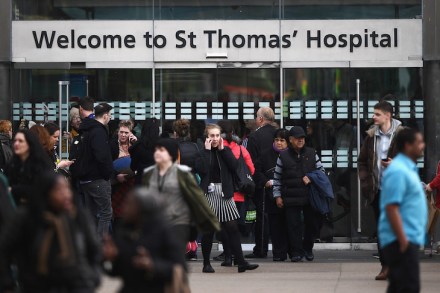
Everyone praised the staff of St Thomas’s Hospital during the terrorist attack. My husband of course brought his own fly to put in the ointment. ‘It’s disgraceful,’ he said. ‘They were told about it years ago.’ He was not referring to medical matters but to the spelling of the hospital’s name, attached to the building in letters taller than a man as St Thomas’ Hospital. I mentioned it here in 2008. Now a reader has written to the editor of The Spectator, saying that the jumbo-sized error remains on show. It is undoubtedly wrong. Why can’t people who run a big hospital grasp the simple rules for using apostrophes?

Girls

From our UK edition

Sir Roger Gale sounds like an old-bufferish knight of the shires, but he once worked as a disc-jockey on a pirate radio station. Last week he got into hot water when he said on the radio that his wife was ‘utterly dedicated to her job, as indeed are the other girls in my office’. Before he knew it, Today got some American academic on air to denounce him. ‘We know, looking in the dictionary,’ she said, ‘that girl means a young woman only up to the age of 11 or 12.’ This bossy woman should get a bigger dictionary to look in. There is plenty of evidence that girl has meant ‘woman’ for centuries. In its earliest history it signified ‘a young person’ of either sex.

Meet with

From our UK edition

Don’t tell my husband, but I have been having doubts. (He never reads this column, so our secret is safe.) The doubt is about meet with. I always regarded it is a pleonasm, and a rebarbative one, being of American origin. Theresa May made a mark, one way or another, by meeting President Trump. She didn’t meet him by chance, she met with him (by appointment), as several British papers said, never mind the American ones. And she didn’t meet with him as one meets with a misfortune. Meet with and its ampler form meet up with are examples of the ‘phrasal verb’, a term that (though found here and there earlier) was adopted in 1923 by Logan Pearsall Smith, that Anglocentric American.

Kippah

From our UK edition

What, asks the columnist Philologus in the online magazine Mosaic, is the difference between a kippah and a yarmulke? I’m glad he supplied an answer, for I know no Yiddish and less Hebrew, and the Oxford English Dictionary is reticent. Kippah first appeared in the OED in 1997, with the bare etymology ‘from Hebrew’. Philologus observes that it denotes ‘any skullcap worn by a Jew for religious reasons’. He suggests that kippah derives from a word in early rabbinic Hebrew (from the time of the compilation of the Mishnah, the first century in AD-dating). That Hebrew word meant ‘dome’ or ‘vault’, either of a building or of the heavens. This sounds a satisfying derivation.

Pick

From our UK edition

I have long pondered the motive with which Michael Wharton, for long the author of the Daily Telegraph’s Peter Simple column, gave a memorable detail in his second volume of memories, A Dubious Codicil, about the habits of his rival Colin Welch: ‘He had a habit of picking his nose, occasionally tasting the extracted mucus or “bogey”, without any attempt to conceal himself, as most people would, behind a newspaper.’ Since they are both dead, I am unlikely to find out. But I have been piqued recently by another kind of pick, mostly relating to Donald Trump, and now spilling over into British affairs. The choice for one of his cabinet posts was widely called a pick, even by British correspondents.

Curry favour

From our UK edition

The number of things I don’t know is infinite — or infinite minus one, if such as number exists, since I discovered something the other day: the most unlikely origin for a common phrase. I could hardly believe it at first. A perfectly current idiom in English is to talk of people currying favour, in the sense of ‘ingratiating themselves’. I knew that currying here had nothing to do with the kind of curry we eat with rice, the name of which we borrowed from Tamil in the 17th century. I supposed, right enough, that the currying of favour was the sort done with a curry-comb when rubbing down a horse. The horsy curry came to us in the 13th century, from Old French conrei, meaning ‘preparation’.

Rocket

From our UK edition

‘It is rocket science,’ said my husband waving a pinnately lobed leaf snatched from his restaurant salad. He doesn’t much like rocket salad and wishes all supplies had perished along with the lettuces of Spain. So as a distraction I tried telling him that rocket leaves were connected with street urchins, caterpillars, caprices and hedgehogs. The herb rocket is older in English than the sky-rocket, which appeared no earlier than 1566. The firework rocket took its name from rocchetta in Italian, meaning ‘little bobbin’, from the similarity in shape. There is a related old word in English, rock, which once meant ‘distaff’ and is used by historians now to mean ‘spindle’. But that is nothing to do with the greenery.

Trope

From our UK edition

A law I’d like to see passed would exact severe penalties for the use of the word trope. It is as welcome in our language as toxic particulates are in the air we breathe. I saw a piece in the Guardian about a dramatic monologue called The Encounter offering ‘a recognised narrative trope: the white interloper introduced to a new way of being via an encounter with the other, the magical native’. Here trope seems to mean ‘a story in miniature, a recognisable theme’. The notion of a trope pops up all over the place these days. ‘How jazz ruins a young white man’s life,’ observed Caitlin Moran in the Times, ‘is quite a niche trope.’ She was making a little joke.

Italianglish

From our UK edition

Waiting for my husband in a Rome hotel, I was reduced to reading some of the weekend newspaper supplements. The Italians think themselves highly fashionable, and using words from English cements the image. La Repubblica’s weekly magazine called D has two sections with English names: Beauty and Lifestyle. Coverage of Paris Fashion Week was headlined ‘Parigi Fashion Week’ and a discussion of cosmetics was headed ‘No make up’. This is the sort of thing that drives the Accademia della Crusca into a frenzy. The academy has been making judgments since its foundation in 1583 on the use of the national language. Crusca mean ‘bran’ and the academy likes to sift out indigestible foreign bran from the fine home-ground flour.