Deborah Ross

Deborah Ross is the chief film critic of The Spectator

Whisky galore

Ken Loach’s The Angels’ Share, which has just won the Jury Prize at Cannes, is part social realism, part comedy caper, and so good-natured, warm and affectionate it’s rather a joy, even though it doesn’t exactly add up; even though its climax is implausible, its tonal shifts are sometimes jarring, and it feels so familiar. It’s quite Bill Forsythian (with particular reference to his first ever feature, That Sinking Feeling, since you didn’t ask, but should have) via Whisky Galore! and The Full Monty.

Birth pains

As a general rule, what to expect when you are expecting is a baby, which is always kind of miraculous, but the way everyone carries on in this film you’d think nobody had ever had one before. This is odd, particularly as the latest research has proven that having babies predates the iPod, internet and digital photography, and may even predate the Breville sandwich toaster, although this is not yet known for certain. Still, this all-star ensemble mash-up treats pregnancy as if it were the very latest news, and although it’s meant to be a comedy, did I laugh? I might never have stopped but for one small thing, which I feel obliged to mention: I never started. I sat there stony-faced like a stone, with a face.

Tough at the top

The first thing you should know is that I love, adore and worship Sacha Baron Cohen and have this fantasy whereby we get married and set up home in Notting Hill as a power couple and when the phone rings and it’s Richard Branson I will say, ‘I’m so sorry, Dick, but we can’t come to Necker Island next week as we’ve promised to go away with Charles and Nigella. We know, boring, but we can’t cancel them again.’ Baron Cohen is, I believe, the greatest comic film-maker working today, and although The Dictator is not up there with Borat, or even his Ali G television persona, as it’s so much broader and more familiar, I would not allow this to come between us. ‘Sacha,’ I would say to him at the breakfast table, ‘pass the toast.

Flaws with a clause

Jeff, Who Lives at Home is a film about Jeff, who lives at home, and that’s enough subordinate clauses for one day. (Don’t be greedy; you know how fattening they are.) It’s a comedy from the Duplass brothers, Mark and Jay, who have previously made small films that have been well received (The Puffy Chair, Cyrus), and this is their first big film although it’s a small big film, coming in at 83 minutes, which, in its small way, is quite big enough. It’s a whimsical comedy and, as far as whimsical comedies go, it is quite whimsical, and sometimes comedic, which is fair enough, but ultimately it is slight and repetitive and nothing sticks in the mind.

The gentle touch

OK, no funny business this week. Just a straightforward review. No interrogative techniques. No verse. No sky-writing. I don’t have the time. Or the energy. I have a life. It’s quite a crappy one, full of ennui — who are these people who say there aren’t enough hours in the day? There are far too many! — but if I don’t attend to it, who will? (If you leave ennui to its own devices, it will take over your gutters, and then fur up your pipes, and, if it doesn’t get into the brickwork, you’re lucky.

What a marvel!

As last week I believe I provided the world’s first entirely interrogative film review, I thought that this week I would up the stakes and embroider this review on antimacassars, in mirror writing — this has also never been done before, as far as I know — but time, alas, proved my great enemy, so I’m afraid I have simply written it in verse instead. I hope you will forgive me. Avengers Assemble, my lovelies, is ‘the superhero event of the year’, And if this gets you all excited, you probably have nothing to fear. But if big action so big it’s humongous just isn’t really your thing, You may find, as I did, it drags, with its surfeit of CGI bling.

No flies on me

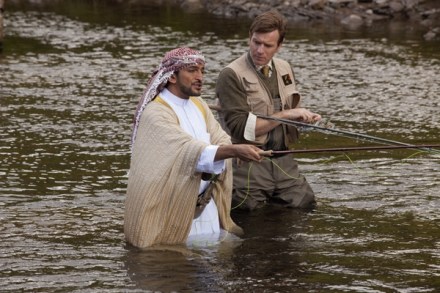
Ladies and gentleman, boys and girls, anyone who happens to be passing, I have decided to quiz myself about this week’s film, for no other reason than the idea occurred to me, and I fancied it, so here goes: Salmon Fishing in the Yemen, any good? No. That it? OK, if this film teaches us anything, it teaches us how to take a perfectly fine book — Paul Torday’s novel of the same name — and transform it into a mushy, corny, ghastly mess of the most trying kind. How would you describe the viewing experience? Like swimming upstream yourself, but through treacle, and with someone heavy strapped to your back. How heavy? Someone like Eric Pickles, say. I wouldn’t like Eric Pickles strapped to my back, I don’t think.

Routine carnage

If you go down to The Cabin in the Woods today you can be sure of very little in the surprise department and an insufferably dreary time of it. It’s a comic horror film and although I do not like horror, comic or otherwise, it’s the only major release this week, so I felt compelled. Also, the website www.rottentomatoes.com, which aggregates film reviews, had given it a 95 per cent approval rating based on critics calling it both ‘hilarious’ and ‘frightening’ and ‘a game-changer’ even though it is none of those things. Still, at least it does go to prove what I have said all along: I am the only one you can ever trust, and the only one you should trust.

Defying logic

Switch is a French action thriller starring that lumbering wooden legend of French cinema, Eric Cantona, and it’s awful, but at least it is one of my favourite kinds of awful film: so awful it’s a triumph. If I were ever invited to lecture at film school — remarkably, I have yet to receive such an invite — the first thing I’d say is: girls, boys, although your narrative shouldn’t be predictable, it must add up in terms of what has gone before. Your characters shouldn’t change personalities overnight. Also, it always helps if the plot actually makes sense. This narrative follows no known logic: not internal, not external, and not even the sort of logic that dithers out on the patio and has a smoke while trying to make up its mind.

Man and boy

Totally unexpectedly, as I don’t like Brit gangster films particularly — so many sociopaths, so little time — I loved, loved, loved, loved, loved Wild Bill and, for those of you who are slow on the uptake, let me say four times more: I loved, loved, loved, loved it. It may not even be a gangster film proper, although it is certainly being sold as such, with a poster that’s all tattooed fist. This is a shame, as it’s actually a rather delicate and elegant piece of work combining great storytelling, a terrific script, and characters you can seriously care about, and do. It hits all the marks. You’ll laugh. You’ll cry. And you’ll love it as many times over as you can accommodate.

Redeeming creatures

We Bought a Zoo — in which a family buys a zoo — does what it says on the tin and if you like this sort of film you will like this and if you don’t you won’t, and you have to ask yourself why you buy The Spectator every week? It’s for analysis like this which, I think you will find, is unavailable elsewhere. But do I like this sort of film? Actually, I rather do. There are no surprises. It is comfortingly straight up and down. It is heartwarming, to the extent you can buy it. There are animals: lions, tigers, a grizzly bear, and a funny little monkey. I found it a perfectly agreeable way to spend the two hours I would otherwise waste and you may feel similarly if this is the sort of film you like, but probably not if you don’t.

Running on empty | 10 March 2012

Bel Ami is based on Guy de Maupassant’s 1895 novel of the same name about a young man who sleeps himself to the top of Parisian society — I once slept myself to the top of Parisian society, but by the time I got there I was far too exhausted to properly enjoy it — and while it is lush and handsomely mounted and features copious sex scenes it lacks what it would absolutely have to have were it to work: erotic sizzle.

Going nowhere | 3 March 2012

The first and perhaps only thing to really say about Hunky Dory is that it is anything but. It is not hunky dory at all. Instead, it is half-baked and tiresome. I’d had rather high hopes for it. It’s a ‘let’s-put-on-a-show!’ film set in a Welsh comprehensive during the long hot summer of 1976 — the summer I turned 16, as it happens — so I expected at least some of it to resonate, but its characters are so unfinished and improbabilities so plentiful and narrative so unoriginal it’s like an extended episode of Fame, only worse.

Terribly long & awfully sentimental

Unless I am Extremely Dim & Incredibly Thick, which is always a possibility — you think I don’t know? I do — this Stephen Daldry adaptation of Jonathan Safran Foer’s 2005 novel Extremely Loud & Incredibly Close just doesn’t seen to have any point, and is sentimental and banal as well as very, very long (or so it seemed). It may have worked as a book — I can’t say; I never read it — but as a film it’s a trial. Why has it been Oscar-nominated in the Best Picture category? No idea, although I would suggest it caters to America’s idea of itself as a nation that can triumph over anything, including 9/11, and to the notion that all scars can always be healed, which I’m thinking is patently trite nonsense.

It’s not easy being green

The Muppet Show was my favourite TV programme when I was growing up, but this film, the first in over a decade? Not so much, even though it is fun in parts. I liked it terrifically at the beginning, and loved seeing Kermit again, and Miss Piggy, with her ‘pork chop’ (‘Hi-yah!’) and Gonzo and Fozzie Bear and Animal, because they are all such distinct personalities, and have such presence, and when I heard the theme tune for the first time in years — ‘It’s time to play the music, it’s time to light the lights, it’s time to meet the Muppets on The Muppet Show tonight...’ — I felt I might actually burst with happiness, although luckily I didn’t.

The parent trap | 4 February 2012

Carnage is Roman Polanski’s adaptation of Yasmina Reza’s hit stage play The God of Carnage, in which two sets of parents get together to discuss an altercation between their 11-year-old sons in the hope that they can figure it out sensibly, and all hell breaks loose. I have my reservations. I’m not convinced the play was exactly begging to be filmed, particularly as Polanski doesn’t open it up and keeps it, more or less, to one suffocating room and hallway, and I’m not convinced it’s particularly deep or insightful, but there is some enjoyment to be had from watching four actors at the top of their game get to where they do get to, even though it’s not much of any place.

Crisis in Hawaii

The Descendants is a comedy-drama about a dysfunctional family — is there any other kind of family? I’ve yet to meet one — made by Alexander Payne, who also made About Schmidt and Sideways, but whereas I warmed to those films, I could not warm to this. I liked it. I enjoyed it. I did not resent the time I’d spent watching it, although that may just be because I seriously have nothing better to do. (I spent much of this morning removing the fluff from my keyboard with a pin, for example.) It’s already been heaped with praise and two Oscar nominations (for best picture and George Clooney’s performance) but it left me cold. I suppose at some level I just could not buy it or its basic premise that someone married to Clooney might have an affair.

Who does she think she is?

W.E. is Madonna’s second outing as a film director, and this tells ‘the greatest royal love story of the 20th century’ via two women separated by more than half a century: Wallis Simpson (Andrea Riseborough) and a modern-day New Yorker, Wally Winthrop (Abbie Cornish), a society wife who becomes obsessed with Mrs Simpson when her possessions come up for auction at Sotheby’s. These days, it is common practice to ridicule and deride Madonna — just who does she think she is? And so on — but I am not of this camp, believe this film has much to teach us, and the top ten lessons are as follows. 1.

Lost in translation | 14 January 2012

Steven Spielberg’s version of War Horse is like an extended Sunday afternoon episode of Black Beauty gone mad via the first world war, just so you know, and although it made me cry this is no endorsement. I rarely cry in real life but have been known to howl in the cinema, even when I’m aware something isn’t much good. It’s as if my brain and tear ducts are entirely unconnected so while, in this instance, my brain was saying this is a mediocre film, prosaic, plodding, over-sugared and with nothing like the power or imagination of the stage play, the tears still plopped. I wish there was something I could do about it. Is there a lead available to somehow connect my brain to my tear ducts? From Maplins, say? It would be good if there was.

Mixed blessings | 7 January 2012

Firstly, my review of 2011, which I was going to do in photographs until I realised I didn’t take any, and then in animal thumbprints, but they are quite rubbish. My dog, for example, looks nothing like a dog. So I will spare you my review of last year — my giraffe is getting there, but still needs work — and, instead, will give you our first film of 2012, Mother and Child, which is terrifically acted and affecting in part, but also peculiarly pat and unsatisfying. If you haven’t yet seen The Artist, I would put that way, way, way ahead in the queue, and if you’ve yet to see it, I would further ask you this: something wrong with you? My recommendations not good enough for you all of a sudden?