Deborah Ross

Deborah Ross is the chief film critic of The Spectator

Gorgeous and electrifying: And Then We Danced reviewed

The film you want to see this week that you mightn’t have seen if you weren’t stuck at home is And Then We Danced, a gay love story set in Tbilisi, Georgia, and it is truly wonderful and gorgeous. Every cloud and all that. However, in my area the demand on broadband is so high that all I get is buffering, buffering, buffering, like it’s 1996, so the only way I could watch this in its entirety was by getting up at 5 a.m. And if it was an absolute pleasure then, it’ll be an absolute pleasure anytime. It passed the 5 a.m. test, you could say.

Catherine Deneuve at her most Deneuve-ish: The Truth reviewed

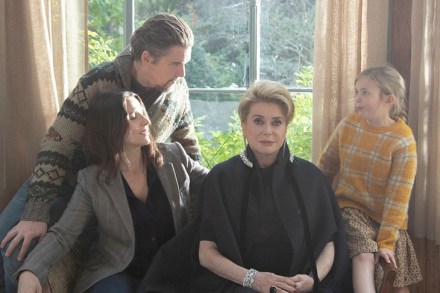
To tell you the truth about The Truth, even though it stars Catherine Deneuve at her most Catherine Deneuve-ish (i.e. campily grand) and I was so looking forward it — it’s the first non-Japanese production from Hirokazu Kore-eda, who made the very lovely Shoplifters — it is now quite hard to concentrate on anything in films beyond the fact that they already feel like social history. My God, there was a time when people just went out and about willy-nilly? And they hugged and kissed and weren’t always washing their hands while singing ‘Happy Birthday’? So that gets in the way, as does having to watch films at home rather than on a big screen, now that cinemas have closed. But we will try our best — here to serve and what have you.

Astonishing to think Miss World ever existed: Misbehaviour reviewed

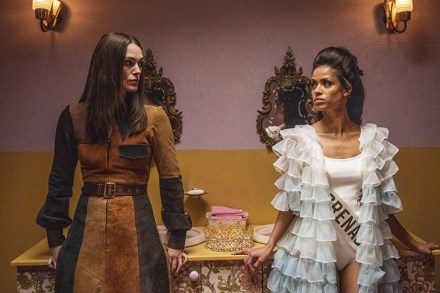
Misbehaviour is a film about the 1970 Miss World contest that was disrupted by ‘bloody women’s libbers’ — that’s what my dad always called them, anyhow — throwing flour bombs and shouting ‘we’re not cattle!’ as Bob Hope fled the stage in a panic and our televisions temporarily blacked out.Marvellous, I think now, although at the time I was probably as annoyed as my dad. I loved this show when I was growing up and wouldn’t have known there was anything amiss, as it was all so normalised, watched by a global audience of 100 million. Great family entertainment, I’d have said, now get out my way so I can see the contestants parade with actual numbered discs on their wrists as Michael Aspel pervs all over them.

An algorithmic zero-to-hero narrative: Military Wives reviewed

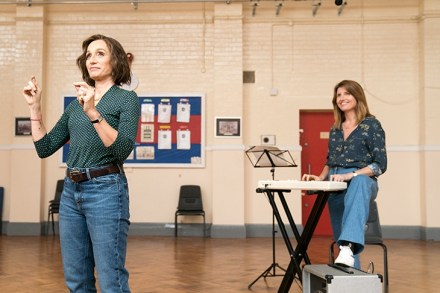
Military Wives is a British comedy drama starring Kristin Scott Thomas and Sharon Horgan. It is based on the true story of the service spouses who formed a choir (and were the subject of a BBC documentary series in 2011) and it’s wholly in the style of Calendar Girls, The Full Monty, Brassed off, Kinky Boots etc, but that’s OK as we love all those films. This does shamelessly play you — you’ll laugh; you’ll cry! You may even cry from four minutes in! Like I did! — but you’d be disappointed if it didn’t, just as you’d be disappointed if it didn’t end with Sister Sledge belting out ‘We Are Family’. Oh, God — is that a spoiler? Sorry.

Deeply romantic and wildly sexy: Portrait of a Lady on Fire reviewed

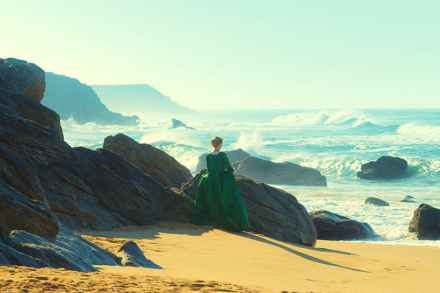
Céline Sciamma’s Portrait of a Lady on Fire is set on a remote, windswept Brittany island in the late 18th century. It’s about two women falling in love and it’s rapturous, scorching, ravishing and will lock your eyes to the screen. I’ve seen it three times and on each occasion my eyes were locked to the screen. At this point I could also say it’s a film that tells the male gaze to go take a running jump, then follow up with one of my lectures on post-structural feminism, as I know you are keen on all that, but ‘rapturous, scorching and ravishing’ will do for now. Plus it is deeply romantic. And wildly sexy. And, my God, so full of feeling. So let’s just go with all that.

In this instance, greed isn’t good: Greed reviewed

Greed is Michael Winterbottom’s satire on the obscenely rich and, in particular, a billionaire, asset-stripping retail tycoon whose resemblance to any living person is purely intentional. (Hello, Sir Philip Green.) Plenty to work with, you would think. Low-hanging fruit and all that. But as the characters are so feebly sketched and the ‘jokes’ — ‘jokes’ in quotation marks; always a bad sign — are so heavy-handed it drags (and drags) rather than flies. Greed is good, greed works, Gordon Gekko famously said in Wall Street. But in this instance it isn’t. And doesn’t. Greed is good, Gordon Gekko famously said in Wall Street.

Satire, thriller, comedy all in one: ‘Parasite’ reviewed

Bong Joon-ho’s Parasite won the Bafta for best foreign film and is up for six Oscars and it is an involving drama. And satire. And thriller. And comedy. And allegory. And it is fabulous and enthralling on all those counts. It works on every level which is, perhaps, fitting for a film about levels and whether you are at the top or bottom in life. Essentially, it’s the story of a low-status family who gaslight a high-status family so it’s Crazy Rich Asians but Crazy Poor Asians too. Plus, it features the grimmest child’s birthday party ever. It is also a horror flick, I forgot to say.

Fabulous and enthralling: Parasite reviewed

Bong Joon-ho’s Parasite won the Bafta for best foreign film and is up for six Oscars and it is an involving drama. And satire. And thriller. And comedy. And allegory. And it is fabulous and enthralling on all those counts. It works on every level which is, perhaps, fitting for a film about levels and whether you are at the top or bottom in life. Essentially, it’s the story of a low-status family who gaslight a high-status family so it’s Crazy Rich Asians but Crazy Poor Asians too. Plus, it features the grimmest child’s birthday party ever. It is also a horror flick, I forgot to say.

Mad but terrific: The Lighthouse reviewed

The Lighthouse stars Willem Dafoe and Robert Pattinson (and a very nasty seagull) in a gothic thriller set off the coast of Maine in 1890, and it’s terrific. Mad, but terrific. It is gripping, intense, extraordinarily written — someone is accused of smelling like ‘curdled foreskin’ at one point — and is about two fellas thrown together. But unlike most odd-couple scenarios there is no bonding. So get bonding right out of your mind. Instead, they drive each other full-on (and marvellously) insane. It’s a mad film about madness, in short.

Fun and likeable and forgettable: The Personal History of David Copperfield reviewed

Armando Iannucci’s adaptation of Charles Dickens’s David Copperfield is a romp told at a lick, and while it’s fun and likeable with fantastic casting — Hugh Laurie as Mr Dick is especially sublime — it is not particularly immersive or memorable. It’s 600 pages squashed into just under two hours so it’s bound to feel more like CliffsNotes (or SparkNotes or York Notes, depending on your era), rather than the real deal. I have nothing against CliffsNotes (or similar), by the way — I loved its synopsis of The Mayor of Casterbridge so much at A-level that I never bothered with the actual book; I did OK — but you still know you are getting the bare bones rather than anything richer or deeper.

One of those films that never seems to end: A Hidden Life reviewed

Terrence Malick’s A Hidden Life is a historical drama based on the true story of Franz Jäggerstätter, an Austrian who refused to fight for the Nazis in the second world war and was later beatified by the Catholic church. It isn’t peak Malick as it’s linear rather than associative — let’s not pretend we aren’t mightily relieved — but otherwise it’s business as usual in the sense that it’s visually beautiful, poetic, philosophical, theological and slowly, slowly, slowly meditative. In fact, it’s so slowly, slowly, slowly meditative it’s one of those films that feels as if it’s been playing for ever when there is still an hour to go.

Gripping, immersive and powerful: 1917 reviewed

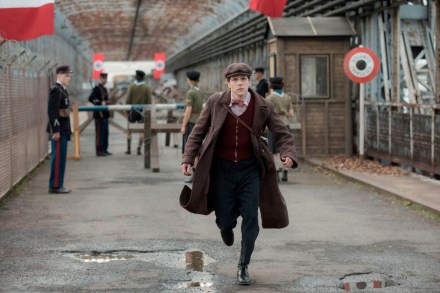
Sam Mendes’s 1917 is the first world war drama that this week won the Golden Globe for best film and also best director and there is no arguing with that, ha ha. In fact there has been plenty of arguing with that. Some critics say that it feels like a videogame. ‘Turns one of the most catastrophic episodes in modern times into an exercise in preening showmanship,’ says the New York Times. I don’t know what film they were watching. True, 1917 is formulaic — it’s your archetypal man-on-a-mission story — but it is also gripping, immersive and powerful. It isn’t the closest you will get to experiencing the Great War, as there is nothing to beat Peter Jackson’s They Shall Not Grow Old, but it’s as near as damn it. (Or so you imagine.

Clever, spirited, vigorous and intelligent: Little Women reviewed

There have already been several film adaptations of Louisa May Alcott’s beloved 1868 novel Little Women, and why not? After all, who ever gets tired of Jo burning off Meg’s hair? But the latest, from Greta Gerwig, is so clever and spirited and vigorous and engaging it knocks all the others into a cocked hat. This version is, I had read, Little Women for ‘a new generation’ but just so we’re clear, the ‘old generation’ like it perfectly fine. They love it, in fact. There’s life in us yet. Sometimes. This has a stellar cast and stars practically everyone: Saoirse Ronan (Jo), Emma Watson (Meg), Florence Pugh (Amy), Eliza Scanlen (Beth; oh God, Beth), Laura Dern (Maaaarmeeeeeeee) and Meryl Streep as a wonderfully scene-stealing Aunt March.

I’ve never seen a film like it: Ordinary Love reviewed

Ordinary Love stars Lesley Manville and Liam Neeson as a long-married couple whose lives are disrupted when she is diagnosed with breast cancer. Not very Christmassy, you might think, but it’s not a ‘cancer story’, as has been said in some quarters, it’s a love story, told profoundly and beautifully and honestly rather than cloyingly or sentimentally. Chances are, it may even stay with you longer than any Richard Curtis film. I can’t guarantee it, but am quietly confident this will be so. The screenplay is by the Northern Irish playwright Owen McCafferty whose own wife, Peggy, underwent breast cancer treatment, and the film is directed by Lisa Barros D’Sa and Glenn Leyburn.

Wildly entertaining Pope-off: The Two Popes reviewed

The Two Popes stars Anthony Hopkins and Jonathan Pryce — that’s two reasons to buy a ticket, right there — as Pope Benedict XVI and his successor Pope Francis I, and it is wildly entertaining, so now you have a third reason too. True, it does, as others have noted, shy away from directly tackling the most difficult questions currently facing the church. But is that really the film you want to see? Rather than this affectionate and literate bromance that does, in fact, nudge us towards the bigger picture, but slyly? Also, it is brilliantly comic. Pope Benedict, for instance, doesn’t get jokes but does try to tell one, which no one else gets. ‘It’s a German joke, so it doesn’t have to be funny,’ he then explains. I laughed my head off.

Detailed and devastating: Marriage Story reviewed

Noah Baumbach’s Marriage Story is a drama about the breakdown of a marriage and it is, at times, devastatingly painful. ‘Divorce,’ says a lawyer at one point, ‘is like a death without a body.’ It’s certainly not the most fun you’ll ever have at the cinema — although it is witty and there are some brilliantly comic lines — but you will see something riveting, detailed, authentic and excellent. Plus it also marks the return of Scarlett Johansson as an interesting actress — remember Lost in Translation? — rather than the one who hangs out with Iron Man and Thor and just does sexy kicks. I’d even forgotten she could be as interesting as this, frankly. Johansson plays Nicole while Adam Driver plays Charlie.

Scorsese at his most leisurely, meandering and engrossing: The Irishman reviewed

The Irishman is Martin Scorsese’s three-and-a-half-hour epic — a mobster-a-thon, you could say — starring Robert De Niro, Al Pacino, Joe Pesci and a light sprinkling of Harvey Keitel (he’s only in a couple of scenes). It’s based on the true, late-life confession of Mafia hitman Frank ‘The Irishman’ Sheeran and, while gangster flicks can often leave me cold and sometimes baffled — he was dispatched to sleep with the fishes for why? — this is magnificently engrossing. I wasn’t bored for a single minute which, given there are 210 of them, has to be a triumph, surely.

The Disney sequel that no one wanted is finally here – what a relief! Maleficent: Mistress of Evil reviewed

Maleficent: Mistress of Evil is the sequel to the 2014 film Maleficent, and it will certainly come as a relief to all those who, in the interim, have been worried that Disney might let a potential franchise go unexploited. Did that keep you awake at night, as it did me? Well, now we can all sleep easy, knowing that the sequel no one was clamouring for (yet may still make a ton of money even though it’s crap) is finally here. Phew. So, once upon a second time, Angelina Jolie reprises her role as the evil fairy in the giant horn wig who cursed Sleeping Beauty. The first film was, in effect, an origins story. It wasn’t an especially good origins story, but at least it had a point, as it asked: how did Maleficent become so dark and wicked and twisted. Whereas this time out?

Only fitfully funny: Chris Morris’s The Day Shall Come reviewed

The Day Shall Come is a second feature from British satirist Chris Morris and like the first, Four Lions, it is a ‘comedy of terrors’, you could say. But this time, rather than a group of hapless home-grown Muslim suicide bombers we’ve decamped to America and it’s the FBI that will do anything to get their man even if that man is harmless and insists that God speaks to him through a duck. It is funny, fitfully, but it asks us to laugh at someone I wasn’t sure we should be laughing at, plus it is repetitive and acts like we didn’t get the joke the first time, when we did. Or, at least, I did. You may be slower-witted, of course.

If you ever want to sleep again, step away from Joker

Judy is in cinemas this week and so is Joker and if you have to choose between the two, then it’s Judy every time. I would even add: step away from Joker. Step away, and step away now, if you know what’s good for you. It may be a masterpiece or it may be irresponsible trash — there is some controversy here — but either way it is so bleak and so dark and so upsetting the words ‘bleak’ and ‘dark’ and ‘upsetting’ don’t really cover it, and you may never be able to sleep again. Strange as it may be, the film about the wounded Hollywood chanteuse driven to an early and tragic death is, in fact, the far sunnier proposition.