Deborah Ross

Deborah Ross is the chief film critic of The Spectator

Horrible – but in a very fun way: I Care a Lot reviewed

I Care a Lot is a deliciously dark comic thriller that You’ll Enjoy a Lot. It’s heartless. It’s vicious. It’s savage. It’ll make you dread old age even more than you already do, if that’s possible. It’s horrible in so many ways — cruel? Did I mention it’s also cruel? — yet it is also smart, stylish and such a fun watch. Written and directed by J. Blakeson (The Disappearance of Alice Creed), the film stars Rosamund Pike as Marla Grayson, who runs a business ripping off old people. Or, to put it more formally, she is a court-appointed legal guardian for elderly wards — or ‘marks’, as she calls them — whose assets she then seizes perfectly legally.

Predictable, repetitive and exploitative: Run Hide Fight reviewed

In this line of business you receive many emails from PRs ‘reaching out’ about their particular film, which I really must see, as it wowed a festival in Bulgaria. But the other day, a PR reached out to boast excitedly about a film because it had been savaged, which was a first. ‘The film has absolutely enraged Hollywood critics,’ this person wrote, with obvious pride, before quoting the following from reviews: ‘insanely poor taste’, ‘wildly misjudged’, ‘tone deaf’, ‘gross’. What’s more, this person continued, while critics hate it — it has a critics’ score of 25 per cent at Rotten Tomatoes, the review- aggregator site — audiences are loving it (93 per cent).

The Icelandic version was better – and had better knits: Rams reviewed

Rams is an average film with a better film trying to get out, and you may already have seen that better film. It’s the Icelandic one, of the same name, released in 2015, on which this Australian version is based. That was played as a spare, stark, bitterly dark comedy set amid ice and blizzards and featuring men with unkempt beards, whereas this is sunnier and more kempt and therefore significantly blander. You may even, at various points, feel as though you’ve been trapped in an overlong episode of All Creatures Great and Small (nothing against All Creatures Great and Small, but two hours of it?).

Remarkably moving: The Dig reviewed

Just before the outbreak of the second world war a discovery was made in a riverside field at Sutton Hoo in Suffolk. It was an immense buried boat, dating from the 7th century, and it yielded gilded treasure after gilded treasure, thereby wholly changing our understanding of the Dark Ages. ‘They weren’t dark… by Jupiter!’ as one archaeologist puts it here. It is a fascinating story that could have been told as a full-on thriller. But instead the film employs a delicious, graceful restraint, paying as much attention to deeply buried feeling as to what’s buried deeply in the earth. It’s remarkably moving. By Jupiter, I even cried by the end.

So good I watched it twice: Netflix’s The White Tiger reviewed

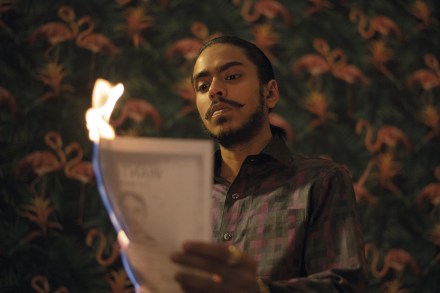
The White Tiger is adapted from the Booker-prize winning novel (2008) by Aravind Adiga. It is directed by Ramin Bahrani (Man Push Cart, 99 Homes) who also wrote the screenplay. It stars Adarsh Gourav, otherwise a songwriter and singer. It’s a rags-to-riches story set in India but it’s not at all a typical rags-to-riches story set in India. Those are some of the things you probably should know, but there is only one thing I want you to know: it is wonderful and, even though the subject matter is often chilling, and there’s simmering rage, and murder, it’s still two hours of boisterous, dazzling, swaggering fun. I watched it once and thought: I could easily watch that again. So I did. Unheard of. And one last thing I want you to know: Bahrani may be a genius.

The acting is very Scooby-Doo: Blithe Spirit reviewed

The comedy Blithe Spirit was written by Noël Coward in 1941. It is, essentially, about a séance going wrong and a deceased first wife coming back to haunt her husband and his second wife, causing mayhem. Better if she’d been left to rest in peace, and, after seeing this film adaption, you may well wish the play had been left to rest in peace too. Don’t dig it up! Leave well alone! I would even add that if Dame Judi Dench can’t save an adaptation — and I was previously of the mind that Judi Dench could save anything — then you know you are in real, real trouble. The play was famously filmed by David Lean in 1945, starring Rex Harrison as novelist Charles Condomine and Margaret Rutherford as Madame Arcati.

Riveting: Dear Comrades! reviewed

Andrei Konchalovsky’s Dear Comrades! is based on a true event and set in 1962 in the Russian city of Novocherkassk where the local factory, the Novocherkassk Electric Locomotive Plant, went on strike. This doesn’t sound especially sexy, I know, but it is superbly acted and so rivetingly told my concentration did not waver for an instant which, given how hard it has been to concentrate lately, is high recommendation indeed. (It wouldn’t be fair to list the films I couldn’t concentrate on, as the problem is likely mine, but… Mank!) Konchalovsky certainly has a wild CV. He has worked with Tarkovsky. He made the wonderfully hypnotic The Postman’s White Nights, about a remote Russian village whose only contact with the outside world is their postman.

Even I, a bitter and cynical middle-aged woman, felt stirred: Sylvie’s Love reviewed

Sylvie’s Love is an exquisitely styled, swooning, old-school, period Hollywood romance and while it has been described as ‘glib’ in some quarters, it’s Christmas, we’ve had a rotten year, and it may be just what the doctor ordered. And if it is glib — I’m not convinced it is, actually; it may even be quite groundbreaking — it is, at least, adorably and cheeringly so. (My heart was warmed.) It is written and directed by Eugene Ashe, and opens in Harlem in the summer of 1957 with Sylvie, played by a luminous Tessa Thompson. She works in her father’s record store but is obsessed by television and dreams of becoming a TV producer.

Buttercup the cow was so convincing I felt quite moved: Jack and the Beanstalk reviewed

This pantomime was filmed by ‘legendary Blue Peter presenter’ Peter Duncan in his back garden over the summer. It was intended for online release only but it’s also gone into cinemas because this is the world we now live in. Oh no it isn’t. Oh yes it is. Oh no it isn’t. Seriously, it is. Why are you arguing like this? Stop it. As many theatres are still closed, and as most pantomimes have been cancelled, it makes sense to show it in cinemas and for cinemas to have something to show. During normal times the Christmas period is The Favourite and Portrait of a Lady and, while we’re at it, have David Copperfield and Little Women too.

A hard watch, but ultimately a rewarding one: County Lines reviewed

County Lines is the kind of social realism that the British do so well, if not too well. In other words, a hard watch. In fact, at times it’s so unbearable you might find yourself pressing pause because you’ve suddenly remembered the fridge needs a clean, say. Or the hall: couldn’t it do with a tidy-up? But this tale of a young boy caught up in transporting drugs has to be tough. And there is sympathy, tenderness and hope, too. As for the kid, who is a sort of modern-day Billy from Kes, you will certainly take him to heart. The film is written and directed by Henry Blake, a one-time actor who was a youth worker in London for 11 years.

It’ll blow you away: Collective reviewed

When I recommend this documentary to people, telling them it follows the journalistic investigation into a fire that broke out in a Bucharest nightclub, killing 64, with the majority not dying of their injuries but later in hospital, their look says: ‘Not a chance.’ Their look says: ‘This film is not something I wish to see.’ I felt similarly, but trust me on this. It’s gripping. It’s electrifying. It’s explosive. It plays like a crime thriller yet with real consequences. There are revelations that will make you gasp. And it opens a can of worms. Literally. The fire broke out at Club Colectiv in 2015 when a band’s pyrotechnics ignited the building’s soundproofing foam.

Like a never-ending episode of The Jerry Springer Show: Hillbilly Elegy reviewed

Hillbilly Elegy is an adaptation of the best-selling memoir, published in 2016, by J.D. Vance and it’s quite a story. He was brought up in the American rust belt amid poverty, violence, addiction, trash heaps, burning cars, hopelessness and, on top of all that, a grandma who, we now know, was the spit of Catherine Tate’s Nan. (It’s Glenn Close, but check it out.) Still, if you can get past Nan — if, if — this film should be an emotionally stirring and moving account of, ultimately, achieving the American dream. (Vance went on to Yale and became a successful investment banker.) But as directed by Ron Howard it isn’t any of that. Instead, this is like being trapped in a seemingly never-ending episode of The Jerry Springer Show.

A gripping portrait: Billie reviewed

This documentary about Billie Holiday is transfixing. Not just because it’s about Billie Holiday — I am not into jazz yet her version of ‘Strange Fruit’ is obviously incredible — but for the previously unheard audio tapes recorded by Linda Lipnack Kuehl in the 1970s with the people who knew her. This includes, for instance, Billie’s cousin, John Fagan, who chucklingly says he pimped her out as a child — ‘girls started young’ — and that women who ‘step out of line’ like to be knocked about and are proud of having a black eye as it shows ‘someone loves them’.

Every scene Sophia Loren isn’t in feels like a wasted one: The Life Ahead reviewed

The Life Ahead stars Sophia Loren, and if there is one reason to see The Life Ahead it is this: Sophia Loren. And if you need a second reason, it is this: Sophia Loren. Also, it is the third, fourth, fifth, sixth and seventh reason. And probably the eighth. She is magnificent, truly. Directed by Edoardo Ponti, Loren’s son, the film is based on the 1975 novel The Life Before Us by Romain Gary. It was filmed in 1977 as Madame Rosa, starring Simone Signoret, and won the Oscar for best foreign film. Here, the action has been transposed from France to Italy and the port city of Bari which is, from what we see of it, rough and poverty-stricken rather than picturesque. And our Madame Rosa is Loren, in her first proper film role for 11 years.

You won’t be able to look away: Shirley reviewed

This week, two electrifying performances in two excellent films rather than two mediocre performances in the one mediocre film — see: Rebecca — so things are looking up. Firstly, Mogul Mowgli, starring Riz Ahmed, directed by Bassam Tariq and co-written by the pair. Ahmed plays Zed, a British-Pakistani rapper who has lived in New York for two years and is on the brink of stardom when he returns home to his family in London. It’s intended as a brief visit but then he is struck down by an autoimmune disease that is never named but is something like multiple sclerosis. The point is, I think, even his body doesn’t recognise him any more.

You’re not going to get a better spin on bromance – brobably: The Climb reviewed

The Climb is, essentially, a bickering bromance as two longtime pals bicker bromantically down the years, and it doesn’t sound like a film you’d especially wish to see and it didn’t sound like a film I’d especially wish to see. Bromances are bad enough, so God save us from a bickering one. But it’s actually quite the marvel: original, sometimes absurdist, touching, funny, and it also takes male friendship seriously, which is a novelty. So you do wish to see it. You just didn’t know till now. It was written by Michael Angelo Covino and Kyle Marvin, directed by Covino, produced by Covino and Marvin (among others) and stars Covino and Marvin who play characters called Mike and Kyle.

Like a weird episode of Downton – with less sexual chemistry: Rebecca reviewed

Rebecca is a new adaptation of Daphne du Maurier’s gothic, twisted, never-out-of-print tale of sexual jealousy. It’s directed by Ben Wheatley, with a script by Jane Goldman, and stars Lily James, Armie Hammer and Kristin Scott Thomas. High hopes? Me too. But though it’s perfectly watchable, it’s not at all daring. Would the second Mrs de Winter be more fully formed and less of a pallid, round-shouldered meek little thing? Would sinister Mrs Danvers have more substance? Would it be a modern interpretation for modern times? No, is the short answer. And also it just isn’t sexy enough. Meanwhile, I forgot to start this with: ‘Last night I dreamt I went to Manderley again…’ as it’s how every other review will begin, I’m sure.

Gripping high gothic psychological horror: Saint Maud reviewed

Saint Maud is a first feature from writer-director Rose Glass and it’s being billed as a horror film. But it’s not your common-or-garden horror film. There are no chases through woods. No one watches a doorknob being twisted from inside the room. Also, there are no maypoles. (Always bad news, maypoles.) Instead, it’s more of a character study, as well as a study of religious fervour, told in the high gothic style, grippingly, with wonderful originality and no dilly-dallying. Eighty minutes, and that’s it. (Sorkin, Nolan, Scorsese, Tarantino… please take note.) The film stars the terrific Morfydd Clark who, I think, you cast when you can’t get Molly Windsor who, in turn, you cast when you can’t get Morfydd Clark.

One zinger after another – but it’ll leave you cold: Trial of the Chicago 7 reviewed

Aaron Sorkin’s The Trial of the Chicago 7 — don’t worry, you haven’t missed six earlier films — is a courtroom drama based on true events featuring a stellar cast: Mark Rylance, Frank Langella, Sacha Baron Cohen, Eddie Redmayne, Jeremy Strong. You may be wondering: hang on, no Michael Keaton? But he tips up too! What, no Joseph Gordon-Levitt? Don’t worry. He’s here. But while the performances are ace and the script is one of those Sorkin scripts where the dialogue is one zinger after another — zinger ping pong, I call it — it will leave you cold emotionally. This is a film to admire, in some respects, but it will never make you feel. I wasn’t bothered who did or didn’t go to prison in the end.