David Patrikarakos

David Patrikarakos

David Patrikarakos is the author of 'War in 140 Characters: How Social Media Is Reshaping Conflict in the Twenty-First Century' and 'Nuclear Iran: The Birth of an Atomic State'

Why won’t Britain support the Kurdish referendum?

From our UK edition

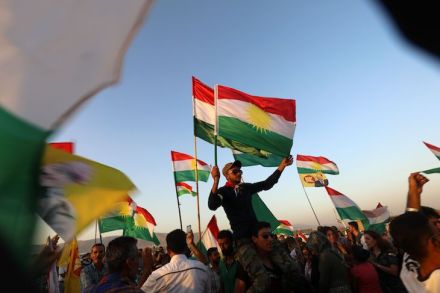
Erbil They like the British here in Iraqi Kurdistan. You hear it from people everywhere in Erbil, the region’s capital. And there were a great many of them out in the streets. It was hot and crowded on 25 September; the polls opened early for the Kurds to vote. The question was simple: did they want independence from Iraq? Did they, after over 2,000 years of statelessness, want their own sovereign nation? 48 hours after the question was officially put to the populace they replied- unequivocally. The Kurdish electoral commission said around 92 per cent voted 'yes' to an independent Kurdistan. This answer – though entirely expected – did not go down well in Baghdad or with any of Erbil’s neighbours. The day before the vote, Iran closed its airspace to Kurdistan.

Rumbles in the jungle

From our UK edition

A CIA agent, a naive young filmmaker, a dilettante heir and a lost Mayan temple form the basis of Ned Beauman’s latest, and arguably most impressive, novel. Two rival expeditions set off from the United States to the jungles of Honduras to find the temple — one with the intention of using it as a location in which to film an absurd comedy, the other determined to disassemble it and take it back to New York. The two sides clash, each refusing to give way. The weeks roll into years; and life around the temple, populated with a disparate and distinct array of characters, steadily deteriorates into greater savagery. Meanwhile, Zonulet, rogue CIA agent (and primary narrator), under internal investigation, needs to unlock the secrets of the temple to prove his innocence.

Combating 21st-century terror: what Europe can learn from Israel

From our UK edition

Spain, Finland, Russia: in the space of a few days, Europe is reminded, yet again, that terrorism – like the virus it is – kills brutally, indiscriminately and, critically, transnationally. On Thursday, August 17, a van rammed into crowds of people in Barcelona’s Las Ramblas boulevard – a hub of tourism and social life. Thirteen were killed with dozens more injured. The atrocity was followed by a knife attack the very next day in the Finnish city of Turku, which killed two people and injured eight. Another knife attack, this time in the Siberian city of Surgut on the 19 August, injured eight. Islamic State has claimed responsibly for all the attacks. In a democratic society based on liberal values it is impossible to stop every madman that wishes us harm.

Could the French far left propel Marine Le Pen to victory?

From our UK edition

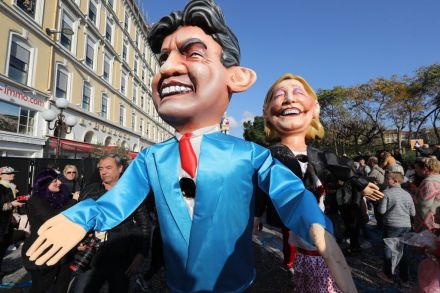
The French philosopher Jean-Pierre Faye’s career has encompassed everything from fiction to prose poetry, but he will best be remembered for his contribution to political science: Horseshoe Theory. This maxim holds that the far left and far right, rather than being at opposite ends of a linear political spectrum, in fact closely resemble each other. This is because the political spectrum is not linear but instead curves like a horseshoe, the right and left extremes of which almost meet. Faye’s theory has often been derided for being simplistic, so he could be forgiven for feeling a quiet sense of vindication after a recent survey of supporters of the defeated far left candidate Jean-Luc Mélenchon, a former Trotskyite, who received 19.

A parable of good and evil

From our UK edition

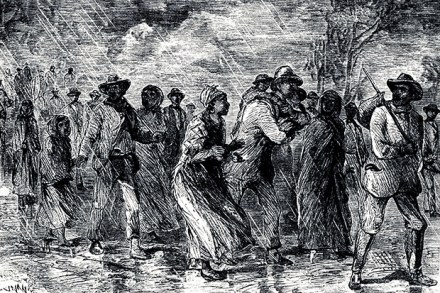
It is difficult to write well about slavery. As with the Holocaust, the subject’s horrific nature lends itself too easily to mawkishness. This tendency is one that Colson White-head consummately avoids in this impressive novel. The Underground Railroad, set before the American civil war, tells the story of Cora, a young slave on a cotton plantation in Georgia, and her escape with a fellow slave, Caesar, via the Underground Railroad, a secret network of routes and activists that enabled slaves to reach the free states of America’s north. It tells it beautifully.

There’s one major lesson Labour should learn from Syriza’s anniversary

From our UK edition

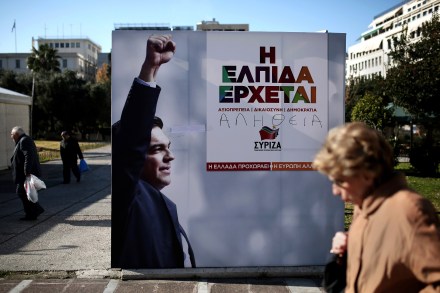
If a week is a long time in politics what’s a year? A century? A millennium? An Ice Age? If you’re Greek it can sometimes feel like all three. One year ago today, on 26 January 2015, Greece’s Syriza party formed the most left-wing government in the country’s history having (ludicrously) promised the Greek people to take on the European establishment and rid them of the austerity measures that had blighted their lives for close to a decade. If hubris and bombast characterised Syriza’s election campaign, then naivety and disaster characterised its first months in office. The new Prime Minister Alexis Tsipras had given the job of re-negotiating with Greece’s numerous European creditors to his charismatic but abrasive finance minister, Yannis Varoufakis.

An historic day for Iran and a horrifying one for Israel

From our UK edition

When the Shah of Iran gave the order to create the Atomic Energy Organisation of Iran (AEOI) in 1974 it is unlikely that he had any idea of just how controversial his move would ultimately prove. The AEOI brought order to what had hitherto been a disorganised programme and set the country on the path to an eventual clash with the world’s leading western powers. That clash began in 2002, when at a public press conference in Washington DC, an Iranian opposition group, the Mojahedin-e-Khalq (MKO) exposed details of undeclared Iranian nuclear activities, which had progressed much further than anyone had suspected. At least, almost anyone.

Alexis Tsipras asked if people were happy. The answer was always going to be ‘no’

From our UK edition

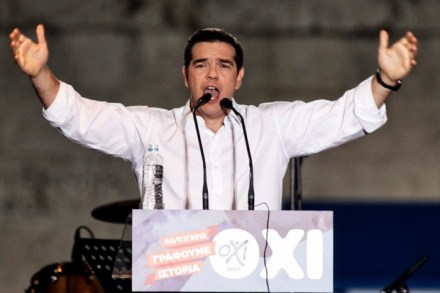
Greek Prime Minister Alexis Tsipras has just done something unthinkable. He has won the Greek referendum. And make no mistake, it was him that won it. It was his decision to call a referendum just over a week ago and send the EU into a panic. The last Prime Minister to try that was George Papandreou in 2011 before he was forced to backtrack rapidly. He resigned shortly after. But winning the referendum isn’t what is so astounding – opinion polls were neck and neck throughout last week and once voting closed at 7pm Greek time it became almost immediately apparent that the No side would win.

The one thing that might ensure a Greek deal: fear

From our UK edition

On a narrow, sloping street in downtown Athens sits a graffiti-strewn wall that has captured the spirit of a nation. Amidst the spray-painted slogans and flaking posters, a black-and-white stencilled image of Greek Prime Minister Alexis Tsipras looks down benignly (beneath a perfectly-observed monobrow) at passers-by. His arms outstretched, dressed in flowing robes and with a halo circling his head, he is Christ come to redeem Greece. Such is the bitter humour that now pervades the country’s capital city as the prospect of financial implosion nears. Tsipras came to power promising to get rid of austerity and take the fight to Greece’s European partners. Reality, alas, proved less accommodating. The partners didn’t budge. Syriza, the party Tsipras leads, has had to.