David Blackburn

The trimmers mobilise

From our UK edition

The Independent on Sunday reports that a cabal of four disgruntled/horrified Lib Dem MPs have held secret talks with Labour to amend contentious elements of the Budget, such as the VAT hike. Four rebels will not be enough to defeat the government, but it is the first indication that Simon Hughes’ call to arms will be answered by the social democrat wing of the party, damaging the coalition’s long-term prospects. Of course, it is healthy that government backbenchers scrutinise and improve government legislation for whatever cause – the odd amendment to public borrowing clauses would have been welcome over the last decade. Scrutiny does not imply revolution, stressed Andrew George, the four members’ leader. But scrutiny is a double edged sword.
Cameron and Clegg’s love-in deepens

From our UK edition

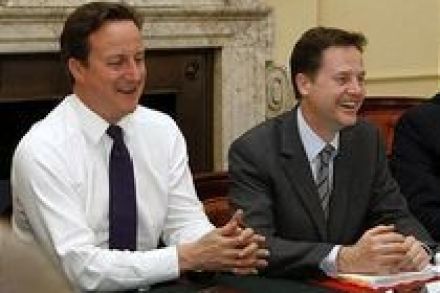
What began as a coalition of expediency is maturing into a pact of principle – or at least that’s what Cameron and Clegg would have you believe.  Of course, relations may sour and enormous efforts are being made to preserve Cameron and Clegg’s public cordiality. Journalists are being briefed that plans are in progress to enable Cameron and Clegg to speak at each others’ party conferences.   It will be little more than a public relations exercise if it goes ahead, and an extremely hollow one in all probability. What are they going say? It’ll be a cartoonist’s dream, as Clegg is politely applauded by the contemptuous Colonels, and Cameron, shandy in hand, schmoozes the socks and sandals brigade.

Unwinnable war?

From our UK edition

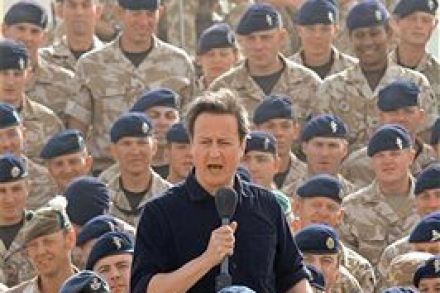
Today is Armed Forces Day, and I don’t recall seeing such collective negativity from newspapers and broadcasters on the Afghan war.  It borders on despair. Most news outlets have dissected David Cameron’s comments yesterday, where he could only offer the hope that troops would be withdrawn by the end of this parliament. Cameron’s non-committal answers, the regular drip of casualties and the sense that the surge has become a slog have led journalists and analysts to conclude, en masse, that the war is unwinnable.   Three interviews are particularly striking. Nick Harvey, the armed forces minister, re-iterated Cameron’s comments in the exact same terms. As I argued yesterday, the vague statements pose questions not answers.

Cameron wants troops out of Afghanistan by 2015

From our UK edition

Everything about the Cameron government comes in fives. Five year terms, a five-year coalition and now we learn that it is Cameron’s considered opinion that British troops cannot remain Afghanistan for another five years. All Cameron has offered is the hope that troops will be home before the proposed May 2015 election. Five more years in Helmand on the current trajectory would be extremely costly and unpopular, especially given the political pressure surrounding defence cuts. Cameron realises this but will the nature of Britain’s engagement change? The assumption was that Britain would mirror President Obama’s timetable and begin a gradual withdrawal next year. That political and military strategy depended on the success of COINS entirely.

Obama wants ‘global concert’ to delay cuts

From our UK edition

G20 summits are usually turgid affairs, but this one has some (limited) potential. Relations between the White House and Britain and the White House and Europe have been frosty of late. Afghanistan, BP, the Falklands, Merkel and Sarkozy’s irritation at Obama’s personal and political aloofness, all of these have been contentious. Diplomatic tension has now developed an economic arm. The broadly centre right governments of Britain, France and Germany are committed to cutting public spending now. Each has introduced an austerity programme, and Cameron has made retrenchment is his international cause. Obama still stands for stimulus.

Union backing is an indication of how far David Miliband has shifted to the left

From our UK edition

Paul Waugh has news that David Miliband has received the backing of USDAW, the shop workers’ union. Block union voting is a thing of the past, but this endorsement is a surprise nonetheless. It’s lazy to categorize Miliband as a ‘Blairite’, but he is certainly on the right of the party – vigorously pro-European, pro-business and an avowed social democrat. USDAW’s general secretary John Hannett is said to be impressed by Miliband’s defence of Labour’s record in office. To be honest, Diane Abbott is the only candidate who has lacerated the Blair/Brown governments, all the others are ‘proud of our record in government but recognise the need for change.

Cameron takes to the global stage, orating for a domestic audience

From our UK edition

From the point of view of historical curiosity, it is a pity that the great Victorian statesman predeceased the era of global summits. What would Palmerston or Melbourne have made of the pageantry? What might they have said to permeate it? Would they have wanted to? Modern British Prime Ministers have moulded themselves on the world stage: Blair as a liberal interventionist, Brown as a Keynesian. Judging by an article David Cameron has written in the Globe and Mail, he hopes to lead the world to fiscal re-trenchment and inaugurate lasting and real prosperity through free trade. Once again, Cameron’s premiership appears to be descended from Gladstone.

Hughes and Davis fomenting rebellion?

From our UK edition

From opposing sides of the coalition's strait, two warning shots have been fired across the government's bows. David Davis has challenged Theresa May’s decision to renew the 28-day detention limit for six months pending a review. And Simon Hughes has declared that he and a like-minded posse will seek to amend ‘unfair’ aspects of the Finance Bill. Neither is an outright revolt. Neither move amounts to what Ed Miliband termed ‘cracks appearing in the coalition’. Both Davis and Hughes remain in support of the coalition agreement – Hughes will ‘support the Budget’, and Davis, to his enormous credit, has made excessive and illiberal detention periods his raison d’être.

Re-invigorating retirement

From our UK edition

The retirement age must rise, timing is the sole contention. Yvette Cooper asserts that the coalition’s acceleration of the planned rise in the state pension age will force those currently in their late fifties to re-plan their retirement. Certainly, but a rise in the state pension age from 65 to 66 is unlikely to be life-changing. So why not bring it forward? Of more interest, I think, are the government’s other pension proposals. 'Re-invigorating retirement' sounds rather jaunty, being forced to pay into less than lucrative company pension schemes does not - especially as those schemes are far from secure. Also, the abolition of the Default Retirement Age limits the capacity of private companies to manage their workforces.

The Budget PR battle enters a second phase

From our UK edition

The government is on the defensive. The IFS’ pronouncement that the Budget was ‘regressive’ and the VAT hike ‘avoidable’ has given sustenance to the opposition and their supporters in the media. At the time, Harriet Harman’s response to the Budget seemed execrable. Now, I’m not so sure. Harman is like a Swordfish bi-plane attacking a battleship: she is so slow and obsolete that her superior opponents cannot bring their modern guns to bear. So she closes the range and scores a hit. Tuesday was one of her more successful strikes. As John Rentoul notes, Harman had a point beneath the bluster. The OBR is George Osborne’s weak spot; it downgraded growth forecasts in light of his Budget.

RIP Lord Walker

From our UK edition

Peter Walker, Baron Walker of Worcester, has died aged 78. He served as a Cabinet Minister in both the Heath and Thatcher governments. He was what might be termed derisively as a ‘Wet’, and was a leading figure on the liberal side of the Conservative Party for thirty years. He was a founder member of the Tory Reform Group, which propounds One Nation Toryism and economic efficiency, ideals that have, it might be argued, profoundly influenced David Cameron’s leadership. Walker served with distinction throughout the Thatcher government, carrying the brief for Wales, Energy and Food and Fisheries. As Energy Secretary, he was a key figure during the Miner’s Strike.

All in all, a pretty good day for the government

From our UK edition

I doubt David Cameron will have many better days in government than this. Considering the government cancelled a hospital project yesterday, today has passed as one long photo-op, free of incident. It began with Theresa May banning a radical Islamist cleric, Zakir Naik, displaying a resolve that eluded her immediate predecessors. The papers were full of Cameron’s ‘coup’ in Brussels yesterday; the only major news story that might have unnerved Cameron was the FT’s research into Tory immigration policy, which the FT calculates will hit growth and raise taxes. It was too esoteric to hit the TV screens, so too the cuts in arts funding. It must have been a happy breakfast in No 10 this morning.

May calls for culture change towards LGB&T groups

From our UK edition

Theresa May has called for ‘culture change’ in wider society to ease the equality and acceptance of lesbian, gay, bi-sexual and transgender minorities. Abstractions are the executive’s favoured metier these days. I’ve read and re-read May’s article in Pink News and nowhere does she define ‘culture change’. The end product of a culture change towards LGB&T groups might be envisaged, but how is it initiated? The government cannot answer that question, beyond suggesting that supporting pride marches is positive. True, but society is more than a pride march. It exists in the daily confusion caused by ill-defined laws, such as who B&B owners let into their homes/businesses.

Miliband turns Brownite

From our UK edition

Well done David Miliband, for writing an article in the Guardian that is free of wonkery and abstractions. Miliband deserves applause for being the first Labour leadership contender to address public spending cuts with reasoned analysis, not ideological retorts. Also, he is right to urge George Osborne not to sell the public stakes in RBS and Lloyds at a bargain price. But his central thesis merits censure. He perverts recent history to fit an avowedly left-wing analysis of public spending. Miliband writes: ‘Let's take the deficit argument head on. We need to remember what the Tories want the country to forget: it was falling tax receipts – not rising spending – that primarily caused the deficit to rise.

The audacity of hope

From our UK edition

70 years ago today, Winston Churchill and Charles de Gaulle delivered two of the most important speeches of the 20th Century. Against the odds and common sense, both urged their respective nations to fight on against the tyranny of Nazi Germany. Today is a reminder that France is one of Britain’s oldest and closest allies, a point that the Times expresses this morning. Their words merit revisiting. Here is Churchill’s timeless address: ‘However matters may go in France or with the French Government or with another French Government, we in this island and in the British Empire will never lose our sense of comradeship with the French people.

Worrying developments

From our UK edition

Paul Waugh has news that the Treasury asked a broadcaster to sign a written legal agreement that they would not ask any questions about the OBR’s announcement. Well, some of the figures embarrassed Osborne but surely it wasn’t that bad? As Paul notes, this may be a case of the Civil Service taking advantage of ministers’ inexperience but even so. Equally, the government has adopted the practice of its predecessor and issued statements to the press before stating them to the House. Carry on like this and we'll join the axis of evil. New politics please. UPDATE: Turns out not to have been so worrying.

The euro crisis is an opportunity for Cameron

From our UK edition

Gerard Baker has written the cover piece for this week’s magazine and it’s a must read. In it, he explains why ‘closer fiscal union’, as Rompuy terms it, is not to Germany’s advantage: ‘Any attempted fiscal union might well yield to Germany the biggest single vote in how much to raise in taxes and how to spend it. But it could still be outvoted by an alliance of smaller countries. Such a set-up would become an institutionalised mechanism by which German taxes will be siphoned off permanently to weaker European states.

The coalition is edging the public spending debate

From our UK edition

Danny Alexander acquitted himself effectively this morning. The restructuring of government spending has gone beyond bland clichés about ‘efficiencies’; with care, the government is dismantling Labour’s unfunded spending projects. £8.5bn in unfunded projects signed-off since 1 January 2010 are on a stay of execution until the autumn; £1bn of unfunded projects signed-off before 1 January 2010 are also on their way to the block. £2bn will be saved almost immediately with the cancellation of the 2 year jobseekers’ guarantee, the young person’s guarantee, CLG regional leader board, the local authority business growth incentive and the county sports partnerships.

A good war

From our UK edition

As Allister Heath notes in City AM this morning, Mervyn King has had a good war. Well, not so much a good war as a profitable peace. King contributed to the domestic crisis by sustaining very low interest rates whilst ignoring asset prices. Brown may have forced the Governor’s hand, but King was groggily supine until a sovereign debt crisis threatened. George Osborne is dismantling Gordon Brown’s regulatory imperium. King is the major beneficiary as the FSA is subsumed by the Bank of England. How will exercise that power? Obviously, time will tell; but monetary tightening will moderate excess (and spruce up banks' balance sheets) in the short-term.