David Blackburn

A ‘regressive’ budget?

From our UK edition

The IFS has given the coalition’s opponents powder for their muskets, only it’s a little damp. The IFS’ analysis is drawn exclusively from straight tax and spend figures; it does not account for the future financial benefits brought by structural public service reform – so Gove’s and IDS’ reforms, both of which aim to alleviate poverty, have not been evaluated.  Matthew Sinclair explains why this means the IFS has exaggerated the severity of Osborne’s Budget: ‘Suppose you invented a policy, some kind of economic miracle, which doubled the incomes of the poorest ten per cent of families without the Government spending a pound.  That would reduce benefit spending.
Clegg needs to find some courage

From our UK edition

Nick Clegg is eviscerated by this morning's press. The Independent, The FT and The Guardian gleefully report that the influential IFS has decreed the Budget (supposedly a model of fairness according to Clegg) to be regressive, that there is discontent fomenting on the Lib Dem benches and that the latest polls place Lib Dem support at 12 percent. None of this is news. The IFS is reiterating what it argued on Budget day: Osborne’s measures will hit the poorest in 2014-15. That is still some way off and action can be taken to lessen their impact. Besides, the coalition should have delivered its promise to raise the income tax threshold to £10,000 by 20-14-25.

Stage 2 in the penal revolution

From our UK edition

The government’s position is that prison does not work. It aims to reduce prison numbers and now Ken Clarke has announced that further savings will be made to the criminal justice budget. The Times reports (£) that Clarke will continue Labour’s policy of closing courts; 103 magistrates courts and 54 county courts will shut up shop. The Tories campaigned against court-closures at the fag-end of the last government; and there is whispered concern around Whitehall and Westminster that the concrete apparatus of justice is already over-stretched. But, savings must be made. Clarke's closures will save a paltry £15.3 million from the annual £1.1bn budget; the bulk of cuts will come from reducing the number of contested trials.

IDS versus Osborne: there can only be one winner

From our UK edition

The Quiet Man is an odd moniker for Iain Duncan Smith. There was nothing quiet about his opposition to the Maastricht Treaty and he turned up the volume when he told the Tories to ‘unite or die’. Matthew d’Ancona observes that IDS is a noisy maverick again. IDS has threatened to resign if his welfare reforms are obstructed. Principles are one thing and tactics another. As d’Ancona notes: ‘Such talk is fine if a minister means he will quit if he himself fails. But in IDS's case it has sounded more like a threat: if the leaders of the coalition do not give him what he wants, he will resign and bring the temple walls crashing down around him.

David Miliband and the graduate tax

From our UK edition

As James Kirkup notes, it looks as if David Miliband supports a graduate tax – only ‘looks’ mind, we can’t be sure. The university funding debate is now captive to ill-defined terms – is what is being proposed a tax, a fee or a contribution? David Miliband is hard enough to comprehend as it is, but is he talking about a graduate contribution or a graduate tax? How would either be assessed? Also, does David Willetts make any more sense?

Andy Burnham’s faltering campaign

From our UK edition

Andy Burnham’s leadership campaign is going the way of all flesh. According to Left Foot Forward’s model, Burnham is set to come fourth behind Ed Balls. A You Gov poll predicted a similarly poor showing for Burnham. I’m surprised by this. Burnham is presentable against a field of gawky rivals. Also, after a faltering start, he has tuned a clear anti-establishment message, crafted to politicise the north south divide and New Labour's soulless metropolitanism. He reiterates it for today’s Independent, arguing that the party has been run for too long in ‘an elitist, London-centric and controlling way’ and that New Labour was ‘born of a distrust of its members.

Clegg to be sidelined from AV campaign

From our UK edition

The Sunday Times (£) has news that Nick Clegg will not front his party’s ‘Yes to AV’ campaign next May. This makes sense. The deluge of abuse he received in Bristol yesterday was another indication that many have fallen out love with Clegg. The Lib Dem leadership fear that if Clegg heads the campaign it will descend into a referendum on Clegg and his decision to form a coalition with the Tories. That will probably transpire in any event, especially if Labour opposes the introduction of AV, which it looks set to do. It makes sense to protect the embattled Lib Dem leader from as much collateral damage as possible. Presumably that will extend to Lib Dem cabinet ministers, which suggests that Simon Hughes is likely to play a significant role.

Ed Balls’ contract with the Labour Party

From our UK edition

Ed Balls has produced a contract with the Labour party. Three things strike me about it. First, he emphasizes broader consultation and promises a greater role for activists and local representatives. These political impulses are championed by the coalition – an indication that Cameron and Clegg’s partnership is beginning to change Britain party political landscape. Second, Balls is a proud friend of the trade unions and wants to restore the link between Labour and the unions, perhaps to redress Labour’s chronic financial position. Third, like Ed Miliband, he has adopted Harriet Harman’s goal of having women as 50 percent of the shadow cabinet.

Seconds out…IDS versus Osborne

From our UK edition

Infamously, George Canning and Viscount Castlereagh fought a duel over a policy disagreement; Iain Duncan Smith and George Osborne will follow suit at this rate. I had thought they’d resolved their differences over the upfront costs of IDS’ welfare reform; but the Mail on Sunday reports otherwise, glorying in the glares, savage bon mots and expletives. This is the conundrum: if IDS doesn’t find £10bn in savings, he will not get the £3bn needed to enact his reforms to make work pay.

Clegg’s no Dave

From our UK edition

Nick Clegg faced a stormy Q&A session this afternoon and he isn’t in David Cameron’s league as a performer. He struggled through tough questions on VAT, DfID, a transaction tax, AV and the appointment of Philip Green. His answers were garbled, though he did stick to the government’s script. There was, however, one particularly damaging exchange. Clegg was heckled by a man who thought the coalition ‘lacked a mandate for its rather brutal social policies’, and added that Clegg should get out of the coalition before it was ‘too late.’ Clegg’s response was limply pugilistic. ‘You’ve obviously got an axe to grind.

Too close to call Down Under

From our UK edition

Australia has spoken, but it will take some time to determine what they’ve said. ABC is reporting that Australia is headed for its first hung parliament since 1940. Exit polls suggested that Julia Gillard’s Labor party would win the most seats; but it now looks as if Tony Abbott’s Coalition has obtained 73 seats, one more than Labor; there are also 4 independents and 1 Green MP to throw into the mix. Conservative Home is following the election in detail. Weak and indecisive government may follow, but the Coalition has the political momentum. 6 months ago Kevin Rudd was, in racing parlance, a dead-cert for re-election.

David Miliband looks odds-on

From our UK edition

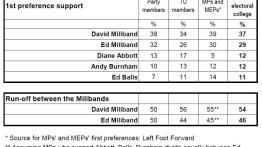
Crack out the nibbles, David: looks like you’re going to win the Labour leadership. An extensive You Gov poll of Labour members and trade unionists puts David Miliband 8 points clear of his brother in the final run-off. This is the first statistical analysis that supports the general feeling in Westminster that Ed Miliband’s charge has calmed. Courtesy of John Rentoul, the results are diluted in this table. UPDATE: Mike Smithson points out that the fieldwork for this poll was carried out between 27-29 July. So I stand corrected: Ed Miliband's charge has been on the wane for a month.

Clegg and the dissenters

From our UK edition

Nick Clegg understands his party’s misgivings, and he has devoted an interview with the Telegraph to calming his troops with some of the old religion. He will continue to fight for an alternative nuclear deterrent to Trident and he hints that tuition fees will be abolished. He says of the proposed graduate tax or student contribution: “It’s one we think is acceptable. The perception of [tuition fees] is that it imposes a wall of debt as you walk through the entry gates of university. This has a chilling effect on applications. It sends a signal which seems to be discouraging.

The 100 Days

From our UK edition

It’s been 100 days since love was in the air in the Rose Garden. So, how’s it been for you? For most, the Honeymoon continues. An ICM poll for the Telegraph reveals that 46 percent think the government is governing well and that 44 percent believe the government is doing a ‘good job’ in securing economic recovery, against 37 percent who think we’re irreversibly on the road to ruin. True, spending cuts have not yet hit the easily swayed and the government’s popularity will recede, but it won’t collapse – the 37 percent who think the economy is doomed do so for ideological reasons, the economy has not tanked yet.

Ambition should be made of sterner stuff

From our UK edition

Few writers can make a silly season story read like official history, so it's worth drifting behind the Times’ paywall to read Rachel Sylvester on Boris and Dave's mutual emnity. It is no secret that BoJo and DC are united in rivalry, but Sylvester adds a second dimension with insider quotations - a mix of arch witticisms and savage partisanship. Here are several of many from today’s column: ‘Most people at Westminster assume that Boris — compared by one of his editors to Marilyn Monroe, “another egomaniacal blonde” — still harbours ambitions to lead his party.

Osborne emerges from the shadows

From our UK edition

George Osborne has been quiet these past few weeks, tussling with ministers desperate to preserve some of their budget from his spending review. Today though, Osborne will emerge from the Treasury's recesses to launch a political attack on the ‘deficit denying’ opposition. Come on, Osborne will ask Darling et al, where are these £44bn of cuts you planned?   And answer comes there none, not even an incredible one. Labour’s refusal to countenance a spending review in government means it has very little to offer the spending debate in opposition.

The university funding debate continued

From our UK edition

University funding is beginning to dominate op-ed pages. Yesterday, Matthew d’Ancona put the case for a graduate tax from the conservative perspective; and to which Douglas Carswell has responded. Today, Professor Alison Wolf, a specialist in Public Sector Management at KCL, makes the point that any debate about higher education funding is prejudiced because Britain’s politicians and policy makers are predominantly Oxbridge educated, and the structure of Oxbridge undergraduate degrees is radically different from anywhere else. Writing in the Times (£), she asserts: ‘I’ve sat in many meetings, in Whitehall and Westminster, where people have talked up credit systems (a modular system of assessment) without the faintest idea that we have one.

Blair, magnanimous master of PR

From our UK edition

It’s easy to be loose with a trifling £4.6m when you’re Tony Blair. Many will denounce his decision to give the advance and any royalties on his memoir to the British Legion as opportunistic - a cynical gesture characteristic of the man. As ever with Blair, there is more than a hint of a public relations exercise about this. But it is also extremely gracious, aiding people who prick his conscience. So I prefer to take his generosity at face value. As Con Coughlin puts it:   ‘Whatever you might think of Mr Blair, he always had the courage of his convictions when it came to defending our freedoms, whether it was confronting genocidal maniacs like Saddam Hussein and Slobodan Milosevic, or tackling the modern curse of Islamist terrorism.

Clegg must resist temptation

From our UK edition

As Pete notes, Nick Clegg is moderating the debate over the spending review in David Cameron’s absence. It’s an unenviable task. IDS and Liam Fox have been the most cussed opponents of George Osborne, but all ministers are fighting for their budgets behind the scenes. This morning, reports suggest that Chris Huhne could break from the ranks of the silent. The Times gives details of ‘intense discussions’ over the future of nuclear clean-up and renewable energy funding, worth more than £2bn of the Energy department’s £3.4bn budget. Obviously, any reductions in environmentally friendly initiatives carry a political cost for the Liberal Democrats.

Livingstone the insurgent

From our UK edition

Ken Livingstone’s long reign as a Labour London Mayor was predicated on his supposed insurgency against New Labour’s orthodoxy. Well, he remains intent on dissociating himself from his party. For instance today, he has endorsed Eric Pickles’ abolition of the Audit Commission. ‘This is one Tory cut I support,’ he said. This contradicts John Denham’s position. Perhaps Livingstone recognises that Labour cannot give the public sector unqualified support; there are fat cats protecting vested interests in Whitehall, just as there are in the City.