David Blackburn

From the archives: Rupert Murdoch edition

From our UK edition

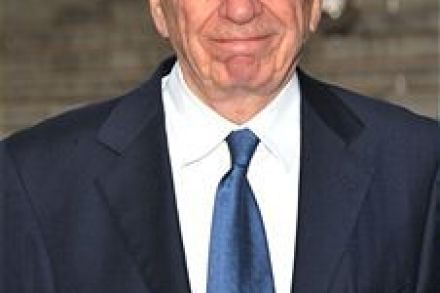
Rupert Murdoch showed a ruthless strain in his personality yesterday. Here are some anecdotes about the man from Craig Brown. Diary, Craig Brown, The Spectator, 12 September 1987. As TUC delegates bore on about Nye Bevan and the Tolpuddle Martyrs, journalists attempt to remain sane by exchanging fond memories of their own mythological figures, the newspaper proprietors. Robert Maxwell has just taken over from Beaverbrook as the most anthologised ogre, but for some reason there are precious few stories about Rupert Murdoch. He well be bad but he is obviously not bonkers, and both attributes are necessary for real popularity among journalists. Anecdotes about Murdoch’s wit are few and far between, but the following one might help boost his reputation.
Seriously damaging your wealth

From our UK edition

The news that gas and electricity bills will rise by 18 and 16 per cent respectively will have many reaching for a bottle of scotch just to keep warm. At an immediate level, this is another act in the ongoing drama about rising living costs; but it runs deeper too. British Gas says that the price rises are concurrent with inflated wholesale prices. Wholesale prices began to grow last July, a result of Qatari liquefied natural gas being less readily available and the increasingly unreliable connection from Norway. Global economic recovery has also affected prices where supply is weak. But might the gas companies still be being rapacious?

From the archives: Knowing Mervyn Peake

From our UK edition

Continuing our series of posts marking Mervyn Peake’s centenary, here is a piece written by Peake’s friend, Rodney Ackland, after the former’s untimely death in November 1968. Thit and thefuther by Rodney Ackland, The Spectator, 20th December 1968 Any reader who has once been lost to the world in the stone fields and labyrinths of Gormenghast lies all around us, silent and invisible, yet casting sometimes, from its other dimension, shadows – refractions of darkness and Gormenghast light – which, effecting subtle changes in the shapes, the colours of all familiar things, enhance them with that quality of strangeness lacking which, beauty, as Walter Pater once hinted, is strictly for professors of maths.

Frank Dikötter wins the Samuel Johnson Prize

From our UK edition

Frank Dikötter’s history of Mao’s great famine took the Samuel Johnson prize last. The prize is the most prestigious non-fiction award in Britain, carrying a cheque for £20,000. It also gets an hour long special on BBC2’s The Culture Show, worth its weight in pixels to publishers of challenging and largely unmarketable books. The programme airs tonight. The general consensus is that Dikötter is a worthy winner, who succeeded in finding new seams from that very well mined area of research on Mao’s pig-headed ignorance.

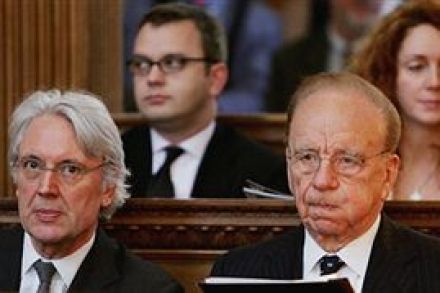
Murdoch stands by Brooks

From our UK edition

Released by News Corporation this afternoon: "Statement from Rupert Murdoch, Chairman and Chief Executive Officer, News CorporationLondon, 6 July, 2011 - Recent allegations of phone hacking and making payments to police with respect to the News of the World are deplorable and unacceptable. I have made clear that our company must fully and proactively cooperate with the police in all investigations and that is exactly what News International has been doing and will continue to do under Rebekah Brooks' leadership. We are committed to addressing these issues fully and have taken a number of important steps to prevent them from happening again.

From the archives – the genius of Mervyn Peake

From our UK edition

It is Mervyn Peake’s centenary this week and there have been parties thrown in his honour across the country. Gormenghast lours over this revelry, as if a still breathing creation has outgrown its dead creator. This seems only natural: Anthony Burgess once described the Gormenghast trilogy as one of the ‘most important works of the imagination to come out of this age’. It is the archetypal cult classic that has obtained a permanent eminence. Yet it was not always so. The books were noticed when first printed, but without ceremony. Indeed, the Spectator did not review a single one of the trilogy when they were released.

Mother, brother, lover

From our UK edition

Jarvis Cocker on Writing and Publishing his Lyrics from FaberBooks on Vimeo. Faber&Faber's excellent The Thought Fox blog carries an interview with Jarvis Cocker on how to write lyrics. The key, it seems, is to record the mundane, especially if it happens in Sheffield; although I suspect you need more than a pair of horn rimmed glasses and a bad dress sense to pull it off. Cocker also draws an interesting distinction between reading lyrics and hearing them. The sleeves on Pulp records carry a warning that the lyrics are not to be read separately from the song because the rhythm of the music is integral to the words. “They are part of song,” says Cocker.

Unpicking Bombardier’s job losses

From our UK edition

The news that 1,400 jobs are to be shorn from Bombardier’s train manufacturing plant in Derby has sent the worlds of business and politics into collision. Ostensibly, these job losses are the result of the Department of Transport’s decision to award the Thameslink renewal contract to German company Siemens. And unions warn that the 12,000 jobs that depend on supplying Bombardier are now threatened. This has led some on the left to criticise the government’s “incoherent plan for growth”. Elsewhere, both right and left blame European competition law, and there is consensus that the government should intervene to preserve British jobs.

Back to the future | 5 July 2011

From our UK edition

What a good idea. Faber have launched a Waste Land app. Among the numerous features is T.S. Eliot reading from The Waste Land. Listening to it, I was reminded of the opening lines of Four Quartets (Time present and time past/ Are both perhaps present in time future). There seems something fitting about Eliot's patricianly drawl being played on a gadget that embodies the future. I doubt that the Waste Land App will be a roaring commercial success to rival the Pocket God app, in which you rule omnipotent over pygmies, but so what? It's tremendous fun, and an excellent way for publishers to introduce new audiences to their back catalogues. Think of it: Betjeman reading Christmas, Dylan Thomas reading from Under Milk Wood; Joyce declaiming the Fire Sermons.

Spreading the word | 4 July 2011

From our UK edition

At the end of last month, the British Library signed a deal with Google to digitise 40 million pages from its collection. Today, Tristram Hunt has written a piece in the Guardian welcoming the change, but saying that, when it comes to history, it’s best to dirty your hands in an archive. He has set Twitter-tongues wagging, with critics branding him an intellectual snob and worse. It’s quite a storm; but, Hunt and his detractors seem to be talking at crossed purposes. Hunt is right: I took a History degree and throughout my studies nothing matched pulling on some protective gloves, donning a face mask and digging around in a musty archive. Trouble is that it takes an eon to get there.

Across the literary pages | 4 July 2011

From our UK edition

Michael Moorcock, China Miéville, Hilary Spurling and AL Kennedy celebrate the life and work of Mervyn Peake, who was born 100 years ago next Saturday. Editor of the Times James Harding talks to his predecessor William Rhys Mogg about the latter’s memoirs (£). ‘What did you think of Ted Heath? “Well, I liked him, but he could be appallingly difficult.” That said, “He was a serious and important figure to a degree which people don’t at the moment realise”. What about Harold Wilson, you didn’t seem to have much time for him? “He was frightfully dodgy at the way he handled difficult issues.

Britain’s ill-defined counter-terror strategy exposed by America’s clarity

From our UK edition

In a post over at the Staggers, defence and security expert Matt Cavanagh has compared and contrasted Barack Obama’s review of US counter-terrorism policy and the coalition’s recent update of the Prevent strategy, together with David Cameron’s professed ‘muscular liberalism’. Here are his insights: ‘The new (American) strategy contains a fairly detailed discussion of the Arab Spring, arguing for applying "targeted force on Al Qaida at a time when its ideology is under extreme pressure" from events in North Africa and the Middle East.

No paramilitary link to last night’s riots in East Belfast

From our UK edition

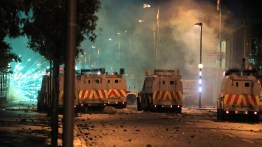
The PSNI is clear that last night’s riots on Castlereagh Street, East Belfast, were not linked to sectarian paramilitary activity. Rather, this was a ‘spontaneous demonstration’ against the police. As I wrote last week, gangs on both sides of the Ulster divide have been targeting the police in recent months; and they rely on exploiting current economic hardship and ancient sectarian divisions to further their criminal ends. The continued violence is a test of Stormont’s ability to govern without the close supervision from Westminster.

In for a penny, in for a trillion

From our UK edition

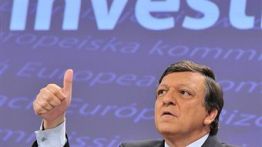
The news that the EU seeks a budget of £1 trillion between 2013 and 2020 inspired disbelief rather than ire. President Barroso’s almost childlike insistence that the proposal was ‘relatively small’ was amusing, certainly not alarming. It’s a classic EU trick: pitch for 5 per cent and a string of crazy financial measures (including a ‘Tobin tax’ on financial transactions) in the hope obtaining more modest gains of say 2 per cent. Barroso will also throw the odd concession into the bargain: the announcement of a £5.4bn saving on the Commission’s staffing costs represents a concession. But, Barroso has his work cut out to secure even a 1 per cent rise on this occasion.

IDS’ great expectations

From our UK edition

There is no rest for IDS. Yesterday he was in Madrid talking about youth unemployment and immigration and today he turns his attention to child poverty. Of all life's accidents, the accident of birth is the most decisive. It is said that a child’s prospects are determined by the age of five, and numerous other statistics and factoids lead to a similar conclusion. IDS rehearses some in a piece in today’s Guardian. IDS and Labour MP Graham Allen have conducted a report into these matters, and have concluded that early intervention in a child from a deprived or broken family is vital if the poverty gap is to be closed, and for opportunity and prosperity to be extended.

Should the state be funding literary prizes?

From our UK edition

The Booktrust has cancelled the John Llewellyn Rhys prize this year because it is suffering a ‘lack of funds’. £13m was cut from the Booktrust’s annual grant from the Department of Education was cut earlier in the year and the organisation has been forced into retrenchment. Now, it is a pity that this widely respected prize will not be awarded this year. It is a favourite among the literati, many of whom owe their success to it. Margaret Drabble reveals in today’s Guardian that she would not have been introduced to the ‘London literary scene without the JLR’ and she labels it the ‘Booker without the back-stabbing’.

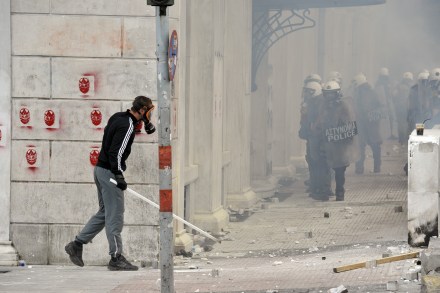
Greek vote leaves questions unanswered

From our UK edition

The Greek parliament has passed a vital bill to approve Prime Minister Papandreou’s austerity package, which was imposed by the European Union. The bill passed by 158 votes to 138, which suggests that some of those on the opposition benches abstained.   The markets rose this morning in anticipation of the bill’s safe passage; the FTSE, for example, climbed by nearly 100 points before lunch. The markets fell back after the vote, but have since recovered. The FTSE closed at 5855.95, a rise of 89.07 points on the day.   That’s not to be scoffed at, but the situation remains grave and the markets' apparent caution reflects that.

PMQs live-blog | 29 June 2011

From our UK edition

VERDICT: Once again, Ed Miliband caught David Cameron out on an obscure point; this time about NHS reform. But, it was much too narrow a line of questioning and he had nothing to say on today's other issues (Greece, Ken Clarke's knife crime u-turn or tomorrow's strikes etc.). Indeed, Labour was silent on the issue of tomorrow's strikes and the economy. Cameron easily turned this to his advantage, painting Labour as being trapped in the pocket of the unions. Thus, was victory won from an awkward position. 12:30: Finally, a question Labour's backbenchers about pension reform in the public sector, but it sounds like a half-hearted after-thought. Cameron defends his reforms, saying that he agrees with Lord Hutton that public sector pensions must be sustainable. And that's it.

Miliband keen to relieve the squeezed middle from Thursday’s strikes

From our UK edition

Ed Miliband is learning. He has written a blog on Thursday’s strikes and it is plain that he has learnt from the errors he made during the March against the Cuts by associating himself with militancy. First, he places himself firmly on the side of parents who will be inconvenienced by Thursday’s strikes: “The Labour Party I lead will always be the party of the parent trying to get their children to school, the mother and father who know the value of a day’s education.” Miliband gives the unions and their members pretty short-shrift to be honest. He writes: “I understand why teachers are so angry with the government.

Lagarde three giant steps closer as Russia, China and the US back her IMF bid

From our UK edition

The 24 members of the IMF board are meeting to see if they can agree that Christine Lagarde should be the organisation’s next leader without a formal vote. Lagarde has already gained formidable backing. 40 per cent of the membership had indicated its support before today’s meetings, while her closest competitor, Mexican Augustin Carstens, had mustered just 12 per cent of the IMF’s votes. The remaining 48 per cent is now concentrating behind Lagarde’s candidacy. Her popularity extends beyond Europe into the vital emerging markets.  Russian Finance Minister Alexei Kudrin gave his signature today, saying that he hopes she will ‘secure reform of the IMF in the interests of developing world.