David Blackburn

The importance of being earnest | 4 December 2011

From our UK edition

The absence of growth and the importance of credibility are recurring themes in this morning’s papers. John Lord Hutton has told the BBC that revised growth figures make pension reform even more urgent, and he added that the deal that was put before trade unions was ‘perfectly credible’. Meanwhile, David Cameron has insisted that ministers increase their pension contributions by an average of 4.2 per cent (more than the 3.2 average across the public sector) to show that ‘we are all in this together’. Pensions also feature in an Independent on Sunday interview with Tim Farron, the Lib Dem President.

A slight change of heart on HS2?

From our UK edition

There’s been an intriguing, if minor, development in the HS2 case this afternoon. The Guardian reports that the Department of Transport has miraculously found £500 million to spend on 1.5 miles of tunnelling to reduce aesthetic damage to the Chilterns, an area of outstanding natural beauty. The decision on HS2 was expected before Christmas, but Transport Secretary Justine Greening has delayed it until after the New Year pending a feasibility study and further environmental impact assessments. The cash has materialised thanks to internal efficiency savings within the £32bn scheme, which has led rural campaigners to fear that other beautification funds have been reallocated. Greening is expected to clarify these points in the coming days.

The Gospel according to Delors

From our UK edition

An old enemy of England nestles in the pages of today’s Daily Telegraph. Charles Moore travelled to Paris to meet Jacques Delors, the architect of the euro and advocate of Europe’s ‘social dimension’. Moore found defiance where one might have expected humility, perhaps even repentance. Delors insists that the fault was in the execution not the design of the euro.

A tale of two cities | 2 December 2011

From our UK edition

Nicolas Sarkozy is grudgingly admired by French socialists as a political fighter, capable of thriving even in the most desperate situation. David Cameron is coming to understand what they mean. It is the best of times and the worst of times between Paris and London. Two months ago, David Cameron and Nicolas Sarkozy assumed the victor’s garlands in Benghazi; today, they met at odds, if not yet in animosity, over the contested logic of ever closer union in Europe. Sarkozy appears to have got his wish: the 17 countries of the Eurozone will deepen their economic and political relations in an attempt to save the single currency — and with it, he hopes, France’s economic and political strength on the international stage.

The art of fiction: Evelyn Waugh

From our UK edition

Here is a short clip of Evelyn Waugh lambasting the "gibberish" written by modernist writers, a satirical staple of his. Waugh saw no reason to vulgarise traditional prose because it's understood and spoken by the common man. Christopher Hitchens makes a similar point in this Vanity Fair column about the importance of writing with a spoken voice.

Woolf tucks into perfidious Albion

From our UK edition

Yesterday night's news that a senior FCO official lobbied Oxford University on behalf of Saif al-Islam Gaddafi adds more ordure to the already fetid story of Britain’s role in Colonel Gaddafi’s rehabilitation. The Woolf Inquiry into Saif’s dealings with British universities and businesses found that, 'It was made clear [to Oxford] … that the FCO would appreciate help in this case since Libya was opening up to the West again.'  Oxford resisted; but this episode has hardly covered Britain’s elites in glory: the civil service, BAE and august universities are all criticised in Woolf's report.

It’s literally a disgrace

From our UK edition

Silly old Jeremy Clarkson, where would the chattering classes be without him? The Top Gear presenter has landed himself in hot water by saying that yesterday’s public sectors strikers should be lined up against a wall and shot — or words to that effect. He made the comments live on the One Show last night. To my mind, the outraged reaction to this latest Clarksonboob — demands for apologies, the prospect of legal action and so forth — is more intersting than Clarkson's apparent heartlessness. It reveals how prevailing social mores demand that figurative language be replaced by bland literalism.

Andy McNab: I owe everything to the military education system

From our UK edition

Last night, at a secret location in the East End, Andy McNab addressed the London branch of the Royal Green Jackets Association, the body representing former members of the Rifles Regiment. McNab, a decorated Rifleman before he entered SAS folklore on the botched Bravo Two Zero mission, was drumming up support at a private bash for Care for Casualties, the regiment’s appeal to care for the families of its wounded and dead. The building was packed and donations flowed as if these were times of plenty. Care for Casualties has raised more than £1.5 million in the last two years. Such generosity is necessary. Since the regiment was re-formed in 2007, 61 Riflemen have been killed in action, leaving more than 40 wives or long-term girlfriends and 31 dependent children.

Pippa’s Christmas turkey

From our UK edition

How much would you spend on a joke stocking-filler? £5 £10 £15? Not much more than that, surely, the ways things are at present. This vacuous question was prompted by yesterday’s astonishing news that Penguin has apparently paid Pippa Middleton a £400,000 advance for a book on party giving, working title: How to be the Perfect Party Hostess. The Guardian’s Alison Flood relates how there was a 'fierce bidding war by some of Britain’s largest publishers' over Middleton’s first book, with Random House overwhelmed by Penguin at the eleventh hour. As Flood says, publishers obviously have faith in Middleton’s winning smile, so much faith in fact that they expect her to sell glossy tomes.

Across the literary pages: The history boys

From our UK edition

Several usually eloquent pens spat venom last weekend. The spat between Niall Ferguson and Pankaj Mishra and the London Review of Books has escalated. You might recall that Ferguson and Mishra trading insults over the latter’s review of the former’s book Civilisation; their acrimony has been underscored by references to racism. Mishra has since said that Ferguson is not a racist; but the matter remains unresolved. Ferguson has had another letter of complaint published in the latest issue of the LRB. He opens by saying that Mishra is ‘in full and ignominious retreat’ and ends by writing, ‘I am still waiting for an apology, from both Pankaj Mishra and the editor who published his defamatory article.

Into battle

From our UK edition

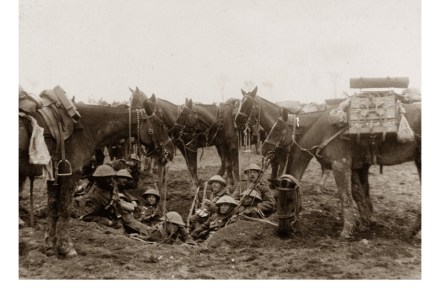
The charge of the Scots Greys at Waterloo: you’ll know it from the Risk board game. Hundreds of soldiers on lustrous white horses, manes billowing as they gallop straight at the viewer. A magnificent sight, but the stuff of nonsense: the horses probably weren’t all greys and they definitely weren’t turned out as if for Ascot. This is one fact to emerge from War Horse: Fact or Fiction?, the exhibition now showing at the National Army Museum in Chelsea (until August). Other myths are dispelled. Contrary to popular opinion, the history of British cavalry is not one of heroic failure. Even the bloodiest charges succeeded in their military aims. To adapt Tennyson, the Light Brigade did and died in the valley of death.

The art of fiction | 25 November 2011

From our UK edition

What to do if you want to write a novel, but can’t find a plot (in the broadest sense of the term) around which to frame your ideas? Give up, is Margaret Atwood’s stark advice. There is no formula, she says, no easy answer to writing fiction. Most people have a creative spark, but not everyone has the intellect to discipline it. You either have it or you don’t. So much for the truism that everyone has at least one novel in them.

Interview: Lammy speaks to the common people

From our UK edition

Tottenham is a very long way from Tuscany, in every sense. But they were briefly connected earlier this year as riots spread across London. The political class clung to their Tuscan sunbeds for a few more hours while Tottenham burned. David Lammy, Tottenham's MP, was an exception. His immediate response to the unfolding enormity impressed observers. Now he has written a book analysing the riots' causes, although he describes much more than that. Lammy grew up in Tottenham during the troubled '70s and '80s and his book is an engaging mix of autobiography and a sharp critique of New Labour (and Britain) in decline. We met in Westminster and I asked when he began writing what has become Out of the Ashes.

The craze for political language

From our UK edition

Well, at least Ed’s won something. The Oxford English Dictionary has chosen Ed Miliband’s ‘squeezed middle’ as the word of the year. It beat off competition from the hopeful ‘Arab Spring’, the dully functional ‘phonehacking’ and the abominable ‘Hacktivism’. It is a remarkably political list, no doubt reflecting the interesting times in which we live. Indeed, the fashion for political language is strong at present: ‘big society’ took the same award last year. What next? Even now, a conscientious special advisor is scribbling away in the bowels of Whitehall, unwittingly close to lexicographical immortality. In related news, libraries are a growing issue at Westminster.

Drinking to the ‘remarkable’ survival of the Tory party

From our UK edition

The Centre for Policy Studies hosted a party for Robin Harris earlier this evening, in honour of the publication of his one volume history of the Conservatives. Andrew Gimson reviewed the book in a recent issue of the Spectator and described it as ‘a marvel of concision, lucidity and scholarship’, plenty of eminent Tories agree. The CPS’ cramped offices were graced by Lord Lamont, Spectator select committee chairman of the year and Thatcher’s one time PPS John Whittingdale, and rising backbencher Jesse Norman — to name but a few. A smattering of ministers and government aides had also braved the thickening night to attend Harris’ shin-dig.

The dangers of ever-closer union

From our UK edition

Yesterday, Fraser wrote that 'reporting of European issues tends to ignore public opinion'. Today, Philip Stephens has neatly illustrated Fraser's point in his Financial Times column. Musing on Britain's possible exit from the European Union, Stephens writes: 'I am not sure this is what the prime minister intends; nor, when it comes to it, that British voters will accept such an outcome.' Stephens' conjecture ignores the European Union's own polling, which, as Fraser says, shows most Britons to be hostile to the EU. That said, Stephens' article is substantial. He argues that 'fiscal union carries its own remorseless logic: the progressive exclusion of Britain from Europe’s economic decision-making'.

A lot of bad sex

From our UK edition

It’s that time of the year again: prepare for bad sex, courtesy of the Literary Review. The Bad Sex Awards will be held, wait for it, at the In and Out Club on 6 December. The list is still open, and readers can still nominate worthy candidate by contacting the Literary Review. At present, though, 12 authors from around the world will compete for the prize. Some luminaries who ought to have known better are among the condemned. Haruki Murakami’s 1Q84 has been included, as has Stephen King’s 11.22.63. The Guardian has reproduced this excruciating passage from King’s book: '"She said, "Don't make me wait, I've had enough of that," and so I kissed the sweaty hollow of her temple and moved my hips forward ...

Across the literary pages: To be a poet

From our UK edition

The Times has invited (£) everyone aged 16 and under to enter its Young Poet of the Year competition. The winning entry will be published in the newspaper. The Times also suggests (£) that competitors record YouTube videos of themselves declaiming their poems; selected entries will then be posted on the Times’ website. Inspiration is always hard to find, so the Times’ literary team has chosen (£) 30 poems that ‘everyone should know’. It’s a thoroughly predictable list. Who, for instance, doesn’t know ‘If’, ‘Kubla Khan’, ‘Funeral Blues, ‘The Owl and the Pussycat’ or ‘Jabberwocky’ (pictured)? But that's a minor quibble about what is a very good cause.

The art of fiction | 18 November 2011

From our UK edition

The Charlie Rose show is a cultural treasure, provided you ignore the host. In this instance, the late John Updike talks about the art of fiction from the perspective of the character he is “measured against”, Harry "Rabbit" Angstrom. In two and half minutes of candour, Updike reveals much about his method and how his most famous creation altered that method. Their relationship extended beyond the page and into Updike’s body and soul; he even admits that they transferred ailments. To all intents and purposes, Rabbit was real.

The immortal Nat Tate

From our UK edition

An anonymous buyer paid more than £7,000 at Sotheby’s last night for the late Nat Tate’s signature work, Bridge No.114. The money will go to the Artists’ General Benevolent Fund because, of course, Nat Tate never existed — he was the invention of the novelist William Boyd, who also painted the atrocious picture above.  Tate was conceived in 1998, at the height of the fever for the Young British Artists, when Boyd decided to play an intellectual game. He would test the credulity of the art world by writing the biography of a fictional artist. Boyd's imagination conjured an unappreciated American genius, whose work had been lost his contemporaries.