Daniel McCarthy

Daniel McCarthy

Daniel McCarthy is a US columnist for The Spectator and is the editor of Modern Age: A Conservative Review.

Joe Biden’s party is over

From our US edition

Washington, DC The Democratic party is dying. That may be hard to believe since Democrats control both houses of Congress and won the last presidential election with a record 81 million votes. But the exiguous margins of their hold on the House and Senate, with fewer than 51 per cent of the seats in either chamber, tell another story, as does the desperation of their struggle to abolish the filibuster and federalise election law. Those policy aims are of a piece with dreams of ‘packing’ the Supreme Court with left-liberal justices — and packing the Senate too, by turning tiny Democratic bastions into new states. The left wing of the party even assails the constitutional principle behind the Senate itself, the idea of equal representation of the states.


Last chance to end the tech tyranny

From our US edition

What would Adam Smith think of cancel culture? Many advocates of banning books now hide behind a veil of free-market purity: If Amazon bans a book, it’s not really banned because the online megalomart is, a private company. But it controls an outright majority of book sales in the United States, and even that remarkable measure may underestimate the power Jeff Bezos’s company wields over individual titles. Bestsellers can be found elsewhere perhaps, but most books have few other outlets. So Amazon doesn’t ban books. It just makes them much harder to buy and read. If a private company chooses to do that, who are you to complain?

oligarchy tech capitalist pigs

The Republican party has taken over Donald Trump

From our US edition

Forty minutes into Donald Trump’s remarks at CPAC, I’d formed a conclusion. Donald Trump hasn’t just taken over the Republican party, I thought, the Republican party has taken over Donald Trump. The speech got off to a slow start, with Trump’s familiar critiques of illegal immigration failing to elicit much excitement from the audience. Was this tried and true, as far as they were concerned, or just tired and true? Soon enough Trump was uttering phrases that any Republican leader of the last 30 years might have recited: socialism, radical Democrats, exceptional nation, Judeo-Christian values. Farmers this and farmers that. Mostly fine — all routine. The urgency was gone. But the speech kept going. And while little was new, Trump started to sound like Trump again.

republican party

Death by debt

From our US edition

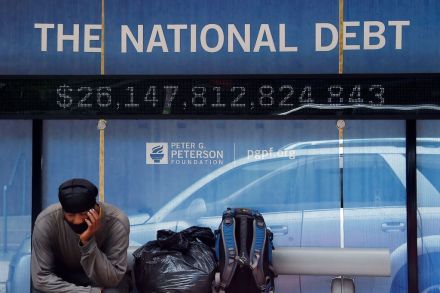
The US national debt is now in the neighborhood of $28 trillion. Some of that is money the government owes itself, but the publicly owned portion of the debt, some $21 trillion and counting, is roughly equal to the nation’s entire pre-COVID-19 domestic output for 2019 ($21.4 trillion). Republicans in Washington have already begun to sound the alarm over these figures — though, of course, far fewer of them were so outspoken about the debt when President Trump was the one running up the numbers. Is the mounting debt a threat to America’s way of life or just a convenient stick with which to beat a Democratic administration? Republicans tie the debt to spending. This crushing burden on the taxpayers of the future, they say, is a testament to the uncontrolled growth of government.

debt

Rush Limbaugh, conservative rebel

From our US edition

‘The cutting edge of societal evolution.’ That was one of Rush Limbaugh’s catchphrases in the 1990s, and it was an apt description of a man who revolutionized radio and politics alike. Limbaugh has now died at age 70, but the societal evolution that he accelerated continues. This is why Limbaugh will still be loved by the right and hated by the left for years to come. Rush was a media powerhouse in his own right as a radio host, but he was also the grandfather of Fox News. Ever since the Nixon years conservatives had thought that there could be a mass audience for their message, one large enough to support a television network. Efforts to create one, or buy one of the existing networks, all fell flat, however.

rush limbaugh

The death of the Republican right has been greatly exaggerated

From our US edition

As Donald Trump goes on trial in the Senate, the Republican party faces the possibility of a crack-up. Trump will almost certainly be acquitted, but the vote will be the third time in two weeks that GOP disunity is in the spotlight. Last week the attempt to oust Liz Cheney from her leadership role in the House saw the pro-Trump wing of the party come up short. Then 11 Republicans voted with the Democrats to strip Rep. Marjorie Taylor Greene (R-Ga / Q-Anon) of her committee assignments. Now it’s the Senate GOP’s turn to showcase its divisions. ​Cheney’s survival showed that the Trump faction isn’t strong enough — in Congress anyway — to purge the anti-Trump faction. Trump’s acquittal will mean his enemies inside the party can’t get rid of him, either.

republican

What does Trump want now? Revenge — and a second term

The figure of the ex-president is one of the most endearingly republican features of American politics. He who was the most powerful man in the world for as many as eight years turns overnight into a political fossil. He’s no longer the leader of his party, much less his country. Whether in his fifties or in his seventies, his battles are over. Now there’s just millions to be made on the corporate lecture circuit and publishing ghosted memoirs. If you’re Jimmy Carter, you build houses for the poor. If not, the spotlight returns only when you’re the opening act for your party’s next nominee at the convention. The only big national event that’s all about you, once your time as president is up, is your funeral.

America’s Yeltsin moment

From our US edition

The end of the Cold War was as great a shock to US politics as it was to the Soviet Union’s. The Soviet regime didn’t survive, of course, and late 2021 will mark 30 years since the USSR dissolved. Mikhail Gorbachev had tried to save the Soviet system through reform. The Communist hardliners who briefly deposed him in the summer of 1991 tried to save it by rolling back reform. Neither sufficed — the regime, and the party and ideology at its heart, had lost their legitimacy irrevocably. The first US presidential election after the collapse of the USSR almost rendered the same verdict on the regime in Washington. The 1992 election saw a populist challenge to President George H.W. Bush from within his own party.

yeltsin

The fight for liberalism

From our US edition

The world has many island nations, and sometimes the United States counts itself among them. We have water on either side of us, and though we share our big island with Canada and Mexico, neither poses any threat. America is immune to invasion, a castle surrounded by the safest of moats. This wasn’t always so, and it isn’t really true today, unless we forget about Hawaii and our Pacific and Caribbean territories, most of which would be easy prey for other states if they weren’t under our sovereignty. In the earliest days of the republic, we shared the North American continent with outposts of Europe’s leading powers: France, Russia, Spain and Britain.

liberalism

How the GOP can win by losing Georgia

From our US edition

Not long ago I attended a gathering of young White House and congressional Republican staffers. Conversation turned, as you might expect, to the prospects for the GOP in Georgia’s two Senate runoff races in January — races that will swing control of the chamber if Democrats win them both. Only one young man dared to say the unsayable: not only would the GOP lose those races, but it should lose those races for the party’s own good. His points were sharp, even if no one was entirely persuaded. There would indeed be a silver lining to losing the Senate majority, and while few Republicans will wish for that, Trump voters will have some consolation if David Perdue and Kelly Loeffler go down next month.

georgia

The wars go on

From our US edition

America’s longest war has just entered its 20th year. The US invaded Afghanistan in October 2001 to overthrow the Taliban and destroy al-Qaeda. Now, nearly a decade after the death of Osama bin Laden, the Afghan war continues. And everyone expects that if the Americans ever leave, the Taliban will return to power. Yet the Taliban who take charge will not be the same as those who harbored bin Laden. The median age in Afghanistan is around 19 years old: half the country’s population was born after the war began. The US is not fighting a limited reservoir of Taliban militants; it is fighting a cultural force that has renewed itself over a generation.

wars

Has Ben Sasse won it for Joe Biden?

From our US edition

Will a Republican senator from Nebraska be the man who hands Joe Biden the White House? Ben Sasse has tried his best to do that. Sasse easily won reelection in the safe red state of Nebraska on Tuesday, leading his Democratic opponent by nearly 30 points with 85 percent of the vote in. But President Trump has not fared so well; in fact, he lost the vote in Nebraska’s Second Congressional district. Since Nebraska, like Maine, divides its Electoral College votes by district, that means Joe Biden gets an elector from Nebraska. And for that, Biden can thank Sasse, who next to Mitt Romney is the sitting Republican senator who has been most outspokenly critical of President Trump.

ben sasse

Joe Biden’s endless wars

From our US edition

In just over a week, the Empire hopes to strike back. Joe Biden personifies the foreign policy of endless war that Democrats and neoconservatives pursued for 25 years, from the end of the Cold War until the election of Donald Trump in 2016. Biden voted for the biggest and most foolish intervention of that era, the Iraq War of 2003. He has not so much repudiated this act as tried to exculpate himself for it, claiming that in voting to authorize military force he didn’t think military force would be used. This is not credible on its face, and not the way anyone understood the vote at the time. It was as clear a vote for war as any vote has been since World War Two.

joe biden endless wars

Will Amy Coney Barrett save America — or wreck it?

From our US edition

Americans hate the Supreme Court. You wouldn’t think so from a look at the polls, which usually show that the court is far more popular than the elected branches of government. But history tells a very different story. The conservative movement as it exists today was formed in large part as a reaction against the liberalism of the Supreme Court under chief justices Earl Warren and Warren Burger — both of whom were Republicans, as it happens. The progressive movement of the early 20th century and the populist movement of the late 19th century were also spurred to varying degrees by the character of the Supreme Court at the time, which was seen as conservative and elitist. Franklin D.

amy coney barrett

How democracy dies

From our US edition

What would happen if Americans voted on different days? Suppose Republicans voted on Tuesday and Democrats voted on Wednesday. Would this be better than everyone voting on the same day? Would it be more fair and less confusing? Like hell it would! One reasonable complaint Republicans had about the 2000 presidential elections — famously decided, in the end, at the Supreme Court — was that some television networks called the State of Florida for Al Gore before polls had closed in the westernmost Florida Panhandle, which lay in the Central Time Zone, an hour behind the rest of the state in the Eastern Time Zone. Declaring a winner prematurely amounted to telling Panhandle voters not to bother casting their ballots.

mail

The persistent myth of a non-political Supreme Court

The death of Justice Ruth Bader Ginsburg is a terrible blow to Democrats, but there is an important point to be considered – the principled arguments Democrats made in 2016 after the death of Justice Antonin Scalia prevail. Democrats insisted that the Scalia vacancy should be filled swiftly by President Obama’s nominee, Merrick Garland, but the Republican-controlled Senate refused to hold hearings. Their pleas were not in vain, however, and Senate Majority leader Mitch McConnell has now been persuaded by the logic and compassion of the Democrats’ case – and this time the president’s nominee will, probably, get a speedy hearing. It took four years, but Democrats will get the process they wanted. Is this too soon?

After Trump, the reckoning

As voters prepare to pass judgment on Donald Trump’s presidency in November, they might want to entertain a few counterfactuals. Imagine that Russia had annexed Crimea during the Trump years rather than while Obama was president. MSNBC and other left-wing media would have hawked claims that Trump actively conspired with Putin to let the Russian president dismember Ukraine. More sober outlets, some of them ‘conservative’, would have chalked up the loss of Crimea to president Trump’s basic incompetence and reckless defiance of the foreign-policy establishment. Much the same narrative web would have been spun if, say, Otto Warmbier had been imprisoned by Kim Jong-un’s regime this year rather than in the last year of the Obama administration.

Trump redefines the race

From our US edition

Helplessness and passivity were the defining themes of the Democratic convention last week. The American people are unable to overcome COVID-19 and an even more all-pervasive racial guilt without the right man in the White House — the nation is weak, and truth be told its would-be savior, Joe Biden, is not strong. But he is nice. The convention emphasized not Biden’s 47-year record in government, but his family and the tragedies it has suffered. Even in building up the nominee, suffering was the dominant trope. Americans must huddle together, and somehow by huddling around Joe Biden everything will be all right.This passivity was perhaps an inevitable byproduct of the rationale behind the Biden candidacy. Is he the best Democrat around?

donald trump race

Joe Biden’s Republican Convention

Joe Biden’s range of emotional expression has narrowed with age – when he wants to convey feeling now, he shouts. Anger is the only thing that gets through, even when he’s trying to be hopeful or inspiring. And his acceptance remarks at the Democratic convention were well short of inspirational: the nominee didn’t seem tired, but his words did. From the first day of the convention, viewers had to wonder, ‘Why is Joe Biden the nominee of this party?’, a party that neither looks nor sounds like the almost octogenarian ex-VP. Biden has testified to his friendships with segregationists in the Senate. He was the sponsor of a historic anti-crime bill.

Will it be Biden-Harris or Harris-Biden?

From our US edition

News of Kamala Harris’s selection as Joe Biden’s running mate was greeted by everything but the popping of champagne corks by my right-wing friends at lunch. The consensus of the policy wonks, policy makers, businessmen and journalists at my table was that Harris is good news for Donald Trump. ‘She’s unlikable’ and ‘she’s a cop’ were the instant reactions — though if Harris really were a cop, and not a former prosecutor, she might find some support among Americans horrified by the riots in Chicago, Portland and everywhere else that’s succumbed to left-wing Democratic control. I expected Harris all along, ever since Biden imposed a sex test on his list of potential running mates.

biden-harris