Daniel Korski

“Conservative” silence on the British Council may undermine their value-promoting credentials

From our UK edition

The Conservative party’s security proposals have sparked a bit of debate, with many on the right concerned that democracy-promotion is getting short shrift. A lot of the attention has focused on Pauline Neville-Jones’ role in a future government, rather than anything the documents say. Though she is likely to take over Lord West’s job, rather than become the Prime Minister Cameron’s adviser -– in their security blueprint, the role of National Security Adviser is described as being taken up by “an official” –- many fear Dame Neville-Jones’ old-school, realist instincts will unduly influence Tory policy.
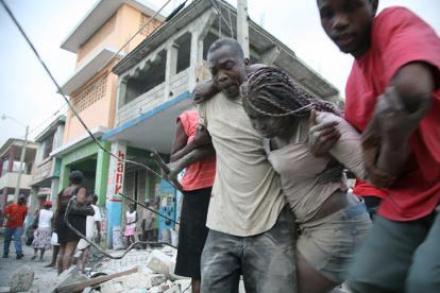
Helping Haiti

From our UK edition

As the world has geared up to help a devastated Haiti, new challenges came into view. Destroyed ports, a crumbling airport and the lack of a local counterpart are hampering the international effort to help people still trapped under the rubble. Survivors, many of whom have no place to sleep, may have lost friends and family, and are now left to scavenge for food.  President Obama has pledged $100 million and is dispatching 5,000 soldiers, as well as a hospital ship. Britain, China, France, Belgium and even debt-saddled Iceland have followed suit.  But the scale of the disaster is frightening. When it becomes clearer how best to help, I will donate money; you should too. Even the most civilised society would struggle in those current conditions.

Cutting the Foreign Office

From our UK edition

Spending cuts are coming – we all know that.  And if any party is serious about tackling the debt mountain, then pretty much every department will have to face the axe in some form or other.  But wherever that axe falls, you can expect loud protest in reponse.  Cut the RAF, and a former Chief of the RAF will pop up on TV and say that the cuts will endanger the nation. Rationalise the NHS, and the party responsible will be called heartless. Close the High Commission in Port Moresby, and the newspapers will be full of stories about the historical link between Britain and Papua New Guinea. So to make matters easier for a future foreign secretary, I have decided to have a first go at cutting British legations – i.e. its embassies, high commissions and consulates.

Getting rid of the 0.7 percent aid target

From our UK edition

A leader in yesterday’s Times concentrated on the Conservatives’ aid policy – and, in particular, their commitment (shared by the government and by plenty of developed nations) to spend 0.7 percent of gross national income on development assistance. There was much to like in the article, but it misses a few key points and trains too much fire at the Tories. The key points to make about the 0.7 percent commitment is that it is not based on any assessment of how much money is needed to achieve any defined set of objectives, and has not been revised since it was set forty years ago to take into account new trends – such as remittances from migrant workers, a rise in philanthropic giving, or the role of China and India.

The Iraq Inquiry should call Gordon Brown now

From our UK edition

Alastair Campbell is before the Iraq Inquiry. As one of Blair’s closest aides, Campbell’s role in the run-up to the Iraq war was key. But I suspect the spinner-in-chief will be doing what he was originally hired to do: namely, protect his master by attracting the incoming fire. In this case, though, he will be helping Gordon Brown, not Tony Blair.   Because it is Brown’s role in the Iraq War, not that of Blair, that is the most obscure part of Britain’s modern history. As chancellor, Brown was the second most powerful man in government. He held the purse strings. If he had opposed the Iraq War, it is hard to see Tony Blair succeeding in persuading Cabinet, the Parliamentary Labour party or the House of Commons.

Military manoeuvres

From our UK edition

Just when you thought it was safe to go back into the water, the leadership speculation starts stirring again. It's not Gordon Brown who's the subject of it this time, though - but rather the defence chief, Air Marshall Sir Jock Stirrup, who, according to today's Times, is due for the chop after the next election. Either his deputy, Nick Houghton, or the Army chief, David Richards, are likely to fill the breach. The story brings to the surface long-simmering tensions at the top of the military establishment about Sir Jock's leadership. The Times says that Gordon Brown did not force out the defence chief because he did not want more rowing with the military after General Richard Dannat's retirement.

Security and Defence Review 101

From our UK edition

Defence geeks are waiting to see how the Conservative Party intends to conduct a Security and Defence Review, if they are elected. By the time a new government comes to power, the Ministry of Defence will in all likelihood have produced a Green Paper, setting out initial thoughts on the future of the military, which is meant to lead on to a more substantive Strategic Defence Review.  But if the Tories want a process (and ultimately plans and ideas) that encompasses not only the MoD, but also the Foreign Office, DfiD, the security services and even parts of the Home Office, then a new kind of institutional vehicle will have to be set up. There are, broadly speaking, three options.

In preparing for war, the Tories differ from Labour in one respect – they would be prepared

From our UK edition

In today's Times, and on the occasion of George Osborne and William Hague's visit to Helmand, the Tories are publishing proposals for how to improve the Government's approach to post-conflict operations. Their central idea: to create a stabilisation force in the military, complete with the necessary expertise, training and so on to win the peace after combat. If it was not already abundantly clear, the Iraq Inquiry has shown how ill-prepared the British state – civil service, military and government – was for post-combat reconstruction. Though much has changed since the Iraq War – e.g.

Cancel the London Afghanistan Conference

From our UK edition

In a few weeks time, a slew of foreign ministers will descend on London to attend a conference on Afghanistan. No.10 will use the event to sell Gordon Brown as a statesman, confidently dealing with the nation’s threats. The Conservatives, in turn, will probably try to score the usual points about Britain’s failure, alongside its NATO allies, to make any in-roads in the fight against the Taliban. Together with Tony Blair’s evidence to the Iraq Inquiry, the conference may create one of the few moments in the drawn-out election campaign when the three party leaders stop talking about the NHS and focus on national security issues instead.

Dealing with China in 2010

From our UK edition

The execution of Akmal Shaikh has brought China to our frontpages, and to the forefront of diplomatic thinking, as the New Year begins. The question is not just how to respond to this single and, in many regards, sad event – but how to deal with growing Chinese power more generally. How will we shape our relations with China for this decade and beyond? It would obviously be wrong to end all UK-China links over Akmal Shaikh’s execution. The Labour government's use of pique as a guiding principle of foreign policy had little effect on Russia and will not move China. Nor should anger over the excecution – however righteous or justified – occlude Britain's real interests in cordial Sino-Anglo relations.

The “sleeper issue” of 2010: Yemen

From our UK edition

As Melanie Phillips says in her article for this week's issue of the magazine, the case of Umar Farouk Abdulmutallab highlights the role of other, less frequently discussed, countries in Islamist terror. One such country is Yemen, where Abdulmutallab is thought to have trained at an Al Qaeda camp. The US believes there may be a few hundred al Qaeda fighters in Yemen, centered on a group of key network leaders who are operating a number of camps.   Yemen has slowly been getting more international attention. A few weeks ago I was meant to go on Al Jazeera, but my appearance was cancelled at the last minute because, I was told, of other “breaking news”. Curious, I turned on BBC and searched the internet to find out what the headline-grabbing story could be.

2010: my predictions and yours

From our UK edition

It’s that time of year – TV and radio are packed with special editions of Dr Who, news reviews and numerous best-ofs. So let me add to the cacophony with a look ahead to next year. Here are thirteen (and a bit) predictions for 2010: 1. The Taliban will mount a Tet-like attack on an Afghan town centre, such as Laskar Gar, prompting the Lib Dems to call for a British withdrawal from Afghanistan. 2. Iran’s regime will arrest and condemn to death one of the contenders in the 2009 presidential election. 3. Brazil will win the World Cup in South Africa. 4. The Pakistani president will be forced from office to be replaced by Nawaz Sharif. 5. Marwan Barghouti is exchanged for Gilad Shalit and subsequently elected Palestinian president. 6.

I blame Bono for the Copenhagen failure

From our UK edition

So who or what is to blame for the failure of the Copenhagen gathering to achieve what most people hoped for? Polly Toynbee says that the nature of politics is to blame. Personally I blame U2’s Bono. I don’t blame him for the failure of world leaders to agree a legally-binding agreement, of course. But I do blame him for the unrealistic expectations that were raised in the run-up to the meeting. Issue-based campaigning, of which the climate change movement is the latest example, came into its own with the debt-relief campaign of Jubilee 2000, which the Irish singer spearheaded.

Pre-empting Chilcot

From our UK edition

Sir John Chilcot’s Iraq inquiry has begun honing in on failures of US and British post-conflict planning. As General Sir Frederick Viggers told the inquiry, problems arose from “not having defined the ends, ways and means of how we were going to deliver this phase of the campaign.” None of this is particularly new. As further evidence is provided to the inquiry, it will become even clearer how unprepared the British state – the Government, civil service and military - were for the task at hand, and how soldiers, diplomats and development workers were expected to deliver near-miracles with limited resources, limited backing, limited security and limited public support. I was there and it was not very pretty.

What do Muslims think?

From our UK edition

Coffee House readers sometimes complain that we do not talk enough about Muslims and Islam. I have certainly shied away from the subject, fearing that emotion and prejudice, rather than argumentation and empirical data, would dominate the debate. I don’t write about Christians, Jews or Buddhists, so why focus on Muslims? At any rate, I don’t like talking about collective groups, much as I prefer not to be talked about based solely on my heritage. But now a new study called Muslims in Europe allows for an empirically-based debate about sentiments across a number of Muslim communities. Based on interviews and surveys in 11 European cities, it presents some interesting facts. It does not tell us what Muslims think, of course, but gives a statistically-relevant sample of views.

Not Foxy enough

From our UK edition

Analysts analyse, reporters report and politicians, well, they are meant to make decisions. When in power, they are meant to decide things; when in opposition they are meant to set our alternatives to government policy. But not, it seems, when it comes to defence policy. Or at least not always. I have just sat down to read Liam Fox’s NATO speech (as I could not attend), which he gave at Chatham House recently. To say that I am disappointed is an understatement. I think Liam Fox is a first-rate politician. His ongoing exposure of the Government’s military under-resourcing has been excellent. On a Tory team that is sometime accused of lacking stand-out talent, he is a national politician with clear views, consistency and a large following.

Copenhagen dispatch

From our UK edition

I make my second foray into the climate debate with trepidation. But visiting Denmark a few days before COP 15, it is impossible to escape the subject. Whether I speak to friends, family or strangers on the bus, everyone has a view and wants to share it. TV coverage of the forthcoming climate talks is relentless and there is even a separate passport queue for COP participants at Copenhagen’s stylish airport.   The latest “story” to emerge has pitted the new Climate Change Minister, the former commentator Lykke Friis against the Speaker of Parliament, Thor Pedersen. Though they are both from the same centre-right/liberal party, Mr.

Don’t give us your unwashed masses

From our UK edition

Downturns turn people against immigrants. That’s normal. But even according to the statistical average, Britons are particularly unhappy about the state of immigration these days. In a new survey undertaken by the German Marshall Fund, seventy-one percent of Britons polled disapproved of Labour’s immigration policy. Spaniards (64%), Americans (63%), Italians (53%) are also sceptical of government action.  In contrast, 71% of Germans, 59% of Canadians and 50% of French approved of the steps their countries had taken. In fact, Britons are the most sceptical about immigration, with 66% seeing it as more of a problem than an opportunity – a jump of seven percentage points on 2008 figures.

Welcome to Obamastan

From our UK edition

After months of deliberation, endless consultation and reams of paper, President Obama came to the same conclusion that he himself had reached only a few months ago, and that which his handpicked commander, General McChrystal, had arrived at more recently: the US-led intervention is just, right and demands more resources. As usual, Obama's oratory was impressive - though without the personal anecdotes he normally works in. He rejected comparisons with Vietnam and evoked World War II with a reference to President Roosevelt. The West Point cadets added a kind of battle-evoking gravitas that Obama, who has never worn a uniform or been in war, often struggles to evoke.

There are troops – and there are troops

From our UK edition

The waiting will soon be over. Later today, the President Obama is expected to order around 34,000 troops into battle, including into Helmand province. This surge will be added to the additional 500 troops Gordon Brown committed yesterday and what sources tell me are cast-iron troop offers by another eight countries, including Turkey, Australia, Montenegro, and Georgia. If all these countries do sign up to send more troops, the credit must primarily go to Anders Fogh Rasmussen, the NATO Secretary-General, who has travelled far and wide in the attempt to drum up more military muscle.